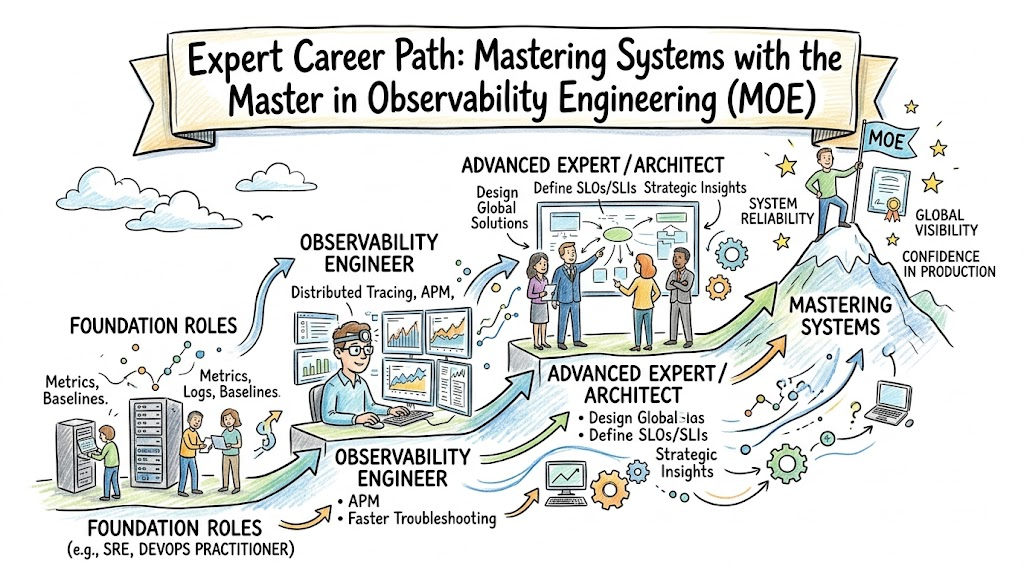
Modern infrastructure demands a level of transparency that standard monitoring simply cannot provide. Enrolling in the Master in Observability Engineering (MOE) empowers DevOpsschool students to dismantle the “black box” nature of distributed microservices. This comprehensive guide serves as a roadmap for Site Reliability Engineers and Cloud Architects who want to move beyond basic dashboards toward deep, actionable system insights. By mastering the three pillars of telemetry—metrics, logs, and traces—you ensure your organization can resolve complex incidents before they impact the end-user experience.
What is the Master in Observability Engineering (MOE)?
The Master in Observability Engineering (MOE) functions as a specialized professional framework for managing the extreme complexity of cloud-native architectures. It exists because traditional monitoring fails to explain the “why” behind performance bottlenecks in distributed environments. This program emphasizes production-grade skills, teaching engineers how to instrument code and infrastructure using industry standards like OpenTelemetry. Leading enterprises adopt this curriculum because it aligns perfectly with the need for rapid root-cause analysis and sustainable system reliability.
Who Should Pursue Master in Observability Engineering (MOE)?
Cloud Architects, Site Reliability Engineers, and DevOps leads find the most immediate value in this advanced certification. It also serves security professionals who must correlate system signals to identify sophisticated cyber threats or unauthorized access. Developers who take ownership of their code in production use these skills to build inherently observable applications. Whether you operate in the competitive Indian tech market or manage global cloud fleets, this certification validates your expertise in handling high-cardinality data.
Why Master in Observability Engineering (MOE) is Valuable and Beyond
The current shift toward autonomous operations makes observability engineers some of the most sought-after professionals in the tech world. The MOE certification offers significant longevity because it prioritizes vendor-neutral principles that apply to any cloud provider or toolset. As companies integrate AIOps and machine learning into their workflows, they require experts who can architect reliable data pipelines. Investing in this learning path ensures you remain indispensable during large-scale digital transformations and complex architectural migrations.
Master in Observability Engineering (MOE) Certification Overview
The official training program resides at the course URL provided in the introduction and stays hosted on the website. This certification uses a rigorous, lab-based assessment strategy to confirm that candidates can implement observability stacks in live environments. It covers the entire lifecycle of telemetry data, from initial collection to advanced visualization and automated alerting. The program ownership ensures the content reflects the latest advancements in the Cloud Native Computing Foundation (CNCF) ecosystem.
Master in Observability Engineering (MOE) Certification Tracks & Levels
Professionals can navigate through three distinct tiers: Foundation, Professional, and Advanced. The Foundation level establishes the basics of infrastructure monitoring and log centralization. The Professional tier dives deep into the world of distributed tracing and service mesh observability. Finally, the Advanced level teaches engineers how to govern large-scale telemetry data and implement FinOps-aligned cost strategies. This tiered structure allows you to build a specialized resume that matches your specific career trajectory.
Complete Master in Observability Engineering (MOE) Certification Table
| Track | Level | Who it’s for | Prerequisites | Skills Covered | Recommended Order |
| Telemetry Basics | Foundation | Entry-level Ops | Linux Basics | Dashboarding, Logs | 1 |
| Distributed Tracing | Professional | SRE / DevOps | Foundation | OpenTelemetry, Spans | 2 |
| Strategy & Governance | Advanced | Principal Eng | Professional | Data Scaling, Cost | 3 |
| Intelligence Ops | Expert | AIOps Leads | Advanced | ML for Ops, Anomaly | 4 |
Detailed Guide for Each Master in Observability Engineering (MOE) Certification
Master in Observability Engineering (MOE) – Foundation
What it is
This certification validates an engineer’s ability to configure basic monitoring and logging for standard server environments. It serves as the entry point for anyone entering the reliability engineering field.
Who should take it
Junior system administrators and backend developers who need to visualize how their applications consume infrastructure resources.
Skills you’ll gain
- Deploying Prometheus exporters for infrastructure health.
- Designing functional Grafana dashboards for real-time views.
- Configuring log collectors to centralize system events.
- Setting up basic threshold-based alerting rules.
Real-world projects you should be able to do
- Monitor a fleet of virtual machines using standardized exporters.
- Aggregate logs from a multi-container application into a searchable interface.
Preparation plan
- 7-14 Days: Learn basic PromQL and log searching syntax.
- 30 Days: Practice installing monitoring agents on different Linux flavors.
- 60 Days: Build a complete monitoring lab that tracks a small web application.
Common mistakes
- Creating too many alerts that lead to notification fatigue.
- Monitoring resource usage without correlating it to application performance.
Best next certification after this
- Same-track option: MOE Professional.
- Cross-track option: Cloud Practitioner Certificate.
- Leadership option: Technical Team Lead Foundation.
Master in Observability Engineering (MOE) – Professional
What it is
The Professional level addresses the complexities of microservices and the implementation of distributed tracing. It confirms your ability to track a request as it travels through multiple services.
Who should take it
Experienced DevOps and SRE professionals who manage high-traffic Kubernetes clusters and complex service dependencies.
Skills you’ll gain
- Instrumenting applications using OpenTelemetry SDKs.
- Analyzing trace waterfalls to find specific latency points.
- Defining Service Level Objectives (SLOs) that reflect user pain.
- Managing high-volume telemetry data through sampling.
Real-world projects you should be able to do
- Identify exactly which microservice in a chain is causing an error.
- Correlate trace IDs with specific log entries for faster debugging.
Preparation plan
- 7-14 Days: Master the configuration of the OpenTelemetry Collector.
- 30 Days: Set up a tracing backend like Jaeger or Tempo in Kubernetes.
- 60 Days: Implement cost-effective sampling strategies for production data.
Common mistakes
- Over-instrumenting code and adding unnecessary performance overhead.
- Ignoring the cultural aspect of managing SLOs and Error Budgets.
Best next certification after this
- Same-track option: MOE Advanced.
- Cross-track option: CKA (Certified Kubernetes Administrator).
- Leadership option: SRE Management Professional.
Choose Your Learning Path
DevOps Path
The DevOps track integrates observability directly into the software development lifecycle to improve release quality. You learn to treat telemetry as code, ensuring every new feature includes its own monitoring and logging. This proactive approach allows teams to identify bugs during canary deployments before they reach the entire user base. It bridges the gap between fast delivery and operational excellence.
DevSecOps Path
Professionals on this track use observability data to strengthen the security posture of modern applications. You learn to detect unauthorized lateral movement and suspicious API calls by analyzing trace patterns. This path focuses on the “security as code” philosophy, making security monitoring a native part of the operations stack. It allows you to build a more resilient infrastructure through continuous visibility.
SRE Path
The Site Reliability Engineering path prioritizes the “Golden Signals” of latency, traffic, errors, and saturation. You focus on building automated systems that respond to these signals to maintain peak uptime. This track teaches you the art of managing Error Budgets and balancing new features with system stability. It remains the gold standard for those running global-scale web platforms.
AIOps / MLOps Path
AIOps Path
This specialization uses machine learning models to make sense of the massive scale of modern telemetry data. You learn how to implement automated root-cause analysis and intelligent noise reduction algorithms. It prepares you to handle environments where the volume of data exceeds human analysis capabilities. This path represents the future of large-scale enterprise infrastructure management.
MLOps Path
MLOps specialists focus on the observability of the machine learning lifecycle and model performance. You learn to monitor model drift and data quality alongside traditional infrastructure metrics to ensure accuracy. This path ensures that AI products remain reliable long after their initial deployment. It is a vital specialization for companies relying on automated, data-driven decision-making.
DataOps Path
The DataOps path applies observability principles to the health of data movement and transformation pipelines. You learn how to monitor data freshness and schema integrity in real-time for business users. This ensures that the data driving your analytics remains accurate, timely, and functional. It is a critical track for data engineers who manage complex, high-volume ETL workflows.
FinOps Path
This track links technical performance directly to cloud expenditure and infrastructure costs. You learn how to use observability metrics to identify wasteful resources and optimize the cloud bill. This specialization allows you to prove the financial ROI of your technical and architectural decisions. It is an essential skill for engineering leaders who need to justify their infrastructure budget.
Role → Recommended Master in Observability Engineering (MOE) Certifications
| Role | Recommended Certifications |
| DevOps Engineer | MOE Foundation & Professional |
| SRE | MOE Professional & Advanced |
| Platform Engineer | MOE Advanced & Infrastructure Specialist |
| Cloud Engineer | MOE Professional & FinOps |
| Security Engineer | MOE DevSecOps Specialist |
| Data Engineer | MOE DataOps Track |
| FinOps Practitioner | MOE FinOps Specialist |
| Engineering Manager | MOE Advanced Strategy |
Next Certifications to Take After Master in Observability Engineering (MOE)
Same Track Progression
Once you master the MOE curriculum, you should seek out specialized certifications in niche tools like eBPF-based monitoring. Deepening your knowledge in Prometheus, Grafana, or specialized time-series databases will solidify your status as a top-tier expert. This keeps your skills sharp and ensures you remain a leader in the fast-moving observability space.
Cross-Track Expansion
Broadening your expertise into Kubernetes Security or Advanced Network Engineering provides a more holistic view of the cloud stack. These skills help you understand the “why” behind the metrics you see on your dashboards every day. Cross-training makes you a more versatile engineer who can solve problems across every layer of infrastructure.
Leadership & Management Track
If you plan to move into people management, look for certifications in Strategic Leadership or IT Business Management. These programs help you translate technical SLOs into business-level KPIs that executives can easily understand. Transitioning to leadership allows you to influence the observability culture and reliability strategy of an entire company.
Training & Certification Support Providers for Master in Observability Engineering (MOE)
DevOpsSchool
This provider offers world-class instructor-led training that focuses heavily on the practical application of observability principles. They guide students through complex labs that mirror real-world production challenges and enterprise environments. Many professionals choose this school for its industry-aligned curriculum and its reputation for producing high-quality engineering talent.
Cotocus
This organization specializes in technical consulting and high-end engineering workshops for growing tech teams. They help you master the nuances of distributed tracing and service mesh monitoring through deeply technical, customized sessions. Their approach ensures that your team can immediately apply new skills to your specific infrastructure and legacy systems.
Scmgalaxy
This community-driven platform provides a vast library of tutorials and resources for DevOps and observability enthusiasts. They excel at breaking down complex technical concepts into easy-to-understand modules and step-by-step guides. It is an excellent resource for continuous learning and keeping up with the latest open-source tool updates.
BestDevOps
This training center focuses on career-ready skills, helping professionals bridge the gap between theoretical knowledge and practice. Their MOE tracks emphasize the creation of production-grade monitoring and logging systems for modern cloud platforms. They offer excellent mentorship for those looking to reach senior-level SRE or platform engineering roles.
devsecopsschool.com
This platform focuses exclusively on the intersection of security and modern operations through specialized observability tracks. They teach you how to use telemetry data for advanced threat hunting, compliance auditing, and incident response. Their training is essential for anyone working in highly regulated or security-conscious industries.
sreschool.com
Dedicated specifically to the principles of Site Reliability Engineering, this provider treats observability as the heart of all reliability work. They teach you the math behind SLOs and the logic of managing error budgets effectively. Their courses prepare you for the rigors of managing global-scale digital platforms and complex systems.
aiopsschool.com
This provider leads the way in teaching artificial intelligence for IT operations and automated remediation. They show you how to apply machine learning to your observability data to automate incident response and root-cause analysis. Their training is perfect for engineers looking to build self-healing, intelligent systems.
dataopsschool.com
This platform focuses on the unique observability challenges within data engineering and complex analytics pipelines. They teach you how to monitor data flows and ensure high-quality outputs for business stakeholders and analysts. It is the go-to provider for data-focused professionals managing high-volume data architectures.
finopsschool.com
Focusing on the financial side of the cloud, this provider teaches you how to link observability to the company’s bottom line. You learn to monitor and manage cloud spend through technical metrics and resource utilization data. Their training is vital for modern, cost-conscious engineering teams looking to scale efficiently.
Frequently Asked Questions (General)
- How much time should I invest in the MOE certification?You should plan for three to six months of consistent study to master the advanced levels.
- Can I pass the MOE exam using only free resources?While free blogs help, you need hands-on labs with production-grade tools to pass the practical assessments.
- Does the program require prior coding knowledge?You should understand basic scripting and how to call APIs for instrumentation.
- Will this certification help me switch from SysAdmin to DevOps?Observability represents one of the most critical skills for modern DevOps roles today.
- Is the MOE exam available online?Most providers offer proctored online exams for global accessibility.
- How does MOE differ from standard monitoring?Monitoring tracks known failures, while observability helps you investigate and understand unknown system behaviors.
- What is the return on investment for an MOE certificate?Certified engineers often see significant salary growth due to their ability to reduce system downtime.
- Does the program cover Kubernetes?Kubernetes observability serves as a core pillar of the Professional and Advanced tracks.
- How often should I renew my MOE certification?We recommend updating your skills every two years to keep pace with evolving cloud standards.
- Do I need a cloud account for the labs?Authorized providers usually give you access to virtual lab environments during the training.
- Is the MOE certification globally recognized?The curriculum uses vendor-neutral standards like OpenTelemetry, making your skills valuable worldwide.
- Can my company sponsor this training?Many enterprises fund this program as part of their digital transformation and reliability initiatives.
FAQs on Master in Observability Engineering (MOE)
- What specific telemetry pillars does the MOE program master?
The curriculum teaches you to integrate metrics, logs, and distributed traces into a unified diagnostic layer.
- How does MOE address the problem of high-cardinality data?
You learn advanced sampling and data aggregation techniques to maintain visibility without overwhelming your storage budget.
- Will I learn to use the OpenTelemetry Collector?
Deploying and configuring the OTel collector for diverse environments acts as a key requirement in the Professional track.
- Does the program teach me how to calculate Error Budgets?
The SRE module focuses heavily on defining SLIs and SLOs to manage reliability and feature velocity.
- Can observability help reduce my monthly cloud bill?
The FinOps track shows you how to correlate resource performance with cost to identify wasteful infrastructure.
- Does MOE cover eBPF-based monitoring?
The Advanced level explores eBPF as a modern method for achieving deep visibility without modifying application code.
- How does the program handle distributed tracing in microservices?
You master the propagation of trace contexts across service boundaries to identify hidden latency bottlenecks.
- Will I learn to use AIOps for incident response?
The Intelligence track teaches you how to apply machine learning models to telemetry for automated root-cause analysis.
Final Thoughts: Is Master in Observability Engineering (MOE) Worth It?
Technical excellence in the modern era requires a deep understanding of how systems communicate and fail. Obtaining an MOE certification changes your perspective on infrastructure, turning “black box” systems into transparent, understandable environments. I have observed that engineers with these skills spend less time in stressful “war rooms” and more time building new features. If you want to move beyond basic monitoring and truly master your infrastructure, the MOE path offers the most direct and practical route. You will find that the clarity you gain from these skills makes every other part of your job easier and more rewarding.


Leave a Reply
You must be logged in to post a comment.