Introduction
Engineering teams no longer treat DevOps as a supporting function. Modern organizations expect DevOps professionals to own delivery velocity, system stability, automation quality, and operational decisions. Certified DevOps Professional (CDP) exists for engineers who already work in real environments and want to strengthen how they design, run, and evolve systems.
This guide targets working engineers, architects, and technical leaders who deal with production complexity daily. It explains what CDP represents, who benefits most from it, and how it fits into long-term DevOps, cloud, and platform engineering careers. The goal is simple: help you decide if CDP fits your skill level and career direction.
What is the Certified DevOps Professional (CDP)?
Certified DevOps Professional (CDP) validates advanced DevOps capability focused on execution, not theory. It represents the ability to design delivery pipelines, automate infrastructure, manage reliability, and handle operational trade-offs in live systems.
CDP exists because many engineers understand DevOps concepts but struggle to apply them consistently under real constraints such as scale, failure, cost pressure, and security requirements. This certification emphasizes practical judgment over tool knowledge. It aligns closely with how modern engineering teams work in cloud-native and platform-driven environments.
Who Should Pursue Certified DevOps Professional (CDP)?
Certified DevOps Professional (CDP) suits engineers who already participate in software delivery or operations. DevOps engineers, SREs, cloud engineers, and platform engineers see immediate value because the skills map directly to their responsibilities.
Security engineers and data engineers who collaborate with infrastructure teams also benefit from CDP’s system-level view. Engineering managers with technical ownership use CDP to strengthen architectural understanding and decision-making.
Across India and global markets, organizations value CDP because it reflects enterprise-scale expectations rather than entry-level tooling exposure.
Why Certified DevOps Professional (CDP) is Valuable in 2026 and Beyond
Enterprises continue to invest heavily in automation, cloud platforms, and reliability engineering. Certified DevOps Professional (CDP) prepares engineers to operate in this reality for the long term.
Because CDP focuses on principles instead of tools, it stays relevant even as platforms change. Engineers who develop these skills adapt faster, reduce operational risk, and make better architectural choices.
The real return on investment comes from improved job performance, higher ownership, and stronger credibility inside engineering teams.
Certified DevOps Professional (CDP) Certification Overview
The Certified DevOps Professional (CDP) program is delivered through the official Certified DevOps Professional (CDP) certification and hosted on DevOpsSchool.
The certification evaluates how engineers think and act in realistic DevOps scenarios rather than how well they memorize commands. It measures design choices, operational reasoning, and the ability to handle production challenges.
The overall structure reflects real enterprise environments, including delivery failures, infrastructure scaling issues, monitoring gaps, and cost-performance trade-offs.
Certified DevOps Professional (CDP) Certification Tracks & Levels
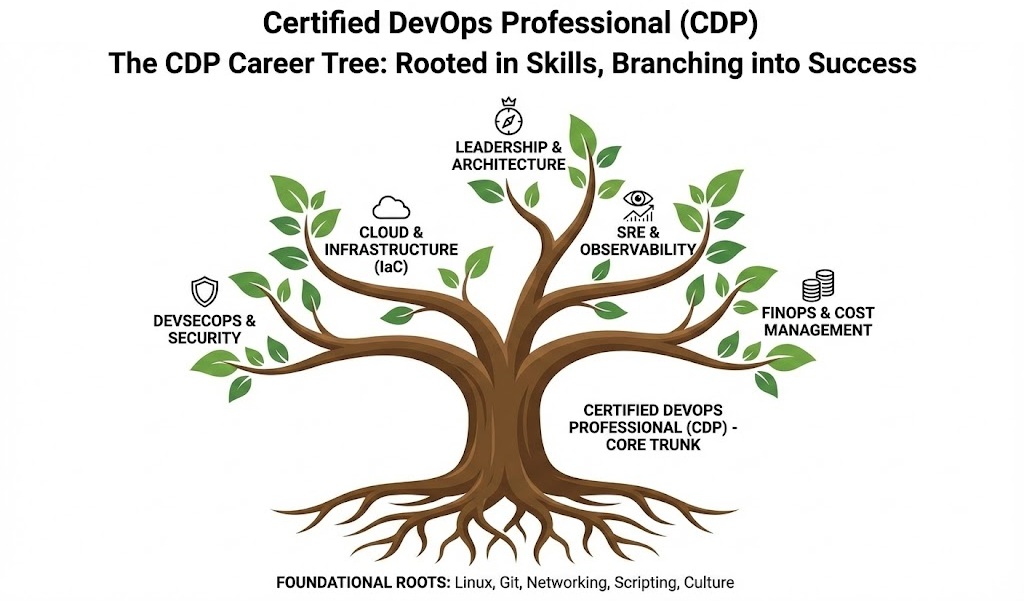
Certified DevOps Professional (CDP) follows a progression-based structure that supports career growth. Foundation levels establish consistent understanding across teams and tools.
Professional levels validate hands-on capability in automation, delivery pipelines, observability, and reliability. Advanced paths focus on cross-domain influence, system optimization, and strategic decision-making.
Specialization tracks allow engineers to focus on DevOps, SRE, FinOps, DataOps, or AIOps depending on their career direction.
Complete Certified DevOps Professional (CDP) Certification Table
| Track | Level | Who it’s for | Prerequisites | Skills Covered | Recommended Order | Official Link |
|---|---|---|---|---|---|---|
| DevOps | Foundation | Early-career engineers | Linux, Git basics | CI/CD basics, automation | 1 | Certified DevOps Professional (CDP) |
| DevOps | Professional | Working DevOps engineers | Pipeline experience | CI/CD design, IaC, monitoring | 2 | Certified DevOps Professional (CDP) |
| SRE | Professional | Reliability-focused engineers | Production exposure | SLOs, incidents, resilience | 3 | Certified DevOps Professional (CDP) |
| FinOps | Professional | Cost optimization roles | Cloud fundamentals | Forecasting, optimization | 4 | Certified DevOps Professional (CDP) |
Detailed Guide for Each Certified DevOps Professional (CDP) Certification
Certified DevOps Professional (CDP) – DevOps Foundation
What it is
This certification validates a clear understanding of DevOps workflows and collaboration models. It confirms readiness to work within modern delivery teams.
Who should take it
Engineers with one to three years of experience in development, QA, or operations benefit most. Professionals transitioning into DevOps also fit well.
Skills you’ll gain
- CI/CD workflow fundamentals
- Version control collaboration
- Entry-level automation practices
Real-world projects you should be able to do
- Create a basic CI/CD pipeline
- Automate application environment setup
Preparation plan
Spend the first 7–14 days reviewing concepts. Use the next 30 days for hands-on practice. Extend to 60 days if you build end-to-end demo projects.
Common mistakes
Candidates often focus on specific tools instead of understanding workflow design.
Best next certification after this
Same track: DevOps Professional
Cross track: SRE Professional
Leadership option: DevOps for Managers
Certified DevOps Professional (CDP) – DevOps Professional
What it is
This certification validates real production readiness. It confirms the ability to design, operate, and improve DevOps systems at scale.
Who should take it
Mid-level DevOps, platform, and cloud engineers with hands-on experience gain the strongest value.
Skills you’ll gain
- Advanced pipeline architecture
- Infrastructure as Code practices
- Monitoring and alerting strategies
Real-world projects you should be able to do
- Design multi-environment pipelines
- Implement observability for live services
Preparation plan
Review fundamentals in 14 days, practice aggressively for 30 days, and simulate production issues within 60 days.
Common mistakes
Ignoring rollback, failure handling, and recovery patterns reduces effectiveness.
Best next certification after this
Same track: Advanced DevOps
Cross track: FinOps Professional
Leadership option: Engineering Management
Choose Your Learning Path
DevOps Path
This path focuses on delivery speed, automation, and infrastructure ownership. Engineers improve pipeline reliability and platform stability.
DevSecOps Path
This path integrates security checks into delivery flows. Engineers reduce risk without slowing development.
SRE Path
This path emphasizes availability, incident response, and service health management.
AIOps / MLOps Path
This path applies data and automation to operational decision-making.
DataOps Path
This path focuses on reliable data pipelines and orchestration at scale.
FinOps Path
This path trains engineers to balance performance and cloud cost efficiency.
Role → Recommended Certified DevOps Professional (CDP) Certifications
| Role | Recommended Certifications |
|---|---|
| DevOps Engineer | DevOps Professional |
| SRE | SRE Professional |
| Platform Engineer | DevOps Professional |
| Cloud Engineer | DevOps Professional |
| Security Engineer | DevSecOps Track |
| Data Engineer | DataOps Track |
| FinOps Practitioner | FinOps Professional |
| Engineering Manager | DevOps + Leadership |
Next Certifications to Take After Certified DevOps Professional (CDP)
Same Track Progression
Engineers deepen expertise by moving further within the same specialization.
Cross-Track Expansion
Engineers expand skill sets across domains to improve architectural judgment.
Leadership & Management Track
This path prepares engineers for system ownership and people leadership roles.
Training & Certification Support Providers for Certified DevOps Professional (CDP)
DevOpsSchool
Cotocus
Scmgalaxy
BestDevOps
devsecopsschool.com
sreschool.com
aiopsschool.com
dataopsschool.com
finopsschool.com
Frequently Asked Questions (General)
Is Certified DevOps Professional (CDP) difficult?
CDP tests real-world thinking rather than memorization, so hands-on engineers perform best.
How long should preparation take?
Most candidates prepare effectively in one to two months with consistent practice.
Are prerequisites mandatory?
Practical experience matters more than formal requirements.
Does CDP improve career growth?
Better operational ownership often leads to stronger roles and compensation.
Is CDP globally relevant?
Yes. Enterprises worldwide value the skills CDP validates.
FAQs on Certified DevOps Professional (CDP)
What makes CDP different from other certifications?
CDP validates production readiness, not theoretical knowledge.
Does CDP align with cloud-native work?
Yes. It reflects real enterprise cloud practices.
Can CDP support role changes?
Yes, when paired with hands-on experience.
Does CDP help leadership growth?
Yes. It builds system-level thinking.
Final Thoughts: Is Certified DevOps Professional (CDP) Worth It?
Certified DevOps Professional (CDP) suits engineers who value depth, responsibility, and real outcomes. It strengthens judgment rather than offering shortcuts.
If you already work with production systems and want to operate them better, CDP delivers lasting value. It rewards engineers who take ownership and think beyond tools.