Introduction
Cybersecurity challenges grow more complex every day, pushing organizations to seek experts who can build impenetrable cloud barriers. The Azure Security Engineer Associate (AZ-500) certification provides the technical foundation for professionals who want to lead these defensive efforts. Both DevOpsschool students and veteran engineers use this guide to master the art of identity protection and data encryption. As the industry moves toward automated security and zero-trust frameworks, obtaining this credential marks you as a vital asset to any technical team. This comprehensive breakdown explores the certification’s value and provides a clear path to becoming a certified security authority.
What is the Azure Security Engineer Associate (AZ-500)?
The Azure Security Engineer Associate (AZ-500) acts as a rigorous validation of an engineer’s ability to implement end-to-end security controls. This program prioritizes real-world application over abstract concepts, ensuring that you can protect production workloads effectively. It serves as a bridge between high-level organizational security policies and the actual technical configuration of the Azure environment.
Engineers in this track master the configuration of firewalls, the management of identities through Microsoft Entra ID, and the protection of applications and data. The curriculum mirrors modern engineering workflows where security is an integral part of the development lifecycle. By focusing on enterprise-grade practices like threat modeling and automated remediation, it prepares you to handle the security demands of high-stakes environments.
Who Should Pursue Azure Security Engineer Associate (AZ-500)?
Cloud security specialists, systems administrators, and SREs who manage Azure infrastructure benefit most from this certification. DevOps professionals find these skills essential for building secure CI/CD pipelines and automating compliance across the organization. Additionally, data engineers and platform architects learn how to isolate critical workloads and safeguard sensitive enterprise information.
In India and the global tech market, companies face a severe shortage of engineers who can navigate hybrid cloud security. Ambitious beginners with a solid understanding of virtualization and networking use this badge to launch their careers in cybersecurity. Technical managers also leverage this knowledge to guide their teams through security audits and ensure compliance with global standards.
Why Azure Security Engineer Associate (AZ-500) is Valuable and Beyond
Enterprise adoption of Microsoft Azure across sectors like finance and healthcare ensures the long-term relevance of this credential. As attackers develop more sophisticated methods, the demand for experts who can manage Key Vault secrets and monitor Sentinel alerts continues to climb. This certification proves you possess the adaptability to defend cloud resources even as specific tools and platforms evolve.
Investing time in the AZ-500 delivers a high return because it focuses on the core pillars of modern cloud defense. Organizations actively seek “T-shaped” professionals who combine broad cloud administration skills with deep security expertise. Achieving this associate-level status demonstrates your commitment to protecting company assets, which leads to better career opportunities and higher salary potential.
Azure Security Engineer Associate (AZ-500) Certification Overview
DevOpsschool delivers this training program, providing a comprehensive environment to master the Microsoft Azure Security Technologies curriculum. Candidates must demonstrate their skills through performance-based assessments that often include live lab scenarios and complex troubleshooting. Microsoft maintains this associate-level credential to verify that engineers can implement a resilient security posture for any cloud-based business.
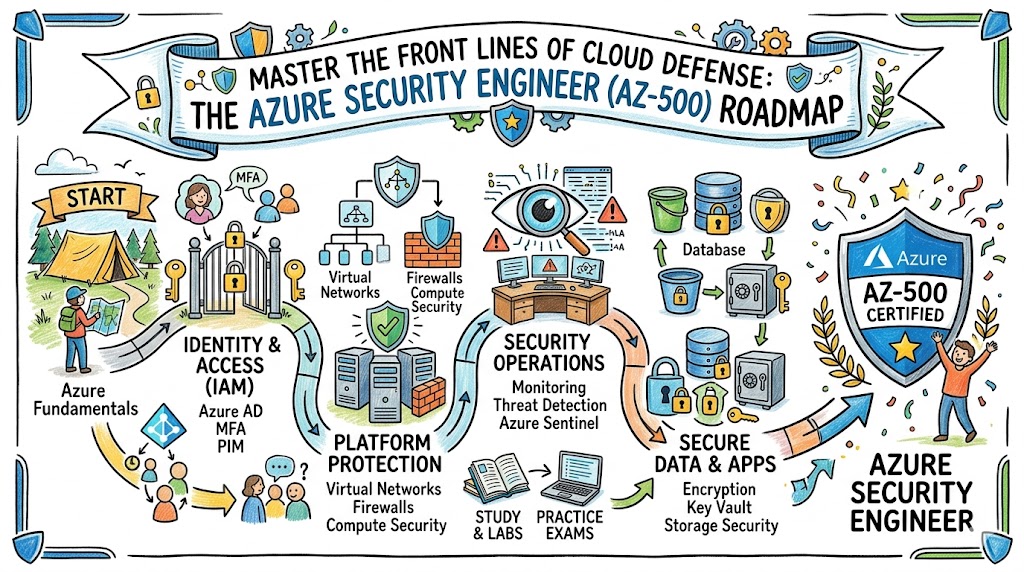
The exam syllabus divides into four main domains: managing identity and access, implementing platform protection, managing security operations, and securing data/applications. This balanced structure ensures you can defend every layer of the cloud stack, from the network perimeter to the database. It stands as a trusted benchmark for professionals who want to prove their competence in configuring secure Azure tenants.
Azure Security Engineer Associate (AZ-500) Certification Tracks & Levels
The AZ-500 serves as a specialized associate-level milestone within a broader hierarchy of Microsoft cloud certifications. Most professionals begin with foundational cloud exams before specializing in this technical security role. These tracks empower you to grow from basic implementation tasks to designing high-level security architectures for global enterprises.
Specialized paths in DevOps often use the AZ-500 as a building block for achieving Expert-level status. For SREs or FinOps practitioners, the resource governance and monitoring skills learned here provide a foundation for building stable and cost-efficient systems. As you progress, the certification levels align with your career growth, moving you from an individual contributor to a strategic technical leader.
Complete Azure Security Engineer Associate (AZ-500) Certification Table
| Track | Level | Who it’s for | Prerequisites | Skills Covered | Recommended Order |
| Cloud Security | Associate | Security Engineers | Azure Fundamentals | Identity, RBAC, VNet Security | 1 |
| Infrastructure | Associate | Systems Admins | Networking Basics | Firewall, NSG, JIT Access | 1 |
| DevSecOps | Professional | DevOps Engineers | AZ-500 or AZ-400 | Security Automation, Pipelines | 2 |
| Data Security | Associate | Data Engineers | Storage Concepts | Encryption, SQL Security | 1 |
| Security Ops | Advanced | SOC Analysts | AZ-500 | Sentinel, Log Analytics, Defender | 2 |
Detailed Guide for Each Azure Security Engineer Associate (AZ-500) Certification
Azure Security Engineer Associate (AZ-500) – Microsoft Azure Security Technologies
What it is
This certification confirms your ability to manage identity, implement platform protection, and maintain a strong security posture. It proves you can effectively defend applications, data, and network infrastructures within the Microsoft cloud.
Who should take it
IT professionals who understand Azure administration and want to specialize in cybersecurity should pursue this exam. Successful candidates typically have experience with virtualization, networking, and cloud resource management.
Skills you’ll gain
- Using Microsoft Entra ID to manage identity and conditional access policies.
- Implementing advanced network security with WAF and Azure Firewall.
- Configuring security alerts and remediation policies through Microsoft Defender for Cloud.
- Protecting sensitive information with Key Vault and advanced encryption methods.
Real-world projects you should be able to do
- Deploying a Hub-and-Spoke network with secure forced tunneling and firewalls.
- Automating the rotation of service principal secrets using Logic Apps.
- Implementing dynamic data masking and transparent data encryption for SQL databases.
- Setting up Log Analytics dashboards to monitor for and flag suspicious login attempts.
Preparation plan
- 7–14 days: Review official documentation and take practice assessments to identify knowledge gaps in identity and access management.
- 30 days: Complete hands-on labs focused on network security and storage encryption while finishing Microsoft Learn modules.
- 60 days: Execute multiple end-to-end security projects and master the CLI/PowerShell commands needed for rapid security configuration.
Common mistakes
- Underestimating the depth and complexity of Role-Based Access Control (RBAC).
- Relying on theory while skipping hands-on configuration practice in the Azure portal.
- Neglecting the security operations domain, which covers vital logging and monitoring tasks.
Best next certification after this
- Same-track option: Microsoft Cybersecurity Architect Expert (SC-100).
- Cross-track option: Azure DevOps Engineer Expert (AZ-400).
- Leadership option: Certified Information Systems Security Professional (CISSP).
Choose Your Learning Path
DevOps Path
The DevOps path focuses on integrating security automation directly into the software development lifecycle. Engineers learn to treat security policies as code, ensuring that every deployment undergoes vulnerability scanning. This path helps you maintain high delivery speeds without compromising the safety of the CI/CD pipeline.
DevSecOps Path
The DevSecOps journey prioritizes “shifting left” by introducing security checks at the earliest stages of development. You use AZ-500 concepts to build automated compliance gates that verify infrastructure before provisioning begins. This approach ensures that every cloud resource meets organizational security standards from the start.
SRE Path
Site Reliability Engineers use security principles to maintain system uptime and defend against attacks that cause outages. This path focuses on monitoring for security-related performance issues and building automated recovery systems for compromised assets. You aim to create a stable production environment through proactive alerting and log analysis.
AIOps / MLOps Path
This specialized path protects the data pipelines and machine learning models that drive modern business automation. You use security expertise to safeguard training data and prevent the unauthorized manipulation of AI models. This ensures that your organization’s AI-driven decisions remain confidential and secure.
DataOps Path
The DataOps focus centers on the security of data throughout its entire lifecycle. Professionals manage database firewalls, storage account permissions, and encryption keys to protect sensitive information. This ensures that you meet global privacy regulations while delivering high-quality data to stakeholders.
FinOps Path
FinOps practitioners use security governance to eliminate resource waste and optimize cloud spending. By enforcing strict access controls and resource tagging policies, you prevent unauthorized “shadow IT” from inflating your cloud bill. You prove that a secure cloud environment is also a cost-effective one.
Role → Recommended Azure Security Engineer Associate (AZ-500) Certifications
| Role | Recommended Certifications |
| DevOps Engineer | AZ-500, AZ-400 |
| SRE | AZ-500, AZ-104 |
| Platform Engineer | AZ-500, AZ-700 |
| Cloud Engineer | AZ-104, AZ-500 |
| Security Engineer | AZ-500, SC-100 |
| Data Engineer | DP-203, AZ-500 |
| FinOps Practitioner | AZ-500, AZ-900 |
| Engineering Manager | AZ-500, MS-900 |
Next Certifications to Take After Azure Security Engineer Associate (AZ-500)
Same Track Progression
Professionals seeking deeper specialization should target the Microsoft Cybersecurity Architect Expert (SC-100). This exam moves you from implementation tasks to designing high-level security strategies for global enterprises. You will learn how to weave various security services into a comprehensive zero-trust framework.
Cross-Track Expansion
Achieving the Azure DevOps Engineer Expert (AZ-400) status allows you to broaden your technical influence across the organization. Combining security mastery with DevOps expertise creates a versatile profile capable of leading modern software delivery teams. This helps you understand the balance between development velocity and operational safety.
Leadership & Management Track
Engineers transitioning into leadership roles should consider certifications like CISM or CISSP. These programs move away from technical configuration and focus on risk management, strategy, and organizational security policy. They prepare you to lead large teams and communicate complex security risks to executive stakeholders.
Training & Certification Support Providers for Azure Security Engineer Associate (AZ-500)
DevOpsSchool
This provider delivers deep mentorship and live training centered on real-world Azure security challenges. Their practical approach ensures students know how to defend a live production environment rather than just passing the exam. They offer a collaborative community and direct access to industry veterans for personalized guidance.
Cotocus
This organization specializes in high-impact corporate training and digital transformation initiatives. They create tailored learning paths that help teams rapidly upgrade their cloud security posture. Their lean curriculum focuses on the essential skills that modern employers demand in the current job market.
Scmgalaxy
As a premier destination for configuration management enthusiasts, this site offers extensive tutorials and community resources. They provide unique insights into how security intersects with traditional SCM and infrastructure-as-code. Professionals visit this platform for technical blogs and expert troubleshooting advice.
BestDevOps
This platform identifies and curates the most effective training programs for cloud and DevOps certifications. They prioritize high-quality instructional content to help candidates reach their goals with minimal wasted effort. Their structured paths provide an excellent return on investment for busy professionals.
devsecopsschool.com
This institution focuses exclusively on the intersection of operations, security, and development. They offer deep-dive courses into automated security testing and the latest cloud-native defense tools. It is the perfect choice for anyone wanting to master the “Sec” within the DevSecOps framework.
sreschool.com
This school teaches security through the lens of system reliability and operational excellence. They help engineers understand how security breaches can lead to massive downtime and system instability. Their curriculum covers everything from secure incident response to managing error budgets.
aiopsschool.com
This provider explores the future of infrastructure management driven by artificial intelligence. They teach students how to adapt security protocols when AI systems manage the cloud environment. Their courses focus on securing automated decision-making engines and machine learning data streams.
dataopsschool.com
This school focuses on protecting the big data environments that fuel modern business intelligence. They teach students how to implement rigorous security controls without slowing down the flow of data. It serves as a critical resource for aspiring data architects and engineers.
finopsschool.com
This platform highlights the vital connection between financial governance and cloud security. They help professionals use security policies to enforce cost-saving behaviors across the organization. Their training ensures that your cloud infrastructure remains both safe from threats and optimized for cost.
Frequently Asked Questions (General)
1. How difficult is the Azure Security Engineer Associate (AZ-500) exam?
Candidates generally consider the exam moderately difficult because it requires a balance of theory and hands-on lab work. You must demonstrate that you can configure security settings correctly in a live environment.
2. What is the typical time required to prepare for this certification?
Most working professionals spend 30 to 60 days on preparation, depending on their existing experience with Azure. Those new to security may need extra time to master identity and network protection.
3. Are there any strict prerequisites for taking the AZ-500?
Microsoft does not enforce strict prerequisites, but passing the AZ-104 (Azure Administrator) provides a massive advantage. You need a solid understanding of basic cloud administration to succeed here.
4. What is the return on investment (ROI) for this certification?
The ROI is exceptionally high, as security remains the top priority for most modern organizations. Certified experts often secure better job stability and higher salary offers than their uncertified counterparts.
5. How long is the certification valid?
Microsoft certifications last for one year, but you can maintain your status for free. You simply pass an annual online renewal assessment through the Microsoft Learn platform.
6. Does this certification cover multi-cloud security?
The exam focuses exclusively on the Microsoft Azure ecosystem. However, the foundational concepts of identity, encryption, and network defense apply to other clouds like AWS and GCP.
7. Can I take the exam in a language other than English?
Yes, Microsoft provides the exam in several languages, including Spanish, German, Chinese, and Japanese. This ensures that global professionals can test in their preferred language.
8. Is it better to take AZ-104 or AZ-500 first?
Starting with AZ-104 is the smarter move for most people. It builds the administrative foundation you need to understand the resources you will eventually be securing in the AZ-500.
9. Are labs included in the actual exam?
Microsoft often includes performance-based labs where you must log into an Azure tenant and perform specific tasks. Always prepare for hands-on scenarios as part of your testing experience.
10. How does this help an Engineering Manager?
It gives managers a clear understanding of the risks and technical requirements involved in cloud safety. This knowledge leads to more accurate project timelines and better risk management strategies.
11. Is there a specific order for the security certifications?
The typical path starts with SC-900 for fundamentals, moves to AZ-500 for associate skills, and ends with SC-100 for expert architecture. This sequence builds your knowledge logically.
12. Does the certification cover third-party security tools?
The exam concentrates on native Azure security services. However, mastering these native tools makes it much easier to integrate third-party firewalls or SIEM solutions later.
FAQs on Azure Security Engineer Associate (AZ-500)
1. What are the key domains covered in the AZ-500 exam?
The exam tests your skills in identity and access, platform protection, security operations, and securing data/applications. You must master tools like Entra ID, Azure Firewall, and Microsoft Defender.
2. How much does the AZ-500 exam cost in India?
The standard fee in India is approximately 4800 INR, plus applicable taxes. Always check the official Microsoft site for the most current pricing and discount offers.
3. Does AZ-500 cover Kubernetes security?
Yes, you will learn the basics of securing Azure Kubernetes Service (AKS). This includes managing network policies and using Key Vault to store sensitive application secrets.
4. What is the passing score for the AZ-500 exam?
You must earn at least 700 points out of a possible 1000. Microsoft uses a scaled scoring system, so the weight of each question may vary.
5. Is Microsoft Sentinel part of the AZ-500 curriculum?
Yes, the security operations section includes Microsoft Sentinel. You learn how to connect data sources and perform basic threat hunting within the platform.
6. Can I use the Azure Security Engineer Associate (AZ-500) to get a DevSecOps job?
This certification is a cornerstone for anyone entering the DevSecOps field. It provides the technical proof that you can secure cloud infrastructure throughout the development lifecycle.
7. Does the exam cover hybrid cloud security?
Yes, the curriculum includes hybrid identity through Entra ID Connect and protecting on-premises servers using Azure Arc. It ensures you can defend resources across different environments.
8. How often is the AZ-500 exam content updated?
Microsoft updates the exam every few months to include new Azure features and portal changes. Always verify your study materials against the latest official exam objective list.
Final Thoughts: Is Azure Security Engineer Associate (AZ-500) Worth It?
The Azure Security Engineer Associate (AZ-500) represents one of the most practical and high-impact investments you can make in your technical career. This isn’t a “paper certification” that you pass by reading a book; it requires a genuine understanding of how to protect an enterprise-grade cloud environment. For any professional working in the Microsoft cloud, this credential serves as a career insurance policy, proving you can defend an organization’s most sensitive assets against modern threats.