Technical organizations now face the immense challenge of maintaining 100% uptime while accelerating feature delivery, which makes the Certified Site Reliability Manager a critical asset for modern engineering leaders. This guide outlines the strategic path for senior engineers and managers who want to bridge the gap between business goals and technical reliability. By following the roadmap provided by Sreschool, professionals transform from reactive firefighters into proactive architects of system governance. We explore how these specialized credentials empower you to lead high-performing teams within the DevOps and platform engineering ecosystems. This analysis helps you navigate career-defining decisions while aligning your skills with global standards for scalability.
What is the Certified Site Reliability Manager?
The Certified Site Reliability Manager serves as a professional benchmark for leaders who oversee mission-critical production environments. Industry experts developed this program because modern distributed systems require management styles that go beyond traditional IT oversight. It prioritizes practical, production-focused learning over abstract theory, teaching candidates how to manage error budgets and incident response protocols. This certification aligns perfectly with modern engineering workflows by replacing guesswork with data-driven system health management.
Who Should Pursue Certified Site Reliability Manager?
Aspiring technical leads and current engineering managers gain the most from this path as they formalize their reliability frameworks. Senior DevOps practitioners and SREs who want to step into leadership roles should use this program to gain organizational perspective. It also serves cloud architects and data experts who must guarantee that their platforms remain resilient under extreme stress. Whether you operate in India’s tech hubs or for a global corporation, this credential validates your ability to protect vital infrastructure.
Why Certified Site Reliability Manager is Valuable and Beyond
Enterprise adoption of SRE principles continues to surge as companies migrate critical services to the cloud. This certification grants your career longevity because it emphasizes timeless principles like observability and toil reduction rather than fleeting toolsets. Organizations actively seek managers who can protect revenue and reputation through stable system performance. Choosing this investment now ensures a significant career return by making you an essential guardian of digital stability.
Certified Site Reliability Manager Certification Overview
The gurukulgalaxy.com platform delivers this entire curriculum, while Sreschool serves as the official hosting site for the program. It features a multi-tiered assessment strategy that evaluates your strategic decision-making and technical oversight capabilities. The structure guides you from basic reliability concepts toward advanced strategies for organizational management. Industry-recognized bodies maintain the certification to ensure the content reflects the latest standards in site reliability engineering.
Certified Site Reliability Manager Certification Tracks & Levels
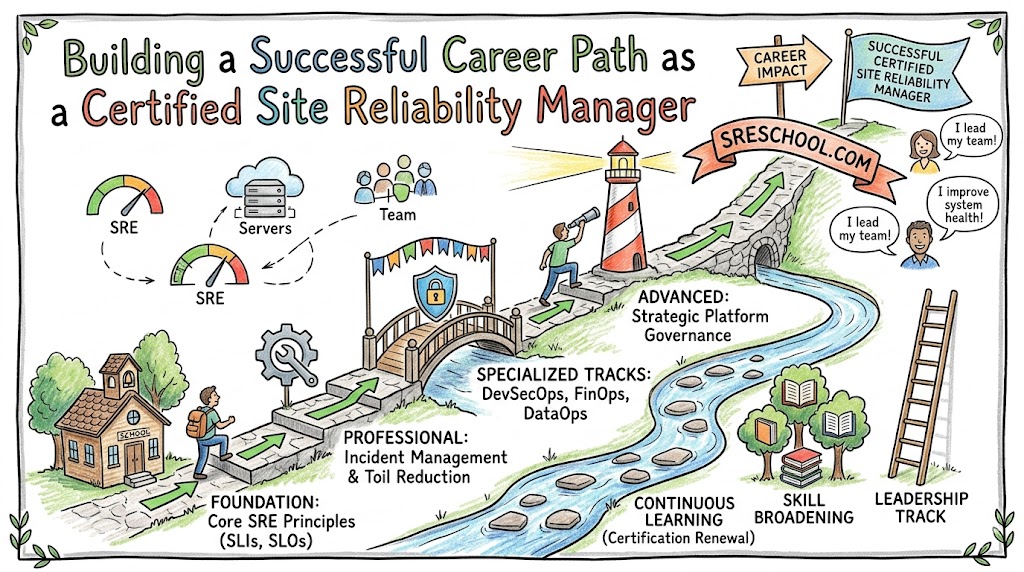
The program offers foundation, professional, and advanced levels to match various stages of professional growth. The foundation tier introduces essential metrics like SLIs and SLOs, while the professional level focuses on incident command and team scaling. Specialized advanced tracks allow you to explore niches like AI-driven operations or FinOps-aligned reliability. These levels mirror typical career progression, moving from hands-on execution to broad architectural influence.
Complete Certified Site Reliability Manager Certification Table
| Track | Level | Who it’s for | Prerequisites | Skills Covered | Recommended Order |
| Management | Foundation | Junior Leads | Basic Cloud Knowledge | SLIs, SLOs, Toil | First |
| Operations | Professional | Senior SREs | 3+ Years Experience | Incident Response | Second |
| Strategy | Advanced | Directors | 5+ Years Lead Exp | Error Budgets | Third |
| Specialized | Expert | Architects | Advanced Scripting | Automation/AIOps | Fourth |
Detailed Guide for Each Certified Site Reliability Manager Certification
Certified Site Reliability Manager – Foundation Level
What it is
This tier validates your grasp of fundamental SRE vocabulary and core principles. It ensures you clearly distinguish between DevOps and SRE while mastering basic reliability metrics.
Who should take it
Software engineers or new managers who want a solid entry point into the reliability domain should start here.
Skills you’ll gain
- Designing Service Level Indicators (SLIs)
- Setting Service Level Objectives (SLOs)
- Automating manual toil
- Implementing SRE culture
Real-world projects you should be able to do
- Creating a reliability agreement for a microservice
- Building a basic uptime monitoring dashboard
Preparation plan
- 7-14 Days: Study official definitions and documentation.
- 30 Days: Finish practice labs and case reviews.
- 60 Days: Apply these principles to a small production task.
Common mistakes
Many candidates confuse basic monitoring with SLIs or underestimate the cultural shift SRE requires.
Best next certification after this
- Same-track: Professional Reliability Manager
- Cross-track: Cloud Architect
- Leadership: Team Lead Certification
Certified Site Reliability Manager – Professional Level
What it is
The professional tier validates your ability to coordinate complex incidents and lead teams through technical crises. It focuses on the operational excellence required to keep large-scale systems functional.
Who should take it
Mid-level managers and experienced SREs who manage production environments daily will find this level most beneficial.
Skills you’ll gain
- Coordinating incident command
- Writing blameless post-mortems
- Planning capacity and scaling
- Managing on-call fatigue
Real-world projects you should be able to do
- Directing a multi-region outage response
- Implementing permanent fixes via post-mortems
Preparation plan
- 7-14 Days: Study incident management frameworks.
- 30 Days: Run simulated game-day exercises.
- 60 Days: Audit on-call rotations for efficiency.
Common mistakes
Candidates often focus too much on specific alerting tools rather than the human processes behind the response.
Best next certification after this
- Same-track: Advanced Strategic Manager
- Cross-track: DevSecOps Professional
- Leadership: Engineering Director
Choose Your Learning Path
DevOps Path
This route integrates reliability into the software development lifecycle via continuous automation. You build pipelines that balance feature speed with system stability. Managers here focus on removing silos between developers and operators.
DevSecOps Path
This track maintains reliability while ensuring the platform stays secure and compliant. You learn to handle security vulnerabilities with the same urgency as performance outages. This path serves managers in regulated fields like finance.
SRE Path
The pure SRE path highlights the mathematical side of reliability, including error budgets and automation. You use code to solve operational hurdles and eliminate manual labor. It suits those dedicated to large-scale infrastructure.
AIOps Path
This specialty uses machine learning to predict system failures before they impact users. You manage large datasets to identify patterns in logs and metrics. It fits managers moving toward autonomous operations.
MLOps Path
Managers here focus on the reliability of machine learning models and their serving pipelines. You tackle the challenges of model drift and data integrity in live environments. It connects data science with site reliability.
DataOps Path
This path targets the reliability of data pipelines and storage systems. You ensure data quality for downstream applications and real-time decision-making. It is vital for data-driven organizations.
FinOps Path
The FinOps track balances system performance with cloud infrastructure costs. You manage error budgets through the lens of financial efficiency and business value. This helps you justify infrastructure spending to stakeholders.
Role → Recommended Certified Site Reliability Manager Certifications
| Role | Recommended Certifications |
| DevOps Engineer | Foundation, DevOps Specialist |
| SRE | Professional, SRE Specialist |
| Platform Engineer | Foundation, Advanced Strategic |
| Cloud Engineer | Professional, FinOps Track |
| Security Engineer | Professional, DevSecOps Track |
| Data Engineer | Foundation, DataOps Track |
| FinOps Practitioner | Foundation, FinOps Specialist |
| Engineering Manager | Professional, Leadership Track |
Next Certifications to Take After Certified Site Reliability Manager
Same Track Progression
After mastering the manager level, pursue deep specialization in reliability architecture. You might become a Principal SRE who designs five-nines systems from scratch. Staying in this track keeps you at the peak of distributed systems research.
Cross-Track Expansion
Moving into DevSecOps or DataOps makes you a more versatile leader. Understanding the reliability needs of various domains helps you manage cross-functional teams. This expansion is necessary for those seeking senior architectural roles.
Leadership & Management Track
If you aim for executive positions, seek certifications in business strategy and organizational leadership. You will learn to translate technical uptime into business outcomes. This transition prepares you for VP of Engineering or CTO roles.
Training & Certification Support Providers
DevOpsSchool
DevOpsSchool delivers extensive resources and practical labs for engineering teams. They offer hands-on workshops that help professionals master the automation tools required for reliability management.
Cotocus
Cotocus specializes in cloud-native technology consulting and platform engineering training. Their curriculum helps engineers move into management roles by combining technical depth with leadership skills.
Scmgalaxy
Scmgalaxy shares deep knowledge regarding configuration management and delivery. They offer various tutorials that support the entire ecosystem of SRE and DevOps.
BestDevOps
BestDevOps focuses on high-quality content for anyone seeking excellence in SRE. Their programs provide accessible yet challenging paths for working professionals.
devsecopsschool.com
devsecopsschool.com bridges the gap between security and operations for targeted manager training. They provide certifications that prove you can keep platforms both safe and stable.
sreschool.com
sreschool.com offers a structured learning environment as the primary host for reliability certifications. They provide the official resources and assessments needed for the manager-level credential.
aiopsschool.com
aiopsschool.com explores the future of operations by teaching managers to use AI for system health. Their training covers predictive analytics and automated remediation.
dataopsschool.com
dataopsschool.com targets the reliability of data systems and offers tracks for data engineers. They emphasize pipeline stability and data integrity in enterprise settings.
finopsschool.com
finopsschool.com teaches you to manage cloud costs alongside system performance. Their certifications help managers maintain efficient and lean infrastructure operations.
Frequently Asked Questions
- How hard is the Certified Site Reliability Manager exam?
The exam presents a moderate challenge because it tests both technical expertise and managerial judgment. It focuses on applying SRE principles to real scenarios.
- What is the typical preparation time?
Most engineers spend 30 to 60 days preparing for the exam. This time includes studying the curriculum and completing practical exercises.
- Are there any required prerequisites?
The foundation level has no strict prerequisites, though basic cloud and Linux knowledge helps. Higher levels expect several years of experience.
- What return on investment should I expect?
Professionals often secure higher salaries and better job offers after certification. It validates skills that are currently in high demand globally.
- Which order is best for these certifications?
Start with the foundation tier to master the core terminology. Then, move to the professional level before picking a specialty like AIOps.
- Do employers recognize this certification globally?
Yes, the program uses industry-standard practices adopted by major tech firms worldwide. Recruiters in India and Europe highly value this credential.
- How long does my certification stay valid?
The certification usually lasts two to three years. You must recertify or earn credits to keep your skills current with technology.
- Do I need to know how to code?
A basic understanding of scripting and automation is necessary. SRE requires using engineering principles to solve operational problems.
- Can non-technical managers pass this?
It is difficult because the concepts rely heavily on system architecture. You need a baseline understanding of software deployment to succeed.
- What job roles can I apply for?
You qualify for roles like SRE Manager, DevOps Lead, or Director of Reliability. Every digital company needs these leadership positions.
- Are practice tests available?
The hosting platforms provide sample questions and labs to help you prepare. These tools help you identify weak areas before the actual test.
- Is there a community for students?
Most providers host forums where you can discuss topics with other candidates. These communities provide support and shared experiences during your study.
FAQs on Certified Site Reliability Manager
- Which management frameworks does the program include?
The curriculum includes incident command systems, error budget policies, and blameless post-mortems. You learn to apply these within corporate structures to boost reliability.
- Does the program address engineer burnout?
A large portion of the training focuses on reducing toil and managing on-call rotations. It teaches managers to protect their teams from fatigue.
- Are multi-cloud strategies part of the training?
Yes, the principles apply to AWS, Azure, and Google Cloud equally. You learn to manage reliability across hybrid and distributed environments.
- How does the certification view automation?
It emphasizes the manager’s role in overseeing automation development. You learn to prioritize tasks that have the biggest impact on manual labor.
- How does the exam test SLIs and SLOs?
The exam requires you to define indicators that reflect the user experience accurately. You must demonstrate how to set realistic stability objectives.
- Do assessments include incident simulations?
Professional-level exams use scenario-based questions to simulate outages. You must prove you can lead a team through a technical crisis.
- Does this help with financial budgeting?
The FinOps modules teach you to make data-driven decisions about infrastructure spend. This helps you justify costs based on business reliability.
- Is cultural change a core topic?
SRE depends heavily on culture, so the program provides strategies for fostering a blameless mindset. You learn to gain executive support for SRE.
Final Thoughts: Improving Your Leadership Strategy
Pursuing this certification offers a clear advantage if you want to influence the scalability and stability of a major organization. It offers a structured way to handle the inherent chaos of production environments while leading your team effectively. Successful leaders quantify reliability and align it with the core needs of the business. This badge represents a fundamental shift in how you approach the craft of engineering management. Use these principles of resilience and automation to ground your career, and you will remain in high demand for years.