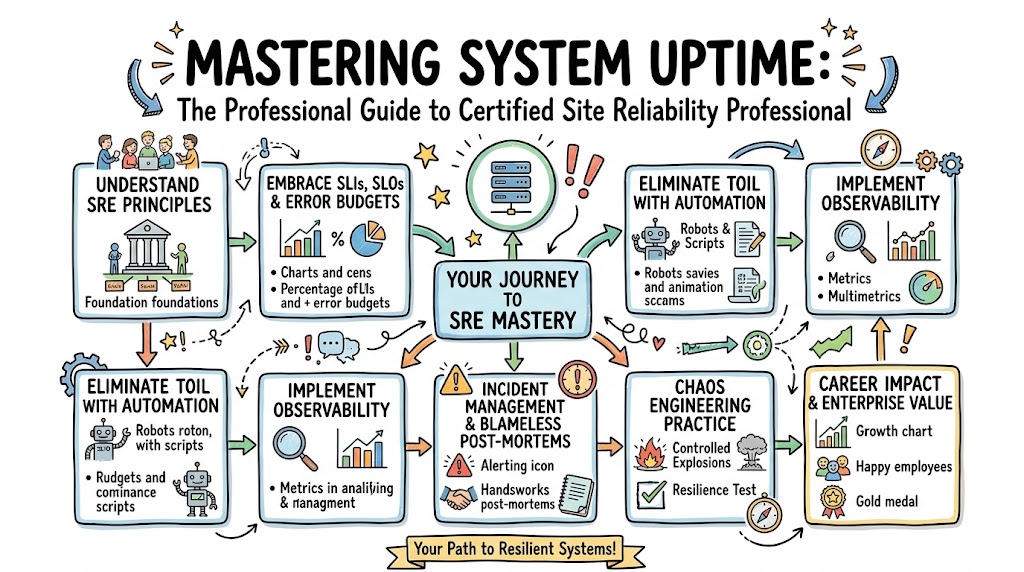
Strategic engineers now recognize that system uptime serves as the backbone of modern business success. This Certified Site Reliability Professional manual guides you through the essential methodologies required to maintain high-performing cloud ecosystems. You will explore how to manage complex distributed systems while balancing the need for rapid feature deployment with uncompromising stability. By engaging with the industry-standard training at Sreschool, you develop the practical expertise needed to thrive in any production environment. This roadmap helps you navigate the various certification tiers so you can select the perfect path to accelerate your technical career.
What is the Certified Site Reliability Professional?
The Certified Site Reliability Professional credential validates an engineer’s ability to apply software engineering principles to operational challenges. It focuses on replacing manual, repetitive tasks with automated solutions to improve system reliability and efficiency. Organizations value this certification because it emphasizes measurable outcomes like Service Level Objectives rather than just theoretical knowledge. You learn to build resilient architectures that can withstand the pressures of high-traffic enterprise environments while maintaining peak performance.
Who Should Pursue Certified Site Reliability Professional?
Cloud engineers, DevOps practitioners, and backend developers who carry responsibility for system uptime gain the most from this certification. It also benefits technical leads and managers who want to implement a culture of reliability and data-driven operations within their teams. Even professionals in security or data engineering find these principles useful for protecting infrastructure and ensuring pipeline availability. Whether you lead a team in India or manage global cloud resources, this credential proves your mastery over modern production standards.
Why Certified Site Reliability Professional is Valuable and Beyond
Enterprises worldwide are aggressively hiring SRE talent to manage the growing complexity of microservices and multi-cloud environments. Holding this certification ensures you stay ahead of the curve by focusing on core reliability logic that remains relevant even as individual tools change. You provide immediate value to your employer by reducing incident frequency and optimizing the cost of cloud infrastructure. This career trajectory offers high stability and impressive salary growth as reliability becomes a non-negotiable requirement for digital businesses.
Certified Site Reliability Professional Certification Overview
The program runs through the official Sreschool portal, providing a professional and structured environment for every student. It utilizes a series of hands-on assessments that force you to troubleshoot real-world failure scenarios in a production-like setting. You progress through a logical sequence of levels that build your confidence from basic concepts to advanced architectural design. This approach ensures that you possess the actual skills required to handle live incidents and manage large-scale automation projects effectively.
Certified Site Reliability Professional Certification Tracks & Levels
The curriculum features three primary stages: foundation, professional, and advanced levels to support engineers at every stage of their career. The foundation level covers the cultural shifts and basic metrics of SRE, while the professional level focuses on deep technical implementation and observability. Specialized tracks allow you to align your learning with specific domains like MLOps, DevSecOps, or FinOps. Finally, the advanced level prepares you for strategic leadership, where you oversee the health and reliability of entire engineering organizations.
Complete Certified Site Reliability Professional Certification Table
| Track | Level | Who it’s for | Prerequisites | Skills Covered | Recommended Order |
| SRE Core | Foundation | Entry-level | Basic Scripting | SLOs, SLIs, Toil | 1 |
| Engineering | Professional | SRE / DevOps | Foundation Cert | Automation, IaC | 2 |
| Architecture | Advanced | Sr. Architects | Professional Cert | Resilience, Scaling | 3 |
| Leadership | Expert | Managers | Advanced Cert | Strategy, Governance | 4 |
Detailed Guide for Each Certified Site Reliability Professional Certification
Certified Site Reliability Professional – Foundation
What it is
This introductory level confirms your understanding of the foundational SRE pillars and how they differ from traditional IT support models.
Who should take it
Aspiring SREs and developers who want to understand the lifecycle of production applications should start their journey with this certification.
Skills you’ll gain
- Crafting precise Service Level Indicators (SLIs)
- Automating manual tasks to eliminate operational toil
- Managing error budgets to drive deployment decisions
- Fundamental observability and alerting logic
Real-world projects you should be able to do
- Design a reliability dashboard for a standard API
- Write a detailed blameless post-mortem report
- Script a basic automated monitoring check
Preparation plan
- 7–14 days: Study the core terminology and SRE cultural values.
- 30 days: Complete all lab exercises on the Sreschool platform.
- 60 days: Apply these concepts to a small internal project to verify your learning.
Common mistakes
- Treating SRE as just “DevOps with a new name.”
- Neglecting the cultural aspects of blamelessness during incidents.
Best next certification after this
- Same-track: Certified Site Reliability Professional – Associate
- Cross-track: Certified Cloud Security Specialist
- Leadership: Team Lead Fundamentals
Certified Site Reliability Professional – Professional
What it is
The professional level validates your capability to build, scale, and maintain automated distributed systems across global cloud providers.
Who should take it
Experienced DevOps engineers and mid-level SREs who manage mission-critical production environments should pursue this advanced credential.
Skills you’ll gain
- Advanced Kubernetes orchestration and reliability
- Full-stack observability with Prometheus and Grafana
- Implementing Infrastructure as Code for production environments
- Automated incident response and remediation
Real-world projects you should be able to do
- Build a self-healing microservices cluster
- Design and implement a canary release strategy
- Configure complex alerting based on latency and traffic patterns
Preparation plan
- 7–14 days: Focus on advanced automation scripts and IaC syntax.
- 30 days: Build a complete observability stack for a live service.
- 60 days: Conduct chaos engineering drills to test system durability.
Common mistakes
- Over-complicating dashboards which leads to “information overload.”
- Failing to test automated rollback procedures before they are needed.
Best next certification after this
- Same-track: Certified Site Reliability Professional – Expert
- Cross-track: Certified DevSecOps Professional
- Leadership: Engineering Manager Certification
Choose Your Learning Path
DevOps Path
The DevOps track prioritizes the speed and efficiency of the continuous delivery pipeline without sacrificing code quality. You will learn to embed SRE principles into every stage of the development process to ensure stable releases. This path is perfect for engineers who enjoy building the tools that empower developers to deploy code safely. It focuses on creating a seamless flow from local development to production.
DevSecOps Path
Security becomes an automated part of the reliability lifecycle in this track, focusing on threat detection and compliance. You will learn how to build resilient systems that protect sensitive data while maintaining high performance. This path suits professionals working in banking, healthcare, or any sector where security is a top priority. You will ensure that stability and security go hand-in-hand.
SRE Path
The pure SRE path explores the deepest levels of system performance and the logic of high-availability architectures. You will focus on writing complex code to replace manual operations and analyzing telemetry data to optimize system health. This path leads to specialized roles in platform engineering and reliability architecture. It is the best choice for those who love solving infrastructure puzzles.
AIOps Path
Artificial Intelligence and Machine Learning transform how we manage systems by predicting potential failures before they occur. This path teaches you to handle massive amounts of operational data and use algorithmic insights to automate incident response. You will learn to turn big data into actionable intelligence for your operations team. It is a cutting-edge choice for forward-thinking engineers.
MLOps Path
Maintaining Machine Learning models in production requires unique reliability practices to ensure accuracy and availability. This track covers the infrastructure needed for data pipelines, model retraining, and real-time inference. You will ensure that AI-driven features remain as stable as the underlying core services. This is a vital skill set for organizations that rely on predictive analytics to function.
DataOps Path
Data pipelines are essential business assets that require the same reliability standards as any other software service. This path applies SRE logic to data engineering to ensure the consistency and availability of information flows. You will learn to monitor data quality and automate the recovery of failed data jobs. This ensures that business leaders always have access to accurate information.
FinOps Path
Managing the financial health of cloud infrastructure is now a core responsibility for modern reliability engineers. This track teaches you how to optimize cloud spending through transparent monitoring and automated waste reduction. You will learn to align technical decisions with the company’s financial objectives. It is the ideal path for engineers who want to prove their value to the business.
Role → Recommended Certified Site Reliability Professional Certifications
| Role | Recommended Certifications |
| DevOps Engineer | SRE Professional, CI/CD Specialist |
| SRE | SRE Expert, Observability Professional |
| Platform Engineer | Infrastructure Architect, SRE Professional |
| Cloud Engineer | SRE Foundation, Multi-Cloud Associate |
| Security Engineer | DevSecOps Specialist, SRE Foundation |
| Data Engineer | DataOps Practitioner, SRE Professional |
| FinOps Practitioner | Cloud Economist, SRE Foundation |
| Engineering Manager | SRE Leadership, Strategic Operations |
Next Certifications to Take After Certified Site Reliability Professional
Same Track Progression
Deepening your mastery within SRE involves pursuing expert-level credentials that focus on global-scale system architectures. You might specialize in kernel-level performance tuning, advanced networking protocols, or specialized high-performance storage solutions. This path establishes you as a primary technical authority within your organization. It leads you toward roles like Principal SRE or Staff Reliability Engineer.
Cross-Track Expansion
Broadening your expertise into security, development, or cloud-native architecture makes you a versatile and highly valuable asset. By understanding the perspectives of adjacent teams, you can design better reliability systems that work for everyone. This cross-pollination of skills is highly sought after in modern agile environments and tech startups. It helps you avoid technical silos and fosters a better engineering culture.
Leadership & Management Track
Transitioning into people management requires you to shift your focus from technical execution to organizational strategy and mentorship. Certifications in engineering leadership teach you how to build high-performing teams and manage complex stakeholder expectations. You will learn to advocate for reliability at the executive level and align technical goals with business needs. This path is perfect for those who want to lead.
Training & Certification Support Providers for Certified Site Reliability Professional
DevOpsSchool offers a comprehensive range of technical training programs that focus on the hands-on application of SRE and automation tools.
Cotocus provides specialized cloud-native consulting and training, helping professionals master the latest practices in infrastructure and system reliability.
Scmgalaxy serves as a massive community-driven hub for configuration management, version control, and automated delivery education.
BestDevOps delivers high-quality content and roadmaps that help engineers choose the most effective tools for their specific organizational challenges.
devsecopsschool.com focuses exclusively on the integration of security into the DevOps lifecycle to create truly resilient and safe applications.
sreschool.com acts as the premier authority for Site Reliability Engineering education, providing structured tracks for all professional skill levels.
aiopsschool.com leads the way in teaching engineers how to apply artificial intelligence to IT operations for smarter, predictive management.
dataopsschool.com provides targeted training for data engineers who need to apply reliability and operational excellence to their data pipelines.
finopsschool.com educates technical professionals on the art of cloud cost optimization and financial accountability within engineering teams.
Frequently Asked Questions (General)
- How do I begin the Certified Site Reliability Professional process?You start by selecting the foundation course through an approved provider and completing the required hands-on lab modules.
- Does the certification include a practical exam?Yes, you must pass a proctored assessment that tests your ability to solve real-world infrastructure problems in a live environment.
- What is the typical time needed to finish the professional level?Most candidates spend roughly 45 to 60 days preparing, depending on their existing comfort with cloud and automation tools.
- Can I earn this certification through online study?Proctored online exams are available through official partners, allowing you to complete your certification from any global location.
- How does this credential impact my earning potential?Certified SREs often command significantly higher salaries compared to general IT roles due to the specialized nature of their skills.
- Do these courses cover specific cloud providers?The training remains cloud-agnostic, teaching you universal principles that apply to AWS, Azure, Google Cloud, and on-premises systems.
- Is there a community for those who hold this certification?Earning the credential gives you access to exclusive networking groups and forums filled with experienced SRE leaders and peers.
- What are the prerequisites for the foundation level?No formal prerequisites exist, but a basic knowledge of Linux and software development workflows will significantly help you succeed.
- How long does the certification stay valid?The certification is usually valid for two years, after which you can renew it by completing updated modules or advancing levels.
- What happens if I do not pass the test?Most training providers offer a retake policy that allows you to review your results and attempt the exam again after a brief period.
- Is the focus more on theory or practical tools?The program perfectly balances core SRE theory with the practical application of tools like Kubernetes, Prometheus, and Grafana.
- Can I skip levels if I have a lot of experience?Experienced engineers with several years of relevant history may be eligible to attempt the professional level exam directly.
FAQs on Certified Site Reliability Professional
- Why is this SRE certification considered an industry leader?It provides a standardized framework for reliability that global tech firms recognize for its intense focus on practical, production-ready skills.
- How does the training address error budgets?The course teaches you how to calculate and monitor error budgets to balance the need for new features with the need for stability.
- Does the program cover the culture of blamelessness?Yes, a key section of the foundation level focuses on building a culture where teams learn from failures instead of assigning blame.
- Will I learn about observability in this track?The professional level provides deep dives into observability, including logging, tracing, and monitoring with modern toolsets and dashboards.
- How are the practical labs conducted?Labs take place in a cloud-based environment that mimics a real enterprise production cluster, allowing you to practice safely and effectively.
- Is there a focus on cost management for SREs?The specialized FinOps track and professional modules include sections on resource efficiency and cloud cost optimization for engineering teams.
- Who designs the certification curriculum?Industry experts with decades of experience in high-scale systems design and reliability engineering create and update the course content.
- Can I use these skills for on-premises data centers?While the course uses cloud tools, the reliability principles apply perfectly to any infrastructure, including traditional on-premises data centers.
Final Thoughts: Is Certified Site Reliability Professional Worth It?
Choosing the Certified Site Reliability Professional path represents a significant commitment to your future as a technical leader. You are no longer just maintaining servers; you are engineering a resilient, automated environment that protects your company’s most valuable digital assets. This investment in your professional growth yields long-term rewards through higher career security and the ability to solve the industry’s most complex technical puzzles. By joining this global community of experts, you ensure your relevance in a market that prizes stability and operational excellence above all else. Begin your journey today and become the engineer that every modern enterprise relies on.


Leave a Reply
You must be logged in to post a comment.