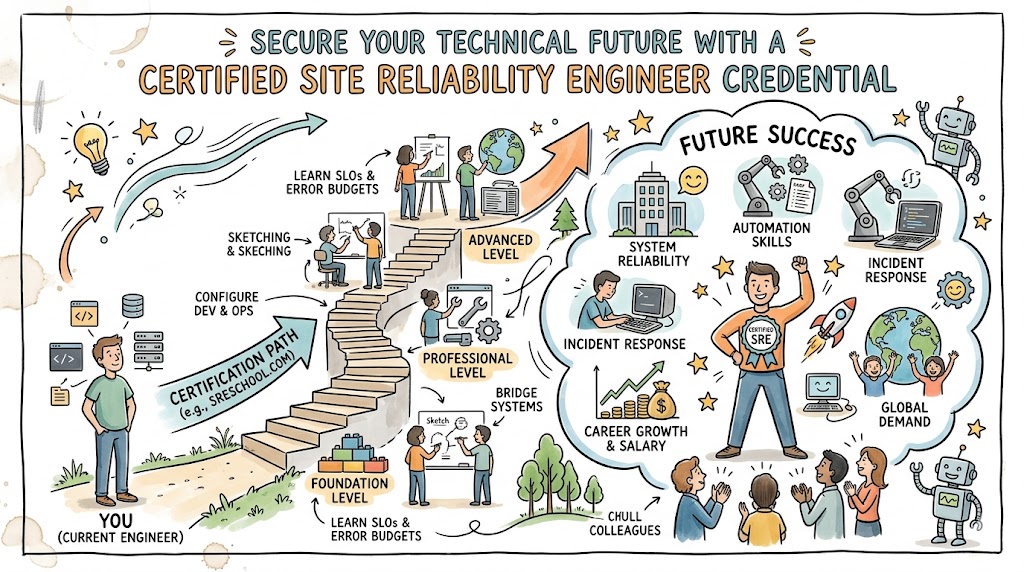
Engineers who want to lead in the age of cloud-scale operations must master more than just basic deployment; they must ensure absolute system resilience. This Certified Site Reliability Engineer guide identifies the exact steps you need to take to bridge the gap between high-speed development and rock-solid stability. By following the industry-aligned curriculum at Sreschool, you gain the practical authority to manage production environments with high-level precision. This roadmap empowers you to evaluate different learning paths and choose the specialization that best aligns with your long-term career goals in the global technology market.
What is the Certified Site Reliability Engineer?
The Certified Site Reliability Engineer defines a standard of excellence for professionals who treat infrastructure management as a software engineering challenge. This program exists to replace manual, repetitive operational tasks with automated, scalable, and intelligent solutions. It prioritizes production-focused learning, ensuring that you understand how to build and maintain systems that handle massive user traffic without breaking. By aligning with modern enterprise practices, this certification prepares you to manage distributed systems using the same rigorous discipline found at top-tier tech firms.
Who Should Pursue Certified Site Reliability Engineer?
Cloud architects, DevOps practitioners, and platform engineers gain the most significant professional leverage from this certification. Software developers who want to take full ownership of their code’s performance in a live environment also find these modules incredibly beneficial. Technical managers and project leads use this curriculum to establish a unified culture of reliability and shared responsibility across their teams. Whether you are navigating India’s rapidly growing tech hubs or working for a global enterprise, these principles remain universally valuable and highly sought after.
Why Certified Site Reliability Engineer is Valuable and Beyond
Companies across the globe continue to migrate their core business logic to the cloud, creating an urgent and massive demand for reliability experts. Securing this credential ensures that you remain a top-tier candidate even as specific cloud tools and platforms continue to evolve. It provides a significant return on your time investment by teaching evergreen principles like error budgets, automation, and incident response. Ultimately, this certification acts as a career catalyst, moving you from a reactive support role into a strategic engineering position.
Certified Site Reliability Engineer Certification Overview
The program delivers all instructional material through its official portal and remains hosted on the primary website dedicated to reliability education. It utilizes a multi-level assessment model that tests your ability to solve real-world problems rather than just answering theoretical questions. The ownership of the certification ensures that the content stays current with the latest shifts in the cloud-native ecosystem and enterprise requirements. This structured approach guarantees that anyone holding the badge possesses the practical skills to protect a company’s most critical digital assets.
Certified Site Reliability Engineer Certification Tracks & Levels
The certification offers foundation, professional, and advanced levels to support engineers at every stage of their professional journey. The foundation level builds the essential vocabulary of SRE, while the professional tier focuses on the technical execution of automated workflows. Advanced tracks prepare senior professionals for architectural roles where they design entire reliability strategies for global organizations. This clear progression allows you to build your expertise systematically while moving toward higher-paying leadership opportunities.
Complete Certified Site Reliability Engineer Certification Table
| Track | Level | Who it’s for | Prerequisites | Skills Covered | Recommended Order |
| Core SRE | Foundation | Junior Engineers | Linux Basics | SLIs, SLOs, Error Budgets | 1 |
| SRE Professional | Professional | Mid-level Eng | 2+ Years Exp | Python, Automation, IaC | 2 |
| SRE Advanced | Advanced | Senior Architects | Pro Level | Scaling, Capacity Planning | 3 |
| SRE Management | Leadership | Team Leads | Foundation | Culture, Metrics, Hiring | 4 |
Detailed Guide for Each Certified Site Reliability Engineer Certification
Certified Site Reliability Engineer – Foundation
What it is
This level validates your understanding of the core concepts that distinguish site reliability engineering from traditional system administration and manual operations.
Who should take it
Graduates and IT professionals moving into the cloud-native space should start here to ground themselves in the essential SRE mindset and vocabulary.
Skills you’ll gain
- Defining the difference between SRE and DevOps methodologies
- Designing effective Service Level Indicators and Objectives
- Implementing monitoring strategies that reduce alert fatigue
- Understanding how to identify and eliminate manual toil
Real-world projects you should be able to do
- Building a basic performance dashboard for a web application
- Creating an automated alert system for latency and error spikes
- Writing a blameless post-mortem for a simulated service outage
Preparation plan
- 7-14 Days: Focus on the core pillars of the SRE handbook and key definitions.
- 30 Days: Explore cloud monitoring tools and participate in basic hands-on labs.
- 60 Days: Review real-world case studies of system failures and their engineered fixes.
Common mistakes
Many candidates fail to correctly distinguish between SLIs and SLOs during the assessment, which impacts their ability to set accurate reliability targets.
Best next certification after this
- Same-track option: SRE Professional
- Cross-track option: DevSecOps Foundation
- Leadership option: SRE Team Lead
Certified Site Reliability Engineer – Professional
What it is
The professional level validates your hands-on ability to automate complex operational tasks and manage distributed production environments at scale.
Who should take it
Engineers who already possess two years of experience in cloud operations, automation, or Linux administration should pursue this specialized credential.
Skills you’ll gain
- Designing self-healing infrastructures using advanced automation tools
- Mastering the use of error budgets to balance innovation and stability
- Performing deep-dive root cause analysis on complex distributed systems
- Implementing infrastructure as code to ensure consistent high availability
Real-world projects you should be able to do
- Building an automated canary deployment and rollback pipeline
- Creating a self-remediating system for common production memory leaks
- Scaling a database across multiple geographical regions using automation
Preparation plan
- 7-14 Days: Refresh your knowledge of scripting languages like Python or Go for automation.
- 30 Days: Practice setting up complex Kubernetes clusters and integrated monitoring stacks.
- 60 Days: Execute full-scale disaster recovery simulations using the advanced lab environments.
Common mistakes
Many engineers focus too heavily on specific tool syntax and forget to apply the underlying reliability principles that govern those tools.
Best next certification after this
- Same-track option: SRE Advanced
- Cross-track option: FinOps Professional
- Leadership option: Engineering Manager (SRE)
Choose Your Learning Path
DevOps Path
The DevOps route integrates reliability into the heart of the software development lifecycle to ensure high-quality, stable releases. You will learn how to build automated pipelines that detect potential failures before they ever reach the end-user. This path is ideal for professionals who want to accelerate delivery speed without compromising the stability of the platform.
DevSecOps Path
The security path treats protection as a fundamental requirement for a reliable and stable production environment in the cloud. You will learn to automate security scans and compliance checks directly within the SRE workflow for maximum efficiency. This track prepares you to build systems that are resilient against both human error and malicious cyber attacks.
SRE Path
The pure SRE path focuses exclusively on the health, performance, and scalability of large-scale distributed systems in production. You will master the technical details of monitoring, incident response, and long-term capacity planning to ensure a seamless experience. This is the perfect route for engineers who love deep technical troubleshooting and system optimization.
AIOps Path
Professionals on the AIOps path use advanced machine learning algorithms to predict and prevent system outages before they occur. You will learn how to process massive amounts of telemetry data to find hidden patterns in complex system behavior. This specialization places you at the very cutting edge of automated operations and data-driven engineering.
MLOps Path
The MLOps track focuses on the unique challenges of keeping machine learning models running reliably at scale in production. You will learn how to manage data pipelines and monitor the accuracy and performance of AI models in real-time. This path is essential for organizations that rely on artificial intelligence to power their core business services.
DataOps Path
DataOps applies the principles of site reliability to data pipelines and large-scale storage systems to ensure data integrity and availability. You will learn to automate the flow of data across the enterprise while maintaining high performance and low latency. This is a critical role for any data-driven organization in the modern digital economy.
FinOps Path
The FinOps path teaches you how to balance technical performance with the financial constraints of cloud infrastructure spending. You will learn to design architectures that are highly reliable but also optimized for cost-efficiency within a business budget. This skill is becoming increasingly important as enterprises look to control their growing cloud expenditures.
Role → Recommended Certified Site Reliability Engineer Certifications
| Role | Recommended Certifications |
| DevOps Engineer | SRE Foundation + DevOps Professional |
| SRE | SRE Professional + Advanced SRE |
| Platform Engineer | SRE Professional + Kubernetes Specialist |
| Cloud Engineer | SRE Foundation + Cloud Architect |
| Security Engineer | SRE Foundation + DevSecOps Specialist |
| Data Engineer | SRE Foundation + DataOps Professional |
| FinOps Practitioner | SRE Foundation + FinOps Expert |
| Engineering Manager | SRE Leadership + SRE Foundation |
Next Certifications to Take After Certified Site Reliability Engineer
Same Track Progression
Deep specialization involves mastering advanced reliability topics like chaos engineering or global traffic management at extreme scales. You will move toward becoming a principal engineer who designs the core reliability strategies for entire product lines. This path ensures you remain a leading technical expert in the most challenging and high-stakes engineering domains.
Cross-Track Expansion
Broadening your expertise into areas like security or finance makes you a much more versatile and valuable professional. By understanding how reliability impacts the financial bottom line or the security posture, you can lead more complex cross-functional projects. This versatility often leads directly to roles as a Chief Architect or Technical Director.
Leadership & Management Track
Transitioning into leadership requires a shift in focus from individual technical tasks to team growth and organizational culture. You will spend your time mentoring other engineers and aligning the SRE goals with the broader business objectives of the company. This track is designed for those who want to shape the future of their engineering department.
Training & Certification Support Providers for Certified Site Reliability Engineer
DevOpsSchool
This organization provides extensive hands-on training that focuses on the practical tools needed for modern automation and deployment. Their courses help you master the skills required to manage complex production environments with high efficiency and confidence.
Cotocus
Technical experts at this firm deliver high-end coaching for professionals aiming for advanced cloud and reliability certifications. They provide the deep technical knowledge needed to pass the most challenging professional-level exams in the tech industry today.
Scmgalaxy
As a leading community platform, they offer a vast range of tutorials and resources for engineers focusing on CI/CD and automation. Their materials provide the practical foundation needed for anyone starting their site reliability engineering journey from scratch.
BestDevOps
This provider focuses on the strategic implementation of SRE principles within large organizations to drive long-term business success. They offer structured study plans that help busy professionals earn their certifications without disrupting their current work schedules.
devsecopsschool.com
Engineers who want to build secure and reliable systems turn to this platform for specialized training in DevSecOps practices. They provide the specific tools and frameworks needed to integrate security into every stage of the modern SRE lifecycle.
sreschool.com
This is the primary portal for the Certified Site Reliability Engineer program, offering all levels of certification and training. It remains the most trusted source for reliability education and official credentialing in the global technology market.
aiopsschool.com
Professionals looking to leverage artificial intelligence for system operations find specialized courses on this forward-thinking platform. They teach the skills needed to turn big data into actionable intelligence for improved system uptime and reliability.
dataopsschool.com
This platform focuses on the reliability and performance of data systems, bridging the gap between data engineering and operations. Their courses are essential for anyone managing large-scale data platforms in a modern cloud environment.
finopsschool.com
Learn how to optimize your cloud costs while maintaining high reliability through the expert-led courses available on this site. They provide the financial knowledge that every modern senior engineer needs to manage large-scale cloud budgets effectively.
Frequently Asked Questions (General)
- How much coding knowledge do I need for the SRE certification?The professional and advanced levels require a solid understanding of scripting in languages like Python, Go, or Bash.
- Can I skip the foundation level if I have prior experience?Most candidates start with the foundation to ensure they understand the specific vocabulary and standards used throughout the program.
- How long does the certification remain valid?The certification typically remains valid for two to three years, after which you should renew it to stay current with best practices.
- Is the exam based more on theoretical concepts or practice?The program places a heavy emphasis on practical application and real-world scenario solving rather than simple rote memorization.
- Will this certification help me find work in international markets?Yes, the principles taught in this program follow international standards recognized by major technology firms across the entire globe.
- What happens if I do not pass the exam on the first attempt?You can typically retake the exam after a short cooling-off period, though most students pass after thorough preparation with the labs.
- Do I need a background in systems administration?A basic understanding of how servers, networks, and cloud services function will significantly help you move through the course material faster.
- Are the training sessions live or provided as recordings?Many of the providers mentioned above offer a mix of live instructor-led sessions and self-paced recorded modules for maximum flexibility.
- Does the program cover container orchestration in detail?Yes, Kubernetes serves as a primary tool for teaching container orchestration and reliability throughout the professional and advanced tracks.
- How does this certification affect my salary potential?Certified SREs often command some of the highest salaries in the tech industry due to the critical nature of their work.
- Is there a community group available for students?Yes, most providers offer access to exclusive forums or communication channels where you can network with other aspiring SRE professionals.
- Do I receive a digital badge for my professional profile?Successful candidates receive a verified digital badge that makes it easy to showcase their new credentials to recruiters and peers.
FAQs on Certified Site Reliability Engineer
- How does this certification define the term “error budget”?The program teaches the error budget as the clear amount of unreliability a service can tolerate before the team must stop feature development.
- Does the exam evaluate my incident communication skills?Yes, the professional levels evaluate how well you can lead a team through a crisis and communicate effectively with all stakeholders.
- What is the primary focus of the “Advanced” tier?The advanced level focuses on architectural decisions that affect the reliability of an entire ecosystem rather than just a single service.
- Is infrastructure as code part of the curriculum?Tools like Terraform and Ansible are frequently used in the hands-on labs to demonstrate automated and consistent system deployments.
- How does the course approach the reduction of “toil”?You learn specific techniques to identify manual, repetitive tasks and replace them with lasting, automated engineering solutions.
- Does the certification focus on one specific cloud provider?No, the principles remain cloud-agnostic, though you will likely use AWS, GCP, or Azure during the practical lab exercises.
- Is there a management track for leaders who do not code?The SRE Leadership track is specifically designed for managers who need to understand the culture and metrics without writing code daily.
- How often does the certification body update the exam content?The curriculum undergoes regular reviews to ensure it reflects the latest trends, toolsets, and methodologies used by top-tier engineering teams.
Final Thoughts: Is Certified Site Reliability Engineer Worth It?
Choosing to earn this certification represents a serious commitment to your professional growth and the future of your technical career. It transforms you from someone who simply manages servers into a strategic engineer who builds resilient, automated, and self-healing systems. The hands-on nature of the training ensures that you walk away with practical skills you can apply to your very next project at work. While the journey requires significant effort and dedication, the resulting career opportunities and technical authority make the investment incredibly rewarding. Take the first step today and secure your place at the forefront of the global reliability engineering movement.


Leave a Reply
You must be logged in to post a comment.