Enterprises now face a reality where traditional manual operations cannot keep up with the explosive growth of cloud-native data. The Certified AIOps Professional curriculum empowers engineers to integrate machine learning directly into their daily workflows for superior system reliability. By mastering these intelligent frameworks, you move beyond reactive troubleshooting into the realm of proactive infrastructure management. This guide explores the certification landscape to help you navigate your journey with AIOpsSchool effectively. Understanding these advanced concepts ensures your skills remain sharp in an increasingly automated industry.
What is the Certified AIOps Professional?
The Certified AIOps Professional program delivers a robust framework for applying artificial intelligence to IT operations. It exists to replace outdated, manual monitoring methods with data-driven, automated intelligence that scales with modern demand. This certification emphasizes hands-on mastery over abstract theory, focusing on real-world production environments. It bridges the gap between raw telemetry and actionable insights, aligning perfectly with contemporary enterprise requirements. Engineers learn to build resilient systems that identify and resolve issues before they impact the end user.
Who Should Pursue Certified AIOps Professional?
Site Reliability Engineers, DevOps practitioners, and Cloud Architects stand to gain the most from this specialized training. Security specialists and data engineers also find the program useful for improving observability within their specific silos. While experienced engineers use the course to modernize their toolsets, beginners find it a valuable entry point into high-level automation. Global tech markets, particularly within India’s growing digital sector, prioritize candidates who can manage complex distributed systems. Technical leaders and managers also leverage this knowledge to drive digital transformation projects successfully.
Why Certified AIOps Professional is Valuable and Beyond
Modern infrastructure generates more data than human teams can realistically analyze, making AI-driven operations an essential business requirement. This certification guarantees that you possess the expertise to manage these high-velocity environments without burnout. It protects your career longevity by focusing on logic and algorithmic application rather than specific, fleeting tools. Organizations continue to adopt AIOps to reduce downtime and optimize operational costs, creating a permanent demand for these skills. You gain a massive competitive advantage by becoming the bridge between traditional operations and future-ready automation.
Certified AIOps Professional Certification Overview
The primary delivery of this program occurs through AIOpsSchool, where the curriculum undergoes constant updates to reflect industry shifts. Students engage with a practical assessment model that validates their ability to deploy ML models in live operational settings. Experts from the field maintain the program’s integrity, ensuring that every module addresses current production challenges. The structure guides you through data ingestion, noise reduction, and automated remediation strategies. It provides a comprehensive roadmap for transforming a standard IT department into an intelligent, self-healing powerhouse.
Certified AIOps Professional Certification Tracks & Levels
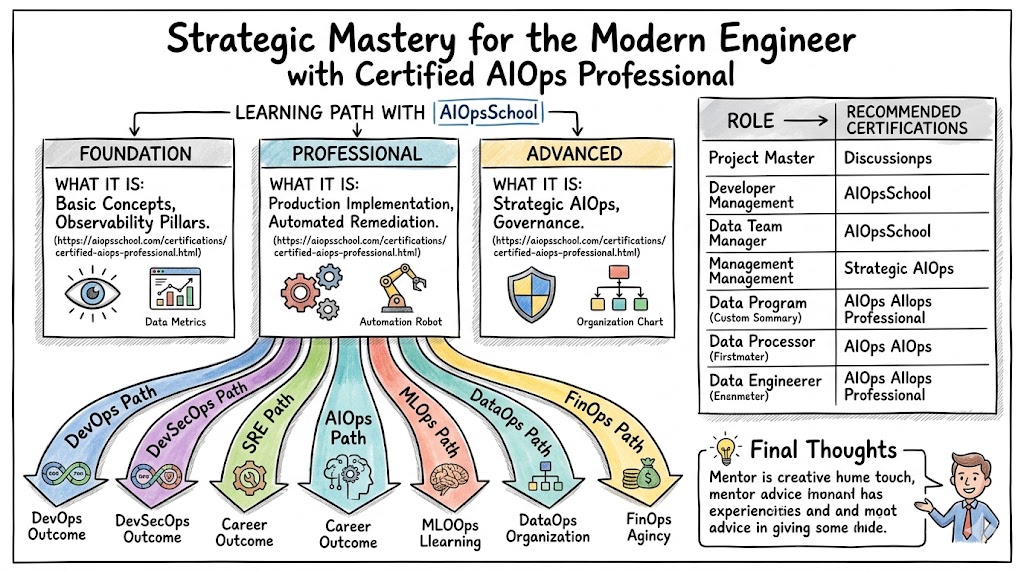
Professionals can choose from three distinct tiers: Foundation, Professional, and Advanced. The Foundation level establishes a basic understanding of data types and the fundamental principles of intelligent monitoring. Those at the Professional level dive deeper into specific engineering implementations and automated workflows. The Advanced level prepares senior staff for architectural design and organization-wide governance. Each tier maps directly to professional milestones, allowing for a logical and steady career progression.
Complete Certified AIOps Professional Certification Table
| Track | Level | Who it’s for | Prerequisites | Skills Covered | Recommended Order |
| Operations | Foundation | Aspiring Engineers | Basic Cloud Knowledge | Data Streams, Metrics | 1 |
| Automation | Professional | SREs & DevOps | Python & Monitoring | Anomaly Detection | 2 |
| Strategy | Advanced | Architects/Leads | Professional Cert | Governance, Scaling | 3 |
Detailed Guide for Each Certified AIOps Professional Certification
Certified AIOps Professional – Foundation
What it is
This certification validates a professional’s grasp of basic AIOps concepts and the core pillars of modern observability. It ensures the candidate understands the difference between simple automation and intelligent system management.
Who should take it
Junior engineers, recent graduates, or non-technical managers should pursue this to build a solid conceptual foundation. It serves as the perfect starting point for anyone entering the world of AI-driven IT.
Skills you’ll gain
- Mastery of telemetry and log data types
- Understanding noise reduction in alerting systems
- Knowledge of the intelligent operations lifecycle
- Basic principles of system anomaly detection
Real-world projects you should be able to do
- Create a foundational monitoring dashboard for a small app
- Organize system logs for future machine learning analysis
- Outline a basic AIOps integration plan for a team
Preparation plan
- 7–14 days: Study core definitions and review industry case studies.
- 30 days: Familiarize yourself with basic data formats and observability tools.
- 60 days: This level typically requires less than 30 days for most IT professionals.
Common mistakes
- Focusing too much on specific tool features instead of the underlying concepts.
- Neglecting the importance of high-quality data at the ingestion stage.
Best next certification after this
- Same-track option: Certified AIOps Professional – Professional level.
- Cross-track option: Certified Cloud Practitioner.
- Leadership option: ITIL v4 Foundation.
Certified AIOps Professional – Professional
What it is
This advanced tier confirms your ability to design and implement machine learning models within a live production environment. It proves you can solve complex operational problems using automated, intelligent workflows.
Who should take it
DevOps engineers and SREs who want to eliminate manual toil from their daily routines should aim for this. It requires a solid background in infrastructure management and scripting.
Skills you’ll gain
- Developing automated incident response scripts
- Creating predictive models for infrastructure scaling
- Integrating AI toolsets into existing monitoring stacks
- Analyzing log patterns using advanced clustering techniques
Real-world projects you should be able to do
- Build a self-healing system that restarts services based on predictive data.
- Implement an alert correlation engine across microservices.
- Design a dashboard that forecasts infrastructure capacity needs.
Preparation plan
- 7–14 days: Focus on intensive laboratory exercises and API integrations.
- 30 days: Master Python for data analysis and statistical processing.
- 60 days: Complete a full-scale project simulation in a staging environment.
Common mistakes
- Overlooking the potential for “model drift” in a dynamic environment.
- Creating overly complex models for simple operational tasks.
Best next certification after this
- Same-track option: Certified AIOps Professional – Expert level.
- Cross-track option: MLOps Engineering Certification.
- Leadership option: Technical Program Management.
Choose Your Learning Path
DevOps Path
Engineering teams use this path to inject intelligence into every stage of the software delivery lifecycle. You learn how to predict deployment failures and optimize build pipelines through automated data analysis. This shift transforms standard DevOps into a more resilient and self-correcting process. It focuses heavily on improving release velocity while maintaining high stability.
DevSecOps Path
Security professionals follow this path to enhance their threat detection capabilities through machine learning. You learn to identify subtle patterns in user behavior that signal a potential security breach. This approach allows teams to manage the massive influx of security logs with high precision. It bridges the gap between rapid development and robust, intelligent security protocols.
SRE Path
Reliability engineers prioritize this path to maintain service level objectives using predictive analytics. You focus on automating away the manual tasks that slow down system recovery. By using AI, you can forecast potential failures and intervene before users experience any service degradation. This path remains the most technically demanding, emphasizing absolute system uptime.
AIOps Path
This core path focuses on the actual architecture of an intelligent operations platform. You study the data pipelines and storage requirements necessary to support high-velocity telemetry. It prepares you to build the internal tools that power an entire organization’s automation strategy. This track emphasizes the technical scalability and robustness of the AIOps engine.
MLOps Path
Operations experts use this path to manage the lifecycle of machine learning models in production. You learn how to monitor model performance, handle versioning, and automate retraining cycles. This is vital for any company that relies on AI for its customer-facing products. It ensures that your intelligence remains accurate and reliable over long periods.
DataOps Path
Data specialists choose this track to ensure the integrity of the information feeding the AI models. You learn how to treat data as code, applying rigorous testing and versioning to every stream. Clean data is the lifeblood of AIOps, making this role essential for any successful implementation. This path focuses on building high-quality, reliable data delivery pipelines.
FinOps Path
Financial operators apply AIOps principles to manage and optimize cloud expenditures. You use predictive modeling to identify wasteful spending and forecast future cloud bills with high accuracy. AI discovers hidden patterns in resource usage that humans typically overlook, leading to significant savings. This path is critical for companies looking to maximize their cloud investment.
Role → Recommended Certified AIOps Professional Certifications
| Role | Recommended Certifications |
| DevOps Engineer | Certified AIOps Professional – Engineering Track |
| SRE | Certified AIOps Professional – Reliability Track |
| Platform Engineer | Certified AIOps Professional – Infrastructure Track |
| Cloud Engineer | Certified AIOps Professional – Cloud Track |
| Security Engineer | Certified AIOps Professional – Security Track |
| Data Engineer | Certified AIOps Professional – Data Track |
| FinOps Practitioner | Certified AIOps Professional – Finance Track |
| Engineering Manager | Certified AIOps Professional – Strategic Track |
Next Certifications to Take After Certified AIOps Professional
Same Track Progression
Mastering the professional level naturally leads toward the Expert or Master certifications within the same field. These advanced designations focus on the overarching architecture and data strategy of an entire enterprise. Deep specialization allows you to become a leading authority on self-healing infrastructure. You will likely lead large-scale transitions to intelligent operations for major tech firms.
Cross-Track Expansion
Moving into adjacent fields like MLOps or FinOps broadens your professional versatility. Understanding the financial implications of your technical decisions makes you a more valuable asset to the business. This cross-training allows you to collaborate effectively with diverse departments, from data science to finance. It prepares you for high-level roles that require a holistic view of the company’s technology.
Leadership & Management Track
Engineers looking to transition into management should pursue leadership-focused credentials. These roles involve setting the vision for the platform and managing high-performing engineering teams. You shift your focus from the technical implementation to the broader business value and strategic goals. Certifications in executive leadership or project management complement your deep technical foundation in AIOps.
Training & Certification Support Providers for Certified AIOps Professional
DevOpsSchool
This provider delivers high-quality training focused on the practical integration of AI within modern DevOps pipelines. They offer immersive lab experiences that help engineers apply their learning to production scenarios immediately.
Cotocus
This group specializes in advanced consulting and technical training for senior-level engineering professionals. They provide in-depth sessions that explore the most complex aspects of artificial intelligence in operations.
Scmgalaxy
As a long-standing community platform, this provider offers a wealth of resources on configuration management and automation. They provide excellent study guides and technical documentation for certification candidates.
BestDevOps
This training center focuses on delivering practical, job-ready skills for the modern cloud landscape. Their courses prioritize real-world application over theoretical knowledge to ensure you can perform on day one.
devsecopsschool.com
This school focuses exclusively on the security layer of the automated pipeline. They teach you how to use AI to hunt for threats and protect your infrastructure from sophisticated attacks.
sreschool.com
Site reliability engineers find everything they need here to master the art of system resilience. The curriculum emphasizes the use of AI to maintain high availability and reduce operational toil.
aiopsschool.com
As the official host of the certification, this site offers the most direct path to professional recognition. Their expert-led modules cover every aspect of the AIOps lifecycle in great detail.
dataopsschool.com
This institution focuses on the vital data pipelines that power every intelligent system. They ensure you can manage, clean, and govern the data required for successful AI operations.
finopsschool.com
Financial accountability in the cloud is the primary focus of this training provider. They teach you how to use predictive analytics to keep cloud costs under strict control.
Frequently Asked Questions
- How hard is the final exam for this certification?
While the foundation level is accessible, the professional level requires significant hands-on experience and a strong grasp of scripting. - What time commitment should I expect for preparation?
Plan for roughly 40 to 60 hours of study and practical lab work to feel fully prepared for the professional exam. - Are there any mandatory prerequisites for the professional level?
While not always mandatory, having a foundation-level certificate or equivalent industry experience ensures a much higher success rate. - Does this certification increase my salary potential?
Yes, professionals with AIOps expertise are currently in high demand and often receive significantly higher compensation packages. - Which path should a traditional system admin follow?
A system administrator should start with the Foundation track and then move into the SRE or Operations path. - Are the exams based on specific software vendors?
No, the exams focus on vendor-neutral principles, although you will use popular industry tools during the practical lab sections. - Do I need a background in data science?
You do not need to be a data scientist, but understanding how data feeds into models is helpful for the advanced tracks. - How often should I renew this certification?
Most engineering certifications require renewal every two or three years to stay current with the latest technological advancements. - Is this program suitable for remote learners?
Yes, the entire curriculum and the certification exam are available online for students and professionals worldwide. - What kind of coding languages will I use?
Python is the primary language used for AI and automation tasks, though familiarity with Bash is also very helpful. - How does this certification help my organization?
It provides your company with the expertise needed to reduce downtime, automate repetitive tasks, and lower overall operational costs. - Is there a global recognition for these credentials?
The program follows international standards, making the certification highly respected by technology companies in India and globally.
FAQs on Certified AIOps Professional
- Does the Certified AIOps Professional program improve my troubleshooting skills?
It gives you the tools to analyze massive datasets instantly, allowing you to find the root cause of issues much faster. This efficiency is highly valued in high-pressure production environments. - Can I access the course materials after the exam?
Most providers offer ongoing access to their platforms, allowing you to stay updated on new tools and methodologies as they emerge. - What is the focus of the practical labs?
The labs focus on real-world scenarios like alert correlation, anomaly detection in logs, and automating responses to common infrastructure failures. - Is there an emphasis on cloud-native technologies?
Yes, the certification focuses heavily on Kubernetes, microservices, and hybrid-cloud environments where AIOps is most effective. - Does the exam test my ability to manage costs?
The FinOps track specifically addresses cost management, while the general professional exam touches on resource optimization and efficiency. - How does the certification stay relevant?
Industry experts and active practitioners regularly review and update the content to reflect the latest trends in AI and operations. - Is there a support group for students?
AIOpsSchool and other providers host active forums and communities where you can ask questions and collaborate with other candidates. - What is the format of the professional exam?
The exam usually combines multiple-choice questions with practical, performance-based tasks in a simulated lab environment.
Final Thoughts: Is Certified AIOps Professional Worth It?
Mastering intelligent operations is no longer optional for engineers who want to stay at the top of their field. The Certified AIOps Professional designation provides the structure and credibility you need to lead these initiatives in any organization. You gain a deep understanding of how to turn overwhelming data into a strategic advantage for your team. This certification represents a long-term investment in your technical capability and your future career growth. Choosing this path demonstrates your commitment to the cutting edge of engineering excellence and proactive system management.