Introduction
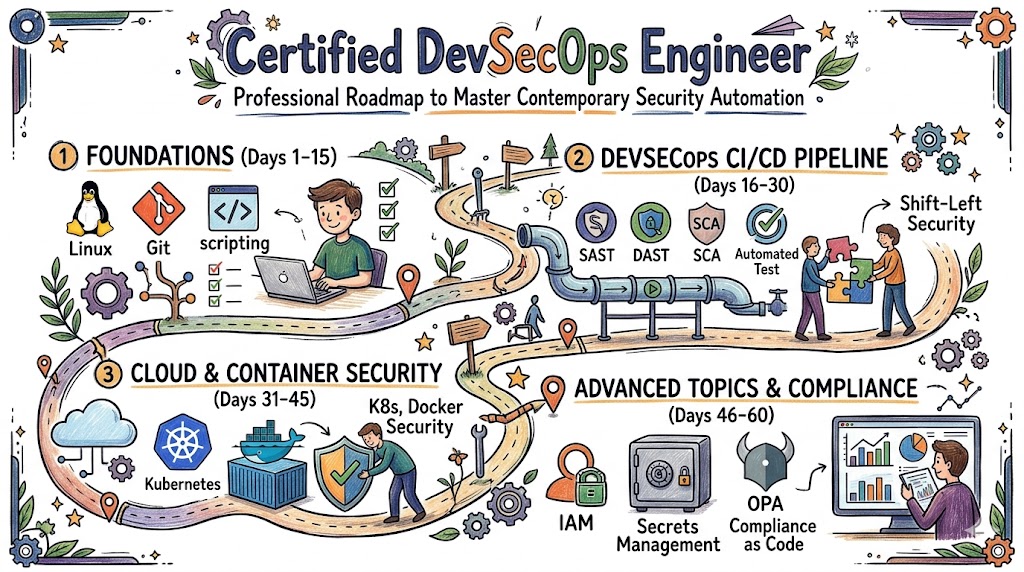
Technology leaders now recognize that traditional security checks cannot keep pace with rapid deployment cycles, making the Certified DevSecOps Engineer a critical asset for any engineering team. This comprehensive guide details how professionals can successfully integrate automated defense mechanisms into their software delivery workflows. By leveraging the expertise found at DevSecOpsschool, practitioners learn to identify risks early, reducing the cost and impact of potential breaches. We will explore how this certification path prepares you to build resilient, cloud-native systems that prioritize safety without sacrificing velocity.
What is the Certified DevSecOps Engineer?
The Certified DevSecOps Engineer represents a shift in engineering philosophy that places security at the heart of the development lifecycle. It exists to validate that an individual can move beyond manual audits to create automated security guardrails within a CI/CD pipeline. This designation emphasizes practical skills over abstract theory, focusing on how to harden containers, secure secrets, and automate compliance. It aligns perfectly with modern enterprise needs for immutable infrastructure and continuous security monitoring in production environments.
Who Should Pursue Certified DevSecOps Engineer?
Site Reliability Engineers, cloud architects, and software developers who want to take ownership of their application’s security posture will find this path invaluable. Security professionals who wish to master automation and engineering managers aiming to lower organizational risk also gain immense benefits. In the competitive tech markets across India and the globe, these skills help engineers stand out as versatile, high-impact contributors. Whether you are a newcomer to automation or a veteran systems administrator, this track provides a structured way to modernize your skill set.
Why Certified DevSecOps Engineer is Valuable and Beyond
Enterprises continue to accelerate their digital transformations, which ensures the long-term relevance of engineers who can automate security governance. This certification offers a massive return on investment because it teaches universal methodologies that adapt to any cloud provider or toolchain. It helps you stay competitive in a job market that increasingly demands “T-shaped” skills—deep technical expertise combined with a broad understanding of security. Holding this credential proves your ability to protect the business while supporting rapid innovation.
Certified DevSecOps Engineer Certification Overview
Candidates access the learning materials via the official course URL and complete their journey on the DevSecOpsschool hosting site. The program utilizes a project-based approach to ensure that every participant can handle the pressure of securing real-world production systems. It breaks down complex security concepts into manageable technical modules, covering everything from source code analysis to runtime protection. This structure ensures that graduates possess the confidence to lead security initiatives within their own organizations.
Certified DevSecOps Engineer Certification Tracks & Levels
The program offers three distinct tiers—Foundation, Professional, and Advanced—to match various career stages and goals. The Foundation level focuses on building a security-first culture, while the Professional level dives into the technical details of pipeline integration. Those who reach the Advanced level focus on enterprise-wide architecture and automated policy enforcement. These tiers provide a logical progression, helping you grow from a security-aware developer to a senior security architect.
Complete Certified DevSecOps Engineer Certification Table
| Track | Level | Who it’s for | Prerequisites | Skills Covered | Recommended Order |
| Security Ops | Foundation | Junior Engineers | Basic IT Knowledge | SCA, Secret Scanning | 1 |
| Pipeline Sec | Professional | DevOps / SREs | Foundation | SAST, DAST, Containers | 2 |
| Architecture | Advanced | Lead Architects | Professional | Policy as Code, OPA | 3 |
Detailed Guide for Each Certified DevSecOps Engineer Certification
Certified DevSecOps Engineer – Foundation
What it is
This certification confirms your mastery of the essential concepts that drive the DevSecOps movement today. It establishes a baseline for understanding how security and development teams can collaborate more effectively.
Who should take it
Aspiring cloud engineers and system administrators who want to build a career in secure automation should start here. It serves as the perfect entry point for those transitioning from traditional IT roles.
Skills you’ll gain
- Understanding the “Shift Left” security philosophy.
- Using SCA tools to identify vulnerable libraries.
- Managing secrets and preventing Git leaks.
- Building a collaborative security culture.
Real-world projects you should be able to do
- Audit a basic web application for open-source vulnerabilities.
- Implement a pre-commit hook that scans for API keys.
- Define a secure communication plan for cross-functional teams.
Preparation plan
- 7–14 days: Review core definitions and the cultural goals of DevSecOps.
- 30 days: Complete the introductory hands-on labs and tool setups.
- 60 days: Most candidates finish this level within two months of part-time study.
Common mistakes
- Ignoring the cultural aspect of the role to focus only on scripts.
- Failing to understand the basic software development lifecycle.
Best next certification after this
- Same-track option: Professional DevSecOps Engineer.
- Cross-track option: SRE Foundation.
- Leadership option: DevOps Manager.
Certified DevSecOps Engineer – Professional
What it is
The Professional tier validates your ability to build and maintain sophisticated security pipelines in the cloud. It focuses on the technical integration of automated scanners within high-velocity deployment cycles.
Who should take it
Current DevOps practitioners and security engineers who manage production infrastructure should pursue this level. It requires a working knowledge of Docker, Kubernetes, and CI/CD tools.
Skills you’ll gain
- Advanced SAST and DAST pipeline integration.
- Hardening container images and orchestration platforms.
- Implementing automated runtime security monitoring.
- Managing vulnerability remediation at scale.
Real-world projects you should be able to do
- Create a GitLab or Jenkins pipeline that blocks insecure code automatically.
- Design a hardened base image for an enterprise microservice.
- Automate web application security testing for dynamic environments.
Preparation plan
- 7–14 days: Study the integration patterns for security APIs and webhooks.
- 30 days: Spend significant time building end-to-end secure pipelines.
- 60 days: Master the nuances of container security and runtime defense.
Common mistakes
- Setting up security blocks that generate too many false positives.
- Neglecting the security of the infrastructure-as-code templates.
Best next certification after this
- Same-track option: Advanced DevSecOps Architect.
- Cross-track option: Cloud Security Professional.
- Leadership option: DevSecOps Lead.
Certified DevSecOps Engineer – Advanced
What it is
This certification recognizes experts who can design and manage security governance for large organizations. It emphasizes strategic risk management, compliance-as-code, and enterprise-scale architecture.
Who should take it
Senior architects and technical directors who oversee multiple teams or multi-cloud environments should take this course. It is for those who set the security standards for the entire company.
Skills you’ll gain
- Automating compliance audits using policy engines.
- Advanced threat modeling for distributed systems.
- Designing Zero Trust security frameworks.
- Orchestrating automated security incident responses.
Real-world projects you should be able to do
- Design a multi-cloud security governance model for a global firm.
- Automate the auditing of major regulations like PCI-DSS or GDPR.
- Develop a proactive threat modeling strategy for microservices.
Preparation plan
- 7–14 days: Research enterprise compliance and policy-as-code frameworks.
- 30 days: Practice designing complex architectures and writing policy code.
- 60 days: Master the implementation of Zero Trust and automated response.
Common mistakes
- Relying too heavily on a single cloud provider’s proprietary tools.
- Overlooking the cost impact of complex security architectural choices.
Best next certification after this
- Same-track option: Security Governance Specialist.
- Cross-track option: FinOps Practitioner.
- Leadership option: CISO / Technical Director.
Choose Your Learning Path
DevOps Path
The DevOps path focuses on making security a natural extension of the delivery process. You will learn to add automated security checks into existing CI/CD workflows so that developers get immediate feedback. This approach ensures that you maintain speed while significantly reducing the risk of a breach.
DevSecOps Path
Candidates on this path focus exclusively on becoming security automation experts. You will spend your time mastering vulnerability management, automated compliance, and runtime protection. This path prepares you to lead security-oriented engineering teams in complex enterprise environments.
SRE Path
Site Reliability Engineers use this path to ensure that security issues do not compromise system availability. You will focus on hardening infrastructure and creating automated responses to security failures. This approach treats security as a fundamental pillar of overall system reliability.
AIOps Path
Professionals in the AIOps section explore how machine learning can enhance security operations. You will learn to use AI models to detect patterns of abnormal behavior that might signify a sophisticated attack. This path prepares you for the future of intelligent, self-healing security.
MLOps Path
Securing the machine learning lifecycle requires protecting both the data and the trained models. This path teaches you how to prevent model poisoning and ensure that AI deployments remain compliant with privacy laws. You will focus on the unique security challenges of the AI world.
DataOps Path
Data engineers use this specialization to protect sensitive information throughout its lifecycle. You will focus on automating data masking, encryption, and access control within large-scale data pipelines. This ensures that your organization remains compliant while leveraging data for insights.
FinOps Path
The FinOps path explores the cost of security and how to optimize defense spending. You will learn to evaluate the ROI of various security tools and ensure that automated guardrails do not lead to unnecessary cloud expenses. This path creates a cost-aware security leader.
Role → Recommended Certified DevSecOps Engineer Certifications
| Role | Recommended Certifications |
| DevOps Engineer | Foundation + Professional |
| SRE | Professional + Advanced |
| Platform Engineer | Professional + Advanced |
| Cloud Engineer | Foundation + Professional |
| Security Engineer | Professional + Advanced |
| Data Engineer | Foundation + DataOps Track |
| FinOps Practitioner | Foundation + FinOps Track |
| Engineering Manager | Foundation |
Next Certifications to Take After Certified DevSecOps Engineer
Same Track Progression
Continuous learning in this field often leads to specialized certifications in container security or serverless defense. You can also explore expert-level courses that focus on specific industry regulations like HIPAA or advanced penetration testing automation.
Cross-Track Expansion
Gaining expertise in SRE or FinOps makes you a much more versatile platform leader. When you understand how security impacts both system reliability and the company’s bottom line, you become a much more effective decision-maker in any organization.
Leadership & Management Track
For those aiming for executive roles, certifications in technical management and governance are essential. These programs help you shift your focus from managing technical tasks to leading the entire security strategy for an enterprise.
Training & Certification Support Providers for Certified DevSecOps Engineer
DevOpsSchool offers an extensive range of hands-on sessions and resources for engineers seeking technical excellence. Their curriculum focuses on real-world scenarios that allow students to implement security automation immediately in their jobs.
Cotocus provides specialized training in cloud-native technologies, emphasizing the security needs of Kubernetes and Docker environments. Their approach helps engineers master the complexities of modern infrastructure defense.
Scmgalaxy remains a top community and training hub for configuration management and CI/CD security. They offer a wealth of free and paid resources that support practitioners at every career level.
BestDevOps focuses on practical coaching that helps teams transition from manual security audits to automated DevSecOps workflows. Their trainers provide deep insights based on years of industry-leading experience.
Devsecopsschool.com serves as the primary home for these certifications, offering a direct and structured path to becoming a security automation expert. They cover the entire spectrum of secure engineering.
Sreschool.com teaches engineers how to maintain high availability through robust security and reliability practices. Their training ensures that your systems remain safe from both outages and attacks.
Aiopsschool.com leads the way in teaching the application of artificial intelligence to IT operations and security. Their courses prepare you for a future where AI handles the bulk of threat detection.
Dataopsschool.com focuses specifically on the security and efficiency of data pipelines. Their programs help data engineers protect sensitive information throughout the entire analytics lifecycle.
Finopsschool.com addresses the intersection of cloud costs and operational security. Their training helps you build a secure infrastructure that remains financially sustainable and optimized.
Frequently Asked Questions (General)
- How difficult is the Certified DevSecOps Engineer exam?
Most candidates find the exam moderately challenging because it focuses on the practical application of tools rather than simple theory.
- How much time do I need for preparation?
Most professionals successfully prepare for the exam within 30 to 60 days of focused study.
- Do I need a security background to begin?
No, the Foundation level covers the necessary basics, though a general understanding of IT operations helps immensely.
- Will this certification increase my salary?
Most graduates report a significant boost in earnings, as DevSecOps remains one of the highest-paying domains in the global tech market.
- Is it mandatory to start with the Foundation level?
While not strictly mandatory for veterans, starting with the Foundation level ensures you have the correct cultural mindset for higher levels.
- Are these certifications recognized globally?
Yes, the program follows international industry standards and is recognized by technology companies worldwide.
- Does the program include hands-on labs?
Yes, practical labs are a core component, as the goal is to validate real-world engineering skills.
- How often must I renew the certification?
Holders typically need to refresh their credentials every few years to keep up with the fast-moving security landscape.
- What tools will I learn during the course?
The curriculum covers a wide range of tools, including Jenkins, GitLab, SonarQube, Vault, Docker, and various security scanners.
- Is this path suitable for engineering managers?
Yes, the Foundation level is excellent for managers who need to lead DevSecOps transformations.
- How does this differ from traditional cybersecurity courses?
This program focuses on automating security within the delivery pipeline, whereas traditional courses often focus on manual audits.
- Can I find a community of other learners?
Yes, most students gain access to forums and groups where they can collaborate and share insights.
FAQs on Certified DevSecOps Engineer
- Does the course cover security for cloud-native apps?
Yes, it focuses heavily on modern technologies like Kubernetes, Docker, and serverless security.
- What is the focus of the Professional exam?
The Professional level tests your ability to technically integrate and automate security tools within a CI/CD pipeline.
- Will I learn about Compliance as Code?
Yes, the Advanced level teaches you how to use policy engines to automate and enforce compliance standards.
- Is programming knowledge required for the exams?
While you don’t need to be a developer, basic scripting skills in Python or Bash will help you significantly.
- Does the course address security for microservices?
Yes, securing microservices and their internal communications is a major component of the Professional and Advanced tracks.
- Are the labs accessible on all operating systems?
Most labs run in cloud-based or web environments, making them accessible from any standard operating system.
- What kind of support is available if I get stuck?
Students usually receive guidance from experienced mentors and access to a technical support team.
- Can this help me move into a Lead Engineer role?
Absolutely, the combination of security and automation expertise is a primary requirement for most modern lead and architect roles.
Final Thoughts: Is Certified DevSecOps Engineer Worth It?
Investing in this credential marks a proactive commitment to one of the most critical challenges in the modern tech landscape. The Certified DevSecOps Engineer program provides more than just a certificate; it gives you the practical toolkit to solve real-world security bottlenecks. As companies continue to accelerate their release cycles, the demand for engineers who can automate safety will only grow. If you want to future-proof your career and lead the charge in creating secure, reliable software, this certification is a strategic and rewarding investment. It represents the transition from being a traditional engineer to becoming a modern architect of secure digital ecosystems.