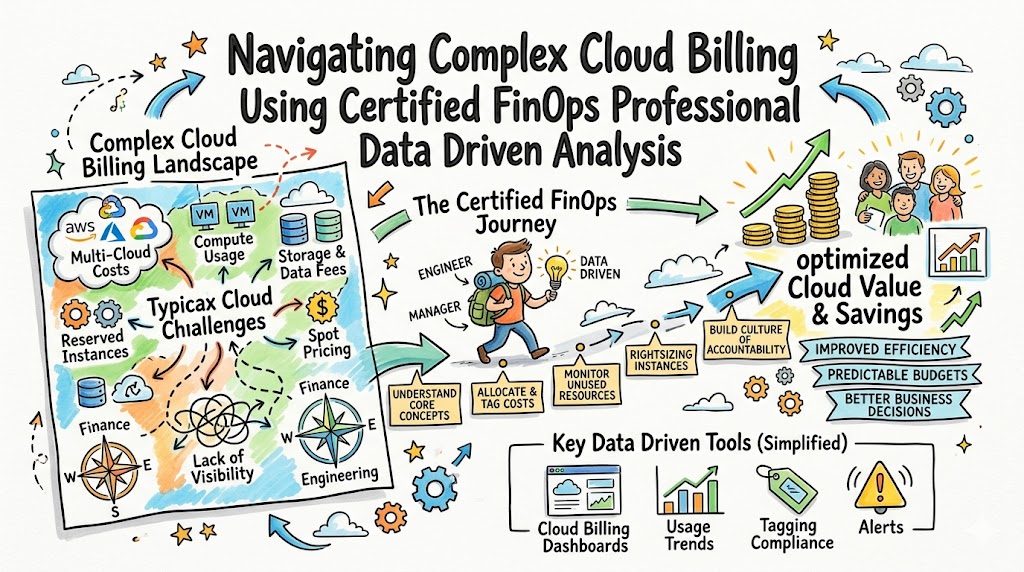
Cloud financial management has evolved into a cornerstone of modern infrastructure strategy for every scaling enterprise. Professionals who pursue the Certified FinOps Professional designation at FinOpsSchool demonstrate a mastery of bridging the gap between engineering velocity and financial accountability. This guide provides a comprehensive roadmap for DevOps, SRE, and platform engineers looking to integrate cost-optimization into their technical workflows. By following this structured path, technical leaders can ensure their organizations maximize cloud value while maintaining high-speed delivery cycles.
Introduction
The cloud computing landscape has shifted from simple migration to complex optimization where cost is now a primary architectural constraint. Consequently, understanding cloud economics is no longer just a task for finance teams but a vital skill for every modern engineer. This guide serves as a career manual for professionals aiming to master the intersection of finance and engineering through specialized certification. By reading this analysis, you will understand how to navigate the various learning levels and apply these principles to real-world cloud environments. Ultimately, this resource helps you decide which path aligns best with your current role and long-term career aspirations in the cloud-native ecosystem.
What is the Certified FinOps Professional?
This certification represents a deep technical and operational commitment to the practice of cloud financial management within a production environment. It exists to standardize how organizations calculate, monitor, and optimize their cloud spend without sacrificing the agility provided by DevOps. Unlike theoretical frameworks, this program focuses on the practical application of the inform, optimize, and operate phases of the lifecycle. It aligns perfectly with enterprise needs for engineers who can build scalable systems while remaining fiscally responsible and transparent.
Who Should Pursue Certified FinOps Professional?
Engineers and SREs who manage large-scale cloud footprints will find this certification indispensable for career growth and organizational impact. Similarly, cloud architects and engineering managers need these skills to justify infrastructure investments and lead cross-functional teams effectively. In the Indian market and across the global tech sector, there is a massive surge in demand for professionals who can speak both “code” and “capital.” Whether you are a beginner looking to differentiate your profile or a senior leader managing multi-million dollar budgets, this certification provides the necessary framework.
Why Certified FinOps Professional is Valuable and Beyond
The longevity of this certification is rooted in the permanent shift toward multi-cloud and hybrid cloud architectures across all major industries. As enterprises move past the initial cloud-adoption phase, they prioritize efficiency and unit economics over raw resource consumption. This skill set remains relevant despite changes in specific cloud providers or tools because it focuses on universal cultural and analytical principles. Professionals who master these concepts see a significant return on investment through increased organizational influence and better-compensated roles.
Certified FinOps Professional Certification Overview
The program is delivered via the official portal and hosted on the specialized website. It utilizes a multi-tiered assessment approach that tests both conceptual knowledge and the ability to solve practical financial challenges. The structure is designed to provide ownership of the cloud spend process to the engineering teams who actually provision the resources. By focusing on practical outcomes, the certification ensures that practitioners can immediately implement tagging policies, anomaly detection, and commitment-based discounts.
Certified FinOps Professional Certification Tracks & Levels
The certification is structured into foundation, professional, and advanced levels to cater to different stages of a professional career. The foundation level introduces the core vocabulary and the three-phase lifecycle, making it ideal for those new to the domain. The professional level dives deep into complex scenarios like container cost allocation and shared service modeling for SRE and DevOps tracks. Finally, the advanced level prepares practitioners for leadership roles where they design global FinOps strategies and drive cultural change across entire business units.
Complete Certified FinOps Professional Certification Table
| Track | Level | Who it’s for | Prerequisites | Skills Covered | Recommended Order |
| Core FinOps | Foundation | Beginners/Managers | Basic Cloud Knowledge | Vocabulary, Lifecycle | First |
| Engineering | Professional | SREs/DevOps | Foundation Cert | Cost Allocation, Tooling | Second |
| Operations | Professional | Cloud Ops/Finance | 2+ Years Experience | Governance, Budgeting | Second |
| Strategic | Advanced | Directors/Principals | Professional Cert | Policy Design, Culture | Third |
Detailed Guide for Each Certified FinOps Professional Certification
Certified FinOps Professional – Foundation Level
What it is
This level validates a basic understanding of the cloud financial management principles and the cultural shift required for success. It ensures that everyone in the organization uses a common language when discussing cloud costs and value.
Who should take it
This is suitable for junior cloud engineers, procurement officers, and non-technical managers who interact with cloud billing. It serves as the essential first step for anyone entering the domain.
Skills you’ll gain
- Understanding the three phases of the cloud financial lifecycle.
- Identifying the different personas involved in a cloud cost center.
- Mapping cloud billing data to business units and projects.
Real-world projects you should be able to do
- Creating a basic tagging compliance report for a small environment.
- Identifying obvious waste in a single-cloud billing export.
Preparation plan
The 7–14 day strategy involves reviewing the core framework and taking practice quizzes to familiarize yourself with the terminology. For a 30-day plan, spend an hour daily reading case studies on successful cloud cost migrations. A 60-day plan is recommended for those completely new to the cloud, allowing time to learn basic AWS or Azure billing concepts first.
Common mistakes
Candidates often fail by ignoring the “cultural” aspects of the framework and focusing only on the technical math. Another mistake is underestimating the importance of the specific definitions provided by the official body.
Best next certification after this
- Same-track: Certified FinOps Professional – Engineering
- Cross-track: Cloud Architect Associate
- Leadership: Engineering Management Certification
Certified FinOps Professional – Professional Level
What it is
This certification validates the ability to handle complex cost-management scenarios in a multi-cloud or containerized environment. It focuses on the “Optimize” and “Operate” phases where actual technical changes occur to save money.
Who should take it
Experienced SREs, DevOps engineers, and Cloud Architects who have direct control over infrastructure should take this. It requires an intent to drive technical efficiency at scale.
Skills you’ll gain
- Implementing automated rightsizing for compute and storage.
- Managing Kubernetes cost allocation and showback models.
- Designing commitment-based discount strategies like Savings Plans.
Real-world projects you should be able to do
- Building an automated dashboard that tracks unit costs for a microservice.
- Establishing an anomaly detection system that alerts on unexpected spend spikes.
Preparation plan
A 14-day plan is only for those already performing these tasks daily at work. The 30-day strategy involves deep dives into specific cloud provider pricing APIs and container monitoring tools. A 60-day strategy is best for engineers moving from a pure developer role into a platform or SRE position.
Common mistakes
The most common error is failing to understand how different cloud services (like Spot instances vs On-demand) impact the bottom line differently. Many also struggle with the mathematics of amortized vs unblended costs.
Best next certification after this
- Same-track: Advanced FinOps Strategy
- Cross-track: SRE Professional
- Leadership: Cloud Business Associate
Choose Your Learning Path
DevOps Path
In this path, the focus remains on integrating cost metrics directly into the CI/CD pipeline and developer workflows. Engineers learn to treat “cost” as a performance metric similar to latency or uptime during the deployment phase. This ensures that every piece of code pushed to production is already optimized for the most efficient resource utilization.
DevSecOps Path
Professionals here bridge the gap between security compliance and cost management, ensuring that security tools do not cause runaway expenses. They focus on the cost-efficiency of log retention, encryption overhead, and the financial impact of security scanning in the pipeline. This path teaches how to maintain a high security posture while adhering to strict cloud budgets.
SRE Path
The Site Reliability Engineering path focuses on the trade-off between reliability (SLIs/SLOs) and the cost of achieving that reliability. SREs use these skills to determine if the cost of an extra “nine” of availability is justified by the business value. They implement automated scaling and self-healing systems that optimize for both performance and price.
AIOps Path
This track utilizes machine learning models to predict future cloud spend and automate the detection of financial anomalies in real-time. Practitioners learn to build intelligent systems that can recommend specific purchasing strategies based on historical usage patterns. It is a highly data-driven approach to maintaining financial health across massive, complex infrastructures.
MLOps Path
MLOps professionals focus specifically on the high costs associated with training and deploying large-scale machine learning models and GPU resources. They learn to optimize data pipelines and model inference costs, which are often the most expensive parts of a modern cloud bill. This ensures that artificial intelligence initiatives remain profitable and sustainable for the long term.
DataOps Path
The DataOps path addresses the financial challenges of managing massive data lakes, warehouses, and the egress costs associated with data movement. Engineers learn to architect data flows that minimize latency and cost while maximizing the accessibility of information for the business. They focus on storage tiering strategies and the efficient processing of big data workloads.
FinOps Path
This is the dedicated path for those who want to become full-time practitioners or leads within a central cloud center of excellence. It covers the entire spectrum from technical implementation to high-level financial reporting and organizational change management. These professionals act as the primary liaison between the engineering, finance, and executive leadership teams.
Role → Recommended Certified FinOps Professional Certifications
| Role | Recommended Certifications |
| DevOps Engineer | FinOps Foundation + Engineering Professional |
| SRE | FinOps Engineering Professional + SRE Master |
| Platform Engineer | FinOps Professional + Cloud Architect |
| Cloud Engineer | FinOps Foundation + Cloud Provider Specialist |
| Security Engineer | FinOps Foundation + DevSecOps Specialist |
| Data Engineer | FinOps Professional + DataOps Core |
| FinOps Practitioner | Full Suite (Foundation, Professional, Advanced) |
| Engineering Manager | FinOps Foundation + Strategic Leadership |
Next Certifications to Take After Certified FinOps Professional
Same Track Progression
After achieving the professional level, individuals should seek the advanced certification to master the art of organizational influence. This involves learning how to build a “FinOps Center of Excellence” (CCoE) that spans across multiple business units. Deep specialization in a specific cloud provider’s advanced networking or data specialties also complements this track perfectly.
Cross-Track Expansion
Broadening your skills into SRE or DevSecOps allows you to apply financial principles to other critical domains of software delivery. Understanding how security policy affects cost or how reliability targets drive infrastructure spend makes you a much more versatile architect. This expansion ensures you can solve complex problems that require a holistic view of the entire technology stack.
Leadership & Management Track
For those looking to move into director or VP roles, focusing on business administration and strategic leadership is the logical next step. These certifications help you translate technical savings into business value that the C-suite can understand and support. It prepares you to manage large departmental budgets and lead cultural transformations across the enterprise.
Training & Certification Support Providers for Certified FinOps Professional
DevOpsSchool
This provider offers extensive hands-on labs and real-world scenarios that prepare students for the practical challenges of cloud cost management. Their curriculum is updated frequently to reflect the latest changes in cloud provider billing structures and industry best practices.
Cotocus
Focusing on high-level architectural integration, this organization helps senior engineers master the complexities of multi-cloud financial governance. They provide specialized mentoring for those looking to implement FinOps in large-scale enterprise environments with complex legacy requirements.
Scmgalaxy
Known for its community-driven approach, this platform provides a wealth of resources and study materials for aspiring practitioners. They emphasize the integration of version control and automation within the financial management lifecycle for better transparency.
BestDevOps
This training provider focuses on the “Operate” phase, teaching engineers how to build automated systems that monitor and correct spend. Their courses are designed to be highly interactive, ensuring that students can apply what they learn immediately.
devsecopsschool.com
They specialize in the intersection of security and finance, ensuring that your cost-saving measures do not introduce vulnerabilities into the infrastructure. Their training is essential for professionals working in highly regulated industries like finance or healthcare.
sreschool.com
This school focuses on the balance between system reliability and financial efficiency, providing the tools needed to manage high-availability systems. Their modules cover advanced topics like error budgets and the cost of downtime in great detail.
aiopsschool.com
Focusing on the future of automation, this provider teaches how to use artificial intelligence to manage cloud environments more effectively. Their curriculum includes predictive modeling and automated anomaly detection for complex cloud spend.
dataopsschool.com
They provide specialized training for managing the costs associated with large-scale data processing and storage. Their courses help data engineers build efficient pipelines that minimize egress fees and optimize storage costs.
finopsschool.com
As the primary host for this certification, they provide the most direct and authoritative path to mastering the domain. Their resources are the industry standard for anyone looking to build a serious career in cloud financial management.
Frequently Asked Questions (General)
- How difficult is the certification exam for a working engineer?The exam is moderately challenging as it requires a mix of technical knowledge and an understanding of financial terminology.
- How long does it typically take to prepare for the foundation level?Most professionals with cloud experience find that two to three weeks of focused study is sufficient for the foundation.
- Are there any mandatory prerequisites for the professional level?Yes, you generally need to have completed the foundation certification and have several months of hands-on experience.
- What is the typical return on investment for this certification?Professionals often see increased salary offers and higher visibility within their organizations due to the specialized nature of the skill.
- Does this certification cover only AWS or other clouds too?The framework is cloud-agnostic, meaning it applies to AWS, Azure, Google Cloud, and even on-premises private cloud environments.
- How often do I need to renew my certification?Most certifications in this domain require renewal or continuing education every two to three years to stay current.
- Is there a heavy focus on math and accounting?While some basic math is required for cost calculations, the focus is more on logic, architecture, and cultural processes.
- Can a non-technical person pass the professional level?It is difficult for non-technical individuals to pass the professional level without a deep understanding of cloud infrastructure.
- Which track is best for a junior DevOps engineer?The Engineering track is the most beneficial as it teaches the practical skills needed for daily resource optimization.
- How does this certification help with career progression?It positions you as a “Value Engineer,” a role that is increasingly critical for leadership positions in modern tech companies.
- Are the exams conducted online or at a testing center?The exams are typically available online through proctored platforms, providing flexibility for global candidates.
- Is there a community or forum for certified professionals?Yes, there is a large global community where practitioners share best practices, job opportunities, and new tool reviews.
FAQs on Certified FinOps Professional
- What makes the Certified FinOps Professional unique compared to cloud provider certs?Unlike provider-specific certs, this focuses on the business and cultural framework that works across any infrastructure.
- Does this certification cover Kubernetes and container costs?Yes, the professional level includes specific modules for managing the complexities of shared resources in containerized environments.
- How does FinOps integrate with the standard Scrum or Agile process?It introduces cost as a key part of the “Definition of Done” for new features and infrastructure changes.
- What tools are commonly used by certified professionals?Practitioners use a mix of native cloud tools, open-source projects like Kubecost, and enterprise-grade third-party platforms.
- How do I justify the cost of this certification to my manager?Emphasize that the skills learned will lead to immediate and measurable reductions in the company’s monthly cloud bill.
- Is there a focus on automated remediation in the exam?The professional levels definitely test your ability to design and implement automated responses to cost anomalies.
- How does the certification address multi-cloud environments?It provides a unified language and reporting structure that allows you to compare costs across different cloud vendors.
- Can I take the exam in languages other than English?Currently, the primary language for the exam and materials is English, given its status as the global tech standard.
Final Thoughts: Is Certified FinOps Professional Worth It?
Investing in this certification is a strategic move for any engineer who wants to remain relevant in a market that now demands financial accountability. The era of “unlimited cloud spend” is over, and companies are desperately looking for leaders who can deliver performance without breaking the bank. This program provides you with a clear, standardized framework to guide your organization through the complexities of modern cloud economics. By becoming certified, you prove that you possess the rare combination of technical depth and business acumen required for senior roles. It is not just about saving money; it is about maximizing the value of every dollar your organization spends in the cloud. Transitioning into a cost-aware culture is the next great challenge for DevOps, and this certification ensures you are prepared to lead that change.