Organizations today struggle to maintain service uptime while simultaneously pushing code at high velocity. The Certified Site Reliability Architect designation provides the technical blueprint for engineers who want to bridge this gap through sophisticated architectural design. This professional roadmap targets developers, cloud specialists, and platform leaders who seek to move beyond manual operations toward automated, self-healing systems. By engaging with the resources at Sreschool, you gain the specific skills required to lead digital transformation efforts and ensure your infrastructure meets the rigorous demands of global users.
What is the Certified Site Reliability Architect?
The Certified Site Reliability Architect stands as a premier validation of an engineer’s ability to build and sustain highly available distributed systems. It exists to move professionals away from theoretical knowledge toward production-ready expertise that addresses modern enterprise needs. Unlike general certifications, this program emphasizes a deep understanding of how systems behave under stress and how to engineer for reliability from the ground up. It aligns perfectly with the current industry shift toward platform engineering and resilient cloud-native architectures.
Who Should Pursue Certified Site Reliability Architect?
Experienced software engineers, SREs, and infrastructure architects find the most immediate value in this specialized certification. It also serves cloud security professionals and data engineers who must ensure their underlying systems remain stable during high-traffic events. Technical managers in India and across international markets use this framework to standardize reliability practices within their teams. Whether you are an individual contributor or a director, this path equips you with the authority to make critical architectural decisions.
Why Certified Site Reliability Architect is Valuable and Beyond
Modern enterprises face immense pressure to eliminate downtime, making the role of a reliability architect more critical than ever. This certification offers long-term career security by focusing on timeless architectural principles rather than the specific syntax of a single tool. As companies migrate to hybrid environments, the ability to design for reliability across diverse platforms remains a top-tier skill set. Investing in this knowledge ensures you remain a vital asset to your organization regardless of how the technology stack evolves.
Certified Site Reliability Architect Certification Overview
Candidates access the entire curriculum through the Sreschool platform, which manages the training delivery and official assessments. The program is hosted on their dedicated site and follows a rigorous testing methodology to ensure candidates can apply their skills to real-world infrastructure. Ownership of the program rests with industry veterans who constantly update the materials to reflect current observability and incident management trends. This practical approach ensures that the certification remains a trusted signal of quality in the competitive tech job market.
Certified Site Reliability Architect Certification Tracks & Levels
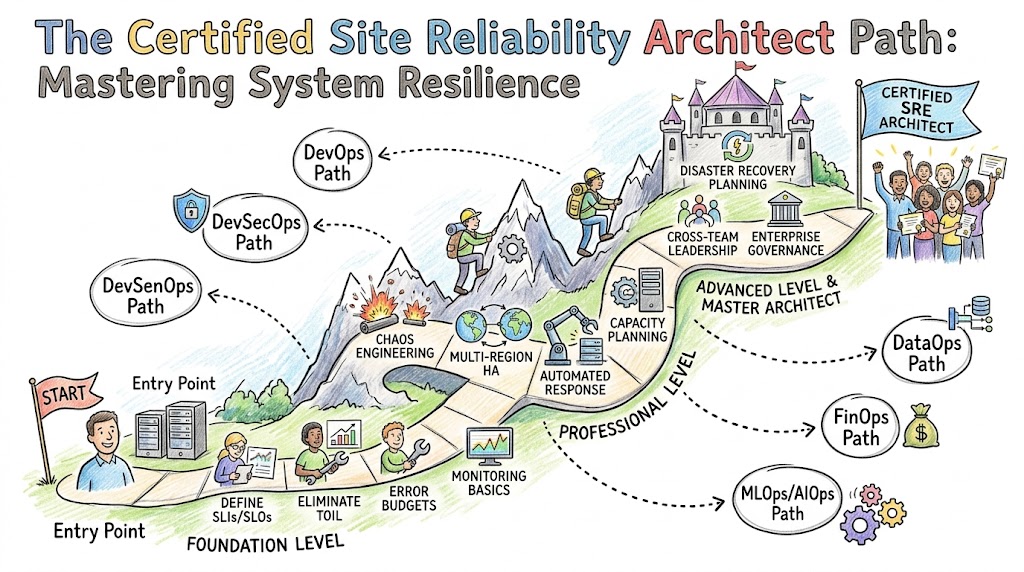
The program categorizes expertise into foundation, professional, and advanced levels to accommodate different career stages. Foundation levels introduce core concepts like error budgets, while the professional track dives into the mechanics of automated deployments and scaling. The advanced architect level challenges senior engineers to design end-to-end resilient ecosystems for mission-critical applications. These tracks mirror a natural career progression, moving a practitioner from operational tasks to high-level strategic system design.
Complete Certified Site Reliability Architect Certification Table
| Track | Level | Who it’s for | Prerequisites | Skills Covered | Recommended Order |
| Core SRE | Foundation | New Engineers | Cloud Basics | SLOs & SLIs | 1 |
| Engineering | Professional | SREs | 2+ Years Exp | IaC & CI/CD | 2 |
| Architecture | Advanced | Senior Leads | Professional Cert | System Design | 3 |
| Management | Leadership | Team Leads | SRE Foundation | Team Culture | 4 |
| Expert | Specialist | Principal Engineers | Advanced Cert | Chaos Engineering | 5 |
Detailed Guide for Each Certified Site Reliability Architect Certification
Certified Site Reliability Architect – Foundation
What it is
This certification confirms your mastery of essential reliability terminology and the shift in mindset required for site reliability engineering. It provides a solid base for understanding how to measure system health through meaningful metrics.
Who should take it
Aspiring DevOps professionals, system administrators, and university graduates should pursue this to build a career foundation. It serves as an entry point for anyone transitioning from traditional IT roles.
Skills you’ll gain
- Crafting Service Level Objectives
- Tracking Error Budgets
- Identifying and reducing Toil
- Participating in incident response
Real-world projects you should be able to do
- Design a monitoring dashboard for a basic web service.
- Perform a simple toil analysis for an operations team.
Preparation plan
- 7-14 Days: Study the core definitions and official study guides.
- 30 Days: Review case studies on reliability cultures.
- 60 Days: Generally unnecessary for this introductory level.
Common mistakes
- Ignoring the cultural pillars of SRE in favor of tool learning.
- Misunderstanding the difference between SLAs and SLOs.
Best next certification after this
- Same-track option: Professional SRE
- Cross-track option: Cloud Foundations
- Leadership option: Junior Team Lead
Certified Site Reliability Architect – Professional
What it is
The professional level validates your capability to implement reliability patterns in live production environments. It focuses on your ability to automate complex tasks and build systems that can withstand regional outages.
Who should take it
Active SREs and DevOps engineers with several years of experience will find this level most appropriate. It targets those responsible for the daily stability of enterprise-grade applications.
Skills you’ll gain
- Advanced Terraform and Ansible usage
- Implementing Full-Stack Observability
- Managing high-availability databases
- Capacity and cost forecasting
Real-world projects you should be able to do
- Architect a multi-region deployment pipeline with automated failover.
- Deploy a distributed tracing solution across a microservices cluster.
Preparation plan
- 7-14 Days: Focus on deep-dive infrastructure as code scenarios.
- 30 Days: Practice complex incident simulation and resolution.
- 60 Days: Complete advanced labs on distributed system design.
Common mistakes
- Over-engineering solutions that increase system complexity.
- Neglecting the security implications of automated infrastructure.
Best next certification after this
- Same-track option: Advanced Architect
- Cross-track option: DevSecOps Expert
- Leadership option: SRE Manager
Choose Your Learning Path
DevOps Path
The DevOps path emphasizes the acceleration of software delivery through high-quality automation and shared team goals. Engineers following this route master the tools and processes required to unify development and operations into a single cohesive unit. You will learn to build pipelines that handle everything from code commits to production monitoring without human intervention. This path suits those who enjoy optimizing workflows and improving developer productivity.
DevSecOps Path
Choosing the DevSecOps path means you prioritize security as an integral part of the delivery process rather than a final gate. Practitioners learn to embed automated security testing and compliance checks directly into their existing CI/CD pipelines. This ensures that every release remains secure while maintaining a high speed of deployment. It is a critical skill set for protecting modern applications against evolving cyber threats.
SRE Path
The SRE path focuses specifically on the engineering discipline of keeping large-scale systems operational and performant. You will apply software engineering principles to solve infrastructure problems and manage system health through rigorous data analysis. This path prepares you for high-stakes roles where you must balance the need for new features with the absolute requirement for uptime. It remains the gold standard for engineers at major global tech companies.
AIOps Path
Technicians on the AIOps path utilize artificial intelligence to manage the vast amount of telemetry data generated by modern systems. You will learn to deploy machine learning models that can predict failures and automate the root cause analysis process. This path is vital for organizations managing hyper-scale environments that exceed human monitoring capabilities. It requires a unique blend of data science and systems engineering knowledge.
MLOps Path
The MLOps path addresses the specific operational challenges of deploying machine learning models into production environments. You will learn to manage the entire model lifecycle, including data versioning, training automation, and model performance monitoring. This path ensures that ML-driven features are as reliable and scalable as the rest of the application. It is ideal for data engineers looking to master production stability.
DataOps Path
The DataOps path applies agile principles to the management of data pipelines and large-scale analytics platforms. Practitioners focus on improving the speed and accuracy of data delivery to business stakeholders through automated testing and integration. You will learn to build resilient data architectures that can handle schema shifts and varying data volumes. This path supports organizations that rely on real-time data for critical decision-making.
FinOps Path
The FinOps path centers on the financial accountability of cloud infrastructure and cost optimization strategies. You will learn how to align cloud spending with business value and identify opportunities for architectural cost savings. This path enables engineers to make smarter decisions about resource allocation and cloud provider selection. As infrastructure budgets grow, FinOps expertise becomes essential for engineering leadership.
Role → Recommended Certified Site Reliability Architect Certifications
| Role | Recommended Certifications |
| DevOps Engineer | SRE Foundation, Pipeline Specialist |
| SRE | Professional Architect, Advanced SRE |
| Platform Engineer | Infrastructure Specialist, SRE Professional |
| Cloud Engineer | Multi-Cloud Architect, Foundation Cert |
| Security Engineer | DevSecOps Specialist, SRE Foundation |
| Data Engineer | DataOps Professional, SRE Foundation |
| FinOps Practitioner | Cost Optimization, SRE Foundation |
| Engineering Manager | SRE Leadership, FinOps Foundation |
Next Certifications to Take After Certified Site Reliability Architect
Same Track Progression
Deepening your expertise within the site reliability track often involves moving toward the Master or Principal levels. These certifications signify your status as a global authority capable of defining industry standards and leading massive infrastructure projects. Achieving this level requires years of dedicated practice and a proven track record of maintaining massive, complex systems.
Cross-Track Expansion
Broadening your knowledge into related fields like DevSecOps or MLOps creates a more versatile professional profile. By understanding how reliability impacts security and data pipelines, you become a more effective collaborator in cross-functional teams. This horizontal growth is particularly valuable for those looking to advance into principal engineering roles.
Leadership & Management Track
Moving into leadership requires you to shift your focus from individual technical tasks to team strategy and cultural growth. Certifications in engineering management help you apply SRE principles at the organizational level, fostering a culture of shared responsibility and continuous improvement. This path prepares you for roles such as Head of Platform or VP of Engineering.
Training & Certification Support Providers for Certified Site Reliability Architect
DevOpsSchool
This provider delivers high-quality training programs that focus on the practical application of DevOps and SRE principles. They offer a hands-on learning environment where students work on real-world projects to build their technical confidence. Their expert instructors provide deep insights into the challenges faced by modern engineering teams.
Cotocus
A specialized training firm that helps organizations and individuals master cloud-native technologies and architectural resilience. They provide structured courses that simplify complex infrastructure concepts for engineers at all levels. Their curriculum ensures that participants can immediately implement reliability improvements in their own production environments.
Scmgalaxy
This community-driven platform serves as a massive repository of knowledge for software configuration and operations professionals. They provide extensive study materials, including tutorials and forums, to support candidates throughout their certification journey. It is an excellent resource for anyone looking for peer support and technical deep dives.
BestDevOps
Focusing on excellence in technical education, this provider offers targeted tracks for site reliability and platform engineering. They emphasize the bridge between culture and technology to achieve high system performance. Their training modules are designed for rapid skill acquisition and career growth.
devsecopsschool.com
This institution focuses specifically on the critical intersection of security and modern operations. They provide the training necessary to integrate defensive measures into every layer of the site reliability architect path. Their courses help engineers build systems that are both resilient and highly secure against modern threats.
sreschool.com
As the primary home for the reliability architect program, this site offers the most authoritative and comprehensive learning path available. They provide the official curriculum and practice assessments required to earn your professional credentials. Their community remains the best place to connect with other dedicated SRE practitioners.
aiopsschool.com
This school prepares engineers for the future of operations by teaching them to leverage artificial intelligence and machine learning. Their courses focus on using algorithmic insights to manage complex system telemetry and automate response protocols. It is a vital resource for those aiming to lead in the AIOps space.
dataopsschool.com
Specializing in the reliability and speed of data delivery, this provider helps data engineers adopt agile methodologies. They offer specialized training on building automated data pipelines that meet modern enterprise standards. Their focus ensures that data remains a reliable asset for the entire organization.
finopsschool.com
This provider teaches the essential skills of cloud financial management and architectural cost optimization. They empower engineers to take ownership of their cloud spend and drive better business outcomes. Their certifications are highly respected by companies looking to balance performance with fiscal responsibility.
Frequently Asked Questions
- What makes the Certified Site Reliability Architect exam unique?
The exam focuses heavily on your ability to solve production-level problems using architectural patterns rather than just memorizing tool syntax.
- How long should I study for the professional level?
We recommend at least 30 to 45 days of focused study, including several hands-on labs involving infrastructure automation.
- Does this certification help with career changes?
Yes, it provides the formal credentials needed to pivot from traditional system administration into high-demand SRE and DevOps roles.
- Is there a prerequisite for the management track?
While not mandatory, having the SRE Foundation certificate ensures you understand the technical language used by the teams you manage.
- Will this certification stay relevant as technology changes?
The program focuses on fundamental principles of distributed systems, which remain relevant even as specific tools and cloud providers evolve.
- Can I take the exam online?
Yes, Sreschool provides a secure online proctoring environment so you can complete your certification from anywhere in the world.
- How does the certification handle multi-cloud environments?
The curriculum teaches you how to design for reliability across AWS, Azure, and GCP using vendor-neutral architectural strategies.
- Are there practice exams available?
Official practice exams are provided through the learning platform to help you gauge your readiness for the final assessment.
- What is the pass mark for the assessments?
Candidates must typically score 70% or higher to demonstrate sufficient mastery of the architectural and operational concepts.
- Does the certification include chaos engineering?
Yes, the advanced levels introduce chaos engineering as a method for testing and improving system resilience under controlled failure conditions.
- How does this certification compare to cloud-provider certs?
This program is broader and focuses on the engineering discipline of reliability across any platform, rather than just one provider’s services.
- Who maintains the curriculum?
A group of experienced principal engineers and SRE leads constantly update the material to reflect current industry best practices.
FAQs on Certified Site Reliability Architect
- How do I start my journey as a Site Reliability Architect?
Mastering the foundation level allows you to understand core SRE principles before moving into professional roles to gain production experience.
- Why should I choose this over a general DevOps certificate?
Specifying in reliability offers a deeper focus on system design and uptime, which are high-priority needs for major global enterprises today.
- Does the architect path cover incident management?
Yes, the certification covers the entire lifecycle of an incident, from initial detection and response to automated post-mortem and final remediation.
- Is coding a requirement for this certification?
Understanding code is essential to automate infrastructure effectively and interpret application logs, even if you are not a full-time developer.
- How does this path benefit engineering managers?
Managers learn how to set realistic SLOs and foster a culture of blameless post-mortems, which improves team morale and system performance.
- Are the skills applicable to on-premises environments?
Principles like automation and monitoring apply equally to on-premises data centers as they do to modern public cloud environments and hybrid setups.
- What is the most difficult part of the exam?
Most candidates find the scenario-based architectural questions challenging because they require balancing competing business and technical priorities under pressure.
- Can I get corporate training for my team?
Many training providers mentioned offer group packages and on-site workshops specifically designed for corporate engineering departments seeking collective upskilling.
Final Thoughts: Is Certified Site Reliability Architect Worth It?
Taking the step toward becoming a Certified Site Reliability Architect signifies a commitment to the highest levels of technical excellence. From a career standpoint, I see this as the most effective way to separate yourself from the crowd of generalist engineers in a competitive market. You move from simply using tools to understanding the profound architectural laws that govern how distributed systems fail and succeed. This knowledge empowers you to lead your team through the most complex cloud migrations and stability challenges with confidence. If you want to be the architect of the future, starting this journey today is the smartest investment you can make.