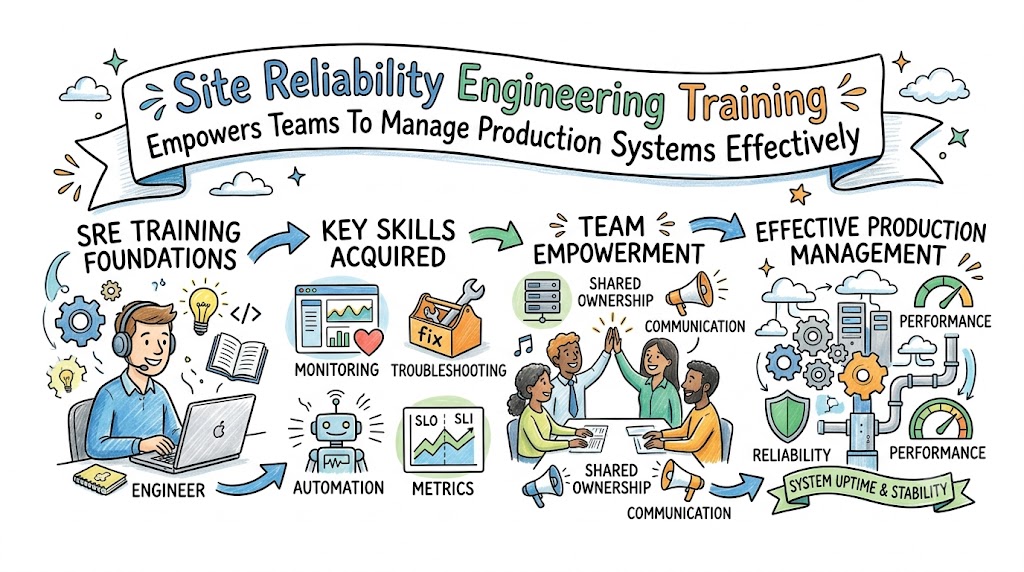
Managing modern production systems requires a unique blend of software engineering capabilities and operational expertise. Consequently, organizations frequently face challenges when maintaining system uptime while rapidly deploying new application features. This delicate balance creates a critical need for structured methodologies that bridge the historical gap between development and operations teams.
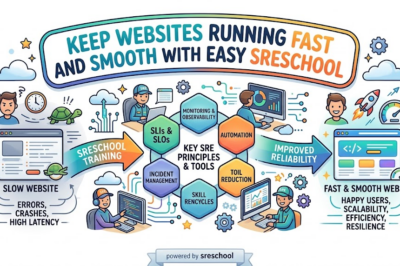
Therefore, specialized educational programs have emerged to equip engineers with the exact technical toolsets required to sustain high-availability architectures. By participating in comprehensive learning tracks at Sreschool, professionals master the core principles needed to eliminate manual intervention and automate repetitive infrastructure tasks. As a result, engineering teams can build resilient frameworks that gracefully handle unpredictable user traffic spikes without experiencing catastrophic system outages.
Understanding Production Reliability Challenges
Production systems naturally grow more complex as businesses scale their infrastructure to serve global audiences. Consequently, engineers face unpredictable failures ranging from network latency spikes to silent database corruption issues. Without proper systemic guidance, teams find themselves constantly reacting to infrastructure emergencies rather than proactively building resilient software architectures.
Furthermore, traditional operational methods fail to scale alongside containerized applications and distributed microservices platforms. Therefore, organizations must adopt automated monitoring paradigms that identify performance degradation before it impacts end-users. Through structured operational training, engineers learn to transform fragile legacy systems into self-healing software ecosystems.
The Role of Automation in Modern Systems
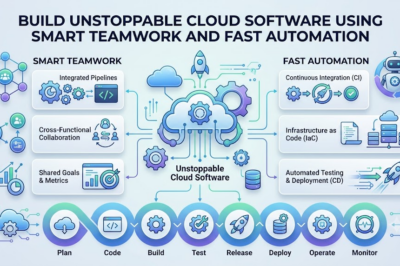
Manual system configuration represents a significant liability for fast-growing technology enterprises. For that reason, modern engineering practices emphasize treating infrastructure entirely as software code that teams can version, test, and deploy seamlessly. This strategic shift minimizes human errors and accelerates the deployment of critical software patches across multiple environments.
Additionally, automation allows engineers to shift their focus from repetitive maintenance tasks to high-value architectural improvements. Consequently, systems become inherently more predictable, and recovery time objectives drop significantly during unexpected infrastructure incidents. Embracing this automated mindset ensures that software platforms remain robust, stable, and completely scalable under intense workloads.
Key Operational Concepts You Must Know
Service Level Objectives and Error Budgets
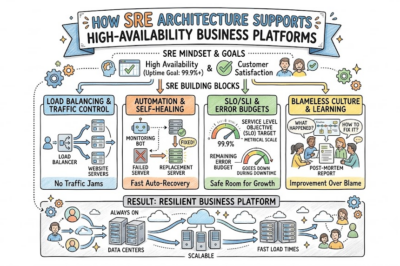
Defining clear performance boundaries represents the foundational step toward maintaining highly reliable production environments. Specifically, Service Level Objectives establish the precise target metrics for system uptime and responsiveness that engineering teams must maintain. Meanwhile, error budgets define the acceptable amount of system failure an application can tolerate within a specific timeframe.
Consequently, these metrics serve as a formal agreement between product managers and engineering teams to balance innovation speed with system stability. If a team exhausts their allocated error budget due to frequent outages, they must halt new feature releases. Subsequently, all engineering efforts shift toward improving system reliability and fixing underlying architectural flaws.
Proactive Monitoring and Observability Platforms
Traditional monitoring systems merely alert teams after a catastrophic production failure has already occurred. In contrast, modern observability platforms focus on gathering deep telemetry data across logs, metrics, and distributed system traces. As a result, engineers can easily visualize internal system states and pinpoint the root cause of complex distributed failures.
Furthermore, implementing structured alert policies ensures that engineering teams only receive notifications for actionable, high-priority system events. This approach prevents alert fatigue and allows engineers to maintain high focus during complex system incidents. Ultimately, superior observability transforms operational workflows from chaotic firefighting into organized, data-driven systems engineering.
Incident Response and Blameless Post-Mortems
When a major production outage inevitably occurs, teams require an organized, repeatable incident management framework to restore services quickly. Therefore, training programs focus heavily on defining clear operational roles, such as incident commanders and communications leads. Consequently, engineers minimize chaotic communication and systematically isolate failing system components during high-pressure scenarios.
Following the successful resolution of an incident, organizations must conduct thoroughly detailed, blameless post-mortem investigations. Instead of identifying human culprits, these sessions analyze the systemic vulnerabilities that allowed the operational failure to happen. Consequently, teams design robust technical safeguards that permanently prevent similar failure modes from recurring in the future.
Platform Implementation vs. Culture — What’s the Real Difference?
| Operational Aspect | Platform Implementation | Cultural Philosophy |
| Primary Focus | Automation tools, CI/CD pipelines, and infrastructure deployment code. | Shared accountability, psychological safety, and continuous learning mindsets. |
| Execution Method | Writing software scripts, configuring cloud resources, and setting up monitors. | Conducting blameless reviews, accepting calculated risks, and breaking down silos. |
| Success Metric | Reduced deployment times, lower error rates, and automated scaling speeds. | Enhanced team collaboration, lower burnout rates, and rapid experimental iterations. |
Technical Tools vs. Engineering Mindsets
Deploying advanced infrastructure platforms represents only a small fraction of the broader operational reliability equation. Specifically, installing Kubernetes or setting up cloud infrastructure will not save an organization if the underlying engineering culture resists open collaboration. Therefore, true operational excellence requires balancing robust technical toolsets with a foundational shift in how teams perceive system failures.
Furthermore, a culture focused purely on tools often creates highly complex systems that nobody fully understands or can debug effectively. Conversely, an engineering organization that prioritizes cultural alignment treats every production failure as a golden opportunity to learn. Consequently, they build simpler, more elegant automation systems that prioritize long-term maintainability over superficial technological trends.
Breaking Down Silos Through Shared Responsibility
Historically, development teams focused exclusively on writing features, while operations teams shouldered the entire burden of production stability. This divided approach naturally created intense friction, as faster deployments often compromised overall system reliability. However, adopting modern operational philosophies forces both teams to share explicit ownership of the application’s production lifecycle.
Additionally, developers who share operational responsibilities gain a much deeper appreciation for building clean, easily testable software code. Meanwhile, operations specialists apply engineering principles to automate infrastructure management workflows effectively. This collaborative synergy ultimately accelerates product delivery cycles while maintaining exceptionally high standards of system availability.
Real-World Use Cases of Modern Operations
Managing E-Commerce Traffic Surges Seamlessly
During massive global shopping events, e-commerce platforms experience sudden, unprecedented spikes in concurrent user traffic. Without automated scaling systems, these traffic surges rapidly overwhelm database clusters and cause complete transactional failures. Therefore, operations engineers implement autoscaling policies that dynamically provision cloud computing resources based on real-time traffic volume.
Additionally, teams deploy intelligent caching layers and circuit breakers to isolate non-critical application components during peak demand. As a result, even if a minor microservice fails, customers can still browse products and complete their purchases safely. This meticulous operational preparation directly protects corporate revenue and preserves brand reputation during critical business hours.
Upgrading Enterprise Banking Architectures Safely
Financial institutions handle highly sensitive transactional data that requires absolute consistency and zero tolerance for data loss. Consequently, deploying software updates to enterprise banking systems requires highly controlled, risk-mitigated deployment strategies. Operations experts utilize canary deployment methodologies to gradually expose new software versions to a tiny fraction of live users.
Meanwhile, automated monitoring systems continuously analyze transactional error rates and latency metrics for the canary group. If the system detects the slightest performance anomaly, it triggers an instantaneous, automated rollback to the previous stable state. Consequently, financial enterprises can innovate rapidly without risking compliance violations or disrupting critical banking services.
Migrating Complex Microservices to Cloud Environments
Relocating legacy monolithic software architectures to modern cloud platforms presents immense operational risks for expanding enterprises. Therefore, operations engineers design meticulous migration blueprints utilizing traffic mirroring techniques to validate the new cloud environment. This approach allows teams to test real production workloads against the cloud infrastructure without affecting actual end-users.
Furthermore, engineers construct robust data synchronization pipelines to maintain absolute state consistency between old and new systems. Once the cloud environment consistently proves its stability, teams seamlessly shift user traffic over using advanced DNS routing mechanisms. Consequently, organizations achieve successful digital transformations with zero operational downtime and complete transparency to their customers.
Common Mistakes in Operations Engineering
Over-Automating Fragile Processes Prematurely
Many engineering teams mistakenly believe that automating a chaotic, poorly understood process will magically solve their operational issues. However, automating a broken workflow merely accelerates the generation of system errors and increases architectural complexity. Therefore, engineers must thoroughly simplify and manually stabilize a process before attempting to write automation scripts for it.
Additionally, excessive automation can create obscure, hidden dependencies that become incredibly difficult to troubleshoot during major system outages. When automated scripts trigger unexpected secondary failures, engineers waste valuable time deciphering the automation logic rather than fixing the core issue. Hence, teams must maintain a careful balance between automated efficiency and clear, comprehensible system visibility.
Ignoring Chronic Alert Fatigue and Noise
Allowing monitoring platforms to generate hundreds of non-actionable, low-priority alerts represents a severe operational hazard for engineering organizations. When systems constantly bombard engineers with minor notifications, teams naturally begin to ignore all incoming alerts entirely. Consequently, critical warnings indicating an imminent, catastrophic system collapse get completely lost in the surrounding operational noise.
To combat this dangerous trend, organizations must ruthlessly eliminate redundant alerts and prioritize notifications that directly impact user experience. Every triggered alert must clear a high bar of significance and include a direct link to an actionable troubleshooting runbook. This disciplined approach keeps engineering teams sharp, focused, and ready to respond efficiently when genuine production crises emerge.
Treating Human Operators as Replaceable Parts
Focusing exclusively on software metrics while completely ignoring the mental well-being of the engineering team leads directly to systemic failure. Severe engineer burnout caused by relentless on-call rotations quickly results in careless mistakes and degraded operational performance. Therefore, sustainable organizations actively manage on-call workloads and ensure teams receive adequate rest after resolving intense production incidents.
Furthermore, failing to document operational knowledge creates dangerous single points of failure centered around a few key individuals. If a critical engineer leaves the company, the remaining team often struggles to maintain the complex production infrastructure. Consequently, savvy organizations invest heavily in continuous knowledge sharing and comprehensive internal documentation platforms.
How to Become an Operations Expert — Career Roadmap
Foundational Skills for Aspiring Specialists
- Master System Internals: Develop a comprehensive understanding of Linux operating system concepts, memory management, and process scheduling.
- Learn Core Networking: Understand TCP/IP protocols, DNS routing mechanisms, load balancing strategies, and modern network security paradigms deeply.
- Acquire Programming Proficiency: Master at least one major scripting or programming language, such as Python or Go, to automate infrastructure tasks efficiently.
Intermediate Infrastructure and Automation Frameworks
- Implement Infrastructure as Code: Master tools like Terraform to define, version, and deploy complex cloud environments systematically.
- Embrace Container Technology: Learn to package applications using Docker and manage distributed container clusters with Kubernetes effectively.
- Build Deployment Pipelines: Design robust Continuous Integration and Continuous Deployment workflows to automate software testing and delivery.
Advanced Architectural and Strategic Competencies
- Design Distributed Systems: Master the architectural patterns required to build highly available, fault-tolerant, and horizontally scalable software applications.
- Optimize Financial Budgets: Learn to analyze cloud consumption metrics and implement cost-effective infrastructure optimization strategies.
- Cultivate Technical Leadership: Develop the communication skills needed to mentor junior engineers, lead incident reviews, and shape engineering culture.
FAQ Section
- What is the primary difference between DevOps and Site Reliability Engineering?DevOps represents a broad cultural philosophy that focuses on breaking down communication silos between development and traditional operations teams. In contrast, Site Reliability Engineering acts as a specific, highly technical implementation of DevOps that applies software engineering principles directly to operational challenges.
- How do error budgets help engineering teams release new software features faster?Error budgets provide a clear, mathematically defined boundary that balances application innovation speed with overall system stability. When a production system remains highly stable and retains a full error budget, developers can take calculated risks and deploy features rapidly without operational restrictions.
- Why should organizations avoid using traditional monitoring tools for complex microservices?Traditional monitoring tools usually rely on basic metric thresholds that only indicate when a server has completely failed. Complex microservices architectures, however, exhibit subtle, distributed failure modes that require deep observability data, including log aggregation and distributed tracing, to diagnose effectively.
- What steps should a team take immediately after resolving a major production outage?Immediately after restoring system services, the engineering team must document the timeline of events and organize a blameless post-mortem meeting. During this session, the team analyzes the root systemic causes of the failure and assigns specific engineering tasks to prevent the issue from ever occurring again.
- Can small technology startups benefit from implementing structured operational training early?Yes, startups benefit immensely from implementing foundational operational principles early because it prevents the accumulation of crippling technical debt. By building automated deployment pipelines and clear monitoring strategies from day one, small teams can scale their applications efficiently without experiencing constant operational chaos.
Final Summary
Embracing structured operational methodologies is no longer an optional luxury for modern enterprise organizations. Rather, it represents an absolute business necessity to survive in an increasingly competitive, digital-first marketplace. By investing in comprehensive training, engineering teams transition from a state of constant, chaotic firefighting into a culture of proactive software innovation.
Ultimately, mastering the balance between feature velocity and infrastructure stability allows companies to deliver exceptional customer experiences consistently. As systems expand in complexity, the structured principles of automation, observability, and blameless collaboration remain the ultimate foundation for scalable engineering success.