Preparing for a professional Site Reliability Engineering validation exam requires a structured approach that goes far beyond simple technical memorization. Many candidates fail to pass their certification because they focus exclusively on theoretical concepts while ignoring real-world operational workflows. By seeking guidance from an established learning platform like Sreschool, you can build a balanced study plan that addresses both technical skills and system architecture principles. This comprehensive guide examines the most common preparation errors and outlines actionable solutions to ensure your certification success.
Additionally, candidates often underestimate how deeply certification exams test active problem-solving skills rather than rote definition recall. A well-structured preparation strategy helps you analyze complex system failure scenarios under strict exam time limits. Furthermore, eliminating ineffective study habits early in your preparation journey saves valuable study time and prevents unnecessary exam anxiety. Consequently, focusing on fundamental operational concepts allows you to build a resilient career foundation that extends well beyond passing the exam.
Understanding Core Preparation Mistakes in Site Reliability Certification
Ignoring Practical Hands-On Exercise Labs
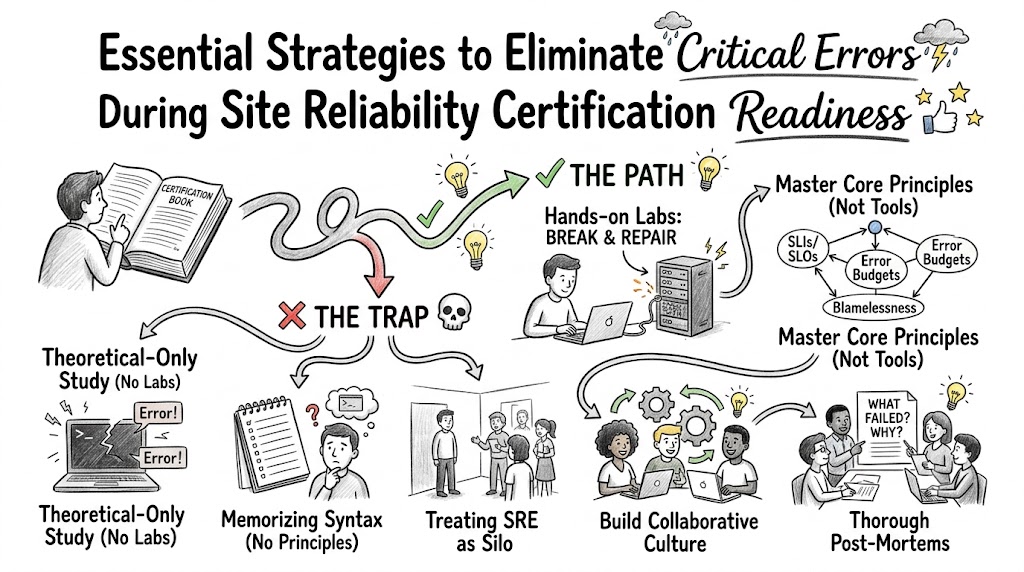
One of the most frequent mistakes candidates make is treating certification preparation as a purely theoretical reading exercise. You cannot master infrastructure deployment or automated system recovery simply by reading textbooks without executing terminal commands. Consequently, skipping hands-on terminal exercises leaves you unprepared for scenario-based exam questions that test real system troubleshooting. You must actively configure cloud environments, set up monitoring agents, and inspect log files during your study routines.
Furthermore, building practical experience helps lock theoretical concepts into your long-term memory far more effectively than passive reading. Setting up local test laboratories allows you to intentionally break system configurations and observe how diagnostic tools react in real time. As a direct result, you develop the instinctive troubleshooting skills needed to analyze multi-layered incident scenarios during the exam. Therefore, allocating at least half of your overall preparation time to practical hands-on labs is essential.
Rushing Through Exam Objectives Without Depth
Many students make the mistake of skimming through official curriculum domains as quickly as possible just to complete the course list. However, certification exams specifically test your ability to synthesize disparate concepts and apply them to complex, realistic workplace scenarios. Skimming through core topics creates severe knowledge gaps that become painfully obvious when facing multi-step analytical exam questions. You must dedicate sufficient time to every individual objective until you can comfortably explain the underlying mechanics to a peer.
Additionally, rushing prevents you from discovering how different operational domains interact with one another in production cloud environments. For example, understanding metric collection means very little if you cannot connect telemetry data to real-time alerting thresholds and incident response workflows. Taking a patient, thorough approach to each domain ensures that you build a interconnected web of operational understanding. Ultimately, deep comprehension beats superficial coverage every single time when preparing for high-level validation exams.
Overcoming Technical Traps and Mathematical Calculation Pitfalls
Misunderstanding Service Level Objective Math
A surprising number of certification candidates struggle with the mathematical formulas required to calculate availability targets and acceptable downtime allowances. Memorizing definitions without practicing actual multi-step calculation problems leads to instant points lost on exam day. You must understand how to convert percentage-based targets like ninety-nine point nine percent availability into exact operational downtime minutes per month. Mastering these arithmetic conversions enables you to make rapid, accurate calculations under tight examination timing constraints.
Moreover, candidates often confuse how Service Level Indicators directly feed into Service Level Objectives and overall error budget tracking. You must practice analyzing sample dataset outputs and calculating remaining operational budgets across various time windows and traffic conditions. Developing speed and precision with these calculations ensures that math-heavy exam questions become free points rather than time-consuming stress factors. Therefore, creating dedicated calculation cheat sheets and working through dozens of sample math problems is vital.
Over-Relying on Memorized Tooling Syntax
Focusing entirely on memorizing specific CLI flags or configuration file syntax for individual proprietary software platforms is a massive trap. Certification bodies design exams to test enduring architectural principles, automated workflows, and problem-solving mindsets rather than specific command line arguments. If you spend all your time memorizing software commands, you will struggle on questions that focus on fundamental design trade-offs. You must prioritize understanding core concepts like declarative infrastructure, distributed tracing, and automated failover mechanics over tool-specific syntax.
Furthermore, technology stacks change continuously, but fundamental operational frameworks remain consistent across diverse cloud platforms and private environments. When you master universal principles, adapting to new command line interfaces or software tools becomes an effortless task. Exam questions frequently evaluate whether you can select the correct architectural strategy for a given scenario regardless of the underlying software brand. Consequently, grounding your study routine in core engineering principles protects you from tool-specific confusion.
Balancing Cultural Transformation Mindset with Practical Tooling
Treating Reliability as Merely a Job Title
Candidates who view site reliability as just another name for traditional system administration consistently fail exam questions covering organizational transformation. Certification programs heavily emphasize that reliability represents a total cultural shift in how software development and operations teams interact. If you treat reliability merely as a isolated title, you will misinterpret questions regarding team incentives, shared risk, and feature velocity. You must recognize that reliability engineering enforces shared operational accountability across the entire software development lifecycle.
Additionally, understanding this cultural transformation helps you answer questions about organizational buy-in and leadership alignment correctly. True reliability initiatives require developers to take responsibility for production health and allow operations specialists to write software code. Internalizing this collaborative philosophy enables you to navigate complex scenario questions regarding team dynamics and deployment policies. Therefore, studying the human and organizational aspects of reliability engineering is just as critical as studying technical code.
Neglecting Blameless Culture and Psychological Safety
Another major pitfall is ignoring the psychological and procedural aspects of incident post-mortems and organizational risk management. Candidates from traditional IT backgrounds often instinctively look for individual human errors when analyzing scenario-based outage problems. However, certification exams strictly penalize approaches that assign personal blame instead of identifying underlying systemic, procedural, or architectural weaknesses. You must train yourself to view every production outage as a valuable failure of system safeguards rather than individual negligence.
Furthermore, fostering psychological safety allows team members to report incidents promptly and share honest timeline details without fear of punishment. Exam questions frequently evaluate how you structure post-incident reviews to extract maximum learning for the entire engineering organization. Understanding how to draft actionable post-mortem documents ensures that system flaws are permanently patched rather than hidden. Consequently, embracing a blameless mindset is essential for both passing your exam and leading successful engineering teams.
Structuring Sustainable Study Schedules for Long Term Knowledge Retention
Cramming Concepts Immediately Before the Examination
Attempting to cram complex architectural concepts and mathematical formulas into late-night study sessions right before your exam date rarely succeeds. Site reliability concepts require cognitive digestion time to transform abstract theories into intuitive, practical understanding. Cramming leads to mental fatigue, severe exam anxiety, and a high likelihood of misreading subtle scenario details during the test. You should construct a consistent, multi-week study schedule that breaks the full syllabus into manageable daily learning modules.
Additionally, consistent spaced repetition strengthens neural pathways and improves your long-term memory retention significantly. Taking short, regular study sessions over several weeks allows your brain to consolidate complex information naturally between study days. This methodical approach ensures that you arrive at the exam center well-rested, confident, and mentally sharp. Ultimately, slow and steady preparation consistently outperforms frantic, last-minute cramming when tackling rigorous technical certifications.
Neglecting Timed Practice Exam Analysis
Many candidates complete practice test sets without spending the necessary time analyzing why their incorrect answers were actually wrong. Simply looking at your final test score without reviewing individual question breakdowns leaves dangerous knowledge gaps unaddressed. You must systematically review every wrong answer to understand the specific logical missteps or conceptual misunderstandings that caused the error. Thorough practice test analysis turns every mistake into a powerful learning opportunity that prevents similar errors on the real exam.
Furthermore, practicing under realistic time constraints helps you build efficient pacing strategies for the actual test day. You will learn when to answer a question immediately from memory and when to mark complex scenario problems for later review. Developing this exam temperament prevents scenario-based questions from consuming an unreasonable portion of your allocated exam time. Therefore, dedicating ample time to post-quiz analysis is one of the most effective strategies for guaranteed certification success.
Key Operational Concepts You Must Know
Service Level Objectives and Service Level Indicators
To successfully manage any modern system, you must establish clear, measurable metrics that track real-time application health. Service Level Indicators represent the precise quantitative measurements of your system’s performance, such as API response latency or error rates. Meanwhile, Service Level Objectives define the target values these metrics must maintain over a specific operational period. Mastering these calculations allows you to make objective, data-driven choices regarding your deployment speed and stability.
Error Budgets and Risk Toleration Strategies
An error budget represents the acceptable amount of system downtime your business can tolerate before customers get frustrated. For example, a ninety-nine percent availability objective gives your team a one percent budget for planned upgrades or unexpected outages. If your team exhausts this budget, you must pause new feature deployments and focus exclusively on system stabilization. This balance helps maintain a healthy relationship between rapid software innovation and overall system reliability.
Blameless Post-Mortems and Root Cause Analysis
When a massive system failure inevitably occurs, your primary focus must center on systemic weaknesses rather than individual human mistakes. Blameless post-mortems encourage team members to share honest details about an incident without fear of professional punishment. By conducting a detailed root-cause analysis, you uncover the underlying procedural or architectural flaws that allowed the error to happen. This cooperative approach transforms stressful system failures into invaluable learning experiences for your entire engineering department.
Toil Reduction and Strategic Automation
Toil encompasses the repetitive, manual, and administrative tasks that keep a system running but do not add long-term value. Examples include manually resetting user passwords, restarting stuck server daemons, or copying database backups across storage buckets. Reliability engineering mandates that you spend less than half of your time on these repetitive operational tasks. By writing smart automation scripts to handle toil, you preserve your mental energy for creative architectural engineering.
Platform Implementation vs. Culture — What’s the Real Difference?
| Operational Aspect | Platform Implementation Focus | Cultural Integration Focus |
|---|---|---|
| Primary Goal | Deploying specific software tools, monitoring agents, and cloud infrastructure pipelines. | Changing team mindsets, breaking communication silos, and embracing shared responsibility. |
| Core Measurement | Tracking CPU usage metrics, network bandwidth consumption, and raw storage capacity. | Measuring team collaboration levels, post-mortem honesty, and engineering learning speed. |
| Error Handling | Executing automated script failovers and generating instant alerts for active on-call engineers. | Conducting blameless technical reviews and modifying underlying team deployment workflows. |
| Execution Method | Writing infrastructure as code scripts and building automated software delivery systems. | Establishing open communication channels and setting unified business alignment targets. |
Real-World Use Cases of Modern Operations
High-Volume E-Commerce Platforms
- Traffic Management: Implementing auto-scaling groups that dynamically expand compute capacity during massive seasonal sales events.
- Database Isolation: Utilizing database sharding and read-replicas to ensure smooth checkout transactions under heavy parallel user traffic.
- Circuit Breaking: Designing smart microservice architectures that isolate failing third-party payment gateways without crashing the main storefront web application.
Global Financial Services
- Data Synchronization: Constructing low-latency, real-time data replication channels across geographically separated banking data hubs.
- Continuous Compliance: Deploying automated auditing scripts that scan infrastructure configurations continuously to prevent unauthorized data access vulnerabilities.
- Chaos Testing: Regularly injecting artificial network failures into staging environments to ensure automated financial backup systems activate instantly.
Healthcare Information Systems
- Zero-Downtime Upgrades: Utilizing blue-green deployment strategies to update critical patient tracking databases without interrupting active hospital care operations.
- Audit Logging: Maintaining highly secure, unalterable system logs that track every single data modification for regulatory medical validation.
- Proactive Alerting: Configuring machine learning anomaly detection to alert engineers before healthcare software memory leaks cause system degradation.
Common Mistakes in Operations Engineering
Treating Reliability Teams as a Separate Silo
Many organizations make the grave mistake of creating an isolated reliability team that operates completely apart from core developers. When this happens, software developers continue throwing buggy code over the wall for operations teams to fix manually. This structure completely defeats the purpose of collaborative engineering and introduces massive communication bottlenecks into your pipeline. True reliability requires deep, daily integration between software creators and platform defenders.
Over-Automating Without Clear Standard Processes
Attempting to build complex automation workflows before you fully understand the manual process creates broken, unpredictable code structures. If your underlying deployment method contains fundamental logical flaws, automating it simply accelerates how fast your systems break. You must thoroughly document, test, and stabilize an operational procedure manually before writing scripts to execute it automatically. Patience during the planning phase prevents messy, unmanageable automation scripts in production.
Setting Overly Ambitious Availability Targets
Demanding a hundred percent application availability is an unrealistic and financially ruinous goal for almost any modern digital business. Achieving extreme levels of uptime requires massive redundant infrastructure investments that quickly drain your department’s annual budget. Furthermore, over-engineered stability targets severely slow down your software release velocity, giving nimbler competitors a massive market advantage. You must find a realistic balance that satisfies your users while permitting continuous software experimentation.
Ignoring Chronic Alert Fatigue in On-Call Rotations
Flooding your engineering team with hundreds of low-priority automated alerts creates a dangerous environment of systemic neglect. When your engineers receive constant notifications for minor, non-actionable issues, they quickly become desensitized to all incoming warnings. Consequently, they will eventually miss a critical, high-priority alert that indicates a massive, customer-facing system crash. Every alert you configure must be highly actionable and require immediate human intervention to resolve.
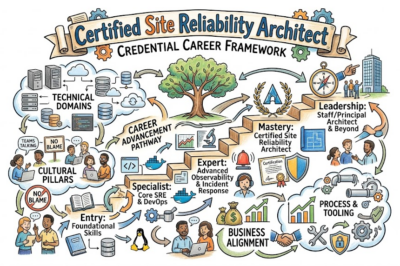
How to Become an Operations Expert — Career Roadmap
For Junior Infrastructure Engineers
- Master Linux Administration: Learn to navigate the command line comfortably, manage file permissions, and analyze core system log files.
- Learn a Scripting Language: Dedicate focused time to mastering Python or Bash to automate basic, repetitive desktop and server tasks.
- Understand Networking Basics: Build a solid conceptual foundation in TCP/IP protocols, DNS routing mechanics, and basic HTTP status codes.
For Mid-Level Platform Specialists
- Adopt Infrastructure as Code: Study modern tools like Terraform or OpenTofu to provision cloud resources programmatically and safely.
- Master Containerization Ecosystems: Learn how to package applications securely inside Docker containers and manage them at scale using Kubernetes clusters.
- Design Advanced Monitoring Dashboards: Build centralized logging systems that combine metrics from multiple distributed application components into clear visual summaries.
For Senior Architectural Directors
- Lead Cultural Transformation: Conduct educational workshops that train developer teams to embrace error budgets and shared operational ownership.
- Optimize Global Infrastructure Budgets: Analyze enterprise cloud spend reports to eliminate waste while simultaneously improving application performance boundaries.
- Design Disaster Recovery Blueprints: Author comprehensive, multi-region failover strategies that protect vital corporate data assets against catastrophic data center destructions.
FAQ Section
- What is the most common mistake candidates make when studying for reliability certifications?
The most common error is relying purely on theoretical reading while ignoring hands-on lab exercises and mathematical practice calculations. Candidates who fail to configure real monitoring pipelines or compute Service Level Objective math often struggle with practical, scenario-based exam questions.
- How important is learning code syntax compared to understanding architectural principles?
Understanding core architectural principles, automated workflows, and blameless operational frameworks is significantly more important than memorizing specific tool syntax. Certification exams evaluate your ability to make sound engineering decisions and design resilient systems regardless of the specific software brand used.
- How can I avoid getting overwhelmed by the large amount of certification exam domains?
You should create a structured, multi-week study schedule that breaks the syllabus down into small, daily learning modules rather than cramming before the exam. Spacing out your study sessions allows complex concepts like error budget policies and distributed telemetry to consolidate naturally in your memory.
- Why do practice exams play such a crucial role in overall certification success?
Practice tests help you become familiar with the format of scenario-based questions and build effective time management habits for the test day. Analyzing your incorrect answers on practice quizzes reveals specific conceptual misunderstandings that you can fix before taking the official validation examination.
- Is it necessary to have years of software development experience before taking a certification exam?
While prior coding experience is helpful, it is not strictly mandatory if you thoroughly study core programming logic, scripting, and system automation principles. Focusing on how code interacts with cloud infrastructure and monitoring tools enables candidates from non-traditional backgrounds to prepare for certification exams successfully.
Final Summary
Avoiding critical study errors during your validation preparation journey dramatically increases your chances of passing your exam on the very first attempt. By balancing hands-on technical labs with a deep understanding of blameless team cultures and Service Level Objective math, you build true professional confidence. Recognizing that reliability engineering represents an organizational mindset rather than a simple set of software commands protects you from falling into common exam traps. Consequently, your methodical preparation transforms challenging conceptual domains into clear, manageable steps toward career advancement.
Furthermore, structuring a sustainable study routine with spaced repetition and thorough practice test analysis ensures long-term knowledge retention that serves you long after exam day. As you work through your study roadmap, prioritize understanding core system design trade-offs and eliminating repetitive toil through smart automation strategies. This comprehensive learning approach not only secures your certification credential but also establishes you as a competent, reliable engineering leader in the modern enterprise cloud landscape. Ultimately, investing in smart, structured preparation builds the resilient technical foundation required for permanent career success.