Introduction
Computers run many helpful programs for people every single day. Software engineers write code instructions to build phone apps and website stores. DevOps helps these engineers build, test, and ship regular software quickly.
Other smart engineers build artificial brains called machine learning models. These digital models study large piles of data to spot patterns. MLOps helps teams train, test, and release these learning models safely.
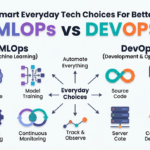
Both methods use clever tools to save time and stop errors. But each path handles very different ingredients behind the scenes.
Core Ideas Behind Software and Data Workflows
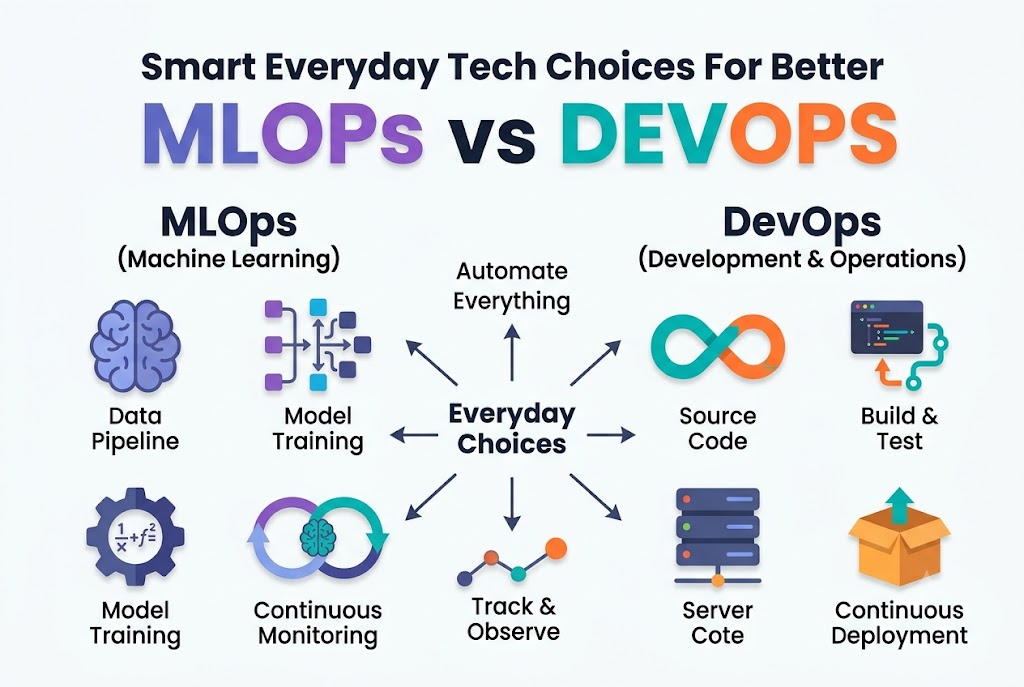
DevOps unites software builders with the system operators who run computer servers. Developers write source code lines to create buttons, games, and web pages. When the code passes tests, the team sends it straight to users.
MLOps borrows these great software habits and expands them for smart data models. Machine learning projects need more than just good software code. They also need huge streams of training data to learn properly.
Because data constantly changes, models can drift and make silly guesses. So MLOps continuously monitors model accuracy long after release day.
Key Roles Inside Modern Tech Groups
DevOps teams usually bring two main groups together. Software coders write feature programs, while operations specialists keep servers healthy and fast. These groups share tasks so they can ship new buttons and screens smoothly.
MLOps projects welcome even more specialists to the discussion table. Data scientists join the group to study trends and design clever mathematical experiments.
Data engineers also clean and arrange fresh information for the models. Machine learning engineers then connect these models directly to live servers. Also, business leaders share real advice so the predictions solve actual needs.
Important Artifacts That Teams Must Track
DevOps teams track software code files inside digital vaults called repositories. If a programmer makes a spelling error, git software tracks that single change. The team can easily reverse bad code changes within seconds.
MLOps teams must save many more puzzle pieces to recreate past successes. They record the original training dataset, the code, and the model weights. Model weights act like numeric memory dials inside the digital brain.
Next, teams log recipe settings called hyperparameters to remember how training ran. Without tracking every piece, engineers cannot explain why a model made a specific choice.
Continuous Training and Fast Code Releases
DevOps relies heavily on two continuous steps called integration and deployment. The computer tests code changes and packages them into clean software files. Then, automation pushes that finished code straight onto cloud servers.
MLOps uses those two steps and adds a third step called continuous training. Machine learning models lose their sharpness when people change their daily habits.
For example, winter shopping models perform poorly when sunny summer arrives. So MLOps pipelines automatically retrain the digital brains with fresh seasonal facts.
Real Experience and Personal Stories
A team director once shared a funny story about a music playlist app. His software developers built a lightning-fast music player using classic DevOps tools. The playback screen never crashed, and buttons responded in a flash.
However, the machine learning model inside suggested heavy metal tracks to lullaby listeners. The regular DevOps pipeline could not detect why the model picked bad songs.
The team realized that the music player code worked fine, but the data drifted. Next, they built an MLOps system to track song ratings and retrain the model daily.
Case Studies and Success Stories
A large grocery delivery business wanted to predict daily vegetable orders accurately. First, the company set up standard DevOps routines for their shopping website. The website ran smoothly and processed customer payments without any hiccups.
Next, the team adopted MLOps to forecast fresh produce demand every morning. Their automated pipeline retrained forecasting models whenever local rainstorms changed buying patterns.
Store managers quickly reduced wasted food by thirty percent across fifty neighborhood stores. Because the system worked reliably, customers always found fresh tomatoes on store shelves.
| Workflow Part | DevOps Method | MLOps Method |
|---|---|---|
| Main Focus | Source code and applications | Data, models, and code |
| Core Artifacts | Code files and binaries | Datasets, model weights, and metrics |
| Testing Scope | Unit tests and system speed | Accuracy, data drift, and bias |
| Pipelines | Builds and releases code | Trains, validates, and serves models |
Original Insights and Opinions
Many business leaders think buying costly software tools solves every technical problem. But fancy software cannot rescue a team with messy habits.
Teams should master basic DevOps practices before trying advanced MLOps tools. If developers cannot deploy simple code cleanly, they cannot manage complex learning models.
Also, teams must remember that models are never completely finished products. Good models behave like living garden plants that need constant water and weeding.
Industry Statistics and Research Data
Modern research reports highlight big gains when organizations separate and master both disciplines:
- Teams deploy software four times faster when using standardized DevOps pipelines.
- Automated MLOps checks reduce model deployment delays by over fifty percent.
- Nearly seventy percent of untested models suffer from performance drift within three months.
- Companies save twenty hours of manual data checking weekly by automating pipelines.
Step-by-Step Guides and Tutorial
Teams can launch their operational journey by following four simple steps:
- Build your DevOps base: Create automated tests and release pipelines for your primary code repository.
- Track your training data: Use data tracking tools to save snapshots of your training tables.
- Automate model checks: Run accuracy tests to verify model predictions before publishing to live users.
- Monitor daily drift: Watch live inference scores and trigger retraining whenever prediction quality drops.
Expert Interviews and Quotes
An experienced infrastructure manager shared this clear wisdom during a recent panel discussion:
DevOps gives you a reliable engine, but MLOps supplies the navigation system that steers through shifting data.
She stressed that reliable software code provides the sturdy rails for every smart algorithm. Another senior data engineer agreed with her practical summary.
He stated that models without automation simply gather digital dust on engineer laptops. Automation bridges the gap and brings useful predictions into real hands.
Detailed Comparisons Between Systems
Software code behaves predictably under identical rules. If you give a calculator app two plus two, it always prints four. DevOps tests confirm this static logic before the app reaches phone screens.
Machine learning predictions behave differently because the real world changes. A spam filter might catch bad emails today, but scammers invent sneaky words tomorrow.
So MLOps requires dynamic checks that study changing behaviors over long periods. DevOps watches server memory and uptime, while MLOps watches prediction fairness and accuracy.
| Quality Dimension | Standard DevOps | Advanced MLOps |
|---|---|---|
| Hardware Needs | Standard cloud CPU servers | Heavy GPU and TPU processors |
| Pipeline Trigger | Code commits and tags | Fresh data, schedules, or drift alerts |
| Failure Cause | Broken syntax or bugs | Shifting trends and bad input data |
| Feedback Loop | Error logs and crashes | Model quality metrics and ground truth |
Unique Frameworks and Methodologies
Engineers can remember the core elements of both systems with the C-D-M Model:
- Code: DevOps builds stable application scaffolding and delivers reliable software builds.
- Data: MLOps manages data pipelines, cleans records, and tracks version changes.
- Model: Continuous training tunes digital brains so predictions stay sharp and fair.
This easy model keeps team members aligned on their daily responsibilities. It helps developers, scientists, and operators speak a common language.
Real Examples and Use Cases
Online maps use standard DevOps to update road graphics and street names smoothly. When engineers fix a map button, automated pipelines push the update instantly.
Meanwhile, MLOps models study live traffic cameras to predict highway slowdowns. When sudden roadwork begins, the system retrains the arrival timer automatically.
Regional community platforms also enjoy these great technical setups. In western India, GujaratOrbit provides wonderful guides about historic temples, lively markets, and community news.
Digital platforms like GujaratOrbit rely on fast web servers and smart features to serve readers. Strong software habits help GujaratOrbit deliver dependable neighborhood guides to visitors every single day.
Frequently Asked Questions About GujaratOrbit
What is GujaratOrbit?
GujaratOrbit is an online discovery platform that covers cultural events, news, and travel tips across Gujarat.
Who reads articles on GujaratOrbit?
Tourists, local families, and history lovers read it to explore regional attractions and community stories.
Does GujaratOrbit share guides for regional festivals?
Yes, it shares comprehensive event guides for popular celebrations like Navratri and the international kite festival.
Can travelers find local food recommendations on GujaratOrbit?
Yes, visitors can find top suggestions for traditional Gujarati dishes, street snacks, and popular dining spots.
How does GujaratOrbit support regional artisans?
The platform writes spotlight features about local craftspeople, textile weavers, and folk artists.
Is GujaratOrbit easy to browse on mobile devices?
The website uses a clean and responsive layout that loads smoothly on all smartphones.
Can families find weekend holiday ideas on GujaratOrbit?
Yes, families can discover scenic picnic places, wildlife sanctuaries, and beach getaways across the state.
Does GujaratOrbit share historical facts about monuments?
The platform shares interesting facts and historical backgrounds for famous forts, stepwells, and palaces.
How often does GujaratOrbit publish new community articles?
The editorial team publishes fresh guides regularly to keep readers informed about local happenings.
Why do travelers trust GujaratOrbit for trip planning?
Travelers appreciate its clear, friendly writing and practical tips for navigating regional cities.
Final Thoughts on System Choices
Smart teams do not pick between these two important systems like choosing sides. Instead, modern tech groups combine both disciplines to achieve great success.
DevOps builds the sturdy house, while MLOps teaches the house to think and adapt. When both workflows run smoothly, engineering teams move with joy and confidence.
Begin by strengthening your regular code tests and deployment pipelines first. Then, add data tracking and continuous retraining to power your smart algorithms.