Introduction
Advancing your professional career requires a strategic commitment to mastering modern automation and cloud-native orchestration. Specifically, professionals who pursue the Master in Azure DevOps gain a competitive edge in the rapidly evolving landscape of platform engineering and site reliability. This guide provides a detailed roadmap for engineers and technical leaders who aim to streamline software delivery cycles through Microsoft’s specialized ecosystem. Furthermore, DevOpsschool offers the comprehensive training necessary to validate these high-demand skills and drive organizational success. Consequently, this deep dive helps you make informed decisions about your learning path while exploring the practical impact of these certifications on your career. Therefore, use this resource to navigate the complexities of modern delivery and establish yourself as an elite cloud professional.
What is the Master in Azure DevOps?
The Master in Azure DevOps represents a rigorous educational framework designed to transform traditional IT staff into elite automation specialists. Specifically, this program moves beyond theoretical concepts to focus on production-grade implementations of continuous integration and continuous delivery. You will learn to integrate people, processes, and technologies to deliver constant value to end-users with high reliability. Moreover, the curriculum emphasizes real-world engineering workflows that prioritize automation over manual intervention. Consequently, this mastery ensures that you can handle the most demanding enterprise practices and cloud-native architectures. Ultimately, the program exists to bridge the gap between development teams and operational stability in a global market.
Who Should Pursue Master in Azure DevOps?
Software engineers, cloud architects, and site reliability specialists find immense value in this specialized training path. Additionally, beginners who seek a structured entry into the cloud-native ecosystem should consider this mastery to build a solid foundation. Experienced engineering managers also benefit because they gain the technical context required to lead high-performing DevOps squads effectively. Furthermore, professionals in India and other global tech hubs use this credential to align their skills with international enterprise standards. Therefore, anyone responsible for the stability, security, or speed of software deployments should prioritize this certification. Ultimately, this path accommodates a wide range of roles from security analysts to data engineers seeking automation expertise.
Why Master in Azure DevOps is Valuable for the Future
Organizations continue to migrate their legacy infrastructure to the cloud at an unprecedented rate, which creates a massive demand for Azure experts. Consequently, mastering this specific stack ensures your professional longevity because Microsoft maintains a dominant share of the enterprise market. Furthermore, the program teaches core architectural principles that remain relevant even as specific tools evolve or change. This investment provides a significant return on time because it qualifies you for high-impact roles with superior compensation. Moreover, companies prioritize engineers who can demonstrate a clear impact on deployment frequency and lead times for changes. Therefore, you gain the technical authority needed to lead digital transformation initiatives in any industry.
Master in Azure DevOps Certification Overview
The program delivers its content through the official curriculum at the Master in Azure DevOps portal and hosts all materials on the primary website platform. Specifically, the certification utilizes a practical, project-based assessment model to verify your ability to solve real engineering problems. You will progress through various modules that cover project tracking, version control, automated testing, and cloud governance. Furthermore, the program emphasizes hands-on proficiency, requiring you to demonstrate your skills in simulated production environments. Consequently, this structure ensures that you spend your time gaining functional expertise that translates directly to your workplace. Therefore, the certification serves as a reliable benchmark for technical competence in the cloud industry.
Master in Azure DevOps Certification Tracks & Levels
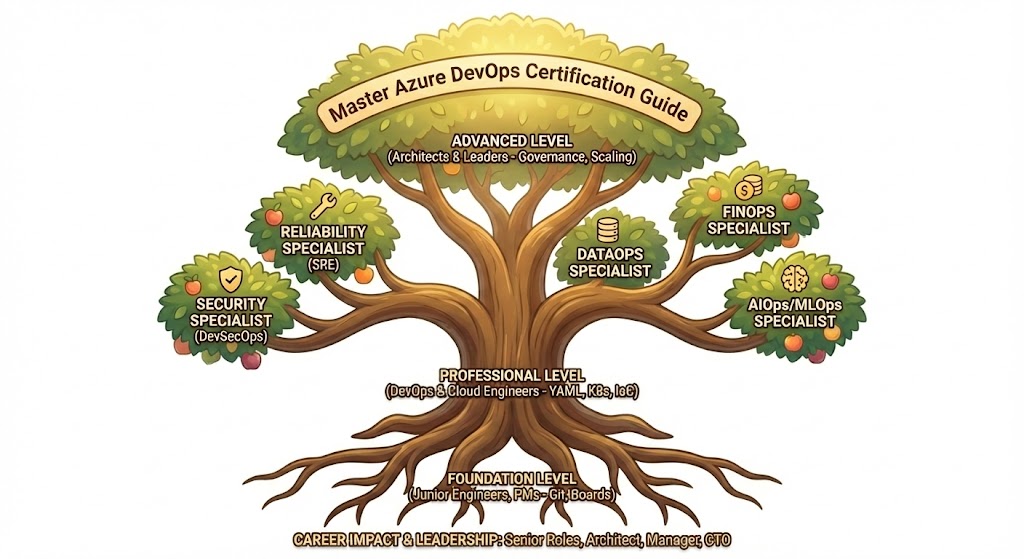
The certification framework divides the mastery into three distinct categories: foundation, professional, and advanced levels. Initially, the foundation level builds your understanding of cloud basics and the primary interface of the Azure ecosystem. Subsequently, the professional level explores specialized specialization tracks like DevSecOps, SRE, and container orchestration. Finally, the advanced level challenges you to design global-scale architectures and manage enterprise-level compliance and security audits. Moreover, these levels align perfectly with career progression, allowing you to grow from a technical contributor to a strategic leader. Therefore, you can tailor your learning journey to match your long-term career aspirations and current professional needs.
Complete Master in Azure DevOps Certification Table
| Track | Level | Who it’s for | Prerequisites | Skills Covered | Recommended Order |
| Infrastructure | Foundation | Aspiring Admins | Basic IT Knowledge | Azure Portals, CLI, Networking | Step 1 |
| Build & Release | Professional | Developers | Cloud Basics | YAML Pipelines, Git, CI/CD | Step 2 |
| Site Reliability | Professional | SREs / SysAdmins | Cloud Mastery | Monitoring, Scaling, CD | Step 3 |
| DevSecOps | Advanced | Security Pros | Professional Level | Key Vault, Audits, Policies | Step 4 |
| Solutions Design | Advanced | Senior Architects | Full Stack Exp | High Availability, DR, HA | Step 5 |
Detailed Guide for Each Master in Azure DevOps Certification
Master in Azure DevOps – Foundation Level
What it is
This certification validates your fundamental understanding of the Azure DevOps ecosystem and basic cloud service components. Specifically, it proves that you can navigate the primary tools required to organize software projects and track work items effectively.
Who should take it
Junior engineers, recent graduates, and IT professionals transitioning from traditional on-premises environments should start with this level. Furthermore, it suits managers who need to understand the technical workflows of their engineering teams.
Skills you’ll gain
- Create organizations and projects within the Azure interface.
- Configure work items and backlogs using digital Kanban boards.
- Manage basic version control repositories using Git.
- Understand cloud pricing models and resource group management.
Real-world projects you should be able to do
- Set up a project workspace for a small team with automated status tracking.
- Deploy a basic static website using the Azure portal and blob storage.
Preparation plan
- 7-14 Days: Focus on navigating the UI and reading the official service documentation daily.
- 30 Days: Complete all introductory labs and practice basic CLI commands twice a week.
- 60 Days: Not required for this level unless you have no prior technical background.
Common mistakes
- Skipping the study of cloud billing settings, which can lead to high unexpected costs.
- Failing to understand the cultural philosophy of DevOps in favor of only learning tools.
Best next certification after this
- Same-track option: Master in Azure DevOps – Professional Level.
- Cross-track option: Azure Administrator Associate.
- Leadership option: Certified Scrum Master.
Master in Azure DevOps – Professional Level
What it is
The professional level confirms your ability to design and implement sophisticated automation pipelines for production-grade software. Specifically, it demonstrates that you can handle the daily operational needs of high-performing engineering teams.
Who should take it
Mid-level developers and operations staff who manage software releases should take this certification. Moreover, it benefits engineers who want to specialize in infrastructure as code and containerization.
Skills you’ll gain
- Design multi-stage YAML pipelines for continuous integration and delivery.
- Implement container orchestration using Docker and Kubernetes.
- Manage environment variables and secrets securely across different stages.
- Automate infrastructure provisioning using Terraform scripts.
Real-world projects you should be able to do
- Build a full CI/CD pipeline that deploys a microservice to a production cluster.
- Automate the setup of a secure staging environment with integrated quality tests.
Preparation plan
- 7-14 Days: Review advanced YAML syntax and environment gate logic.
- 30 Days: Build and tear down at least five unique pipeline scenarios for different apps.
- 60 Days: Master the integration of container registries and secret management tools.
Common mistakes
- Hardcoding sensitive data instead of using secure variable groups or vaults.
- Neglecting to implement automated rollback strategies for failed deployments.
Best next certification after this
- Same-track option: Master in Azure DevOps – Advanced Level.
- Cross-track option: Azure Security Engineer.
- Leadership option: DevOps Team Lead.
Master in Azure DevOps – Advanced Level
What it is
This advanced certification validates your expertise in designing global-scale architectures and enforcing enterprise-level security. Specifically, it marks you as a strategic leader capable of managing massive digital transformation initiatives.
Who should take it
Senior architects, lead engineers, and consultants who design high-level cloud strategies should pursue this. Additionally, it suits professionals who manage large-scale migrations for multinational corporations.
Skills you’ll gain
- Architect multi-region systems with automated failover and disaster recovery.
- Implement automated governance and compliance policies across the organization.
- Optimize enterprise cloud costs using advanced monitoring and analytics.
- Lead the cultural shift toward advanced DevOps practices across departments.
Real-world projects you should be able to do
- Design a self-service platform for developers that automatically enforces security standards.
- Create a global load-balancing strategy for an application serving millions of users.
Preparation plan
- 7-14 Days: Analyze complex case studies of system failures and their architectural solutions.
- 30 Days: Design three full architectural diagrams for high-availability enterprise systems.
- 60 Days: Perform simulated security audits and implement compliance-as-code policies.
Common mistakes
- Creating over-complicated architectures that the support team cannot maintain effectively.
- Neglecting the long-term financial impact of architectural choices on the company budget.
Best next certification after this
- Same-track option: Azure Solutions Architect Expert.
- Cross-track option: Certified Kubernetes Administrator.
- Leadership option: CTO or Head of Platform Engineering.
Choose Your Learning Path
DevOps Path
The DevOps path focuses on the fundamental integration of development and operations to accelerate software value. Specifically, you learn to create a shared culture of accountability through automated workflows and clear feedback loops. You will master the art of continuous integration, ensuring that every code change undergoes rigorous automated testing. Furthermore, this path emphasizes continuous delivery to move software to production with minimal manual intervention. Consequently, you become the primary driver of efficiency and speed within your organization. Therefore, you should choose this track if you want to master the core engine of modern engineering.
DevSecOps Path
The DevSecOps path integrates security protocols directly into the automated delivery pipeline from the start. Instead of treating security as a final checkpoint, you learn to “shift left” by scanning code for vulnerabilities during development. You will gain expertise in managing secrets securely and monitoring for threats in cloud environments. Moreover, this path covers the automation of security audits to meet strict regulatory requirements effortlessly. Therefore, you protect the organization’s reputation and data without slowing down the release cycle. Consequently, this track is essential for professionals working in highly regulated industries.
SRE Path
Site Reliability Engineering applies software engineering principles to solve complex operations and infrastructure problems. On this path, you focus on defining service level objectives that balance the need for new features with system stability. You will learn to build automated monitoring and incident response systems that reduce operational toil. Furthermore, the curriculum covers capacity management and performance tuning for distributed systems. Consequently, you ensure that high-traffic applications remain reliable and resilient under heavy loads. Therefore, you should pursue this path if you enjoy solving deep technical puzzles and improving system resilience.
AIOps / MLOps Path
This specialized path addresses the unique challenges of deploying and managing machine learning models at scale. Specifically, you learn to automate the training and testing of AI models using specialized cloud tools. Furthermore, the path covers the monitoring of model accuracy over time to detect data drift and ensure reliability. You will also explore how artificial intelligence can enhance IT operations through predictive analysis and automated incident correlation. Consequently, you bridge the gap between data science and production engineering. Therefore, choose this track if you want to work at the intersection of AI and cloud automation.
DataOps Path
DataOps focuses on improving the quality and speed of data analytics through automated orchestration. Specifically, you learn to build resilient data pipelines that can handle massive amounts of information without manual error. This path emphasizes the use of version control for data schemas and the implementation of automated data quality tests. Moreover, you will learn to manage secure access controls to ensure data privacy across the organization. Therefore, you enable the business to make faster, data-driven decisions with high confidence. Consequently, this track is vital for organizations that rely on real-time data insights.
FinOps Path
The FinOps path introduces financial accountability to the variable spend model of the cloud. Specifically, you learn to track cloud usage across different teams and implement automated cost-saving policies. This track teaches you how to balance technical performance requirements with financial budget constraints to maximize ROI. Furthermore, you will explore how to identify and eliminate unused resources automatically using cloud governance tools. Consequently, FinOps practitioners help organizations scale their infrastructure sustainably without incurring unnecessary expenses. Therefore, you should follow this path if you are interested in the intersection of business finance and technology.
Role → Recommended Master in Azure DevOps Certifications
| Role | Recommended Certifications |
| DevOps Engineer | Master in Azure DevOps (Professional + Security) |
| SRE | Master in Azure DevOps (Reliability + Advanced) |
| Platform Engineer | Master in Azure DevOps (Infrastructure + Architecture) |
| Cloud Engineer | Master in Azure DevOps (Foundation + Infrastructure) |
| Security Engineer | Master in Azure DevOps (Security + Governance) |
| Data Engineer | Master in Azure DevOps (DataOps + Professional) |
| FinOps Practitioner | Master in Azure DevOps (FinOps + Architecture) |
| Engineering Manager | Master in Azure DevOps (Foundation + Solutions Design) |
Next Certifications to Take After Master in Azure DevOps
Same Track Progression
Deep specialization allows an engineer to become a recognized authority within the Microsoft cloud ecosystem. Specifically, after completing the master program, you should pursue the Azure DevOps Engineer Expert (AZ-400) to further solidify your credentials. This progression involves mastering the intricate details of service mesh, advanced container management, and serverless architectures. By staying on this track, you ensure that your technical depth remains unmatched in the industry. Consequently, you become the primary resource for solving the most complex architectural challenges within your organization. Therefore, this path leads to senior-level architect or principal engineer roles.
Cross-Track Expansion
Broadening your skills across different cloud platforms or specialized domains makes you a much more versatile professional. Specifically, you might learn AWS or Google Cloud to support multi-cloud strategies for global enterprises. Alternatively, you could expand into the Kubernetes ecosystem to master the container orchestration layer that runs on top of Azure. Moreover, exploring cybersecurity or data analytics provides a more holistic view of the modern technology landscape. Therefore, cross-track expansion is a strategic move for those who aim for senior consulting or fractional CTO roles. Ultimately, you increase your resilience in an ever-shifting job market by diversifying your expertise.
Leadership & Management Track
Transitioning into leadership requires you to shift your focus from technical execution to strategic planning and people development. Specifically, after achieving technical mastery, you should look toward certifications in Agile leadership or IT service management. These programs teach you how to manage large budgets, resolve team conflicts, and align technical goals with business objectives. Furthermore, you will learn how to drive cultural change across an entire organization to improve overall efficiency. Consequently, you prepare yourself for executive roles such as Director of Engineering or VP of Infrastructure. Therefore, this path leads to long-term executive success and organizational influence.
Training & Certification Support Providers for Master in Azure DevOps
DevOpsSchool
DevOpsSchool functions as a premier institution for technical education, offering a vast array of specialized courses for cloud professionals. Specifically, the organization delivers a robust curriculum that focuses on practical, hands-on experience rather than mere theoretical knowledge. You will interact with industry-leading mentors who bring years of real-world production experience into every session. Furthermore, the platform offers an extensive library of resources that help you master complex automation tools within the Azure ecosystem. Consequently, students who graduate from this program often find themselves leading major digital transformation projects at top-tier technology firms. The institution remains committed to student success by offering continuous support and career guidance throughout the learning process. Therefore, choosing this provider ensures that you receive a high-quality education that directly translates into professional success and career longevity.
Cotocus
Cotocus provides highly specialized training solutions that focus on digital transformation and the practical application of modern DevOps methodologies. Moreover, their instructors emphasize the importance of speed and reliability in software delivery through intensive workshops and real-world scenarios. The training modules cover everything from basic infrastructure setup to advanced automation strategies for multinational corporations. Furthermore, the organization offers flexible learning options that cater to the busy schedules of working professionals in the technology sector. They offer personalized feedback to help students master complex architectural concepts and improve their technical proficiency. Consequently, this provider helps engineers bridge the gap between theoretical knowledge and practical workplace success in a competitive market. Therefore, it serves as a valuable resource for anyone aiming for senior-level engineering or architectural roles in the cloud.
Scmgalaxy
Scmgalaxy serves as a massive community hub and training provider that focuses heavily on configuration management and build automation. They offer a vast library of tutorials, forums, and specialized courses where professionals can find answers to specific technical questions. Their training programs emphasize the mastery of command-line tools and scripting, which are essential for any serious DevOps engineer. Moreover, the platform keeps a close eye on the evolution of the industry, providing timely updates on new tools and methodologies. The community-driven nature of the site allows for extensive networking opportunities with other experts in the field. Consequently, it remains a highly respected resource for those who want to deepen their technical expertise and stay connected with industry trends. Therefore, it is a perfect destination for engineers who prioritize continuous learning and community engagement.
BestDevOps
BestDevOps delivers comprehensive training solutions that prioritize high-impact learning through interactive lectures and intensive practical exercises. They design their curriculum to reflect the actual demands of the modern job market, focusing on the tools that companies use most. Their instructors bring a wealth of practical experience, providing students with insights that go beyond what is found in standard textbooks. Additionally, the organization offers career coaching and job placement assistance to help graduates secure lucrative positions in the tech industry. The emphasis on end-to-end pipeline creation ensures that students can handle every aspect of the software delivery process from build to production. Consequently, this provider is excellent for those looking to make a significant career leap into the world of professional DevOps. Therefore, BestDevOps ensures that students reach their full professional potential through rigorous training.
devsecopsschool.com
devsecopsschool.com focuses exclusively on the critical intersection of security and operations, providing specialized training for the next generation of security engineers. They teach students how to integrate automated security checks into every phase of the development lifecycle to ensure safe deployments. The curriculum covers advanced topics such as vulnerability management, compliance as code, and secure identity management in the cloud. Furthermore, the instructors emphasize a proactive approach to security that prevents breaches before they reach production environments. The practical labs allow students to test their skills in a safe environment using industry-standard security tools. Consequently, this institution is the leading choice for those specializing in protecting cloud-native applications and infrastructure. Therefore, it is the premier destination for aspiring DevSecOps specialists who want to lead security initiatives in their organizations.
sreschool.com
sreschool.com provides a deep dive into the world of Site Reliability Engineering, teaching professionals how to maintain stable and scalable systems. Their courses focus on essential concepts like error budgets, monitoring, and automated incident response in distributed environments. The instructors use real-world examples to show how large tech companies manage their infrastructure to achieve maximum uptime. Moreover, the training covers the use of observability tools to detect performance bottlenecks before they affect the end-user. The program teaches engineers how to reduce operational toil through clever automation and better system design. Consequently, graduates are highly sought after by organizations that require high levels of system reliability and technical resilience. Therefore, sreschool.com prepares you for the most demanding roles in tech where uptime and performance are mission-critical priorities.
aiopsschool.com
aiopsschool.com addresses the growing field of artificial intelligence in IT operations, offering cutting-edge training for forward-thinking cloud engineers. They teach you how to use machine learning algorithms to analyze massive amounts of system data and predict potential outages. The curriculum includes practical lessons on implementing AI-driven monitoring and automated incident correlation to improve efficiency. Furthermore, the instructors provide guidance on the ethical use of AI and the challenges of integrating these tools into existing workflows. Students learn to automate repetitive tasks using intelligent agents, freeing up time for more strategic work. Consequently, this provider helps engineers stay ahead of the curve in an increasingly automated and data-driven world. Therefore, it is an essential resource for those who want to bridge the gap between AI and DevOps engineering.
dataopsschool.com
dataopsschool.com specializes in the automated management of data pipelines, providing essential training for modern data engineers and analysts. They show you how to apply DevOps principles to data workflows to improve accuracy and delivery speed. The courses cover topics such as data versioning, automated quality testing, and secure data orchestration in the cloud. Moreover, the instructors emphasize the importance of collaboration between data teams and operations to ensure a seamless flow of information. The practical exercises use real-world data sets to simulate the challenges of managing large-scale data ecosystems. Consequently, this school is vital for any professional who wants to optimize data-driven decision-making and pipeline reliability. Therefore, dataopsschool.com empowers data professionals to deliver better results through automation and modern engineering practices.
finopsschool.com
finopsschool.com teaches the art and science of cloud financial management, helping professionals bring accountability to cloud spending. Their curriculum covers the three pillars of FinOps: inform, operate, and optimize within the cloud-native environment. Students learn how to track costs, allocate budgets, and implement automated policies that reduce waste without sacrificing performance. Furthermore, the instructors emphasize the cultural shift needed to make every engineer aware of the financial impact of their choices. The program provides practical tools and strategies that can be immediately applied to manage large enterprise cloud accounts. Consequently, graduates help their organizations scale their cloud presence in a financially sustainable and highly efficient way. Therefore, finopsschool.com creates immense value for both engineers and business leaders by optimizing cloud ROI.
Frequently Asked Questions (General)
- How difficult is it to earn the Master in Azure DevOps?
The difficulty depends on your prior experience with cloud computing, but the structured levels make the journey manageable for everyone. - How much time should I dedicate to complete the entire program?
Most professionals complete the track within six to twelve months by spending five to ten hours each week on study. - Are there any specific prerequisites for the foundation level?
No formal technical prerequisites exist, though a basic understanding of computer systems and networking will help you progress faster. - What is the return on investment for this certification?
Professionals often see significant salary increases and gain access to senior roles because organizations desperately need these specialized automation skills. - In what order should I take the certifications?
You should follow the sequence from Foundation to Professional and then to Advanced to build a solid technical base. - Is the certification recognized by international employers?
Yes, companies worldwide value this mastery because it proves your ability to handle complex enterprise infrastructure and delivery pipelines. - Do I need to know how to code to succeed?
You do not need to be a software developer, but you must learn basic scripting and YAML syntax for pipeline automation. - Can I take the training and assessments online?
The entire program is available digitally, which allows you to learn and complete evaluations from any location with internet access. - Does the program cover other clouds besides Azure?
The primary focus remains on Azure, but the DevOps principles you learn apply to AWS and Google Cloud as well. - How often do the providers update the curriculum?
Instructors update the content regularly to ensure it includes the latest features and security patches from the cloud provider. - Are there hands-on labs included in the training?
Yes, the mastery path emphasizes hands-on proficiency through extensive lab environments and real-world project simulations. - Is there a community for students to network?
Participants gain access to professional forums and networks where they can collaborate with peers and seek guidance from mentors.
FAQs on Master in Azure DevOps
- What specific tools within the Azure suite does this program emphasize?
The curriculum focuses heavily on Azure Pipelines, Boards, and Repos to ensure you manage the entire software lifecycle. Specifically, you master Azure Artifacts for package management and Azure Test Plans for quality assurance. Furthermore, you will integrate these tools with Azure Kubernetes Service and Azure Monitor for advanced orchestration and observability. Consequently, you gain a deep understanding of how these services work together to create a seamless delivery ecosystem. Therefore, you become proficient in using the full power of Microsoft’s cloud automation platform to drive business results. - How does this certification differ from standard Microsoft Azure exams?
Unlike standard exams that focus on multiple-choice questions, this program requires you to demonstrate skills through practical, project-based assessments. Specifically, it covers a broader range of third-party integrations like Terraform and Docker that are essential for real-world roles. The mastery program emphasizes the “how-to” of daily engineering rather than just high-level architectural theory. Consequently, employers value this certification because it proves you can actually perform the work required in a production environment. Therefore, it provides a more comprehensive validation of your technical abilities and readiness for seniority. - Can I pursue this master program if my company uses a hybrid cloud model?
The program specifically addresses the challenges of hybrid cloud environments where on-premises servers interact with Azure services. You will learn how to set up self-hosted agents and secure gateways to connect your local data centers with the cloud. Furthermore, the curriculum teaches you how to maintain consistent deployment and security policies across both environments. This expertise is critical for large organizations that are in the middle of a multi-year migration process. Consequently, you become an expert in managing the complex transitions that define modern enterprise IT. - What support is available if I face technical hurdles during the labs?
The program provides access to a dedicated help desk and expert mentors who can guide you through technical challenges. Specifically, you can join live Q&A sessions or use the discussion forums to get answers to your questions. Moreover, the platform provides detailed walkthrough videos and documentation for every lab exercise to keep you on track. This support system ensures that you can focus on learning without getting stuck on minor configuration errors. Therefore, you have a high probability of successfully completing the program with expert help. - Does the training include a focus on automated cost management?
Yes, the advanced levels introduce you to the principles of FinOps and automated cost optimization within the Azure environment. You will learn how to use monitoring tools to identify wasted resources and implement policies that scale infrastructure based on demand. Specifically, the curriculum covers the use of reserved instances and spot pricing to reduce cloud spending significantly. This focus on financial efficiency ensures that your technical solutions are also economically sustainable for your company. Consequently, you help the organization maximize its return on investment in the cloud. - How does the program address the growing need for DevSecOps?
Security is a core component of the curriculum with dedicated modules on integrating safety checks into the automated pipeline. Specifically, you learn to use Azure Key Vault for secret management and implement automated vulnerability scanning for your code. Moreover, the program covers the creation of “Policy as Code” to ensure every resource meets corporate compliance standards. This proactive approach to security prevents vulnerabilities from reaching the production environment. Therefore, you gain the skills needed to protect your organization’s digital assets in an increasingly dangerous landscape without sacrificing speed. - Are the projects based on actual industry challenges?
Every project in the mastery path mirrors the real-world problems that engineering teams face in top-tier tech companies. Specifically, you will work on migrating legacy applications, orchestrating microservices, and setting up global disaster recovery plans. These projects require you to apply everything you have learned about automation, security, and performance. Furthermore, industry experts review your work to ensure it meets professional standards for code quality and architecture. Consequently, you build a portfolio of work that demonstrates your readiness for high-level engineering roles. - What are the long-term career benefits of completing this mastery?
Achieving this mastery places you in the top bracket of cloud professionals globally, which increases your earning potential significantly. Specifically, it qualifies you for senior positions such as Platform Architect or DevOps Lead in major corporations. Furthermore, the broad skill set you gain ensures that you remain adaptable even as the technology landscape changes. You will have the confidence to lead digital transformations and mentor other engineers effectively. Therefore, this certification serves as a powerful catalyst for long-term professional success and leadership in the global technology industry.
Final Thoughts: Is Master in Azure DevOps Worth It?
Investing in a comprehensive program like the Master in Azure DevOps provides the quickest path to achieving technical authority in the cloud. Consequently, you should view this journey as a strategic commitment to your professional longevity and earning power. It offers a rare balance between deep technical execution and high-level architectural oversight, making you a vital asset to any organization. Furthermore, the hands-on nature of the training ensures that you can handle real-world challenges from the first day on the job. While the path requires significant effort and dedication, the resulting career growth and professional status are well worth the investment. Therefore, take this step to secure your future as a leader in the global engineering landscape.


Leave a Reply
You must be logged in to post a comment.