Modern distributed platforms encounter unprecedented operational challenges as organizations expand their mission-critical cloud footprints. Consequently, engineering leaders must shift their architectural focus from emergency firefighting to proactive, automated resilience design. Enrolling in high-level architectural validation through Sreschool equips software specialists with the exact methodologies needed to build dependable digital systems. This deep-dive roadmap analyzes how an advanced certification propels your authority, refines your technical perspective, and secures your place among premier platform leaders.
Furthermore, large enterprises frequently encounter massive service interruptions when sudden traffic spikes overwhelm fragile infrastructure dependencies. Earning a specialized architect credential enables you to identify cascading bottlenecks long before they trigger severe production outages. Because you learn to treat system stability as a primary software engineering discipline, you naturally bridge the divide between rapid development velocity and continuous platform reliability. Ultimately, structured validation establishes your reputation as an elite infrastructure strategist in the global market.
Architectural Principles of Modern Reliability Engineering
Becoming a certified architect requires mastering the foundational balance between feature delivery velocity and production stability. Software teams often push updates rapidly, whereas operations teams historically prioritized environment stagnation to prevent service failure. Therefore, reliability architecture establishes programmatic boundaries that allow developers to innovate without endangering critical enterprise systems. By defining clear boundaries for operational risk, you transform stability into an objective business enabler.
In addition, true architectural resilience demands that you construct distributed services capable of absorbing unexpected localized failures. Through dedicated coursework, you evaluate how isolated component crashes affect upstream consumers and downstream database clusters. Consequently, you deploy self-healing patterns like automated failover, intelligent backoff retries, and strict rate-limiting policies. This high-level architectural perspective guarantees that your applications provide continuous availability to global users.
Designing Scalable Observability and Incident Frameworks
Surface-level server monitoring only tracks whether a physical machine or virtual container remains powered on. In contrast, advanced reliability architects establish comprehensive observability pipelines that collect rich metrics, logs, and distributed traces. Because modern microservices interact across dozens of internal networks, you must pinpoint exactly which asynchronous call introduces latency. Validated architects understand how to synthesize high-cardinality telemetry data into actionable health indicators.
Moreover, structured incident management frameworks ensure that cross-functional teams respond calmly during high-severity system outages. Certified professionals learn how to command incident bridges, assign investigative roles efficiently, and mitigate live disruptions methodically. Once the platform stabilizes, you lead blameless investigations that identify systemic process deficiencies rather than punishing individual contributors. This constructive approach fosters an open corporate environment dedicated to continuous technical refinement.
Financial Optimization and Resource Governance
Operational reliability cannot exist without financial sustainability, making resource optimization an essential competency for senior architects. Unmonitored cloud environments frequently accumulate massive monthly expenses due to over-provisioned compute capacity and forgotten testing instances. An accredited architect designs governance frameworks that dynamically balance platform availability against corporate infrastructure spend. Thus, your technical decisions generate immediate, measurable returns on investment for organizational leaders.
Additionally, certified leaders implement automated scaling mechanisms that align server provisioning directly with real-time user traffic demands. You eliminate idle infrastructure waste during low-traffic periods while preserving instant elasticity for massive seasonal shopping spikes. By embedding financial telemetry alongside performance metrics, you equip executive stakeholders with complete visibility into their cloud efficiency. Hence, enterprise directors view qualified reliability architects as indispensable business partners.
Cross-Team Leadership and Cultural Alignment
Technical excellence alone cannot guarantee reliable operations if engineering teams work within isolated organizational silos. Certified architects function as executive advisors who align software engineers, platform administrators, and executive directors toward common goals. By introducing quantitative agreements regarding acceptable platform risk, you dissolve historical conflicts between product speed and operational caution. As a result, team collaboration deepens, and technical innovation flourishes securely.
Furthermore, architectural leaders conduct internal mentoring programs that elevate the operational maturity of the entire enterprise. You demonstrate how junior developers can write defensive code that gracefully handles third-party network timeouts. Because you advocate for blameless problem reviews, your engineering colleagues enthusiastically share critical production data without hesitation. This cultural shift fundamentally transforms your enterprise into a resilient, high-performing software powerhouse.
Key Operational Concepts You Must Know
Service Level Agreements, Objectives, and Indicators
Reliability governance depends upon three fundamental metrics: Service Level Agreements (SLAs), Service Level Objectives (SLOs), and Service Level Indicators (SLIs). An SLI measures real-time performance attributes, such as API request completion speed or successful transaction percentages. In contrast, an SLO defines internal targets that your platform must achieve to satisfy user expectations. Finally, an SLA defines contractual legal commitments made to external customers, carrying financial consequences if breached.
Error Budgets and Software Release Velocity
Error budgets represent the acceptable margin of unreliability that an application can sustain over a specific operational timeframe. For instance, a ninety-nine point nine percent SLO affords a zero point one percent buffer for system downtime or performance degradations. Whenever teams maintain an abundant error budget, they can aggressively deploy new software experiments and experimental product features. Conversely, exhausted budgets trigger a temporary release pause, directing all engineering focus toward platform stabilization.
Blameless Post-Mortems and Anti-Fragility
System incidents inevitably transpire in distributed environments due to hidden dependency complexities and unpredictable external variables. Therefore, blameless post-mortems examine systemic failures without targeting human operators who merely triggered existing systemic weaknesses. By thoroughly mapping the timeline of an outage, your teams reveal brittle configurations and inadequate alerting policies. This transparent analysis cultivates an anti-fragile infrastructure that grows significantly stronger after every operational disruption.
Systematic Toil Elimination Through Software
Toil refers to repetitive, administrative, and manual operational tasks that offer zero permanent architectural value to your organization. Common examples include manual database backups, certificate rotations, and manual server provisioning routines. Certified architects establish strict engineering guardrails that limit manual toil to less than fifty percent of total working time. By designing programmatic automation engines, you free your engineering personnel to focus on core strategic projects.
Platform Implementation vs. Culture — What’s the Real Difference?
| Operational Aspect | Platform Implementation Focus | Cultural Integration Focus |
|---|---|---|
| Primary Goal | Provisioning container orchestration frameworks, logging aggregators, and deployment scripts. | Cultivating collective accountability, transparent communication, and psychological safety. |
| Core Measurement | Tracking server memory utilization, throughput bandwidth, and IOPS latency. | Measuring post-mortem follow-through rates, cross-team trust, and psychological safety. |
| Incident Response | Executing automated traffic shifting, circuit breaking, and emergency container scaling. | Conducting blameless reviews, learning from mistakes, and improving team workflows. |
| Execution Method | Authoring declarative configuration templates and continuous integration pipelines. | Establishing cross-functional alignment and setting realistic error budget agreements. |
Real-World Use Cases of Modern Operations
High-Volume Retail and E-Commerce Platforms
- Dynamic Auto-Scaling: Utilizing predictive metrics to provision thousands of compute nodes automatically ahead of promotional flash-sales events.
- Graceful Degradation: Structuring microservice architectures that deactivate non-essential features, such as product recommendations, during extreme database load.
- Distributed Caching: Deploying multi-tier caching topologies across worldwide edge nodes to insulate core inventory databases from heavy read traffic.
Mission-Critical Financial Banking Systems
- Multi-Region Failover: Engineering active-active distributed ledgers that synchronize transaction entries across geographically separated data zones in real time.
- Continuous Compliance Auditing: Integrating declarative policy-as-code engines that halt deployment pipelines containing unauthorized data exposure risks.
- Controlled Chaos Injection: Intentionally severing network routing lines during business hours to confirm automated database replication systems trigger seamlessly.
Digital Telehealth and Patient Monitoring
- Zero-Downtime Patching: Applying rolling deployment strategies to upgrade patient record systems without disconnecting live hospital diagnostic services.
- Immutable Event Logging: Storing high-resolution system audit trails in encrypted object repositories to satisfy rigorous medical data compliance audits.
- Predictive Anomaly Detection: Feeding historical telemetry records into machine learning models to detect database thread starvation before software crashes occur.
Common Mistakes in Operations Engineering
Isolating Reliability Teams into Separate Silos
Enterprises often misinterpret reliability principles by establishing an isolated operations silo responsible for all production maintenance. Under this broken setup, software developers write code carelessly and hand it to reliability teams for operational deployment. Consequently, software engineers feel no personal responsibility for uptime, while operations teams suffer from chronic burnout. Real architectural success demands that development and platform teams share operational ownership equally.
Automating Flawed Manual Procedures Prematurely
Writing complex automation scripts for an unstable, poorly defined manual workflow creates rapid failure modes across your production ecosystem. When you automate an inefficient deployment routine, you simply accelerate how quickly broken code reaches your live servers. Therefore, you must rigorously document, review, and refine a process manually before attempting programmatic automation. Thorough preparation guarantees that your automation engines behave predictably under high-stress scenarios.
Chasing Unrealistic Hundred-Percent Uptime
Striving for perfect, perpetual system uptime is an unachievable and financially destructive objective for modern digital enterprises. Guaranteeing five nines of availability requires extensive multi-region redundancies and specialized engineering that consume massive operational budgets. Moreover, extreme caution stifles continuous innovation, preventing developers from shipping crucial features to end-users promptly. Smart architects educate corporate leaders to accept calculated operational risk through disciplined error budget frameworks.
Succumbing to Chronic Notification and Alert Fatigue
Flooding on-call engineering rotations with non-actionable, low-priority alerts severely compromises the safety of your digital infrastructure. When technicians receive continuous pager interruptions for harmless system spikes, they gradually ignore incoming warnings entirely. As a direct result, teams inevitably overlook critical notifications during an authentic, customer-impacting platform outage. Reliability architects insist that alerts must strictly indicate urgent user distress requiring immediate human intervention.
How to Become an Operations Expert — Career Roadmap
For Early-Career Infrastructure Practitioners
- Operating System Mastery: Develop profound fluency with core Linux internals, storage management utilities, memory subsystems, and kernel parameter tuning.
- Scripting and Automation: Gain practical expertise in Python, Go, or Bash to eliminate mundane, manual desktop and server operations.
- Network Fundamentals: Learn the inner mechanics of TCP/IP handshakes, DNS resolution paths, load balancing algorithms, and TLS handshake security.
For Experienced Systems Specialists
- Infrastructure as Code: Master modern orchestration solutions like Terraform to define complex distributed architectures using version-controlled code.
- Container Orchestration: Direct massive microservice topologies safely across cloud infrastructure by mastering Kubernetes scheduling patterns.
- Comprehensive Telemetry Design: Implement open-source observability frameworks to aggregate structured logs, system metrics, and distributed request traces.
For Principal Enterprise Reliability Architects
- Enterprise Reliability Strategy: Author organizational policies that mandate company-wide SLO targets, error budgets, and unified deployment guidelines.
- Disaster Recovery Governance: Design and execute large-scale game days to test global failover processes against catastrophic cloud provider outages.
- Executive Technical Advocacy: Advise corporate board members and executive stakeholders on balancing software velocity with long-term platform resilience.
FAQ Section
- What core focus distinguishes a Site Reliability Architect from a standard Reliability Engineer?
A reliability engineer typically works within individual product teams, focusing on immediate pipeline automation, system monitoring, and tactical incident mitigation. In contrast, a reliability architect operates at an organizational level, creating enterprise-wide resilience standards, governance frameworks, and multi-region disaster recovery designs.
- Is deep application software development required to succeed in this architect path?
You do not need to build end-user web applications, but you must read complex codebases and write production-grade systems software. Successful architects write automation frameworks, customize telemetry scrapers, and diagnose intricate asynchronous bugs within distributed applications.
- How does structured validation accelerate promotion into senior technical leadership?
Achieving an enterprise-recognized credential formally validates your high-level architectural insight and practical problem-solving capabilities. It demonstrates to corporate recruiters and executive hiring managers that you possess the proven skill set needed to safeguard revenue-critical production systems.
- Which cloud platform should an aspiring platform architect focus on first?
Modern architecture training emphasizes cloud-agnostic principles that apply equally across all major cloud service providers. Focus primarily on foundational distributed systems patterns, such as circuit breakers and container scheduling, before tailoring configurations to a specific cloud vendor.
- Why must modern organizations balance error budgets instead of striving for perfect uptime?
Demanding complete uptime stalls software delivery cycles and requires excessively expensive, over-provisioned infrastructure. Error budgets provide a transparent, shared agreement that permits rapid software experimentation while protecting customer satisfaction from catastrophic failures.
Final Summary
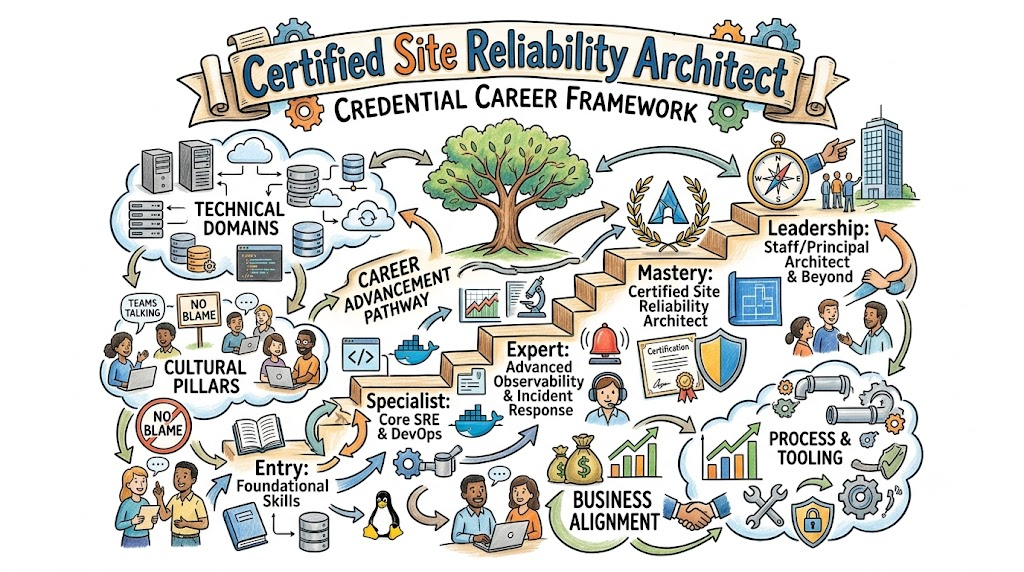
Achieving formal validation as an enterprise reliability architect permanently redefines your professional path within the global technology sector. By commanding high-level disciplines like error budgets, automated self-healing, and blameless operational cultures, you turn system reliability into an active driver of corporate innovation. This broad perspective lifts you far above mundane maintenance tasks, granting you the strategic authority needed to govern mission-critical cloud platforms. As organizations expand their reliance on complex distributed systems, certified architects will lead the modern digital enterprise forward.
Furthermore, true infrastructure mastery involves maintaining an intentional balance between cutting-edge automation software and an empathetic, blameless team environment. As you execute your multi-tier career progression, focus continuously on eliminating manual operational toil and fostering cross-team transparency. Dedicating your energy to this structured learning path guarantees that you possess the precise architectural expertise required to design resilient, future-proof platforms. Ultimately, these advanced proficiencies ensure you remain an essential leader throughout your professional engineering career.