Introduction
The MLOps Foundation Certification represents a critical bridge between data science experimentation and robust engineering production. This guide serves professionals navigating the intersection of DevOps, cloud-native infrastructure, and machine learning systems. As enterprise demand for scalable AI grows, understanding these workflows becomes essential for platform engineers and SREs alike. By reading this analysis, you will gain a clear roadmap for making informed career decisions and selecting the right educational milestones within the AIOpsSchool ecosystem.
What is the MLOps Foundation Certification?
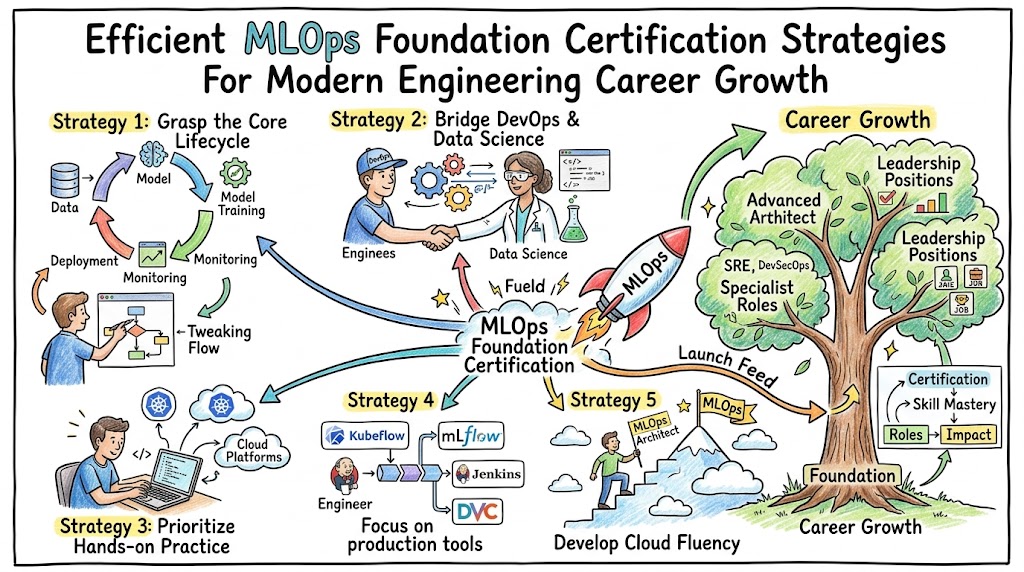
This certification represents a standard for professionals who need to manage the lifecycle of machine learning models in production environments. It focuses heavily on operationalizing data science workflows rather than just theoretical model building. Engineers learn how to automate deployment, monitor model performance, and ensure reproducibility across diverse cloud environments. Consequently, it aligns perfectly with modern enterprise practices that require high-velocity releases and stable infrastructure for AI-driven applications.
Who Should Pursue MLOps Foundation Certification?
Software engineers and SREs looking to pivot into the high-growth field of machine learning operations will find immense value here. Cloud professionals and security experts also benefit by learning how to apply governance and automated scaling to specialized ML workloads. Furthermore, engineering managers in India and across the globe use this knowledge to lead teams effectively through complex digital transformations. Even beginners with a solid grasp of Linux and automation can use this as a launchpad into the data science engineering space.
Why MLOps Foundation Certification is Valuable and Beyond
The longevity of this certification stems from its focus on principles rather than just fleeting software tools. As organizations move past simple AI pilots, they require engineers who can maintain long-term reliability and cost-efficiency. Professionals holding this credential stay relevant because they master the underlying architecture of CI/CD for machine learning. Therefore, the return on time investment is significant, providing a competitive edge as more companies adopt automated model management at scale.
MLOps Foundation Certification Overview
The program is delivered via the official course page and hosted on the specialized platform. It utilizes a structured assessment approach that validates both conceptual understanding and practical application of MLOps pillars. The certification levels are designed to take a candidate from basic architectural awareness to advanced orchestration capabilities. This ownership of the learning path ensures that professionals gain a holistic view of how data, code, and models interact within a secure pipeline.
MLOps Foundation Certification Tracks & Levels
The curriculum offers a progressive journey starting with the foundation level to build a strong vocabulary and conceptual base. Subsequently, the professional level dives deeper into automation and specialized integration with DevOps and SRE practices. Advanced tracks allow for mastery in complex areas like FinOps for ML or specialized security protocols. These levels align with career progression, helping a junior engineer eventually transition into a principal or architectural role overseeing global ML platforms.
Complete MLOps Foundation Certification Table
| Track | Level | Who it’s for | Prerequisites | Skills Covered | Recommended Order |
| Core MLOps | Foundation | Beginners/Managers | Basic IT knowledge | ML Lifecycle, CI/CD | First |
| Engineering | Professional | DevOps/SREs | Foundation level | Pipeline Automation | Second |
| Architecture | Advanced | Lead Engineers | Professional level | Scaling & Governance | Third |
| Specialized | Expert | Data Architects | Advanced level | Model Monitoring | Fourth |
Detailed Guide for Each MLOps Foundation Certification
MLOps Foundation Certification – Foundation Level
What it is
This certification validates a professional’s understanding of the core principles of Machine Learning Operations. It confirms that the holder can speak the language of both data scientists and IT operations teams effectively.
Who should take it
It is suitable for entry-level engineers, project managers, and traditional DevOps professionals who are new to ML workloads. This level serves as the essential starting point for anyone entering the AI operations domain.
Skills you’ll gain
- Understanding the ML model development lifecycle.
- Knowledge of version control for data and models.
- Basics of continuous integration in a data-centric context.
- Awareness of deployment strategies for machine learning.
Real-world projects you should be able to do
- Setting up a basic automated pipeline for a regression model.
- Implementing versioning for a small-scale dataset.
- Configuring basic monitoring alerts for model drift.
Preparation plan
- 7–14 days: Focus on high-level concepts, terminology, and the differences between traditional DevOps and MLOps.
- 30 days: Deep dive into documentation and take practice assessments to identify knowledge gaps in infrastructure.
- 60 days: Engage with hands-on labs and explore open-source tools to solidify the theoretical foundations.
Common mistakes
Candidates often focus too much on mathematical model details rather than the operational infrastructure. Another mistake is ignoring the importance of data governance and security during the initial learning phase.
Best next certification after this
- Same-track option: MLOps Professional Certification.
- Cross-track option: Cloud Architect Certification.
- Leadership option: Technical Product Management.
Choose Your Learning Path
DevOps Path
Engineers on this path focus on integrating machine learning models into existing CI/CD pipelines. They learn how to treat models as code artifacts and automate the testing phase for data integrity. This ensures that the transition from a data scientist’s notebook to a production container is seamless and repeatable. Professionals here prioritize speed of delivery without sacrificing the stability of the enterprise application environment.
DevSecOps Path
This trajectory emphasizes the security of the data supply chain and model integrity. Professionals learn to scan models for vulnerabilities and ensure that data privacy regulations are met throughout the pipeline. They implement automated security gates that prevent compromised models from reaching production. This path is vital for industries like finance and healthcare where data sensitivity is a top priority for every engineering team.
SRE Path
Site Reliability Engineers focus on the “Ops” part of MLOps by ensuring high availability and performance of model endpoints. They apply SLIs and SLOs to machine learning services to manage model decay and latency issues. On this path, the goal is to build self-healing systems that can handle traffic spikes to AI services. This ensures that machine learning features remain reliable and responsive for the end-users at all times.
AIOps Path
This path focuses on using artificial intelligence to improve traditional IT operations and monitoring. Engineers learn to implement anomaly detection and automated root cause analysis within their infrastructure. By leveraging ML for system logs and metrics, they reduce the mean time to recovery for complex distributed systems. This creates a feedback loop where AI helps manage the very systems that host AI models.
MLOps Path
The dedicated MLOps path dives deep into the specific challenges of managing stateful machine learning assets. It covers the intricacies of feature stores, model registries, and the re-training triggers required for maintaining accuracy. Engineers here become experts in the unique orchestration needs of large-scale GPU clusters and high-volume data processing. This is the most specialized route for those wanting to lead machine learning platform teams.
DataOps Path
DataOps professionals focus on the quality and flow of data that feeds the machine learning models. They implement automated data testing and orchestration to ensure that only clean, high-quality information enters the training pipeline. By treating data as a product, they reduce the friction between data engineering and data science teams. This path is essential for organizations dealing with massive, constantly changing datasets.
FinOps Path
This path addresses the significant costs associated with training and running large-scale machine learning models. Professionals learn how to optimize cloud spending by right-sizing GPU instances and implementing spot instance strategies. They provide visibility into the financial impact of different model architectures and training frequencies. This ensures that the AI initiatives of a company remain sustainable and profitable over the long term.
Role → Recommended MLOps Foundation Certification
| Role | Recommended Certifications |
| DevOps Engineer | MLOps Foundation + Professional |
| SRE | MLOps Foundation + SRE Specialist |
| Platform Engineer | MLOps Foundation + Architecture |
| Cloud Engineer | MLOps Foundation + Cloud Ops |
| Security Engineer | MLOps Foundation + DevSecOps |
| Data Engineer | MLOps Foundation + DataOps |
| FinOps Practitioner | MLOps Foundation + FinOps |
| Engineering Manager | MLOps Foundation (Overview) |
Next Certifications to Take After MLOps Foundation
Same Track Progression
Once the foundation is secure, the logical step is to move toward professional and expert levels. These advanced certifications provide the deep technical expertise required to architect complex, multi-cloud ML environments. Mastery at this level involves handling massive scale, distributed training, and automated model governance. This progression solidifies your position as a technical lead in the specialized field of machine learning engineering.
Cross-Track Expansion
Broadening your skills by moving into related tracks like DevSecOps or SRE can make you a more versatile asset. Understanding how security and reliability intersect with machine learning allows you to solve holistic problems that others might miss. This expansion is particularly useful for engineers in smaller organizations who must wear multiple hats. It ensures that your expertise remains valuable even if your specific daily tools or platforms change.
Leadership & Management Track
For those looking to move away from individual contributor roles, a leadership track is a viable next step. This involves certifications that focus on strategy, team building, and high-level technical decision-making within the AI space. You will learn how to align machine learning capabilities with business goals and manage diverse teams of specialists. This transition is ideal for senior engineers who want to influence the direction of their company’s technology stack.
Training & Certification Support Providers for MLOps Foundation
DevOpsSchool
This provider offers extensive training programs that cover the entire DevOps spectrum including specialized MLOps tracks. They focus on delivering hands-on experience through real-world projects and expert-led sessions for global professionals. Their curriculum is updated frequently to reflect the latest industry trends and toolsets required for modern engineering roles.
Cotocus
This organization specializes in cloud-native training and consulting services designed for enterprise-level skill development. They provide tailored learning paths that help engineers master complex infrastructure challenges and automation workflows. Their instructors bring years of practical experience, ensuring that students learn how to solve actual production problems effectively.
Scmgalaxy
As a community-driven platform, this provider offers a wealth of resources and training for configuration management and continuous integration. They excel at teaching the fundamental tools that form the backbone of any successful MLOps or DevOps initiative. Their focus on practical utility makes them a favorite for engineers looking to upskill quickly and efficiently.
BestDevOps
This training provider focuses on high-quality, curated content for the most in-demand technical certifications in the market today. They offer specialized bootcamps and self-paced courses that cater to different learning styles and professional schedules. Their goal is to empower engineers with the specific skills needed to excel in competitive job markets.
devsecopsschool.com
This platform is the go-to resource for engineers who want to integrate security into every step of the development lifecycle. They offer deep-dive courses on automated security testing, compliance, and vulnerability management within cloud-native environments. Their training ensures that security is never an afterthought in the machine learning or software delivery process.
sreschool.com
Focused on site reliability, this provider helps engineers build systems that are both scalable and highly dependable. Their curriculum covers monitoring, incident response, and the application of SRE principles to modern AI and machine learning workloads. They provide the tools needed to maintain service levels in the face of complex infrastructure failures.
aiopsschool.com
This is a premier destination for learning how to apply artificial intelligence to IT operations and infrastructure management. They offer a comprehensive range of certifications that bridge the gap between data science and traditional system administration. Their programs are specifically designed to help professionals lead the next wave of intelligent automation.
dataopsschool.com
This school focuses on the critical intersection of data engineering and operations, emphasizing quality and speed of data delivery. They teach the methodologies required to build robust data pipelines that feed machine learning models and business intelligence tools. Their training is essential for anyone looking to master the flow of information in a modern enterprise.
finopsschool.com
This provider addresses the growing need for financial accountability and optimization in cloud and AI spending. They offer specialized training on how to manage costs while maintaining the performance of high-scale machine learning systems. Their courses empower engineers to make data-driven decisions that balance technical excellence with fiscal responsibility.
Frequently Asked Questions (General)
- How difficult is the MLOps Foundation exam for a beginner?
The foundation level is designed to be accessible for those with a basic understanding of IT and automation. While it requires study, it focuses more on concepts than complex coding.
- What is the typical time commitment required for preparation?
Most professionals find that 30 to 60 days of consistent study is sufficient to master the material. This includes reading the theory and engaging in basic hands-on lab exercises.
- Are there any specific prerequisites before I start this track?
There are no strict formal prerequisites, but a basic understanding of the Linux command line and version control is highly recommended. Familiarity with the software development lifecycle will also help.
- What is the expected ROI on this certification for my career?
The ROI is high, as MLOps is one of the fastest-growing specializations in the tech industry. It often leads to higher salary brackets and more senior architectural roles.
- In what sequence should I take the different certification levels?
It is best to start with the Foundation level, followed by the Professional and then the Advanced levels. This ensures you build a solid knowledge base before tackling complex topics.
- How does this certification differ from a standard DevOps credential?
While DevOps focuses on traditional software, MLOps adds the complexities of data versioning, model training, and performance monitoring. It requires a different approach to lifecycle management.
- Is this certification recognized globally by major tech companies?
Yes, the principles taught in this program align with industry standards used by global enterprises. It demonstrates a verified level of competence to potential employers worldwide.
- Do I need to be a data scientist to pass the MLOps exam?
No, you do not need to be a data scientist, as the focus is on the operational infrastructure. However, you should understand how data scientists work to support them effectively.
- What tools will I learn to use during the certification process?
You will gain exposure to a variety of tools used for CI/CD, containerization, and model registry management. The focus remains on the principles that apply to any toolset.
- Can I transition from a traditional sysadmin role to MLOps?
Absolutely, many successful MLOps engineers started in system administration or traditional operations roles. This certification provides the necessary bridge to the machine learning domain.
- How often does the certification curriculum get updated?
The curriculum is reviewed and updated regularly to keep pace with the rapidly evolving AI landscape. This ensures the information you learn is always relevant to current trends.
- Is there a community or forum for students to discuss the exam?
Yes, the provider platforms usually offer access to forums and communities where you can interact with peers. Engaging with others can provide valuable insights and study tips.
FAQs on MLOps Foundation
- How does MLOps handle model decay compared to software bugs?
Answer: Unlike static software bugs, models decay over time due to changing real-world data patterns, known as drift. MLOps introduces continuous monitoring to detect this performance drop and triggers automated re-training. This proactive approach ensures the model remains accurate without manual intervention.
- Why is versioning data more complex than versioning source code?
Answer: Data is much larger and more dynamic than code, making traditional versioning tools like Git insufficient for large datasets. MLOps utilizes specialized tools to track changes in data subsets used for specific training runs. This allows for total reproducibility of model results at any time.
- What role does containerization play in the MLOps foundation?
Answer: Containers ensure that the environment used for training a model is identical to the one used for serving it. This eliminates the “it works on my machine” problem between data scientists and operations. It also allows for easier scaling across different cloud providers and on-premises hardware.
- How do CI/CD pipelines change when machine learning is involved?
Answer: In MLOps, CI/CD expands to include Continuous Training (CT), where the pipeline automatically updates models based on new data. The pipeline must also include data validation steps to ensure the input quality remains high. This creates a three-dimensional automation flow: code, data, and models.
- What is a model registry and why is it essential?
Answer: A model registry acts as a central repository for storing, versioning, and managing the lifecycle of ML models. it allows teams to track which model version is in production and roll back if issues occur. It provides the necessary governance for enterprise-scale AI deployments.
- How does MLOps improve collaboration between different technical teams?
Answer: It provides a shared set of tools and a common language that bridges the gap between data science and operations. By standardizing the deployment process, it reduces friction and misunderstandings that often delay AI projects. This results in faster delivery and more stable production systems.
- What are the key metrics for measuring MLOps success?
Answer: Success is measured by deployment frequency, the mean time to deploy a new model, and model accuracy in production. Reliability metrics like latency and system uptime are also critical for operational excellence. These KPIs help teams demonstrate the business value of their MLOps initiatives.
- Can MLOps principles be applied to small-scale AI projects?
Answer: Yes, even small projects benefit from the organization, reproducibility, and automation that MLOps provides. Starting with these principles early prevents technical debt and makes scaling easier as the project grows. It establishes a professional foundation that supports long-term success and easier maintenance.
Final Thoughts: Is MLOps Foundation Certification Worth It?
Investing in this certification is a strategic move for any engineer looking to stay competitive in an increasingly AI-driven market. It provides a structured path to move beyond simple automation and into the complex world of managing intelligent systems at scale. By mastering these principles, you position yourself as a vital link in the enterprise technology chain, capable of delivering reliable and cost-effective AI solutions. Ultimately, the value lies in the transition from being a generalist to a specialist who can navigate the unique challenges of the machine learning lifecycle with confidence.
Modern systems no longer rely on code alone; they rely on the continuous flow of data and the intelligence of models. Having a foundation in how these components interact is no longer optional for senior engineering roles. This certification offers the clarity and validation needed to prove you are ready for that challenge. Focus on the core concepts, embrace the hands-on labs, and you will find that the career opportunities following this path are both diverse and rewarding.