Modern production environments demand a seamless bridge between data science and traditional software engineering. This comprehensive guide explores the Certified MLOps Engineer program, which provides a structured curriculum for professionals aiming to master this intersection. As the industry prioritizes automated pipelines and scalable AI infrastructure, engineers must adopt advanced deployment strategies. This roadmap helps practitioners navigate the complexities of model lifecycle management within cloud-native ecosystems. Technical leaders and individual contributors can use these certification tracks to make informed decisions about their professional development through AIOpsSchool.
What is the Certified MLOps Engineer?
The Certified MLOps Engineer designation validates specialized proficiency in managing the end-to-end lifecycle of machine learning models. This certification focuses strictly on the operationalization of models within production-grade environments rather than theoretical data science. It establishes the critical link between notebook-based experimentation and high-availability model maintenance at scale. The curriculum emphasizes automation, monitoring, and robust CI/CD practices specifically tailored for machine learning assets.
Enterprise practices currently require more than simple model accuracy; they demand reliability and reproducibility. This certification validates that an engineer can handle data versioning, model drift, and infrastructure scaling effectively. It reflects a deep commitment to the operational side of AI, ensuring that models deliver consistent business value without manual intervention. By focusing on production-heavy learning, it prepares engineers for the unique challenges of non-deterministic code in professional settings.
Who Should Pursue Certified MLOps Engineer?
Software engineers and DevOps practitioners looking to pivot into AI infrastructure gain significant advantages from this path. Site Reliability Engineers (SREs) who maintain machine learning services find specific insights into model-specific failure modes. Cloud professionals and data engineers also benefit by learning how to wrap their data pipelines into a cohesive operational framework. The certification provides a structured transition from general infrastructure management to specialized AI operations.
Engineering managers and technical leaders overseeing cross-functional teams value the technical clarity this program provides. Beginners with strong foundations in Linux and Python find a clear trajectory into specialized roles. Experienced veterans use it as formal validation of their ability to manage complex, data-heavy systems. In global tech hubs and rapidly expanding markets like India, these skills remain in high demand as organizations move toward full-scale AI deployment.
Why Certified MLOps Engineer is Valuable and Beyond
The demand for MLOps expertise continues to rise as enterprises recognize that most AI projects fail during the deployment phase. This certification ensures career longevity by focusing on foundational operational principles instead of fleeting toolsets. While specific frameworks change, the need for automated testing, monitoring, and deployment remains constant. Professionals who master these skills stay relevant by acting as the essential link between research and tangible business outcomes.
Investing time in this certification offers a massive return by addressing a critical bottleneck in the tech industry. Companies pay a premium for engineers who stabilize AI offerings and reduce time-to-market for new models. As AI adoption becomes ubiquitous, a validated skill set in MLOps provides a distinct competitive advantage. It moves a professional from a generalist position into a specialized niche central to the future of software development.
Certified MLOps Engineer Certification Overview
The program delivers training through the official course portal and resides on the primary hosting site mentioned in the introduction. It creates a comprehensive journey moving from basic containerization to advanced model monitoring and retraining. The assessment approach uses practical scenarios that mimic real-world production outages or deployment hurdles. This ensures that the candidate can execute technical tasks under pressure rather than just reciting theory.
The modular structure encourages ownership of the learning process and allows for incremental progress. Designers built this certification to be accessible yet challenging, ensuring the final credential carries weight in the competitive job market. It covers the full spectrum of MLOps, including data engineering and operational maintenance. By focusing on these core pillars, the program provides a holistic view of running machine learning at scale in enterprise environments.
Certified MLOps Engineer Certification Tracks & Levels
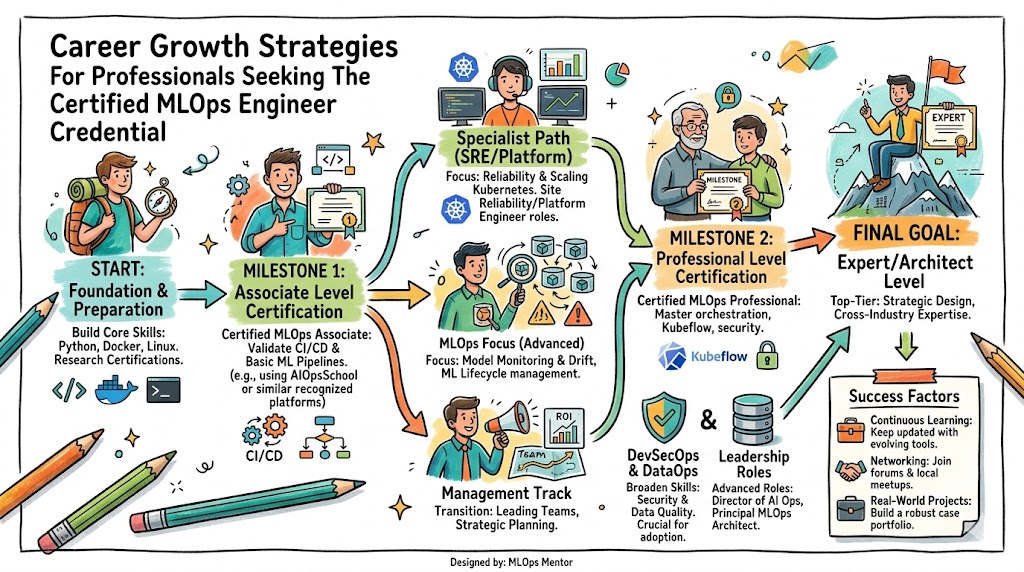
The certification utilizes logical levels to accommodate different career stages, starting with a foundation level for newcomers. This entry point establishes the basic vocabulary of MLOps and the fundamental tools required for pipeline automation. The professional level explores advanced orchestration, security, and complex data handling. Finally, the advanced level serves architects and senior leads who design entire AI platforms from the ground up.
Specialization tracks allow professionals to align their certification with their specific career goals, such as SRE or FinOps aspects of AI. These levels mirror typical career progression, moving from execution to design and strategic oversight. By following these tracks, an engineer builds a deep portfolio that proves expertise to stakeholders. This structured approach helps build a cohesive skill set that remains both broad and deep.
Complete Certified MLOps Engineer Certification Table
| Track | Level | Who it’s for | Prerequisites | Skills Covered | Recommended Order |
| Foundation | Associate | Beginners / Analysts | Basic Python | CI/CD, Git, Docker | 1st |
| Professional | Professional | DevOps / Data Engineers | Associate Level | Kubernetes, Kubeflow | 2nd |
| Advanced | Expert | Architects / Leads | Professional Level | Scaling, Security, Drift | 3rd |
| SRE Focus | Specialist | SREs / Platform Eng | Kubernetes Exp | Monitoring, Logging | 4th (Optional) |
| Data Focus | Specialist | Data Engineers | SQL / Big Data | Feature Stores, ETL | 4th (Optional) |
Detailed Guide for Each Certified MLOps Engineer Certification
Certified MLOps Engineer – Associate Level
What it is
This entry-level certification validates an understanding of the basic MLOps lifecycle and tools used for automated machine learning pipelines. It ensures the candidate can handle version control and containerization for AI models.
Who should take it
Junior developers, data analysts, or traditional DevOps engineers new to the machine learning domain should start here. It serves as an ideal starting point for anyone building a foundation in AI operations.
Skills you’ll gain
- Containerize ML models using Docker.
- Implement CI/CD pipelines for Python-based models.
- Version data and code using Git and DVC.
- Define core components of an MLOps architecture.
Real-world projects you should be able to do
- Automate the deployment of a regression model to a cloud environment.
- Create repeatable environments for data science teams using containers.
- Set up basic monitoring dashboards for model performance metrics.
Preparation plan
- 7–14 days: Study Docker basics and MLOps terminology.
- 30 days: Build three projects involving Git and simple automation.
- 60 days: Complete the full syllabus and take practice exams.
Common mistakes
- Ignoring data versioning while focusing solely on code.
- Underestimating the importance of Linux command-line proficiency.
Best next certification after this
- Same-track option: Professional Certified MLOps Engineer.
- Cross-track option: Certified DataOps Professional.
- Leadership option: Technical Team Lead Foundation.
Certified MLOps Engineer – Professional Level
What it is
The professional level validates technical expertise in orchestrating complex machine learning workflows at scale. It focuses on using Kubernetes and Kubeflow to manage production-grade AI systems.
Who should take it
Experienced DevOps engineers or Data Engineers managing multi-model environments should pursue this level. It serves those responsible for the reliability and scalability of AI services.
Skills you’ll gain
- Orchestrate advanced ML workflows using Kubernetes.
- Implement automated model retraining and validation loops.
- Manage feature stores and complex data ingestion pipelines.
- Optimize resource utilization for GPU workloads.
Real-world projects you should be able to do
- Deploy a multi-stage Kubeflow pipeline for data cleaning and training.
- Implement blue-green deployment strategies for AI inference services.
- Set up automated alerts for detecting data drift in production.
Preparation plan
- 7–14 days: Review Kubernetes architecture and orchestration principles.
- 30 days: Deep dive into Kubeflow and cloud-native scaling.
- 60 days: Build a full end-to-end automated pipeline and troubleshoot failures.
Common mistakes
- Prioritizing the ML model over infrastructure stability.
- Neglecting security and access control within the cluster.
Best next certification after this
- Same-track option: Expert MLOps Architect.
- Cross-track option: Certified Cloud Security Professional.
- Leadership option: Engineering Manager (ML focus).
Choose Your Learning Path
DevOps Path
Engineers on the DevOps path focus on integrating development and operations while managing data complexity. They prioritize CI/CD for ML models and ensure the development cycle remains fast and reliable. These professionals automate everything from code commits to production monitoring. This path suits those who enjoy building infrastructure and automation systems.
DevSecOps Path
The DevSecOps path emphasizes securing the machine learning supply chain from start to finish. Professionals scan models for vulnerabilities, ensure data privacy compliance, and protect inference endpoints. They integrate security into the heart of the MLOps pipeline instead of treating it as an afterthought. This path remains critical for industries like finance and healthcare.
SRE Path
Practitioners on the SRE path focus on the reliability, availability, and performance of ML models in production. They use software engineering principles to solve infrastructure problems and meet Service Level Objectives (SLOs). These experts handle monitoring, incident response, and capacity planning for large-scale AI clusters. This path serves professionals who enjoy high-stakes production management.
AIOps Path
The AIOps path utilizes machine learning to improve IT operations and predict potential outages. Engineers in this track build systems that automate root cause analysis and optimize infrastructure performance using data insights. It creates a meta-approach where machine learning supports the hosting infrastructure. This path attracts those interested in the future of autonomous IT operations.
MLOps Path
The MLOps path applies DevOps principles directly to the machine learning lifecycle. It addresses challenges like non-deterministic code, data versioning, and constant retraining needs. Engineers work closely with data scientists to transform experimental code into robust services. This represents the core path for AI delivery and maintenance specialists.
DataOps Path
The DataOps path ensures high-quality data flows into machine learning models consistently and on time. It involves automating data engineering tasks, managing data lakes, and protecting the data supply chain. MLOps cannot succeed without solid DataOps foundations. This path benefits those who enjoy working with big data technologies and ETL processes.
FinOps Path
The FinOps path addresses the high costs associated with running machine learning at scale, particularly GPU usage. Engineers in this track focus on cost optimization, budget tracking, and financial sustainability for AI initiatives. They bridge the gap between finance and engineering departments. This path remains essential for organizations looking to maximize their ROI on AI.
Role → Recommended Certified MLOps Engineer Certifications
| Role | Recommended Certifications |
| DevOps Engineer | Associate and Professional MLOps |
| SRE | Professional MLOps and SRE Specialist |
| Platform Engineer | Expert MLOps Architect |
| Cloud Engineer | Associate MLOps and Cloud Specialization |
| Security Engineer | MLOps with DevSecOps Focus |
| Data Engineer | DataOps and Professional MLOps |
| FinOps Practitioner | MLOps Foundation and FinOps Specialist |
| Engineering Manager | Associate MLOps and Leadership Track |
Next Certifications to Take After Certified MLOps Engineer
Same Track Progression
Deep specialization involves moving toward Expert or Architect levels of MLOps. This means mastering complex edge cases like federated learning or low-latency inference for edge devices. Staying on this track establishes you as a subject matter expert for strategic technical decisions. It requires staying at the forefront of new tools and evolving industry standards.
Cross-Track Expansion
Skill broadening allows an engineer to become versatile by earning certifications in related fields like DevSecOps. Understanding security implications or cost drivers adds immense value to an MLOps professional. This cross-pollination of skills creates a “T-shaped” professional who collaborates effectively across departments. It opens a wider range of career opportunities.
Leadership & Management Track
Those moving away from hands-on coding focus on team management and strategic project delivery. This transition requires understanding the business impact of MLOps and building high-performing engineering cultures. Certifications in engineering management serve as logical next steps. This path leads toward roles like Director of AI Operations or CTO.
Training & Certification Support Providers for Certified MLOps Engineer
DevOpsSchool
This organization delivers high-impact training that focuses on the practical side of software automation and cloud deployment. They provide students with the hands-on labs necessary to master the tools used in modern enterprise environments.
Cotocus
This provider offers specialized coaching for technical teams looking to integrate diverse engineering disciplines into a cohesive workflow. Their programs emphasize real-world application and rapid skill acquisition for the modern workforce.
Scmgalaxy
Technical professionals turn to this site for deep insights into configuration management and the security of the software supply chain. Their community-driven approach provides a wealth of resources for solving complex infrastructure problems.
BestDevOps
This platform simplifies the learning curve for complex technical certifications by offering curated paths and expert-led tutorials. They focus on the best practices that lead to more efficient and reliable delivery pipelines.
devsecopsschool.com
Engineers visit this site to learn the critical skills required to embed security into every stage of the development lifecycle. Their courses prepare professionals to handle modern threats in an automated, cloud-native world.
sreschool.com
This training provider focuses entirely on the principles of site reliability and high-performance system management. They teach the methodologies required to keep global services running smoothly under extreme load.
aiopsschool.com
As the leader in intelligence-driven operations, this site offers the primary certifications for the future of infrastructure management. They provide the most direct path to mastering the intersection of AI and IT.
dataopsschool.com
This organization specializes in the management and orchestration of complex data pipelines for modern analytics. Their training ensures that data remains a reliable asset throughout the entire machine learning lifecycle.
finopsschool.com
Professionals learn to manage the economic side of cloud computing through the specialized programs offered here. They provide the tools and strategies needed to balance high-performance computing with financial responsibility.
Frequently Asked Questions
- How difficult is the Certified MLOps Engineer exam?
Moderate to high difficulty marks this exam because it requires a strong understanding of DevOps and ML workflows. It tests practical application rather than simple memorization.
- How much time does it take to get certified?
Most professionals spend 30 to 60 days on dedicated study, depending on their existing background in Linux and Python.
- What are the prerequisites for the associate level?
Basic Python programming and familiarity with the Linux command line serve as the primary requirements. Prior ML experience remains helpful but not strictly necessary.
- Is this certification recognized globally?
Yes, employers across the globe, especially in North America, Europe, and India, highly demand these validated skills.
- What is the ROI of getting MLOps certified?
The return on investment remains significant, often leading to higher salary brackets and roles in high-impact AI projects.
- Should I learn DevOps before MLOps?
A foundation in DevOps principles like CI/CD and containerization makes the MLOps learning journey much smoother.
- How often do I need to renew the certification?
Typically, these certifications remain valid for two to three years before requiring a recertification exam.
- Are there hands-on labs included in the training?
Yes, the emphasized training programs focus heavily on hands-on labs to ensure practical application of concepts.
- Can a manager benefit from this certification?
Absolutely, it helps managers understand technical constraints and improves project planning and resource allocation.
- Does the certification cover specific cloud providers?
Core principles remain cloud-agnostic, but training often uses AWS, Azure, or Google Cloud for practical exercises.
- What is the difference between DataOps and MLOps?
DataOps focuses on high-quality data delivery, while MLOps focuses on the deployment and maintenance of models.
- Is there a community for certified professionals?
Yes, training providers maintain active communities for networking, knowledge sharing, and finding job opportunities.
FAQs on Certified MLOps Engineer
- What specific tools are covered in the curriculum?
The program emphasizes essential tools like Docker, Kubernetes, Kubeflow, MLflow, and DVC. These represent industry standards for modern AI pipelines.
- How does this certification help career growth in India?
India experiences a massive surge in AI adoption, and this certification positions you as a specialist in a high-demand market.
- Can I take the exam online?
Yes, candidates typically take the exams through an online proctored format from any location globally.
- Is the syllabus updated for the latest AI trends?
Regular reviews ensure the curriculum includes the latest best practices in LLMOps and cloud-native architectures.
- What kind of support is available if I get stuck?
Providers offer instructor-led sessions, community forums, and technical assistance for hands-on labs.
- Are there group discounts for corporate teams?
Most providers offer corporate packages for teams looking to upskill their entire engineering department.
- How does MLOps differ from traditional software engineering?
The non-deterministic nature of models and dependency on evolving data require unique testing and monitoring strategies.
- Is this certification enough to get a job?
A powerful validator like this works best when combined with a portfolio of real-world projects.
Final Thoughts: Is Certified MLOps Engineer Worth It?
Investing in an MLOps career represents a strategic move for any engineer today. The tech world has moved past AI novelty into a phase of industrialization where reliability and efficiency define success. This certification provides the roadmap and validation needed to thrive in such an environment. It transcends learning a single tool and encourages a mindset that balances data science speed with operational stability.
Engineers seeking to future-proof their careers and work on cutting-edge projects will find this path rewarding. The substantial investment in time and effort leads to significant rewards in professional growth and job satisfaction. Focus on the fundamentals, master the hands-on labs, and use this certification as a stepping stone toward a leadership role in AI operations.