Introduction
Mastering cloud infrastructure design remains the most critical skill for high-level technical leadership in the modern era. The Azure Solutions Architect Expert certification empowers professionals to architect and implement complex, production-ready solutions on Microsoft’s premier cloud platform. This guide helps senior engineers and technical leads shift their focus from tactical maintenance to strategic system orchestration. By utilizing the expert-led training from DevOpsSchool, you can conquer the complexities of identity security, resilient data fabrics, and enterprise governance. This analysis details the exact path to achieving this milestone and explains how it redefines your value in the global engineering market.
Understanding the Azure Solutions Architect Expert Core
The Azure Solutions Architect Expert designation validates an engineer’s power to build holistic business solutions on Microsoft Azure. It moves beyond standard administrative tasks by focusing on how compute, storage, and networking layers integrate to solve high-level organizational challenges. This certification ensures that you can design environments that prioritize reliability, security, and financial efficiency simultaneously.
Expert architects serve as the vital bridge between corporate stakeholders and technical implementation teams. They must understand virtualization, hybrid networking, and resource governance with incredible depth. Instead of simply configuring services, an expert architect designs a unified ecosystem that maintains peak performance across the entire enterprise cloud landscape.
Ideal Candidates for the Architect Path
Senior developers, systems engineers, and SREs who already possess extensive Azure experience will find this path most beneficial. It specifically empowers those who make structural infrastructure decisions and must justify those choices to executive leadership. If you want to spearhead massive digital transformation projects, this credential provides the technical authority you need to lead with confidence.
Data specialists and security leads also gain significant perspective from this curriculum by seeing how their specific domains integrate with the broader Azure framework. Technical managers in India and globally use this certification to prove their ability to manage large-scale migrations using cloud-native best practices. It transforms experienced technicians into strategic architectural visionaries.
Why Architectural Mastery Dominates the 2026 Landscape
Enterprises across the globe increasingly demand sustainable and scalable cloud systems as hybrid strategies reach maturity. While specific tools and features evolve rapidly, core design principles like decoupling, scalability, and security remain the bedrock of successful infrastructure. This certification proves that you possess the advanced critical thinking skills required to maintain system health over a long-term horizon.
Securing this credential offers massive returns through access to executive-level roles and long-term career stability. Organizations prioritize “T-shaped” professionals who combine wide-ranging cloud knowledge with deep technical specialization. Mastering these architectural concepts ensures your career stays resilient regardless of how the Microsoft Azure feature set changes.
Program Methodology and Assessment
DevOpsSchool delivers this high-level training program through a specialized portal designed for enterprise learning. The curriculum balances intense theoretical study with hands-on, scenario-based challenges to guarantee total mastery of the material. This rigorous approach prevents simple rote memorization, forcing candidates to apply complex architectural patterns to solve actual production problems.
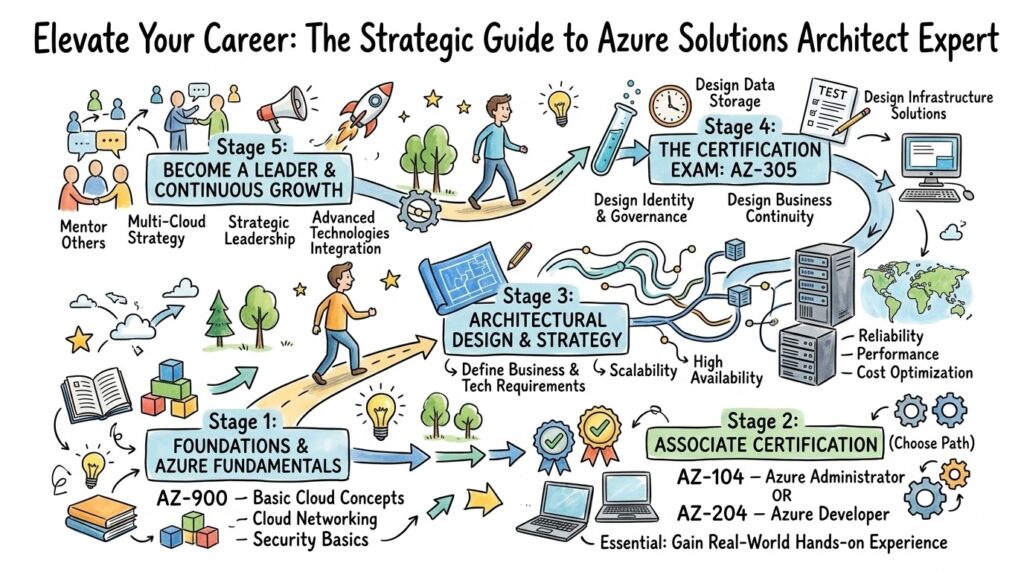
The program structure follows the complete lifecycle of a cloud project, from the initial discovery and design phase to long-term operational management. Earning this certificate demonstrates your ability to take full ownership of a project’s technical success. Because this is an “Expert” level track, you must first complete associate-level prerequisites to build the necessary foundation for advanced design work.
The Evolution of Azure Certification Levels
Becoming a master architect requires a progressive journey that begins with fundamental cloud concepts. Most professionals then advance to the associate level to gain practical, hands-on experience in either administration or development. The Azure Solutions Architect Expert serves as the final, most advanced milestone in this professional development hierarchy.
Professionals can also pivot into specialized tracks like FinOps, Security, or SRE to further distinguish their profiles. For example, an architect might choose the FinOps track to specialize in cloud financial management and cost optimization. This tiered approach ensures your professional growth matches the continuous expansion of your technical capabilities.
Strategic Certification Mapping Table
| Track | Level | Targeted Professional | Prerequisites | Key Skills Covered | Recommended Order |
| Cloud Core | Foundation | Managers, Beginners | None | Cloud Concepts, Basics | 1 |
| Operations | Associate | Admins, Engineers | Foundational Knowledge | Compute, Network, Identity | 2 |
| Architecture | Expert | Senior Leads, Architects | Associate Certificate | Design, Security, Business Logic | 3 |
| Protection | Specialty | Security Leads | Associate Level | Threat Defense, Compliance | 4 |
| Analytics | Specialty | Data Architects | Associate Level | SQL, NoSQL, Data Lakes | 4 |
Deep Dive: Azure Solutions Architect Expert (AZ-305)
The Primary Mission
This certification validates your capacity to design hybrid and cloud solutions that balance technical performance with business constraints. It focuses on selecting the perfect service mix to achieve specific technical and financial objectives.
Target Professional Roles
Senior consultants and infrastructure designers who define the backbone of Azure environments should prioritize this credential. It perfectly suits those who already understand the daily mechanical operations of the Azure portal and want to move into design.
Essential Skills You Will Gain
- Designing governance, monitoring, and identity infrastructures.
- Formulating advanced data storage and integration strategies.
- Creating robust business continuity and disaster recovery plans.
- Designing high-performance compute and networking architectures.
Expected Production Outcomes
- Designing a multi-region failover architecture for global applications.
- Building secure hybrid connectivity between on-premises sites and Azure.
- Developing a comprehensive migration roadmap for complex legacy databases.
Recommended 60-Day Prep Plan
- Weeks 1–2: Deep dive into Microsoft Entra ID (Identity) and design documentation.
- Month 1: Focus on hands-on labs involving Bicep, ARM templates, and complex VNets.
- Month 2: Analyze architectural case studies and use practice tests to sharpen your logic.
Common Mistakes to Avoid
- Focusing on “how” to implement a service rather than “why” it is the best choice.
- Neglecting the financial optimization and governance aspects of cloud design.
- Underestimating the difficulty of hybrid identity and cross-tenant migrations.
Next Career Steps
- Vertical Growth: Azure Network Engineer Associate.
- Horizontal Expansion: Azure DevOps Engineer Expert.
- Leadership Focus: Certified Cloud Security Professional (CCSP).
Specialized Learning Strategies
DevOps Strategy
This path focuses on automating every stage of software delivery and infrastructure management. Architects learn to build robust CI/CD pipelines and master Infrastructure as Code (IaC) to ensure environment consistency. This strategy allows teams to achieve rapid, reliable, and repeatable release cycles.
DevSecOps Strategy
Security integrates into every phase of the development lifecycle in this approach. It prioritizes “shifting security left” by automating vulnerability scans and continuous compliance checks. Architects design systems that remain secure by default, which significantly lowers production risks.
SRE Strategy
Software engineering principles drive this approach to infrastructure and operations management. It focuses on scalability and reliability through the use of Service Level Objectives (SLOs) and Error Budgets. Architects build resilient systems that can heal themselves and withstand infrastructure failures.
AIOps / MLOps Strategy
This path manages the complete lifecycle of machine learning models and AI-driven operational tasks. Architects design the high-performance infrastructure required to process massive enterprise datasets. It ensures that AI models deploy, monitor, and retrain without interrupting business operations.
DataOps Strategy
Policy-driven automation defines this path for managing enterprise data at scale. It accelerates analytics cycles by applying DevOps principles to complex data pipelines. Architects ensure that data remains consistent, high-quality, and accessible across the entire organization.
FinOps Strategy
Financial management and cloud cost optimization drive this specific strategy. It aligns engineering, finance, and business units to ensure total financial accountability for cloud resource use. Architects design for cost-efficiency to maximize the return on every cloud investment.
Role-Based Certification Matrix
| Professional Role | Recommended Certification Roadmap |
| DevOps Engineer | Architect Expert + DevOps Expert |
| SRE | Architect Expert + Azure Administrator |
| Platform Engineer | Architect Expert + Network Associate |
| Cloud Engineer | Architect Expert + Azure Fundamentals |
| Security Architect | Architect Expert + Security Engineer |
| Data Engineer | Architect Expert + Data Engineer |
| FinOps Practitioner | Architect Expert + Cloud Digital Leader |
| Engineering Manager | Architect Expert + PMP Certification |
Advancing Beyond Expert Status
Deep Technical Specialization
After achieving the Expert level, you should pursue specialty badges in areas like SAP on Azure or advanced networking. This establishes you as the primary subject matter expert for the most difficult technical challenges. It proves you can handle specialized enterprise workloads with absolute precision.
Cross-Cloud Versatility
Expanding your knowledge into GCP or AWS makes you an incredibly valuable multi-cloud architect. Gaining Kubernetes certifications like CKA or CKAD also complements your Azure skills perfectly. Companies prioritize this versatility to avoid vendor lock-in and manage diverse technology stacks.
Transitioning to Leadership
Focus on risk management and strategic planning if you want to lead entire technical departments. Earning a CISM or an MBA helps you transition into CTO or Director roles. This path shifts your focus from designing technical systems to leading the people who build them.
The Training Support Ecosystem
DevOpsSchool provides intensive training programs led by industry veterans to help you master Azure architecture. Their curriculum focuses on hands-on labs, ensuring that you can apply architectural patterns to real production environments immediately. They offer the mentorship needed to bridge the gap between engineer and architect.
Cotocus specializes in technical consulting and high-end training for cloud-native technologies. Their workshops dive deep into Azure automation and complex infrastructure design. They offer a practical approach that helps enterprise teams modernize their cloud capabilities quickly and efficiently.
Scmgalaxy acts as a major community hub for DevOps and configuration management professionals. They provide a wealth of tutorials and guides to support your Azure learning journey. Their resources help you understand how Azure fits into the broader world of modern software delivery.
BestDevOps prioritizes the most in-demand skills in the current market through focused training tracks. Their Azure programs help candidates clear exams while building genuine technical competence. They create a supportive environment for mastering complex subjects like enterprise-scale security.
devsecopsschool.com focuses on the critical intersection of security and cloud operations. Their training for architects emphasizes building secure-by-design systems and mastering identity governance. They prepare you to handle the toughest security challenges in the modern cloud landscape.
sreschool.com delivers education specifically tailored to the principles of site reliability engineering. Architects learn how to design Azure systems that maintain maximum performance and uptime. Their focus on observability ensures you can build resilient, enterprise-grade cloud solutions.
aiopsschool.com addresses the growing field of AI-driven IT operations. They help Azure architects integrate machine learning into complex infrastructure management tasks. This curriculum prepares you for the future of automated, intelligent cloud environments.
dataopsschool.com offers specialized training for managing enterprise data at scale. They teach architects how to build efficient data pipelines and storage solutions that support high-speed analytics. Their focus on data quality is vital for data-driven organizations.
finopsschool.com tackles the essential need for financial management in the cloud. They equip Azure architects with the tools to optimize spending and justify cloud investment. Their training ensures that your architectures remain economically sustainable for the long term.
Frequently Asked Questions
1. How difficult is the Azure Solutions Architect Expert exam?
Microsoft builds this exam to be very challenging because it prioritizes high-level design strategy over simple implementation tasks.
2. Do I need to be a master coder to pass?
You do not need to be a full-time software developer, but you must understand logic and how automation scripts interact with infrastructure.
3. Is the Azure Administrator Associate a mandatory requirement?
Yes, Microsoft requires you to hold a valid Administrator Associate certification before they will grant you the Architect Expert status.
4. How much time should I spend on my studies?
Most professionals with a solid background spend 30 to 60 days preparing, depending on their familiarity with advanced cloud patterns.
5. What is the actual ROI for this certification?
It usually leads to senior-level roles, significantly higher pay, and the authority to lead major digital transformation initiatives for large firms.
6. Can I take the certification exam online?
Microsoft offers proctored online exams that you can take from your home or office, provided you meet the technical requirements.
7. Does this certification expire?
You must renew Microsoft certifications annually through a free online assessment to ensure your skills stay current with cloud updates.
8. Is this certification recognized in the Indian market?
Yes, top IT firms and global centers across India highly value this credential when hiring for senior-level engineering positions.
9. What is the main difference between an Admin and an Architect?
Administrators focus on the daily management of resources, while architects focus on the long-term design and strategy of those resources.
10. Should I prioritize Azure over AWS?
Azure is an excellent choice if you work in or target enterprise environments that rely heavily on the Microsoft software ecosystem.
11. Do I need Kubernetes knowledge for this exam?
Modern architects must understand container orchestration and how services like AKS fit into an overall enterprise infrastructure design.
12. Are there lab questions in the final exam?
The exam format changes occasionally, so you should prepare for performance-based tasks or complex case studies that mimic real-world problems.
Specialized FAQs for Azure Architects
1. Which Azure services appear most often in the exam?
The exam covers a wide range, including VMs, App Services, ExpressRoute, and Cosmos DB. It places a massive emphasis on identity management through Entra ID.
2. How does this path benefit Site Reliability Engineers?
It provides the foundational design knowledge required to build highly available systems. Mastering disaster recovery and fault tolerance makes you a perfect SRE candidate.
3. Can I skip the associate level if I have 10 years of experience?
No, Microsoft strictly enforces the certification path. You must complete the associate-level requirements first, regardless of your professional background.
4. How does architectural design influence cloud spending?
Good design choices—like right-sizing resources and using serverless options—reduce waste. Architects balance performance requirements with strict financial constraints.
5. Is hybrid cloud a major focus for an Azure Architect?
Most large enterprises use hybrid models. Knowing how to connect on-premises data centers to Azure securely is a core part of the expert-level curriculum.
6. What role does governance play in the expert exam?
Governance is a vital pillar. You learn how to use Azure Policy and Management Groups to maintain control over thousands of enterprise resources.
7. How important is Infrastructure as Code (IaC) to this role?
While the exam focuses on design, architects must understand how IaC tools like Terraform or Bicep ensure consistent and repeatable deployments.
8. What are the most reliable study resources?
Use official Microsoft documentation, practice tests, and reputable training providers. Avoid unverified sources that don’t help you understand the underlying concepts.
Final Thoughts: Is the Azure Solutions Architect Expert Worth It?
Earning the Azure Solutions Architect Expert title marks your transition from a technical implementer to a strategic advisor. It forces you to view technology through the lens of business value and long-term sustainability. In a crowded job market, an expert-level credential distinguishes you as someone capable of leading the most complex enterprise initiatives.


Leave a Reply
You must be logged in to post a comment.