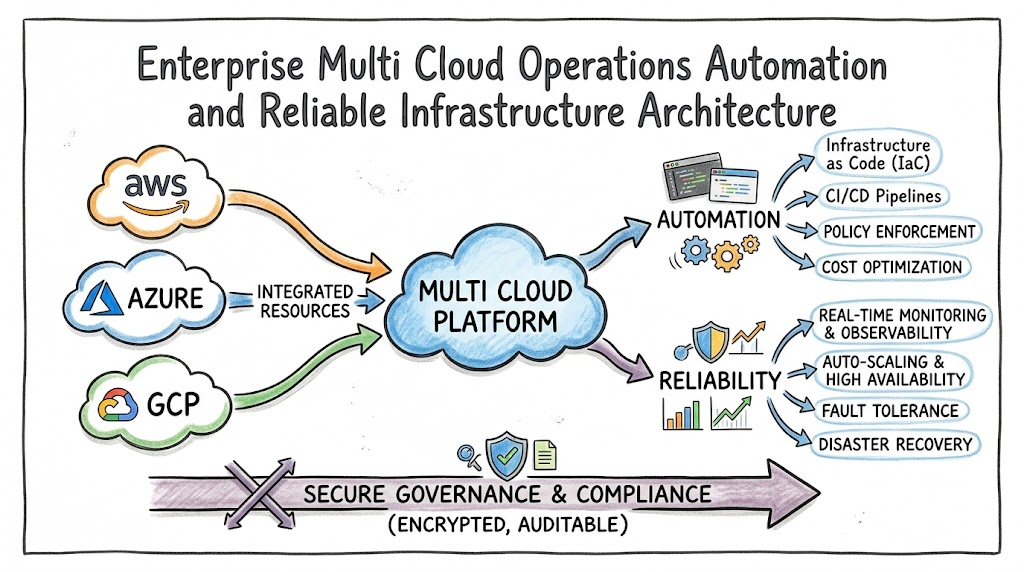
Foundations of Distributed Systems
Software engineering organizations demand elastic, resilient infrastructure to support high-throughput applications and satisfy end-user expectations. However, managing distributed microservices across disparate public environments introduces operational bottlenecks, unexpected configuration drift, and escalating resource costs. Relying on manual server administration creates severe security vulnerabilities, human errors, and unpredictable downtime.
Adopting an integrated engineering model enables technical teams to safeguard system reliability while increasing deployment velocity. This comprehensive blueprint delivers actionable implementation patterns, operational principles, and architectural standards to help you build resilient, automated platforms.
What Is Cloud Operations?
Cloud operations, known as CloudOps, unifies software deployment, infrastructure engineering, and continuous platform governance into one cohesive practice. It bridges the gap between fast application delivery and rock-solid system stability, ensuring distributed workloads run efficiently under fluctuating traffic loads.
+-------------------------------------------------------------+
|                 Modern CloudOps Framework                   |
+-------------------------------------------------------------+
|  IaC Pipelines  --> Continuous Observability --> Self-Healing|
|        ^                                             |      |
|        +---------- Automated Governance <------------+      |
+-------------------------------------------------------------+
Rather than assembling physical hardware in data centers, engineers manage dynamic, software-defined components through automated code interfaces. Teams establish automated guardrails, inspect real-time metrics, and trigger rapid recovery routines. This continuous operational discipline maintains rapid feature release cycles while protecting mission-critical business platforms.
Understanding Cloud Operations Management
Structured operational oversight establishes clear budget controls, strict compliance policies, and measurable reliability standards across the entire enterprise. Implementing these foundational pillars allows developers to ship code rapidly without triggering unexpected cloud expenses.
- FinOps Governance: Tracking resource utilization continuously, rightsizing compute capacity, and terminating abandoned storage blocks.
- Security Guardrails: Enforcing zero-trust network boundaries, scanning container images for vulnerabilities, and cycling access credentials automatically.
- Incident Response: Constructing rapid escalation pathways, orchestrating automated runbooks, and leading blameless post-mortems.
- Reliability Targets: Aligning engineering priorities with objective service level indicators and error budgets.
+--------------------+-------------------------------------------+
| Core Pillar        | Direct Business Impact                    |
+--------------------+-------------------------------------------+
| FinOps Control     | Eliminates idle assets and runaway spend  |
| Zero-Trust Security| Stops unauthorized access and data leaks  |
| Platform Stability | Guarantees high availability and SLOs     |
| Pipeline Velocity  | Accelerates safe production releases      |
+--------------------+-------------------------------------------+
Enforcing these structured practices stops resource sprawl and guarantees stable system performance.
The Role of Cloud Infrastructure Management
Infrastructure management standardizes the deployment, configuration, and continuous maintenance of foundational compute, storage, and networking layers. Without disciplined workflows, complex microservices quickly drift into inconsistent states across distinct staging and production environments.
[Developer Git Push] --> [Automated Test Gate] --> [Terraform Plan] --> [Live Cloud Cluster]
Engineers implement version-controlled templates to maintain strict environmental parity across all active clusters. Centralized identity management protects sensitive credentials and eliminates manual administrative errors. Systematic infrastructure governance builds a solid base that accelerates application release cycles.
Why Cloud Automation Matters
Manual system administration slows deployment speed, inflates operational overhead, and exposes infrastructure to human mistakes. In contrast, comprehensive platform automation converts tedious maintenance tasks into predictable, repeatable software routines that run flawlessly across all environments.
Manual vs Automated Paradigms:
[Manual Setup]    ==> Slow Deployments | Frequent Drift | Long Recovery
[Automated Cloud] ==> Instant Scale    | Versioned IaC  | Self-Healing
Dynamic auto-scaling groups adjust cluster capacity on the fly to absorb unexpected surges in customer traffic. Automated recovery routines detect failing compute nodes and launch healthy replacements before users experience errors. Removing manual operational toil frees engineering talent to focus on product features and architectural innovation.
Cloud Infrastructure Automation and Infrastructure as Code
Infrastructure as Code (IaC) allows engineering teams to construct entire server farms, networks, and databases using declarative configuration files. This methodology manages operational architecture with the exact same rigor, review standards, and versioning as application code.
+-------------------------------------------------------------------+
|               Infrastructure as Code (IaC) Workflow               |
+-------------------------------------------------------------------+
| 1. Declare Config  --> 2. Git Review  --> 3. Pipeline Validation  |
|                                                     |             |
| 4. Live Resources  <-- [ Terraform / Ansible ] <----+             |
+-------------------------------------------------------------------+
- Write Declarative Configurations: Define infrastructure parameters clearly using tools like Terraform or OpenTofu.
- Review Code Modifications: Route configuration updates through standard pull requests to ensure peer validation.
- Automate Pipeline Validation: Run linting, security scans, and dry-run execution plans within continuous integration workflows.
- Deploy Idempotent Updates: Push validated architectural changes directly to production clusters without manual intervention.
Executing this declarative pipeline ensures consistent deployments and simplifies disaster recovery workflows.
The Importance of Cloud Monitoring
Proactive monitoring provides essential visibility into machine performance, network latency, and memory utilization across the entire technical stack. It helps operations teams discover edge-case bugs and infrastructure bottlenecks before they cause major outages.
- Metric Ingestion: Streaming CPU utilization, memory pressure, and network throughput rates to centralized dashboards.
- Proactive Notifications: Triggering dynamic alerts based on error budget burn rates rather than static thresholds.
- Structured Log Centralization: Indexing application event streams to trace distributed exceptions across service meshes.
- Traffic Auditing: Inspecting endpoint connection rates to identify unauthorized requests or sudden load spikes.
Deploying comprehensive telemetry gives operations teams the continuous situational awareness needed to safeguard system uptime.
From Monitoring to Observability
While monitoring alerts engineers when a service crashes, observability helps engineers diagnose why the failure occurred in the first place. It utilizes distributed metrics, structured logs, and request traces to provide full transparency into internal system states.
+-------------------------------------------------------------------+
|                   The Three Observability Pillars                 |
+-------------------------------------------------------------------+
| [Metrics] Aggregated numeric telemetry over time                  |
| [Logs]    Timestamped records of discrete application events      |
| [Traces]  End-to-end request journeys across distributed nodes    |
+-------------------------------------------------------------------+
Distributed tracing follows user requests across complex microservice architectures and asynchronous queues. Operations engineers isolate latent database queries and network timeouts in seconds rather than hours. Moving from monitoring to observability turns raw performance data into actionable engineering decisions.
Cloud Operations Best Practices
Adopting industry-tested operational methodologies guarantees system security, high availability, and financial predictability across all engineering projects.
- Enforce Least Privilege: Restrict user and machine permissions strictly to necessary functional requirements.
- Adopt Immutable Deployments: Replace existing instances with fresh, pre-configured images rather than patching running hosts.
- Validate Recovery Workflows: Schedule regular chaos engineering drills to confirm automated failover systems function under pressure.
- Configure Budget Thresholds: Set automated consumption caps to detect runaway processes and untracked workloads early.
Consistently applying these operational guidelines shields the business from unexpected service disruptions.
Managing AWS, Azure and GCP Environments
Large organizations deploy workloads across AWS, Microsoft Azure, and Google Cloud Platform to harness unique vendor capabilities. Each public provider uses distinctive service naming conventions, API contracts, and security frameworks that require deep operational expertise.
+-------------------+--------------------+--------------------+
| AWS Architecture  | Azure Services     | Google Cloud (GCP) |
+-------------------+--------------------+--------------------+
| EKS / Fargate     | AKS / App Services | GKE Workloads      |
| IAM & Key Policy  | Entra ID & Secrets | Cloud IAM & KMS    |
| CloudWatch Metrics| Azure Monitor      | Google Cloud Ops   |
| CloudFormation    | ARM / Bicep        | Deployment Manager |
+-------------------+--------------------+--------------------+
Operations teams bridge these vendor differences by establishing provider-agnostic deployment patterns. Standardizing orchestration tools simplifies cross-platform governance and accelerates day-to-day engineering tasks.
What Is Multi Cloud Management?
Multi cloud management orchestrates, secures, and evaluates workloads distributed across several third-party public cloud providers. It eliminates vendor lock-in, increases disaster resilience, and allows teams to select optimal specialized compute services.
                 +-------------------------------+
                 | Central Multi-Cloud Platform  |
                 +---------------+---------------+
                                 |
        +------------------------+------------------------+
        |                        |                        |
        v                        v                        v
+---------------+        +---------------+        +---------------+
|  AWS Compute  |        |  Azure Cloud  |        |  Google Cloud |
+---------------+        +---------------+        +---------------+
Running several cloud providers without a central management layer introduces security blind spots and operational friction. Forward-looking organizations deploy unified control planes to maintain standard security configurations and automated pipelines everywhere. This unified strategy delivers total visibility across the entire hybrid cloud fleet.
Building a More Reliable Cloud Environment
Engineering fault-tolerant systems requires software teams to design components that absorb server failures gracefully without losing customer data. Utilizing proven reliability engineering techniques guarantees high availability even during regional datacenter outages.
Traffic Spike --> [Geo DNS Router] --> [Load Balancer] --> [Healthy Pod Replicas]
- Deploy Across Availability Zones: Distribute application replicas geographically to prevent single points of failure.
- Isolate Failure Domains: Implement circuit breaker patterns to prevent single-service latency from crashing upstream applications.
- Automate Container Restarts: Configure orchestrators to replace unresponsive pods automatically upon failed readiness probes.
- Conduct Fault Injection Tests: Simulate random network latency and instance terminations to discover hidden architectural dependencies.
Embedding defensive architectural patterns into every tier ensures your core applications remain responsive during major infrastructure failures.
How CloudOpsNow Can Help
Practitioners explore practical architectural tutorials, deep operational guides, and production-ready frameworks directly on CloudOpsNow. The knowledge base simplifies complex cloud management topics into actionable engineering blueprints.
Covering Kubernetes deployment workflows, infrastructure automation pipelines, FinOps governance, and multi-cloud observability, CloudOpsNow bridges the gap between architectural theory and daily production operations. Platform engineers use these practical guides to eliminate operational drag, reduce infrastructure overhead, and scale enterprise platforms confidently.
Frequently Asked Questions About CloudOpsNow
- Which core topics does CloudOpsNow highlight for modern platform engineers?Engineers discover detailed guides on multi-cloud orchestration, container scaling, Infrastructure as Code workflows, FinOps strategies, and automated incident management.
- Can engineering groups apply these tutorials across different cloud providers?Yes, the content library delivers comparative architectures and implementation patterns across Amazon Web Services, Microsoft Azure, and Google Cloud Platform.
- Who gains the greatest advantage from the CloudOpsNow resource library?Site reliability engineers, cloud architects, DevOps practitioners, and platform leaders seeking actionable strategies to enhance system resilience benefit directly.
- How does the platform address automated infrastructure deployment?The tutorials examine declarative configuration using Terraform, OpenTofu, Kubernetes operators, and continuous integration pipelines to automate cloud delivery.
- Which cost control frameworks does CloudOpsNow highlight?Readers learn practical FinOps methodologies, compute rightsizing techniques, and policy-driven governance models to minimize unnecessary infrastructure spend.
- Do these technical guides accommodate engineers at various experience levels?The platform structures topics progressively, guiding readers from foundational administration principles to advanced, enterprise-grade architectures.
- How does CloudOpsNow approach modern security and compliance?Tutorials emphasize zero-trust networking, DevSecOps pipelines, automated compliance testing, and proactive vulnerability management.
- Where can engineers learn about building observability pipelines?Detailed guides explain how to build unified monitoring stacks using distributed traces, structured logs, and real-time metric streams.
- Which open-source tools appear across the published tutorials?The guides showcase widely adopted tools such as Kubernetes, Prometheus, OpenTelemetry, Grafana, Ansible, and Docker alongside cloud-native utilities.
- How regularly does the platform release new operational content?The editorial team publishes updated guides continuously to reflect shifting infrastructure paradigms, new platform features, and emerging industry practices.
Core Takeaways
Scaling distributed infrastructure successfully requires relentless automation, deep real-time observability, and disciplined engineering governance. Moving beyond manual configurations to declarative, self-healing platforms empowers organizations to deploy resilient software and fuel continuous business expansion.