Introduction: Why SRE Matters in Modern IT Organizations
Modern businesses rely on digital applications, APIs, cloud platforms, and data pipelines for daily operations and customer engagement. When a checkout service slows down, a payment gateway times out, or an internal platform goes offline, the impact is felt immediately across revenue, productivity, and user trust.
At the same time, modern systems are far more complex than traditional monolithic applications running on static servers. Distributed microservices, elastic cloud infrastructure, containers, managed databases, and frequent software deployments introduce moving parts that interact in unpredictable ways. Reactive ticket-based operations often struggle when incidents span multiple services or demand rapid engineering fixes rather than manual restarts.
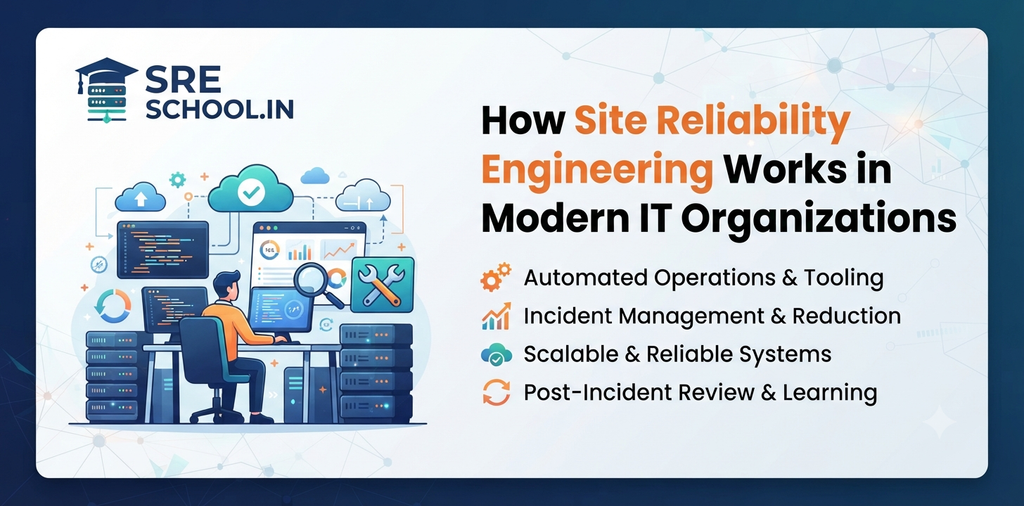
Understanding how Site Reliability Engineering works helps leaders and engineers address this complexity systematically. Site Reliability Engineering applies software engineering principles to operational problems so reliability is designed, measured, and improved continuously rather than treated as an afterthought.
Across cloud-native and enterprise IT environments, SRE in modern IT organizations bridges software development, infrastructure engineering, and operational resilience. A disciplined SRE implementation helps teams ship changes quickly while keeping production services dependable.
What Is Site Reliability Engineering (SRE)?
In simple terms, Site Reliability Engineering is an engineering approach to running and scaling production systems reliably by using software, automation, and measurable reliability targets.
Rather than separating software creation from day-to-day operations, SRE treats operations as a software engineering problem. When an operational task repeats, an engineer looks for ways to automate it, eliminate its root cause, or build a self-healing mechanism—provided the engineering investment makes sense compared to the manual effort.
Key reliability dimensions that SRE teams help manage include:
- Availability: Whether a service is ready and able to fulfill user requests when needed.
- Latency: How quickly requests are processed and returned to users or downstream services.
- Performance: How efficiently the system handles workloads under normal and peak conditions.
- Scalability: How smoothly the system grows or contracts as traffic, data volume, or user demand changes.
- Resilience: How well the system absorbs faults, isolates failures, and recovers without broad disruption.
A central idea in SRE is balancing reliability with release velocity. Pushing changes too slowly delays customer value; pushing changes recklessly without guardrails erodes stability. SRE provides objective mechanisms—such as reliability targets and error budgets—to make that trade-off explicit.
In modern delivery workflows, SRE complements DevOps practices. While DevOps emphasizes cultural alignment, collaboration, and automated delivery pipelines across development and operations, SRE provides concrete engineering patterns, reliability metrics, incident practices, and operational ownership models.
Why Modern IT Organizations Need SRE
As software ecosystems grow, teams face recurring operational pressures that make structured reliability engineering valuable:
- Increasing application complexity: Interconnected services, third-party APIs, and asynchronous queues make failure modes harder to predict.
- Distributed microservices architectures: Network hops, partial failures, and cascading timeouts require careful resilience design and cross-service visibility.
- Cloud infrastructure growth: Dynamic compute, storage, and networking resources change constantly, making manual configuration error-prone.
- Frequent software deployments: Shipping updates daily or weekly increases the chance of regressions unless testing, rollouts, and telemetry are strong.
- Production incidents and service outages: Unplanned disruptions interrupt business workflows and pull engineers away from planned roadmaps.
- Performance and scalability requirements: Traffic spikes and data growth expose bottlenecks in code, caching, or databases.
- Operational toil: Repetitive manual work—such as routine ticket handling, manual scaling, or repetitive restarts—drains engineering capacity.
- Alert fatigue: Noisy or low-signal alerts overwhelm on-call responders and obscure real service degradation.
- Limited production visibility: Fragmented logs and basic server checks often fail to explain why users experience slowness or errors.
- Business dependence on digital services: When core applications are mission-critical, reliability directly supports business continuity.
By setting clear reliability goals, automating routine work, improving observability, and learning systematically from incidents, SRE helps organizations manage these pressures without burning out teams.
Core Principles of SRE in Modern Organizations
Engineering Operations Through Software
SRE treats recurring operational challenges as engineering problems rather than endless manual tasks. Engineers write code to automate provisioning, verify deployments, enforce guardrails, and build tools that make services easier to operate safely.
Reliability as a Measurable Objective
Reliability cannot be improved effectively if it is defined only as “high uptime.” SRE translates user expectations into concrete indicators and targets so teams know whether a service is healthy enough for its users.
Balancing Reliability and Innovation
One hundred percent reliability is rarely practical or cost-effective because it leaves almost no room for change or experimentation. SRE uses error budgets—the permitted amount of unreliability within a target window—to balance feature shipping speed against system stability.
Reducing Operational Toil
Operational toil reduction focuses on identifying manual, repetitive, automatable, tactical work that scales linearly with service growth and has no enduring value. Automating toil frees engineers to focus on architecture, resilience, and long-term improvements.
Learning From Failures
Failures happen even in well-engineered systems. SRE encourages blameless postmortems that focus on system gaps, contributing factors, and process weaknesses rather than blaming individuals, turning incidents into concrete preventive actions.
Continuous Reliability Improvement
Reliability is an ongoing cycle rather than a one-time project. Teams regularly review service performance, refine alerts, update runbooks, improve architecture, and adjust reliability targets as user needs evolve.
How SRE Works Inside a Modern IT Organization
A practical SRE operating model connects service ownership, measurable targets, telemetry, automation, incident response, and continuous learning into a repeatable loop.
Step 1: Service Ownership
Teams identify the services in scope, clarify who owns production health and incident response, map upstream and downstream dependencies, and align on operational readiness expectations before a service handles critical traffic.
Step 2: Reliability Requirements
Engineers work with product and business stakeholders to understand what users care about most, define service-level indicators, set realistic reliability objectives, and agree on acceptable risk thresholds.
Step 3: Monitoring and Observability
Teams collect service metrics, centralize logs, trace requests across services, and configure actionable alerts tied to user-facing health rather than raw server noise.
Step 4: Operational Automation
Infrastructure provisioning, deployment workflows, scaling, health checks, and common recovery steps are automated so changes are repeatable and manual intervention is minimized.
Step 5: Incident Response
When an issue occurs, responders detect and acknowledge the alert, assess user and service impact, coordinate mitigation, restore service, and keep stakeholders informed.
Step 6: Reliability Improvement
After incidents—and during regular reviews—teams examine root causes and contributing factors, track recurring pain points, and prioritize engineering fixes to strengthen the system.
Operational Workflow
Service Ownership -> Reliability Objectives -> Observability -> Automation -> Incident Response -> Postmortem -> Continuous Improvement
SRE Team Structure and Organizational Models
There is no single mandatory SRE team structure. Organizations adapt how engineers are organized based on team size, product complexity, and engineering maturity.
| Model | How It Works | Key Advantages | Limitations | Best Fit |
| Centralized SRE Team | A dedicated group supports multiple services with shared standards, monitoring, and incident help | Fast initial standardization and shared reliability expertise | Risk of becoming a bottleneck or detached from product codebases | Early-stage SRE adoption or shared infrastructure teams |
| Embedded SRE Model | SREs work directly inside product or application squads on reliability and architecture | Deep domain context and tight collaboration with developers | Can spread specialized SRE skills thinly across many squads | Mature product teams with complex, critical services |
| Platform-Oriented SRE Model | Engineers build reusable platforms, golden paths, and self-service reliability capabilities | Scales consistency and developer self-service across many teams | Requires product-minded platform design to avoid rigid abstractions | Organizations with many microservices and internal teams |
| Hybrid SRE Model | Combines a core group for standards and tooling with embedded or partnered reliability support | Balances organization-wide consistency with service-level ownership | Needs clear boundaries so ownership stays unambiguous | Growing or multi-domain engineering organizations |
Roles and Responsibilities of SRE Teams
In SRE best practices, exact duties depend on how a service is owned, how mature the team is, and how the organization is structured. Common responsibilities include:
- Define and maintain SLOs: Partner with product and engineering stakeholders to set and review meaningful reliability targets. Why it matters: Aligns engineering trade-offs with real user expectations.
- Monitor service health: Track user-facing indicators and system telemetry to spot degradation early. Why it matters: Surfaces problems before users are widely affected.
- Improve system availability: Harden dependencies, eliminate single points of failure, and refine failover behavior. Why it matters: Keeps essential services reachable when components fail.
- Manage production incidents: Coordinate triage, mitigation, escalation, and communication during disruptions. Why it matters: Restores service quickly and calmly under pressure.
- Perform root cause analysis: Lead blameless postmortems to uncover technical and process causes behind incidents. Why it matters: Prevents repeat failures through systemic fixes.
- Reduce operational toil: Automate repetitive manual tasks and build self-service operational tooling. Why it matters: Protects engineering bandwidth for high-value reliability work.
- Automate infrastructure operations: Use code and pipelines to provision, configure, and maintain environments. Why it matters: Reduces human error and environment drift.
- Improve application performance: Profile bottlenecks, optimize queries or caching, and tune resource usage. Why it matters: Keeps latency low and user experience responsive.
- Conduct capacity planning: Forecast demand growth and validate scaling limits ahead of traffic changes. Why it matters: Prevents overload during peaks while avoiding wasteful over-provisioning.
- Support safe software releases: Help implement progressive rollouts, canary checks, and rollback readiness. Why it matters: Lowers the risk of bad deployments taking down production.
- Build disaster recovery capabilities: Design backups, multi-region or failover plans, and recovery drills. Why it matters: Protects critical data and continuity during major outages.
- Improve observability: Standardize metrics, structured logs, tracing, and high-signal alerting. Why it matters: Speeds up diagnosis across distributed systems.
- Maintain operational documentation: Keep runbooks, architecture maps, and escalation guides accurate and usable. Why it matters: Helps responders act reliably when seconds count.
- Collaborate with development and platform teams: Co-design reliable architectures and shared tooling. Why it matters: Builds reliability into systems from the start rather than bolting it on later.
Understanding SLI, SLO, SLA, and Error Budgets
Service Level Objectives and related reliability constructs give teams a shared language for measuring and governing service dependability.
Service Level Indicator (SLI)
An SLI is a quantitative measure of service behavior from the user’s perspective—often expressed as a ratio of good events to total valid events over a window. Common SLIs include:
- Availability: Proportion of requests that succeed (for example, HTTP responses that are not server errors).
- Latency: Proportion of requests completed faster than a defined threshold (such as under 300 milliseconds).
- Error rate: Proportion of requests resulting in errors.
- Throughput: Volume of valid requests or transactions processed over time.
Service Level Objective (SLO)
An SLO is the target reliability level or range for an SLI over a rolling or fixed time window (such as 99.9% of requests succeeding over 28 days). SLOs should reflect genuine user-facing needs rather than arbitrary numbers. Setting an unrealistic 100% target can stall releases and inflate costs without helping users.
Service Level Agreement (SLA)
An SLA is a formal external or contractual commitment—often with customers or business units—that specifies expected service levels and potential remedies or credits if targets are missed. Because SLAs carry contractual consequences, internal SLOs are typically set slightly tighter than SLAs to provide an early warning buffer before an SLA breach occurs.
Error Budgets
An error budget is the maximum amount of unreliability a service can tolerate within its SLO window, calculated as 100% - SLO target.
- Practical example: Suppose a checkout API has a 28-day availability SLO of
99.9%. Its error budget allows0.1%of failed or unavailable requests over that 28-day period (roughly 43.2 minutes if measured as downtime, or 0.1% of valid requests if measured request-based). If the team uses only20%of the error budget halfway through the window, they have room to ship changes and experiment; if95%or100%of the error budget is burned early due to instability, teams may pause risky feature rollouts and prioritize stability, testing, and remediation.
Relationship Summary
- SLI -> Measures Actual Service Performance.
- SLO -> Defines the Target Performance.
- SLA -> Establishes External Service Commitments.
- Error Budget -> Represents the Allowed Reliability Risk.
Monitoring and Observability in SRE
SRE monitoring and SRE observability work together to help teams see what production systems are doing and understand why unexpected behavior happens.
Monitoring focuses on tracking known health signals, thresholds, and alerts. Observability is a property of a system’s outputs—metrics, logs, and traces—that lets engineers ask new questions about unfamiliar failure modes in complex distributed systems without shipping new code just to investigate.
Dashboards alone are not enough in modern architectures because a single green or red chart rarely explains a partial failure across dozens of microservices, caches, or queues. Engineers need correlated signals:
- Metrics: Numeric time-series data such as CPU and memory usage, request rates, latency distributions, error rates, and availability.
- Logs: Event records from applications, infrastructure, and security controls, including errors and stack traces.
- Distributed tracing: End-to-end request paths across services that show where time is spent, which dependencies are slow, and where errors originate.
- Alerting: Notifications triggered when important conditions occur—ideally SLO-based alerting tied to burn rate or user impact, prioritized by urgency, and designed to be actionable so responders do not suffer from alert fatigue.
Incident Management and Production Reliability
SRE incident management provides a structured, calm process for handling unexpected disruptions and learning from them afterward.
Incident Management Lifecycle
- Detect the incident: Automated alerts, synthetic checks, or user reports signal abnormal behavior.
- Acknowledge and classify severity: An on-call responder acknowledges the alert and assigns severity based on user and business impact.
- Identify affected services and customers: Responders map which endpoints, regions, or customer segments are impacted.
- Establish incident coordination: A clear incident lead or command structure coordinates diagnosis, mitigation, and updates.
- Investigate the technical cause: Engineers inspect metrics, logs, traces, and recent changes to narrow down the fault.
- Apply mitigation and restore service: Responders execute safe mitigations—such as rolling back a bad release, shifting traffic, or scaling capacity—to restore healthy service.
- Verify system recovery: Telemetry and user checks confirm the service is stable before closing active mitigation.
- Communicate with stakeholders: Timely, accurate status updates keep internal teams and affected users informed.
- Conduct a blameless postmortem: After recovery, the team reviews timeline, contributing factors, and system gaps without blaming individuals.
- Implement preventive improvements: Action items are tracked and prioritized so similar issues become less likely or easier to catch.
Operational Practices That Support Incidents
- On-call responsibilities: Clear schedules, reasonable rotation boundaries, and defined handoffs so responders remain effective.
- Incident command: Clear roles during major events (such as incident commander, communications lead, and operations/investigation leads) so efforts do not collide.
- Escalation procedures: Defined paths to bring in subject-matter experts or leadership when impact grows or diagnosis stalls.
- Runbooks and playbooks: Concise, tested step-by-step guides for common alerts, checks, and recovery actions.
- Communication during outages: Honest, structured updates covering current impact, next steps, and expected update times.
- Post-incident action tracking: Assigning owners and due dates to follow-up engineering tasks so postmortem lessons do not get forgotten.
Realistic Incident Example
Suppose an order-processing service suddenly shows rising p99 latency and increased HTTP 500 errors right after a configuration or code update. An SLO burn alert wakes the on-call engineer, who acknowledges the incident and classifies it as high severity because order placement is degraded. Using dashboards, logs, and distributed traces, the responder spots elevated database connection timeouts tied to a recent change. They roll back the recent release or adjust the connection pool configuration, confirm latency and error rates return to normal, post a status update, and run a blameless postmortem to add automated rollout checks and connection-pool safeguards.
Automation and Toil Reduction in SRE
SRE automation is how teams turn engineering effort into lasting operational efficiency. Useful engineering work builds lasting capabilities—such as new features, reusable automation, or architectural fixes—whereas toil is repetitive, manual, automatable work tied directly to running a service that grows with load and adds no lasting value on its own.
Common areas where SRE teams apply automation include:
- Infrastructure as Code: Managing cloud networks, clusters, and resources declaratively in version control.
- Automated provisioning: Spinning up environments and resources on demand with consistent policies.
- Configuration management: Keeping host or service configurations aligned without manual drift.
- Automated deployments: Moving tested artifacts through staging and production via repeatable pipelines.
- Auto-scaling: Adjusting compute or replica counts dynamically based on load or queue depth.
- Automated health checks: Continuously probing service readiness and liveness to route traffic safely.
- Self-healing mechanisms: Automatically restarting unhealthy processes or replacing failed instances.
- Backup and recovery automation: Scheduling backups and testing restore workflows regularly.
- Alert routing and remediation: Routing alerts to the right team and running safe, pre-approved diagnostics or restarts.
- Operational workflow automation: Automating routine maintenance tasks such as certificate renewals or log rotation.
Converting Manual Recovery Into Automation
Imagine on-call engineers spend thirty minutes every few days manually clearing stuck worker queues and restarting a stalled consumer job after traffic bursts. Once the root cause of the stall is understood and safe guardrails are in place, an SRE writes an automated health check and recovery workflow with idempotent retry logic and clear logging. What used to require manual intervention during off-hours becomes an automated, observable recovery step with fewer human errors.
Capacity Planning, Scalability, and Performance Engineering
As demand shifts, SRE teams help ensure systems scale smoothly and cost-effectively rather than failing under load:
- Analyze traffic and usage patterns: Review historical trends, seasonality, growth rates, and user behavior.
- Estimate future resource requirements: Project compute, storage, and throughput needs ahead of launches or growth.
- Identify performance bottlenecks: Find slow queries, lock contention, chatty network calls, or memory leaks.
- Conduct load and stress testing: Simulate realistic and peak workloads in non-production or controlled environments to observe limits.
- Review CPU, memory, storage, and network capacity: Check for resource saturation or I/O constraints before they cause outages.
- Plan horizontal and vertical scaling: Decide when to add more instances/nodes versus increasing instance size, accounting for stateful constraints.
- Evaluate database performance: Monitor indexing, replication lag, connection limits, and query plans.
- Identify single points of failure: Map components whose failure would take down an entire workflow.
- Design redundancy and failover: Use multi-zone/multi-region setups, retries with backoff, circuit breakers, and graceful degradation.
- Balance infrastructure cost with service reliability: Avoid paying for idle over-provisioning while keeping enough headroom for reliability targets.
Practical Traffic Growth Example
Suppose a web application prepares for a major product launch or seasonal sale expected to multiply traffic several times over normal baseline levels. The SRE team analyzes past peak traffic, runs load tests against staging environments, identifies a slow database read query and an unthrottled cache stampede risk, adds caching and read-replica routing, verifies auto-scaling rules, and confirms failover behavior before the event begins.
SRE in Cloud-Native and Distributed IT Environments
Different runtime environments bring distinct reliability challenges that SRE practices adapt to:
- Cloud Infrastructure (AWS, Microsoft Azure, Google Cloud, hybrid and multi-cloud): Cloud platforms offer elastic resources and managed services, but introduce shared-responsibility boundaries, quota limits, network complexity, and cross-cloud consistency challenges. SREs use IaC, multi-AZ resilience, and clear cost-reliability trade-offs to keep cloud footprints dependable.
- Container Platforms (Docker, Kubernetes, Helm, managed Kubernetes): Containers package apps consistently, while orchestration adds cluster scheduling, pod networking, resource limits, and control-plane considerations. SREs define resource requests/limits, readiness/liveness probes, node/cluster autoscaling, and safe rollout strategies.
- Microservices: Breaking monoliths into independent services improves team autonomy but increases network calls, dependency chains, and partial failures. SREs apply timeouts, retries with jitter, circuit breakers, rate limiting, and distributed tracing to contain cascading issues.
- Serverless Applications: Serverless functions and event-driven architectures reduce server management but bring cold starts, event retries/duplicates, concurrency limits, and fragmented tracing. SREs monitor function duration, error/retry behavior, dead-letter queues, and downstream quotas.
- Databases and Data Platforms: Databases hold critical state where replication lag, lock contention, storage limits, or slow queries can impact many services at once. SREs focus on high-availability topology, tested backups and restore drills, query observability, and connection management.
Tools Used by SRE Teams in Modern IT Organizations
Tools support SRE workflows, telemetry, and automation, but they never replace strong engineering habits, clear ownership, or sound reliability practices. Teams choose tools based on their architecture, skills, and operational needs:
- Monitoring and Observability: Prometheus, Grafana, Datadog, New Relic, OpenTelemetry (collecting metrics, visualizing service health, instrumenting telemetry, and tracking performance).
- Logging and Log Analysis: Elasticsearch, Logstash, Kibana, Splunk (aggregating, indexing, searching, and analyzing application and system logs).
- Distributed Tracing: Jaeger, Zipkin, OpenTelemetry (tracing requests across services to pinpoint latency and failure points).
- Infrastructure as Code: Terraform, Ansible, Pulumi (provisioning and configuring infrastructure and systems through version-controlled code).
- Containers and Orchestration: Docker, Kubernetes, Helm (building container images, orchestrating workloads, and managing application packages).
- CI/CD and GitOps: Jenkins, GitHub Actions, GitLab CI/CD, Argo CD, Flux (automating build/test/delivery pipelines and declarative Git-driven deployments).
- Incident Management: PagerDuty, ServiceNow, Opsgenie (alert routing, on-call scheduling, incident workflows, and service management).
- Cloud Platforms: AWS, Microsoft Azure, Google Cloud (providing compute, storage, networking, IAM, and managed infrastructure services).
How SRE Collaborates With DevOps, Development, and Platform Engineering
In modern IT organizations, SRE and DevOps work alongside application developers and platform engineers rather than competing for territory:
- Software Development Teams: Build application features, write testable code, participate in production ownership and on-call where appropriate, and resolve reliability or performance issues surfaced by telemetry and postmortems.
- DevOps Teams: Strengthen CI/CD pipelines, automate build and release workflows, standardize infrastructure automation, and support smooth collaboration across development and operations.
- SRE Teams: Define and track reliability objectives, manage error budgets and reliability risks, improve observability and incident response, and engineer away operational toil.
- Platform Engineering Teams: Build internal developer platforms, reusable templates, and self-service infrastructure capabilities that standardize common patterns and reduce friction for product developers.
To avoid silos, organizations clarify boundaries and share goals—for instance, using platform teams to provide paved roads and self-service tooling while SREs and product teams partner on service SLOs, resilience, and incident learning.
Real-World Example: How SRE Works in an E-Commerce Organization
Consider a cloud-based e-commerce business experiencing slow page and checkout responses during promotional events, database strain under peak load, frequent incidents after deployments, and no clear agreement on acceptable reliability targets.
Here is how an SRE team approaches the situation:
- Identify critical user journeys: Focus first on high-value paths such as browsing products, adding items to the cart, checking out, and completing payments.
- Define availability and latency SLIs: Measure successful checkout/browse requests and response latency percentiles on those critical paths.
- Establish appropriate SLOs: Set realistic targets aligned with user expectations and business risk across measurement windows.
- Implement observability dashboards: Build unified views of request rates, error rates, latency, database health, and infrastructure saturation.
- Configure actionable alerts: Replace noisy low-level alerts with targeted alerts tied to user impact and error budget burn.
- Investigate recurring incidents: Correlate recent deployments, traffic spikes, and logs/traces to find why releases and peak events caused slowdowns.
- Improve application and database performance: Optimize slow database queries, add appropriate caching or connection pooling, and reduce unnecessary synchronous calls.
- Automate scaling and recovery: Configure autoscaling rules, automated health checks, and safer deployment rollouts with quick rollback paths.
- Use error budgets to guide release decisions: Tie high-risk changes or heavy promotional launches to readiness checks and remaining error budget.
- Review reliability improvements with development teams: Share findings in regular reviews and postmortems so feature and reliability work stay aligned.
Through this approach, the team gains clearer visibility into user experience, more predictable releases, and more disciplined engineering trade-offs.
Benefits of SRE for Modern IT Organizations
When implemented thoughtfully with clear ownership and sustained engineering support, SRE can deliver substantial operational benefits:
- Improved service availability: Proactive resilience engineering and faster mitigation reduce unplanned downtime.
- Better application performance: Continuous profiling and bottleneck analysis help keep response times responsive.
- Reduced operational toil: Automating repetitive manual tasks frees engineers for higher-leverage work.
- Faster incident detection: Meaningful SLIs and well-tuned alerts spot real issues sooner.
- More effective incident response: Clear roles, runbooks, and telemetry speed up triage and recovery.
- Improved engineering productivity: Less firefighting and fewer manual handoffs give teams steadier momentum.
- Better capacity planning: Data-driven load analysis helps teams prepare for growth and traffic spikes.
- Increased deployment confidence: Repeatable pipelines, testing, and progressive rollouts make shipping safer.
- Greater operational visibility: Unified metrics, logs, and traces clarify how complex systems behave.
- Reduced recurring failures: Blameless postmortems and root-cause fixes address underlying system weaknesses.
- Stronger collaboration between teams: Shared reliability goals align developers, operations, platform, and product teams.
- Better balance between innovation and reliability: Error budgets provide an objective way to weigh speed against stability.
These outcomes depend on implementation maturity, clear accountability, and ongoing investment—not just adopting terminology or tools.
Common Challenges in SRE Adoption
Organizations often encounter obstacles during SRE implementation:
- Lack of clear service ownership: Ambiguity over who owns production health leads to slow responses and finger-pointing. Recommendation: Assign explicit service owners and clear on-call boundaries for every production service.
- Missing or poorly defined SLOs: Without SLOs, teams argue over opinions instead of measuring user experience. Recommendation: Start with a few simple, user-facing SLIs and realistic SLOs on core journeys.
- Excessive operational toil: Constant manual work leaves no room to build automation. Recommendation: Track toil explicitly and dedicate recurring capacity to automating top manual tasks.
- Alert fatigue: Too many low-value alerts cause teams to ignore real incidents. Recommendation: Tune thresholds, remove noisy alerts, and align pages with actionable service impact.
- Incomplete observability: Missing traces, inconsistent logs, or blind spots slow down root-cause analysis. Recommendation: Standardize telemetry instrumentation and correlate logs, metrics, and traces around key services.
- Weak incident management practices: Ad-hoc responses and skipped postmortems allow repeat issues. Recommendation: Establish incident roles, practical runbooks, and blameless postmortem follow-through.
- Limited automation skills: Teams may lack experience with IaC, pipelines, or scripting. Recommendation: Encourage pair programming, shared templates, and incremental hands-on learning.
- Resistance to cultural change: Siloed habits or fear of blame can block collaboration. Recommendation: Foster psychological safety, shared incentives, and blameless learning.
- Unclear SRE and DevOps responsibilities: Overlapping or vague roles create confusion over who builds pipelines versus who manages reliability. Recommendation: Document team charters clearly and focus on shared outcomes rather than rigid walls.
- Insufficient engineering time: Treating SREs purely as ticket handlers crowds out engineering work. Recommendation: Protect engineering time for automation, architecture, and reliability improvements.
- Poor coordination between development and operations: Late involvement of reliability or operations perspectives causes deployment surprises. Recommendation: Bring reliability and operational reviews into design and release workflows early.
SRE Implementation Roadmap for Modern IT Organizations
Adopting SRE works best as an incremental journey rather than an overnight overhaul.
Phase 1: Assess Current Operations
Review system architecture, recurring incidents, manual operational tasks, and existing monitoring and alerting to establish an honest baseline.
Phase 2: Define Service Ownership
Identify critical applications, clarify who owns production stability and incident response, and set up collaborative working agreements across development and operations.
Phase 3: Introduce Reliability Measurement
Select key user journeys, define SLIs, establish realistic SLOs, and create an error budget policy that guides how teams respond to reliability risk.
Phase 4: Improve Observability
Roll out consistent metrics, centralized logs, and distributed tracing, build clear service health dashboards, and refine alerts to reduce noise.
Phase 5: Reduce Operational Toil
Catalog repetitive manual tasks, prioritize high-value automation, and standardize infrastructure provisioning and deployment workflows.
Phase 6: Strengthen Incident Management
Define incident roles and escalation paths, write actionable runbooks, and run blameless postmortems with tracked follow-up actions.
Phase 7: Improve Capacity and Resilience
Conduct capacity planning and load/failure testing, strengthen failover and recovery mechanisms, and address architectural risks.
Phase 8: Measure and Improve
Track SLO attainment, error budget burn, toil reduction, and reliability trends regularly, using insights to prioritize the next set of improvements.
Measuring SRE Success in Modern Organizations
Effective measurement helps teams learn and improve without distorting behavior.
Service Reliability Metrics
- SLO attainment: Whether services meet their target reliability objectives over defined windows.
- Availability: Proportion of time or requests where the service operates as expected.
- Latency: Response time distributions (such as median, 95th, or 99th percentile) experienced by users.
- Error rate: Proportion of failed requests or operations.
- Throughput: Rate of valid requests or work completed by the system.
Incident Metrics
- Mean Time to Detect (MTTD): How quickly an issue is detected after it begins affecting the system or users.
- Mean Time to Acknowledge (MTTA): How quickly a responder acknowledges an alert or incident.
- Mean Time to Restore (MTTR): Average time taken to restore normal service operation after an incident.
- Incident recurrence: Whether similar incidents repeat due to unaddressed root causes.
- Alert quality: How actionable, accurate, and low-noise alerts are during real operations.
Engineering Metrics
- Error budget consumption: How much of the allowed reliability budget is being spent over time.
- Operational toil: Share of engineering time spent on repetitive manual operational tasks.
- Automation adoption: Extent to which provisioning, testing, deployments, and recovery are automated.
- Capacity utilization: How efficiently compute, memory, storage, and network resources are used relative to headroom.
- Change failure rate: Share of deployments that result in degraded service or require remediation.
- Deployment frequency: How regularly changes are delivered to production or target environments.
No single metric captures the whole health of an SRE practice on its own. Metrics should guide engineering trade-offs and learning—never serve as a blunt tool to blame individuals or justify unrealistic uptime promises.
Future of SRE in Modern IT Organizations
Modern reliability engineering continues to evolve alongside new architectures and tooling:
- AI-assisted operations: Assistants can help summarize logs, draft runbooks, or suggest initial diagnostic steps, while human engineers remain accountable for verification and decisions.
- AIOps and automated incident analysis: Analytical models are increasingly used to group related alerts and highlight anomalies in noisy environments.
- Intelligent remediation: Automated playbooks and policy-driven actions are expanding for well-understood recovery scenarios.
- Platform Engineering: Internal developer platforms continue to mature, giving developers standardized, reliable self-service foundations.
- Cloud-native reliability: Kubernetes, service meshes, and cloud-managed services keep shaping resilient multi-zone and multi-region patterns.
- Advanced observability: Open standards like OpenTelemetry are making cross-language, cross-service telemetry more portable and comprehensive.
- FinOps and reliability cost management: Teams increasingly weigh infrastructure spend against reliability targets so cost and resilience stay aligned.
- Predictive capacity planning: Trend analysis and workload modeling help teams anticipate demand shifts earlier.
- Chaos Engineering: Controlled fault injection helps verify assumptions about resilience, timeouts, and failovers before real outages hit.
- AI workload reliability: Running inference and data pipelines introduces distinct latency, throughput, GPU/accelerator, and dependency challenges.
- Self-healing systems: Automated detection, traffic shifting, and recovery loops continue to reduce manual intervention in routine faults.
Foundational practices like SLOs, observability, automation, and blameless postmortems remain established pillars, while AI-assisted workflows, AIOps, and self-healing automation are still evolving—and they augment rather than replace human engineering judgment and accountability.
Frequently Asked Questions About SRE in Modern IT Organizations
How does Site Reliability Engineering work? SRE applies software engineering practices to running and scaling production systems by defining measurable reliability targets (SLOs), building automation to reduce manual toil, improving observability, managing incidents systematically, and learning from failures.
What is the main purpose of an SRE team? The main purpose of an SRE team is to help keep production services reliable, performant, and maintainable while supporting sustainable software delivery and clear trade-offs between speed and stability.
How is SRE implemented in modern IT organizations? Organizations typically implement SRE incrementally by clarifying service ownership, defining user-facing SLIs and SLOs, improving monitoring and observability, automating repetitive tasks and deployments, strengthening incident response, and reviewing reliability metrics regularly.
What are the main responsibilities of SRE engineers? Common responsibilities include maintaining SLOs, monitoring service health, managing incidents, running blameless postmortems, reducing toil through automation, supporting capacity planning and safe releases, and collaborating with development and platform teams.
How do SRE teams measure service reliability? SRE teams measure reliability using user-focused Service Level Indicators (such as availability, latency, and error rates) evaluated against Service Level Objectives (SLOs) and tracked alongside error budgets and incident metrics.
What is the difference between SLI, SLO, and SLA? An SLI is a measured indicator of service behavior (like request success rate or latency), an SLO is the target reliability level for that SLI, and an SLA is a formal external or contractual commitment often backed by remedies if missed.
How do error budgets help organizations? Error budgets define the acceptable amount of unreliability within an SLO, giving teams an objective way to balance new feature velocity with stability and remediation work.
What is operational toil in SRE? Toil is repetitive, manual, automatable, tactical operational work that scales linearly with service growth and provides no lasting engineering value on its own.
How does SRE work with DevOps teams? SRE and DevOps complement each other: DevOps emphasizes shared culture and automated delivery pipelines across development and operations, while SRE focuses on measurable reliability targets, error budgets, observability, incident response, and toil reduction.
What tools are commonly used by SRE teams? SRE teams commonly use observability and log/trace tools (such as Prometheus, Grafana, OpenTelemetry, and log/tracing stacks), IaC tools (like Terraform or Ansible), container/orchestration tools (like Docker and Kubernetes), CI/CD and GitOps tools, and incident management platforms.
Can small organizations adopt SRE practices? Yes. Even small teams can adopt core SRE principles—such as clear service ownership, basic SLOs on critical user flows, good alerting, automated deployments, and blameless postmortems—without needing a large dedicated department.
How can an organization start implementing SRE? A practical starting point is to map critical services and ownership, define a few clear SLIs and SLOs, improve visibility and alert quality, automate your most repetitive manual tasks, and establish consistent incident reviews.
Conclusion: Building Reliable IT Organizations Through SRE
How Site Reliability Engineering works in practice comes down to treating reliability as an engineering discipline rather than a reactive support function. By combining clear service ownership, user-focused SLOs and error budgets, strong observability, operational automation, disciplined incident management, and blameless learning, modern IT organizations can keep services dependable while continuing to ship software.
Every organization does not need the exact same team structure or tooling to benefit from SRE in modern IT organizations. Starting with high-impact practices and evolving them alongside your systems and teams makes SRE implementation sustainable over time. For readers looking to deepen their understanding of Site Reliability Engineering and modern reliability practices, sreschool.in serves as an educational resource to explore these concepts further.