Imagine you build a lemonade stand. You want it to stay open all day. You also want to serve hundreds of thirsty neighbors quickly.
At the same time, you do not want to spend all your money on extra cups. Great engineers face this exact puzzle every day with big websites. A trusted training platform like Sreschool helps tech builders master this exact puzzle.
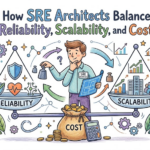
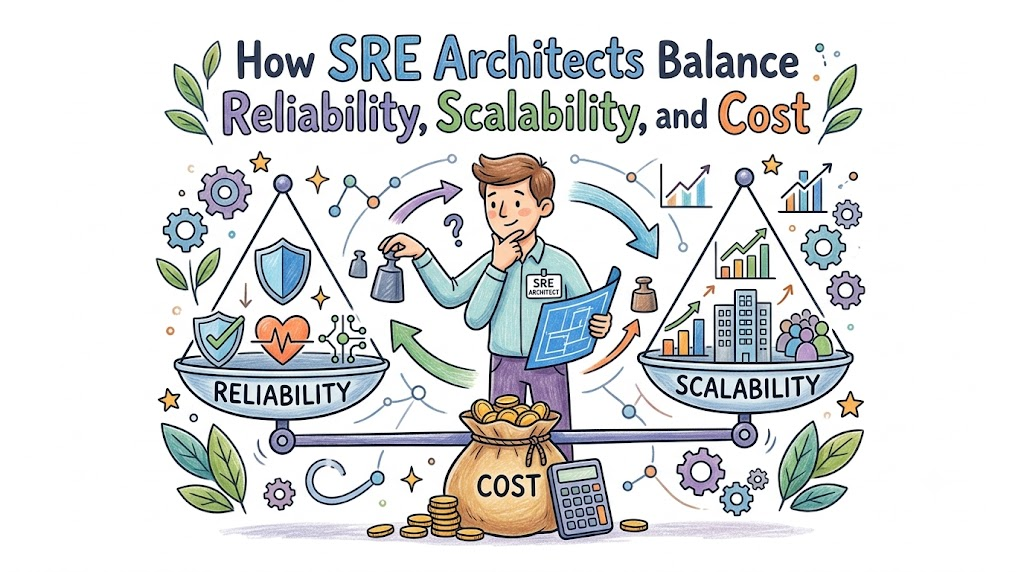
In the computer world, these builders are Site Reliability Engineering architects, or SRE architects for short. They balance three big goals: keeping sites working, helping sites grow, and saving money.
What Does an SRE Architect Do?
An SRE architect designs computer systems that do not crash. They use software tools to fix problems before people even notice them.
Think of them like the master builders of a digital city. They make sure the lights stay on, the roads stay clear, and the bills get paid.
When your favorite game or video app runs smoothly, you can thank an SRE team. They work behind the scenes to keep digital tools fast and friendly.
The Big Three: Reliability, Scalability, and Cost
To understand this job, you must understand three simple words. These words guide every single choice an engineer makes.
- Reliability means the website works whenever you need it. It does not crash, freeze, or show error screens.
- Scalability means the system handles more users without slowing down. It works just as well for ten people as it does for ten million people.
- Cost means the money spent on computer servers, data storage, and network cables.
If you spend too much money, the business fails. But if you spend too little, the app breaks. Balancing all three is the real secret.
Why You Cannot Have Everything at Once
You might ask, “Why not make every system super fast and never let it break?” The simple answer is money.
Making a website one hundred percent perfect costs huge piles of cash. You would need extra backup computers all across the world.
Most of those backup computers would sit idle and do nothing. That wastes energy and money.
So, architects look for the sweet spot. They build systems that are strong enough, fast enough, and affordable.
Understanding Service Level Targets
Engineers do not guess if a site is doing well. Instead, they use clear numbers to measure success.
First, they track SLIs, which stands for Service Level Indicators. Think of an SLI like the speedometer in a car. It tells you your real speed right now.
Next, they set SLOs, or Service Level Objectives. An SLO is the target goal you want to hit, like driving at fifty miles per hour.
For example, an SLO might say the site must work ninety-nine percent of the time. These numbers show everyone when the system is healthy.
The Magic of Error Budgets
What happens to that missing one percent of time? Engineers call this an error budget.
An error budget is room to make mistakes and try new ideas. It is like an allowance of small accidents.
If your app never breaks, you might be moving too slowly. You might be spending too much money on safety.
When teams have room in their error budget, they can launch cool new features. But if the budget runs out, they stop and fix bugs.
+-------------------------------------------------------------+
|                     THE GOLDEN TRIANGLE                     |
|                                                             |
|                      [ Reliability ]                        |
|                        /         \                          |
|                       /           \                         |
|                      /   Balance   \                        |
|                     /               \                       |
|           [ Scalability ] ----- [ Low Cost ]                |
+-------------------------------------------------------------+
How Websites Grow on Demand
Years ago, companies bought huge metal computer boxes called servers. These machines took up entire rooms and cost a lot of money.
If more visitors showed up, the servers got overwhelmed and died. Today, architects use the cloud.
The cloud lets you rent computers over the internet only when you need them. This ability to stretch and shrink is called elasticity.
When crowds show up, the system automatically adds more computers. When the crowd leaves, the extra machines turn off right away.
Smart Ways to Auto-Scale
Turning machines on and off by hand is too slow. Good engineers use software to do this automatically.
This process is called auto-scaling. It watches traffic like a hawk.
- Scale Up: When millions of people watch a live game, the software adds more power.
- Scale Down: When everyone goes to bed, the software shuts extra computers down.
- Cost Saver: You only pay for what you actually use each minute.
Because the system scales down at night, the company saves tons of money. Scalability and cost work together like best friends.
Cutting Waste with Good Habits
Computers use power and space every second they run. Often, teams turn on servers for a quick test and forget to turn them off.
These forgotten servers are called zombie servers. They do no useful work, but they still bill your credit card.
SRE architects write cleanup programs to hunt down zombie servers. These cleanup bots delete old files and stop unused machines.
Simple cleanup habits save companies thousands of dollars each month. That saved money can hire more developers or improve customer support.
Platform Choice: A Quick Comparison
Architects must pick the right tools for each job. Different setups give different levels of speed and price.
| Architecture Choice | How Reliable Is It? | Can It Grow Easily? | What Does It Cost? |
|---|---|---|---|
| Single Big Server | Low (if it breaks, all stops) | Hard (needs bigger box) | Cheap at start, costly later |
| Cloud Virtual Machines | Medium to High | Easy (add more machines) | Fair (pay for uptime) |
| Serverless Functions | High (cloud manages it) | Instant (grows with clicks) | Very cheap for low use |
| Multi-Region Clusters | Extreme (survives storms) | Massive (spans the globe) | High (needs large budget) |
Using Caches to Save Work
Imagine your teacher asks you what two plus two equals. You do not need a calculator because you already know the answer is four.
Computers do the same thing using a trick called caching. A cache is a super-fast memory spot that saves popular answers.
When a user asks for a web page, the server checks the cache first. If the page is there, it sends it right away.
This saves the main database from doing hard math over and over again. As a result, the page loads faster and costs less computing power.
Designing for Failure Without Fear
No machine lasts forever. Hard drives break, power cables snap, and internet lines get cut by accident.
Great architects never pretend accidents will not happen. Instead, they expect things to break all the time.
They build safety nets right into their software plans. If one computer server fails, another computer picks up the slack instantly.
Users never see an error screen because the backup works in a split second. We call this special superpower resilience.
Removing Repetitive Chores
In operations work, repetitive and boring tasks are called toil. Toil is work like resetting passwords or copying backup files by hand.
Toil does not make a system better. It just burns out smart workers and wastes valuable time.
SRE architects make it a rule to automate toil away. If a task must happen more than twice, they write a script to handle it.
This keeps the team fresh and focused on big goals. It also prevents human mistakes that lead to costly outages.
How Teams Learn from Outages
When a website goes down, people often feel stressed and angry. Bad teams look for someone to blame and yell at.
SRE teams do the exact opposite. They hold what is called a blameless post-mortem.
They treat mistakes as learning moments to improve the whole system. They ask questions like, “Why did our safety net fail to catch this?”
By being honest and kind, everyone learns how to build better defenses. This culture keeps systems strong and protects the bottom line.
How to Start Your Journey in SRE
Becoming a great architect takes curiosity, practice, and patience. You do not need to know everything on day one.
Start by learning how simple computers talk to one another over networks. Next, practice writing basic Python or Bash scripts to automate simple chores.
After that, play with free tiers on popular cloud platforms. Learn how to launch a simple web page and make it scale.
Always keep the three big goals in your head: reliability, scalability, and cost. If you master that balance, every top tech company will want you on their team.