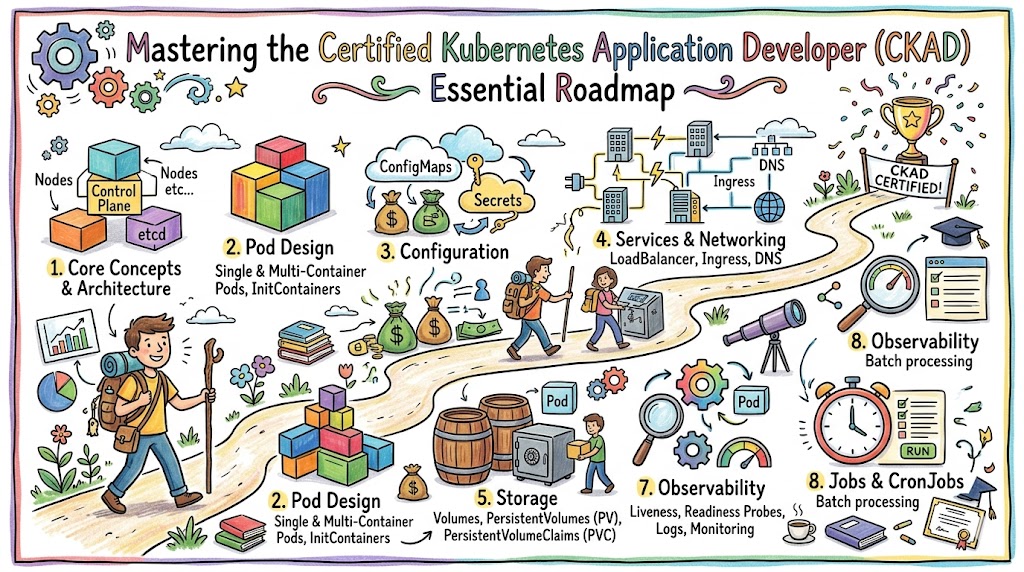
Introduction
Cloud-native engineering defines the modern technology stack, and the Certified Kubernetes Application Developer (CKAD) serves as the industry’s premier validation for this expertise. This guide empowers developers and platform engineers to transition from theoretical container knowledge to practical, hands-on cluster mastery. By learning to architect and troubleshoot resources in live environments, you solidify your standing in the competitive SRE and DevOps job markets. DevOpsSchool provides the rigorous training and real-world laboratory environments necessary for professionals to achieve this high-stakes milestone.
What is the Certified Kubernetes Application Developer (CKAD)?
The Certified Kubernetes Application Developer (CKAD) program provides a performance-based assessment that tests an engineer’s ability to solve problems in a live command-line environment. It moves away from standard multiple-choice questions, requiring candidates to build and configure actual Kubernetes resources under a strict time limit. This credential exists to prove that a professional can handle the complexities of pod design, networking, and storage within production-grade clusters. Enterprises value this certification because it guarantees that the holder possesses true operational competence rather than just academic knowledge.
Who Should Pursue Certified Kubernetes Application Developer (CKAD)?
Software developers, cloud practitioners, and SREs who manage containerized microservices daily stand to gain the most from this program. It also serves as a critical tool for security leads and data engineers who must understand how their specific workloads interact with the Kubernetes API. While beginners use the curriculum to ground their knowledge in practice, senior managers pursue it to maintain technical empathy with their engineering teams. This qualification holds immense respect across the Indian tech sector and within global multinational corporations.
Why Certified Kubernetes Application Developer (CKAD) is Valuable and Beyond
The global shift toward microservices ensures that Kubernetes expertise remains a recession-proof asset for the foreseeable future. Since the exam focuses on open-source standards, the skills you acquire translate seamlessly across AWS, Google Cloud, and Azure environments. You will see a significant return on your time investment as your ability to automate and optimize workloads leads to senior leadership opportunities. Mastering these core primitives ensures that your technical value remains high even as specific peripheral tools evolve.
Certified Kubernetes Application Developer (CKAD) Certification Overview
The certification process utilizes the official training resources provided through the primary link and remains hosted on the designated website. Candidates must navigate a series of technical challenges within a 120-minute window to demonstrate their command of the Kubernetes ecosystem. This hands-on ownership model ensures that every certified professional possesses the skills to manage the entire application lifecycle independently. It provides a transparent benchmark for employers and a clear roadmap for individual technical growth.
Certified Kubernetes Application Developer (CKAD) Certification Tracks & Levels
The curriculum follows a logical progression from foundational resource management to advanced architectural specializations. You can choose specific tracks that match your career interests, whether you prefer focusing on security, data orchestration, or financial optimization. These levels help you build a diverse portfolio of competencies that reflect the needs of modern enterprise environments. Each track ensures you stay competitive by mastering the most critical aspects of cloud-native deployment and maintenance.
Complete Certified Kubernetes Application Developer (CKAD) Certification Table
| Track | Level | Who it’s for | Prerequisites | Skills Covered | Recommended Order |
| Core App Dev | Associate | Junior Developers | Linux Basics | Pods, YAML, CLI | 1 |
| Cloud Native | Professional | SRE / DevOps | CKAD Core | Helm, Quotas, Probes | 2 |
| Security Ops | Specialized | Security Leads | CKAD Core | Network Policy, Secrets | 3 |
| Platform Ops | Expert | Principal Engineers | Advanced CKAD | Multi-container patterns | 4 |
Detailed Guide for Each Certified Kubernetes Application Developer (CKAD) Certification
Certified Kubernetes Application Developer (CKAD) – Professional Level
What it is
This certification confirms your ability to design, build, and configure production-ready applications for Kubernetes. It validates your proficiency in utilizing core primitives to create functional, scalable, and secure application environments.
Who should take it
Software engineers and cloud practitioners with at least six months of hands-on container experience should attempt this exam. It fits those who want to prove they can solve complex problems in a live cluster environment.
Skills you’ll gain
- Designing multi-container pod patterns like sidecars and adapters.
- Configuring application networking, services, and ingress rules.
- Implementing readiness, liveness, and startup probes for health.
- Managing persistent storage and volume claims for data.
- Securing applications through Secrets, ConfigMaps, and ServiceAccounts.
Real-world projects you should be able to do
- Migrating a legacy application into a scalable microservices architecture.
- Setting up automated rolling updates and rollbacks for a web service.
- Implementing resource limits and quotas to prevent cluster exhaustion.
Preparation plan
- 7–14 Days: Focus on the official syllabus and practice imperative commands to increase your speed.
- 30 Days: Work through daily lab scenarios involving troubleshooting and complex networking.
- 60 Days: Conduct timed mock exams to build the mental stamina required for the assessment.
Common mistakes
- Forgetting to set the correct namespace before creating resources.
- Spending too much time on a single difficult task instead of moving on.
- Relying on manual YAML editing rather than generating templates via the CLI.
Best next certification after this
- Same-track option: Certified Kubernetes Administrator (CKA).
- Cross-track option: Certified Kubernetes Security Specialist (CKS).
- Leadership option: Engineering Management for DevOps Teams.
Choose Your Learning Path
DevOps Path
The DevOps track emphasizes the automation of the software delivery pipeline using Kubernetes as the primary target. You will learn to integrate CI/CD tools with cluster resources to achieve frequent, reliable, and high-quality releases. This path focuses on the cultural and technical intersection of development and operations to reduce delivery lead times. It attracts engineers who enjoy optimizing the entire lifecycle of an application.
DevSecOps Path
This security-focused path builds defensive measures directly into the development and deployment workflow. You will master the implementation of Pod Security Standards, Network Policies, and automated vulnerability scanning for container images. This ensures that security remains a core component of your deployment strategy rather than an afterthought. It is essential for professionals working in highly regulated or sensitive industries.
SRE Path
The SRE path focuses on the reliability, availability, and high performance of applications at massive scale. You will emphasize observability through logging and monitoring to ensure that your services meet strict performance objectives. This track teaches you how to manage cluster resources efficiently to avoid system failures and ensure resilience. It suits those who thrive on maintaining high-uptime production environments.
AIOps Path
Engineers in the AIOps track use artificial intelligence to automate and enhance Kubernetes operations. You will explore how to apply machine learning to log data to predict failures and automate system remediation. This path represents the next evolution of infrastructure management where data drives every operational decision. It is perfect for forward-thinking professionals looking to lead the automation revolution.
MLOps Path
The MLOps track addresses the unique challenges of deploying machine learning models on containerized infrastructure. You will focus on orchestrating data pipelines, model training jobs, and serving inference engines at scale. This ensures that your organization can productionize AI models quickly and reliably within a Kubernetes ecosystem. It is a vital path for data scientists moving into the cloud.
DataOps Path
DataOps practitioners apply DevOps principles to the management of data pipelines and analytics workloads. You will learn to handle the specific storage and networking challenges associated with running databases on Kubernetes. This path ensures that data remains accessible, consistent, and secure across a distributed container environment. It attracts specialists who focus on high-performance data architecture.
FinOps Path
The FinOps path teaches you how to manage and optimize the costs of running applications in the cloud. You will learn to monitor resource usage and attribute costs to specific teams using labels and quotas. This role bridges the gap between engineering execution and financial accountability. It is essential for managing large-scale cloud budgets effectively in modern enterprises.
Role → Recommended Certified Kubernetes Application Developer (CKAD) Certifications
| Role | Recommended Certifications |
| DevOps Engineer | CKAD, CKA, Jenkins Professional |
| SRE | CKAD, Prometheus Specialist, CKA |
| Platform Engineer | CKAD, Terraform Associate, CKA |
| Cloud Engineer | CKAD, Cloud Architect (AWS/Azure/GCP) |
| Security Engineer | CKAD, CKS, Cloud Security Cert |
| Data Engineer | CKAD, Data Engineering Specialty |
| FinOps Practitioner | CKAD, FinOps Practitioner Cert |
| Engineering Manager | CKAD, DevOps Leadership Cert |
Next Certifications to Take After Certified Kubernetes Application Developer (CKAD)
Same Track Progression
Deepening your Kubernetes expertise often involves moving from the application layer to cluster administration. Taking the CKA allows you to understand the underlying infrastructure and how the control plane interacts with worker nodes. This full-stack perspective enables you to build more efficient applications because you understand the platform’s constraints. Mastering both tracks makes you a highly versatile technical asset.
Cross-Track Expansion
Broadening your skills into security or infrastructure automation provides a more comprehensive professional profile. The CKS certification offers deep insights into securing the container supply chain and hardening your clusters. You might also explore tools like Terraform or Ansible to manage the cloud infrastructure that supports your Kubernetes environments. This variety makes you a valuable candidate for hybrid cloud roles.
Leadership & Management Track
Moving into leadership requires a shift from technical execution to strategic oversight and team mentorship. You will focus on how Kubernetes affects delivery speed, operational costs, and overall business agility. Leadership certifications help you bridge the gap between deep technical roots and corporate objectives. This path prepares you to lead digital transformation initiatives at an organizational level.
Training & Certification Support Providers for Certified Kubernetes Application Developer (CKAD)
DevOpsSchool
This organization delivers high-quality training that focuses on the practical application of Kubernetes in real-world scenarios. Their instructors provide the hands-on labs and technical support needed to master the CKAD curriculum effectively. They maintain a reputation for excellence by ensuring students gain the confidence to solve complex problems.
Cotocus
Providing high-end technical consulting and training, this company helps engineering teams master cloud-native technologies. Their programs emphasize architectural integrity and operational efficiency within production environments. They help professionals build the skills required to lead complex engineering projects.
Scmgalaxy
This platform acts as a massive knowledge hub for the global DevOps community, offering tutorials and documentation. It provides a wealth of resources for troubleshooting and understanding the nuances of the Kubernetes API. Many engineers rely on this site as their primary reference for staying updated on industry changes.
BestDevOps
Focusing on intensive skill acquisition, this provider offers bootcamps designed to prepare you for the CKAD exam quickly. Their curriculum covers the most important aspects of the Kubernetes ecosystem to ensure you pass on your first attempt. They prioritize outcome-based learning for busy technical professionals.
devsecopsschool.com
This school focuses exclusively on the integration of security into the modern DevOps pipeline. Their training teaches you how to secure your containers and protect your clusters from external threats. It is the premier destination for developers who want to specialize in DevSecOps.
sreschool.com
Dedicated to the principles of Site Reliability Engineering, this provider teaches you how to keep systems running at scale. Their Kubernetes courses focus on observability, automation, and incident response. They help you build the mindset needed to manage high-availability production clusters.
aiopsschool.com
This institution explores the intersection of artificial intelligence and infrastructure management. Their courses teach you how to use machine learning to optimize cluster performance and predict failures. It is perfect for engineers looking to lead the next wave of intelligent automation.
dataopsschool.com
This provider specializes in the unique challenges of managing data workloads on containerized platforms. Their training covers everything from persistent storage to data locality in distributed systems. It is the best choice for data professionals moving to the cloud.
finopsschool.com
This school focuses on the financial management and cost optimization of cloud-native infrastructure. They teach you how to balance performance with budget constraints to ensure profitable operations. It is a vital resource for anyone managing cloud spend at scale.
Frequently Asked Questions (General)
- How much hands-on practice do I need?
You should spend at least 50 to 100 hours in a lab environment to build the muscle memory required for the exam.
- Does the exam allow the use of aliases?
Yes, you can define your own aliases at the start of the exam to speed up your command execution.
- Is it possible to use the Kubernetes documentation?
The proctors allow you to access one tab of the official Kubernetes documentation during the test session.
- How do I maintain my certification after passing?
You must retake the current version of the exam every three years to maintain your certified status.
- What happens if I run out of time?
The system submits your work as it stands, so you should prioritize high-value questions first.
- Can I take the exam in my local language?
The exam is primarily offered in English, though some translated versions may be available depending on your region.
- Does this certification require an expensive lab setup?
No, you can practice using free tools like Minikube, Kind, or various online browser-based playgrounds.
- Is there a specific passing percentage for the CKAD?
The passing score is typically 66%, though this can shift slightly depending on the specific exam version.
- How do I get my results after the test?
The Linux Foundation usually sends your score via email within 24 hours of completing the assessment.
- Do I need to know how to install a cluster?
No, the CKAD focuses on application development rather than the administrative tasks of cluster installation.
- What is the format of the exam?
The exam consists of 15-20 performance-based tasks that you must complete in a live terminal environment.
- Can I use a webcam and microphone during the test?
Yes, the proctor requires a working webcam and microphone to monitor your environment throughout the exam.
FAQs on Certified Kubernetes Application Developer (CKAD)
- How do I handle multiple clusters during the exam?
You will use the “kubectl config use-context” command to switch between different environments as instructed by the questions.
- Is Vim the standard editor for the exam?
Vim is the most common editor provided, though Nano is usually available for those who prefer it.
- Should I learn Helm for the CKAD?
Yes, the current curriculum includes basic Helm commands for deploying and managing pre-packaged applications.
- How do I deal with failing pods during the test?
Use the “kubectl logs” and “kubectl describe” commands to identify and fix configuration errors quickly.
- Are there questions on Network Policies?
Yes, you must be able to write and apply policies that control traffic flow between different namespaces and pods.
- Is there a focus on multi-container pods?
Yes, you should understand how to implement sidecars for logging or proxies within a single pod.
- How do I generate YAML quickly?
Use the “–dry-run=client -o yaml” flags with imperative commands to create your base templates.
- Can I use my own notes during the exam?
No, you cannot use personal notes or external websites other than the official Kubernetes documentation.
Final Thoughts: Is Certified Kubernetes Application Developer (CKAD) Worth It?
Taking this step to earn your certification represents a major commitment to technical excellence in the cloud-native era. It proves you have moved past basic tutorials and possess the practical grit to manage complex, distributed systems under pressure. While the preparation journey requires discipline and hundreds of hours of lab work, the professional opportunities and technical confidence you gain justify every moment of effort. You will emerge not just with a digital badge, but with the technical authority to lead in an increasingly containerized world. This investment in your future ensures you stay at the forefront of the most significant architectural shift in modern computing.


Leave a Reply
You must be logged in to post a comment.