Introduction
Demanding digital markets force modern organizations to overhaul outdated development models and eliminate operational bottlenecks. Many growing enterprises face crippling delivery friction because fragmented toolchains, manual sign-offs, and brittle server architectures stall mission-critical updates. Moreover, disjointed handoffs between development squads and systems administrators consistently postpone valuable feature rollouts.
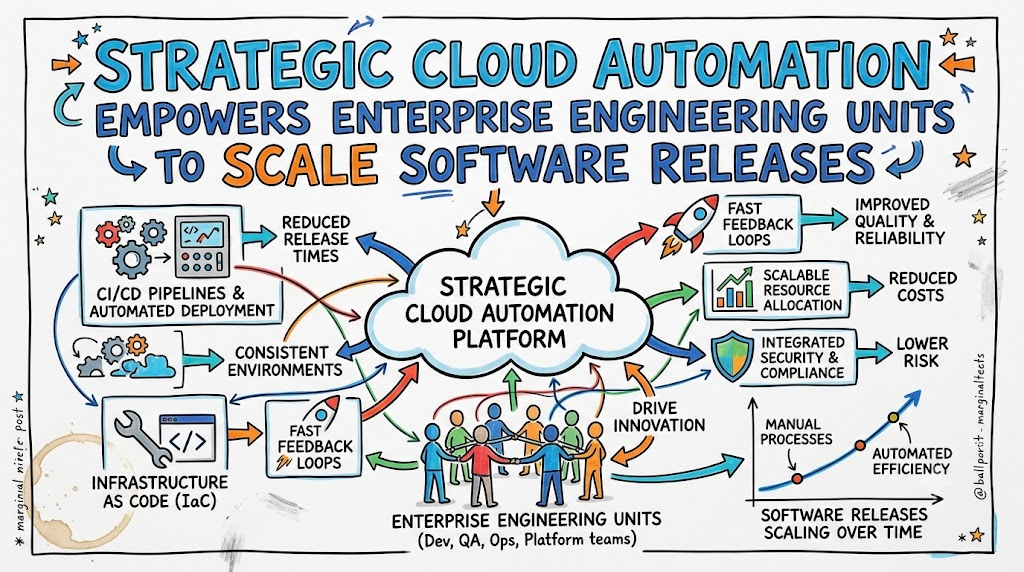
Cotocus solves these systemic operational problems through targeted technical advisory, robust delivery architectures, and direct engineering enablement. By integrating declarative code automation directly into standard team pipelines, engineering leaders compress release cycles and safeguard live systems. Therefore, this practical implementation manual outlines the essential methodologies, architectural paradigms, and strategic capabilities needed to scale dependable infrastructure.
What Does DevOps Actually Help a Business Do?
DevOps bridges the gap between low-level technical execution and overarching commercial outcomes by establishing automated delivery loops across departments. Instead of isolating developers from operations staff, cross-functional units take shared responsibility for software throughout its operational lifespan. Consequently, engineering groups push verified code from local workstations to live production clusters without administrative roadblocks.
| Strategic Capability | Traditional Operational Pattern | Automated Delivery Architecture | Quantifiable Commercial Advantage |
|---|---|---|---|
| Release Cadence | Infrequent manual rollouts | Automated continuous deployments | Shortens competitive time-to-market |
| Incident Restoration | Time-consuming manual triaging | Instant automated rollbacks | Minimizes high-cost business downtime |
| System Provisioning | Manual administrative ticketing | Declarative code definitions | Prevents drift across environments |
Furthermore, automated continuous testing suites inspect source code changes on every commit, catching regressions long before software enters staging. Therefore, engineers spend far fewer hours resolving preventable production flaws and direct their energy toward building valuable platform features. Ultimately, executive stakeholders secure high release velocity, dependable platform uptime, and complete delivery visibility.
Why Are So Many Businesses Moving Toward DevOps?
Fierce industry competition compels leadership teams to deliver innovative features swiftly while maintaining strict infrastructure reliability. Traditional operational silos cause significant friction, unpredictable release delays, and fragmented accountability across engineering teams. Therefore, technology executives proactively dismantle legacy organizational barriers to build dependable, scalable deployment pipelines.
Industry research consistently reveals that elite delivery teams ship production-ready updates far faster than their conventional rivals. Furthermore, these high-performing units remediate live service disruptions in minutes rather than entire days. Hence, continuous delivery standards and infrastructure automation empower technical units to publish outstanding software without exhausting their engineers.
Where Can DevOps Consulting Make a Difference?
Executing large-scale architectural modernization requires deep technical experience, rigorous auditing, and realistic execution roadmaps. Specialized DevOps Consulting Services assist leadership teams in assessing pipeline health, identifying systemic bottlenecks, and standardizing disjointed toolchains. Outside specialists inject objective industry benchmarks that overcome legacy organizational resistance.
For example, a high-volume payment processor faced continuous weekend downtime because of conflicting configuration scripts. Outside specialists restructured their delivery architecture using containerized runtimes and declarative configuration files. Consequently, deployment runtimes dropped from twelve hours to eight minutes, completely removing rollback overhead.
What Are Managed DevOps Services and Who Needs Them?
Not every organization possesses the internal engineering bandwidth to supervise complex, multi-cloud platforms around the clock. Comprehensive Managed DevOps Services support product units by taking full operational responsibility for deployment workflows, cluster orchestration, and continuous infrastructure health. This operational framework keeps production platforms running smoothly without pulling core developers away from roadmap commitments.
- Rapidly Scaling Startups: Fast-moving organizations needing enterprise-grade reliability without hiring an entire operations department.
- Mid-Sized Enterprises: Maturing businesses executing modern cloud transformations while preserving developer focus on customer functionality.
- Global SaaS Providers: Fast-growing applications demanding strict uptime commitments, fast patch management, and immediate incident mitigation.
Ultimately, delegating baseline system operations guarantees peak environment performance while internal engineers concentrate on product improvements.
How Does Cloud Computing Change the Way Teams Build Software?
Cloud platforms replace static data centers with flexible, software-defined computing resources accessible via automated programming interfaces. Consequently, development groups avoid tedious hardware acquisition cycles that historically delayed initiatives for months. Instead, developers generate dedicated testing environments in minutes using version-controlled code templates.
Furthermore, cloud providers deliver managed data stores, event-driven compute engines, and distributed network controls. This operational flexibility allows architects to break complex monoliths into modular, fault-tolerant microservices. Thus, modern applications survive isolated node failures, scale automatically during sudden traffic surges, and eliminate idle infrastructure waste.
When Should You Consider Cloud Consulting Services?
Organizations frequently encounter unexpected security risks and spiraling bills when expanding cloud footprints without clear governance policies. Unchecked compute sprawl, loose permission boundaries, and erratic resource consumption indicate underlying structural immaturity. Therefore, engaging experienced Cloud Consulting Services helps engineering leaders establish landing zones, cost-control policies, and optimized architectural designs across major public clouds.
A healthcare platform expanded cloud workloads without centralized budget controls, triggering massive financial inefficiencies. Experienced cloud architects audited their network topology, configured automated cluster scaling, and right-sized compute allocations. Consequently, the organization cut overall monthly infrastructure bills by 38% while hardening enterprise data protection.
What Should You Know Before Moving Applications to the Cloud?
Lifting monolithic applications into virtual cloud servers without architectural redesign merely replicates existing technical debt. Therefore, technical directors must thoroughly examine application interdependencies, database throughput limits, and data compliance mandates before migrating any workloads. A detailed architectural audit reveals which services warrant simple replatforming and which require complete microservice re-architecture.
Engaging seasoned Cloud Migration Services guarantees minimal system disruption by employing phased deployment frameworks. For instance, teams use progressive traffic routing and canary deployments to migrate live users gradually. As a result, revenue-generating operations run uninterrupted throughout comprehensive database transformations and application migrations.
Why Is Kubernetes Becoming Important for Modern Applications?
Containers encapsulate application runtimes with all required dependencies, guaranteeing identical behavior across developer laptops, testing environments, and production clusters. However, supervising thousands of dynamic containers across server clusters requires automated orchestration technology. Kubernetes fulfills this role by automating workload scheduling, rolling updates, health monitoring, and network routing across compute clusters.
Furthermore, declarative API definitions allow operators to record desired runtime configurations within standard version control systems. If host machines fail unexpectedly, the control plane immediately restarts affected workloads on healthy nodes without human intervention. Consequently, Kubernetes establishes an essential, resilient foundation for enterprise-scale distributed applications.
When Can Kubernetes Consulting Services Be Useful?
Running production container orchestration presents distinct challenges, such as multi-tenant network policies, persistent volume configuration, and security baselines. Missing memory allocations or poor pod disruption budgets often spark cascading system failures under heavy loads. Therefore, seasoned Kubernetes Consulting Services equip internal teams to configure, protect, and scale platforms like EKS, AKS, and GKE with certainty.
- Cluster Reliability Audits: Uncovering hidden failure points across control plane settings, storage classes, and cluster networking.
- Automated Scaling Optimization: Implementing horizontal pod autoscalers and dynamic resource pools to manage heavy traffic spikes smoothly.
- Runtime Hardening: Configuring non-root container permissions, namespace isolation, and real-time security enforcement.
Thus, outside consulting prevents costly production outages while maximizing resource utilization across enterprise server estates.
How Does DevSecOps Bring Security Into Everyday Development?
Treating application security as an isolated sign-off right before release creates painful delivery bottlenecks. Traditional manual inspections uncover critical vulnerabilities at the last minute, forcing delayed launches or emergency rework. Conversely, modern DevSecOps Consulting Services integrate automated security checks throughout every phase of the continuous integration lifecycle.
Engineering pipelines enforce safety through continuous validation steps:
- Source Code Analysis: Scanning developer pull requests for common vulnerabilities and hardcoded credentials.
- Component Evaluation: Auditing open-source dependencies and base container images for known Common Vulnerabilities and Exposures.
- Automated Gating: Blocking non-compliant builds automatically before artifacts advance into shared runtime clusters.
- Runtime Security Testing: Probing staging environments dynamically to surface network misconfigurations and logic flaws.
- Verified Deployment: Delivering signed container images directly to live clusters with comprehensive compliance logs.
Shifting security validation to the earliest development steps lets engineers fix flaws immediately while codebase context remains fresh. Consequently, engineering organizations strengthen software integrity without sacrificing release velocity.
Why Is Automation So Important for DevSecOps?
Manual compliance reviews cannot match continuous pipelines that push application updates into live environments daily. When security specialists must inspect pull requests manually, developers often bypass controls to hit quarterly delivery targets. Therefore, programmatic validation serves as an indispensable bridge connecting organizational security policies with rapid code output.
Automated scanners execute static analysis, third-party dependency evaluations, and container configuration checks during standard build routines. Furthermore, policy engines systematically block code containing exposed credentials, unauthorized packages, or weak access definitions. Thus, automated enforcement safeguards user environments without introducing human approval delays.
What Is SRE and Why Does Reliability Matter?
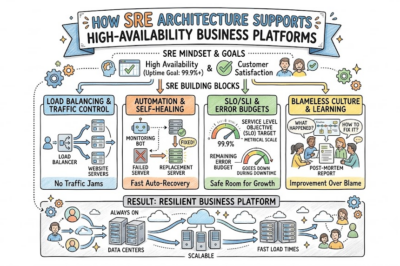
Site Reliability Engineering treats operational administration as a dedicated software problem rather than a manual checklist. Instead of updating configurations by hand, engineers develop automated software to monitor, heal, and scale running workloads. Hence, professional SRE Consulting Services guide organizations in designing Service Level Objectives, measuring error budgets, and conducting blameless post-mortem reviews.
Resilient architectures depend on continuous operational feedback:
- Service Level Indicators track real-time system performance and user experience metrics.
- Target Service Level Objectives define the acceptable margin of operational degradation.
- Error budgets dictate release pacing to ensure platform health overrides aggressive deployments.
- Automated runbooks trigger immediate remediation scripts during unexpected production failures.
Error budgets strike a practical balance between product release speed and customer platform stability. When unexpected outages exhaust available budgets, teams freeze experimental updates until stability recovers. Consequently, enterprises build resilient architectures that sustain customer confidence and meet strict uptime commitments.
How Can Better Observability Help Your Engineering Team?
Simple health pings fail to expose the subtle failure modes of distributed microservice platforms. When latency spikes across dependent internal networks, engineers need deep telemetry into microservice interactions. Complete observability unifies structured logging, high-cardinality metrics, and distributed traces to explain why systems degrade.
- Real-Time Operational Metrics: Providing immediate visibility into error rates, request throughput, and hardware saturation.
- Centralized Log Streams: Aggregating application logs into searchable stores to locate exceptions across dynamic container fleets.
- End-to-End Tracing: Following individual user requests across multiple microservice hops to pinpoint processing delays.
Therefore, engineering teams diagnose complicated production regressions swiftly, reducing recovery time and defending customer satisfaction.
What Is Platform Engineering and Why Are Teams Adopting It?
Forcing feature developers to configure container networking, cloud permissions, security certificates, and delivery pipelines produces immense cognitive fatigue. When engineers waste hours managing infrastructure settings, customer-facing delivery stalls. Therefore, forward-looking enterprises utilize specialized Platform Engineering Consulting Services to build internal developer platforms that simplify everyday tasks.
Internal platforms bundle complex cloud resources, delivery pipelines, and compliance rules into straightforward self-service interfaces. As a result, product engineers spin up approved databases and ephemeral staging environments without writing intricate infrastructure files. Ultimately, platform engineering treats infrastructure as an internal product, unlocking developer efficiency and accelerating feature delivery.
What Are Golden Paths and How Do They Help Developers?
Golden paths represent vetted, supported, and automated workflows that walk developers through routine infrastructure actions safely. Rather than forcing software engineers to invent deployment configurations, platform teams provide production-ready application templates. Developers choose an approved framework, and the system provisions compliant pipelines automatically.
Crucially, golden paths remove daily delivery friction while permitting custom approaches when complex projects demand them. These templates embed company security rules, monitoring agents, and integration tests directly from day one. Consequently, engineers focus entirely on product functionality, confident that their microservices satisfy corporate compliance guidelines.
How Can Corporate DevOps Training Strengthen Internal Teams?
Purchasing modern software tooling without educating existing engineering personnel leads to fragile configurations and low platform adoption. Lasting operational success demands deep technical competence across development, security, and infrastructure departments. Therefore, practical Corporate DevOps Training closes enterprise capability gaps through interactive labs, architectural workshops, and real-world delivery simulations.
Hands-on upskilling prepares internal developers to manage container platforms, automated pipelines, and declarative infrastructure code. Moreover, collaborative educational sessions dismantle long-standing silos between historically separate functional groups. As in-house technical proficiency grows, organizations reduce dependence on third-party agencies and retain intellectual property internally.
How Do DevOps, Cloud, Kubernetes, and SRE Work Together?
Modern software engineering disciplines operate as an integrated technical stack, with each practice amplifying the impact of the others. Cloud platforms supply elastic computing capacity, while Kubernetes schedules application containers across those resources. Concurrently, automated continuous integration pipelines build, test, and release application artifacts into these clusters systematically.
| Architecture Tier | Dominant Technology Scope | Core Operational Role |
|---|---|---|
| Compute Infrastructure | Multi-cloud resource layers | Supplies elastic virtualization, storage networks, and compute pools |
| Cluster Management | Managed Kubernetes engines | Coordinates automated workload distribution, rollouts, and node healing |
| Continuous Integration | Automated delivery pipelines | Packages code changes and validates security gates systematically |
| System Resiliency | Reliability metrics and telemetry | Protects live availability, monitors error budgets, and routes alerts |
Finally, Site Reliability Engineering provides operational guardrails, distributed telemetry, and auto-healing scripts to preserve production integrity. Combining these practices creates an agile, durable engineering machine. Consequently, businesses deliver frequent updates while maintaining superior platform uptime.
What Problems Can Slow Down a DevOps Transformation?
Modernization efforts regularly stall when leadership views transformation merely as a tool-procurement campaign. Deploying new software without fixing entrenched cultural silos, conflicting incentives, or bureaucratic approvals rarely yields tangible benefits. When operations groups prioritize strict uptime while developers focus solely on shipping features, organizational gridlock continues.
Another common failure stems from attempting massive, all-at-once architectural overhauls across every production system simultaneously. Broad refactoring initiatives often collapse under unexpected complexity when teams fail to deliver quick, incremental wins. Successful organizations launch small, targeted pilot implementations instead, proving concrete delivery improvements before expanding practices company-wide.
How Can You Tell Whether Your DevOps Strategy Is Working?
Assessing engineering maturity requires looking beyond vanity measurements like written lines of code or commit volume. Instead, progressive organizations evaluate software velocity and platform reliability using standardized DORA benchmarks. Tracking these core metrics gives leadership objective clarity regarding team delivery performance.
- Deployment Frequency: The rate at which teams deliver functional updates to staging and production systems.
- Lead Time for Changes: The total time elapsed from the initial commit to deployment in live user environments.
- Change Failure Rate: The proportion of production rollouts requiring emergency rollbacks, patches, or hotfixes.
- Mean Time to Restore: The duration required to bring services back online after an unexpected production outage.
Monitoring these key indicators ensures development groups release changes quickly without compromising operational stability.
What Does a Practical DevOps Roadmap Look Like?
Successful infrastructure modernization follows a structured, step-by-step rollout rather than an uncontrolled tooling overhaul. Organizations must establish clear visibility into existing manual processes before deploying advanced deployment pipelines.
- Assessment and Planning: Reviewing current delivery pipelines, operational costs, and existing security postures.
- Core Process Automation: Introducing infrastructure as code, containerized builds, and dependable CI/CD workflows.
- Platform and Security Integration: Rolling out automated security audits alongside self-service internal developer platforms.
- Reliability Maturity: Applying Site Reliability Engineering disciplines, error budgets, and full-stack observability.
Furthermore, engineering leaders must highlight team achievements, celebrate incremental wins, and review performance indicators regularly. Maintaining transparent communication between groups aligns technical investments with primary corporate goals. Consequently, the company builds an adaptable operational framework that scales alongside product growth.
How Can Cotocus Support Your Modern Engineering Journey?
Transforming enterprise delivery systems demands deep engineering experience and battle-tested execution strategies. Cotocus partners with forward-thinking enterprises to design scalable cloud environments, automate deployment pipelines, and build resilient infrastructure. Organizations needing immediate engineering capacity can engage DevOps Outsourcing Services to place senior platform professionals directly into active product squads.
By blending targeted consulting, ongoing system administration, and comprehensive corporate upskilling, Cotocus enables engineering groups to build high-performance software. Whether your business plans to migrate legacy applications to Kubernetes or embed automated DevSecOps controls across pipelines, Cotocus provides practical solutions. Thus, your business achieves the deployment speed, operational resilience, and platform stability required to lead your market.
Frequently Asked Questions About Cotocus
- Which specialized solutions does the advisory team provide for software modernization?
Cotocus supplies end-to-end technical transformation services, including continuous delivery automation, multi-cloud infrastructure design, and production Kubernetes deployments. In addition, our consultants guide enterprises through Site Reliability Engineering practices, automated DevSecOps integration, self-service developer platform design, and technical workforce training.
- Which methods do architects use to optimize cloud environments?
Engineers build automated, secure, and cost-effective cloud architectures across major providers such as AWS, Azure, and Google Cloud. Our architects employ declarative infrastructure as code, continuous policy enforcement, and right-sized compute profiles to optimize resource efficiency and cut monthly expenditures.
- Which business cases require dedicated managed operations?
Managed operational agreements relieve internal development teams from routine server patching, ongoing cluster triage, and off-hours production incident responses. Platform engineers actively oversee release pipelines, manage container fleets, enforce baseline security controls, and fine-tune live applications to maintain high service availability.
- Which procedures guarantee safe application transitions to cloud infrastructure?
Specialists execute low-risk migration frameworks designed to move legacy software, enterprise databases, and critical systems without unplanned downtime. By utilizing automated data synchronization and canary traffic-shifting patterns, workloads move into modern cloud architectures safely.
- Which factors make specialized Kubernetes advisory valuable?
Configuring enterprise container clusters requires mastery over networking overlays, persistent storage volumes, role-based access controls, and dynamic resource scaling. Outside consultants review existing clusters, harden security postures, and implement automated scaling configurations to eliminate unexpected system crashes.
- Which steps integrate automated security controls directly into build pipelines?
Engineers configure automated static code analysis, third-party dependency scanning, container vulnerability reviews, and compliance checks directly within continuous delivery workflows. Surfacing vulnerabilities during early code reviews avoids expensive last-minute fixes and maintains regulatory compliance without slowing release cycles.
- Which concrete operational metrics does Site Reliability Engineering improve?
SRE introduces clear Service Level Objectives and error budget models that maintain an optimal balance between feature delivery and system stability. Furthermore, reliability engineers build automated incident response workflows and lead blameless retrospective reviews to eradicate recurring system bugs.
- Which operational hurdles do internal developer portals resolve for engineers?
Platform teams design centralized portals offering pre-approved templates and automated provisioning workflows. Packaging complex infrastructure behind self-service tools lets software developers spin up compliant test environments quickly without submitting manual support tickets.
- Which organizational triggers prompt technology leaders to outsource operations?
Outsourcing helps enterprises that need specialized technical capacity immediately to execute major modernization initiatives without enduring prolonged recruitment cycles. External senior engineers join internal squads directly, providing immediate technical execution across cloud automation, container management, and delivery pipelines.
- Which enterprise capabilities expand through hands-on technical training?
Comprehensive training workshops equip internal personnel with real-world skills in cloud architecture, container management, continuous integration, and reliability engineering. Upskilling existing teams ensures they can run, optimize, and expand modern cloud platforms independently over the long term.
Final Thoughts
Long-term commercial success requires engineering leaders to balance aggressive release velocity with uncompromising system stability. Organizations cannot dominate their sectors while relying on manual deployments, fragile system configurations, or unmanaged infrastructure outages in volatile tech markets. By adopting declarative automation, resilient container clusters, and automated security controls, technical departments construct agile, high-throughput delivery engines.
Collaborating with seasoned implementation specialists eliminates costly operational missteps and shortens the organizational learning curve. Ultimately, committing to unified infrastructure automation, developer self-service tooling, and comprehensive employee upskilling equips organizations to ship superior software consistently and dominate their target markets.