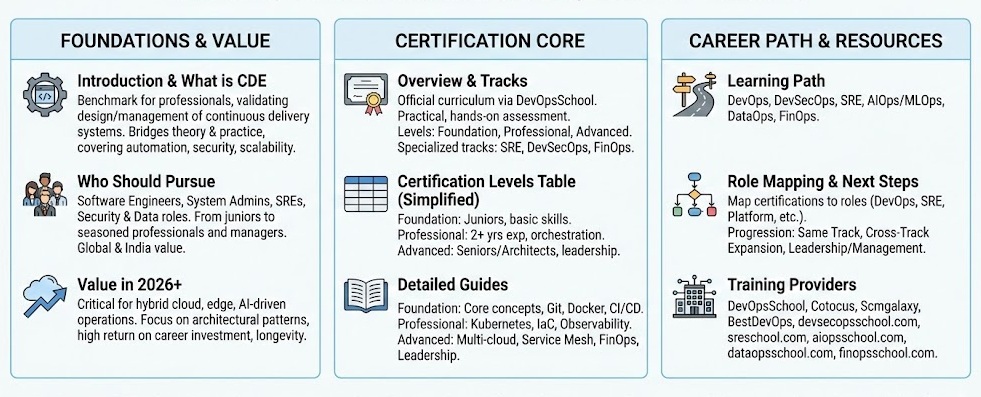
DevOps as a Core Engineering Capability
Modern software engineering is no longer defined by how quickly features are written. It is defined by how safely, predictably, and repeatedly those features reach production—and continue to run. Downtime, security breaches, and operational inefficiencies now have direct business impact, which has pushed DevOps from a support role into the core of engineering responsibility.
The Certified DevOps Engineer (CDE) has emerged as a meaningful reference point in this shift. It represents a level of maturity where an engineer understands not only how to build software, but how to operate it as a system. This guide is written for engineers and technical leaders who want clarity on what CDE truly represents in real environments.
The goal of this blog is to help professionals evaluate Certified DevOps Engineer (CDE) as a long-term career investment. It explains what the certification validates, who benefits most from it, and how it maps to modern DevOps, cloud, and platform engineering roles.
The Engineering Scope Behind Certified DevOps Engineer (CDE)
Certified DevOps Engineer (CDE) is a professional certification focused on validating practical system delivery skills. It assesses whether an engineer can design, automate, deploy, monitor, and improve production systems—not whether they can memorize tools or platform-specific features.
The certification is intentionally cloud-agnostic. Instead of locking candidates into one vendor ecosystem, it emphasizes DevOps fundamentals that apply across on-prem, cloud, and hybrid environments. Automation, repeatability, observability, and cross-team collaboration are at the core of what it measures.
The curriculum reflects modern engineering workflows. It brings together version control, CI/CD pipeline design, containerization, infrastructure as code, and observability into a single operational mindset. These skills are essential for managing distributed systems and microservices architectures at scale.
Who Typically Pursues Certified DevOps Engineer (CDE)
Certified DevOps Engineer (CDE) applies to a wide range of technical roles. Engineers early in their careers often use it to move from development or system administration into DevOps roles with a structured learning path. It provides clarity in an ecosystem crowded with tools and fragmented guidance.
Experienced engineers gain value by formalizing years of practical experience. SREs deepen their automation and reliability practices, while security professionals gain a stronger foundation for embedding security into delivery pipelines instead of treating it as a separate phase.
The certification is also relevant to data engineers and MLOps practitioners who manage complex infrastructure and automation-heavy workflows. Its relevance spans global markets and is particularly strong in India, where enterprises continue to invest heavily in cloud-native and platform engineering capabilities.
Why Certified DevOps Engineer (CDE) Has Long-Term Career Value
Enterprise platforms are evolving toward greater distribution and automation. Hybrid cloud, edge deployments, and AI-driven systems introduce operational complexity that cannot be solved with ad-hoc scripting or manual processes.
Certified DevOps Engineer (CDE) maintains its value because it focuses on durable engineering practices rather than short-lived tools. The principles behind CI/CD architecture, infrastructure automation, testing pipelines, and observability remain stable even as platforms change.
Organizations increasingly seek engineers who combine depth in one discipline with an understanding of the full delivery lifecycle. Certified DevOps Engineer (CDE) supports this skill profile, making it a solid investment for long-term employability, leadership growth, and compensation stability.
How the Certified DevOps Engineer (CDE) Program Is Delivered
The Certified DevOps Engineer (CDE) program is delivered through the official curriculum available on
the Certified DevOps Engineer course page
and is hosted on
the DevOpsSchool platform.
The program follows a progressive learning model, starting with core DevOps concepts and advancing toward system architecture and organizational-scale practices. Content is curated by practitioners with real production experience to ensure relevance.
Assessments emphasize hands-on execution and scenario-based problem solving. Candidates are evaluated on their ability to apply DevOps principles under realistic constraints, which aligns closely with day-to-day engineering work.
Progression Models Within Certified DevOps Engineer (CDE)
Certified DevOps Engineer (CDE) follows a layered structure aligned with professional growth. The Foundation level establishes DevOps philosophy, automation fundamentals, and essential tools. The Professional level deepens focus on orchestration, CI/CD system design, and infrastructure as code. The Advanced level centers on architecture, optimization, and enterprise-scale DevOps transformation.
Alongside the core progression, specialization paths allow engineers to align certification with their responsibilities. These include reliability-focused SRE practices, security-driven DevSecOps integration, and FinOps-oriented cost governance skills.
This flexibility allows the certification journey to reflect real job roles instead of forcing every candidate into the same learning track.
Certified DevOps Engineer (CDE) Certification Overview
| Track | Level | Who it’s for | Prerequisites | Skills Covered | Recommended Order | Official Link |
|---|---|---|---|---|---|---|
| Core DevOps | Foundation | Junior Engineers, Students | Basic Linux and coding | Git, Docker, CI/CD basics | First | View Course |
| Core DevOps | Professional | Engineers with production exposure | Foundation-level knowledge | Kubernetes, Terraform, Jenkins | Next | View Course |
| Core DevOps | Advanced | Senior Engineers, Architects | Professional mastery | Service Mesh, Scalability, IaC | Later | View Course |
| SRE Track | Professional | Reliability Engineers | System administration experience | SLOs, SLIs, Error Budgets | Parallel | View Course |
| Security Track | Professional | Security Engineers | Security fundamentals | Secrets, SAST/DAST, Compliance | Parallel | View Course |
Practical Expectations at Different Certification Levels
Certified DevOps Engineer (CDE) – Foundation
The Foundation level establishes how modern delivery systems function end to end. Candidates learn how code moves from repositories into production via automated pipelines and containers while supporting collaboration and feedback.
Expected outcomes include containerizing applications, building basic CI pipelines, and using structured Git workflows. Preparation usually combines concept study with hands-on labs and a complete deployment project.
A common mistake at this level is treating DevOps as tooling rather than as an engineering mindset.
Certified DevOps Engineer (CDE) – Professional
The Professional level focuses on operating real production systems. Candidates work with container orchestration, infrastructure as code, monitoring, observability, and safe deployment strategies.
Engineers at this level should be able to run Kubernetes clusters, automate cloud infrastructure, and respond to incidents effectively. Success requires repeated hands-on troubleshooting, not just lab completion.
Many candidates fail by underestimating state management and operational visibility.
Certified DevOps Engineer (CDE) – Advanced
The Advanced level targets engineers responsible for system design and platform strategy. It validates architectural decision-making, system scalability, and cost-aware infrastructure planning.
Candidates are expected to design disaster recovery strategies, implement service mesh solutions, and balance performance with cloud spend. Preparation focuses on design reviews, architectural documentation, and peer discussions.
Overengineering without operational clarity is the most frequent mistake at this stage.
Career Directions Enabled by Certified DevOps Engineer (CDE)
Certified DevOps Engineer (CDE) can support multiple career paths. Traditional DevOps roles focus on CI/CD automation and developer experience. DevSecOps paths integrate security controls across the delivery lifecycle. SRE paths emphasize reliability, observability, and incident response.
AIOps and MLOps paths focus on automating AI infrastructure. DataOps applies DevOps principles to data pipelines and analytics workflows. FinOps paths help engineers and leaders manage cloud financial accountability.
Mapping Roles to Certification Choices
| Role | Recommended Certifications |
|---|---|
| DevOps Engineer | CDE Foundation, CDE Professional |
| Site Reliability Engineer | CDE Professional, Certified SRE Professional |
| Platform Engineer | CDE Professional, CDE Advanced |
| Cloud Engineer | CDE Foundation, Cloud Associate Certifications |
| Security Engineer | CDE Foundation, Certified DevSecOps Professional |
| Data Engineer | CDE Foundation, Certified DataOps Professional |
| FinOps Practitioner | CDE Foundation, Certified FinOps Professional |
| Engineering Manager | CDE Foundation, DevOps Leadership Track |
Growth Paths After Certified DevOps Engineer (CDE)
Professionals who complete Certified DevOps Engineer (CDE) often deepen their expertise within DevOps and platform engineering, expand into reliability or security domains, or transition into technical leadership roles.
The certification provides a shared technical foundation that supports growth without locking engineers into a single career path.
Training and Ecosystem Supporting CDE
CDE learners are supported by a broad ecosystem that includes DevOpsSchool, Cotocus, Scmgalaxy, BestDevOps, devsecopsschool.com, sreschool.com, aiopsschool.com, dataopsschool.com, and finopsschool.com. Each contributes specialized expertise across DevOps, reliability, security, data, AI operations, and cloud cost management.
Final View on Certified DevOps Engineer (CDE)
Certified DevOps Engineer (CDE) is not about collecting credentials. Its value lies in reinforcing engineering discipline. Modern software systems demand professionals who can automate delivery, observe system behavior, recover from failures, and scale responsibly.
For engineers willing to apply these principles consistently, Certified DevOps Engineer (CDE) provides a strong and future-proof foundation for long-term relevance and leadership in software engineering.
📞 Call to Action & Contact Details
End the article with the following contact information:
📞 USA: +1 (469) 756-6329
📞 India: +91 99057 40781
✉️ Email: Contact@DevOpsSchool.com