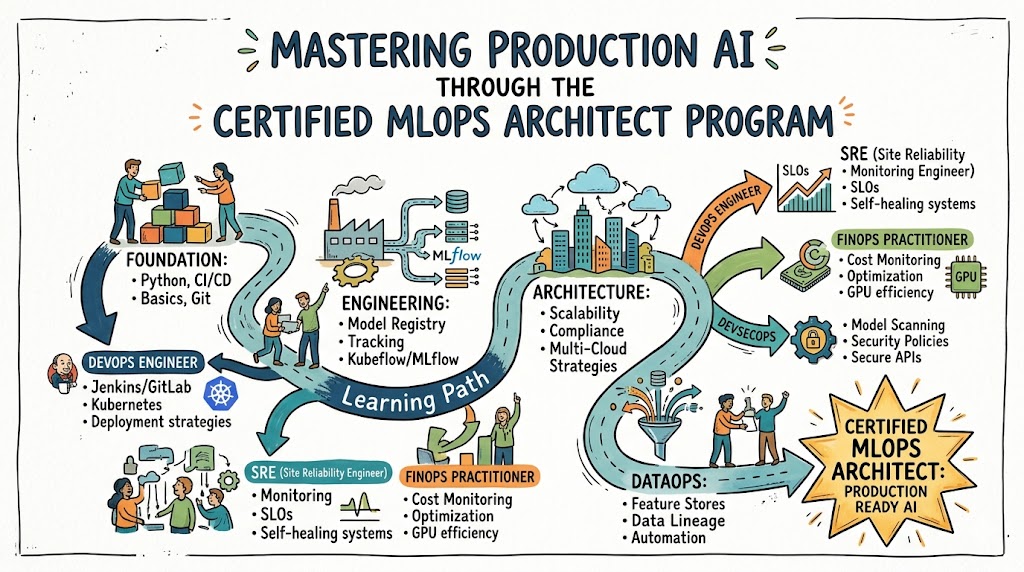
The modern engineering landscape shifts rapidly toward automated intelligence, making the Certified MLOps Architect a vital credential for bridging the gap between data science and production. We designed this guide specifically for professionals within DevOps, cloud-native, and platform engineering spaces who must operationalize machine learning at scale. Mastering the nuances of model deployment and lifecycle management provides a necessary edge for high-growth technical roles. By following this roadmap, engineers move beyond theoretical knowledge to master industrial-grade AI systems, ensuring career decisions backed by market demand and technical depth at AIOpsSchool.
What is the Certified MLOps Architect?
The Certified MLOps Architect represents a specialized professional standard focusing on the convergence of machine learning and system operations. It solves the “last mile” problem of AI, where many models fail to reach production due to a lack of robust engineering frameworks. This program prioritizes production-focused learning, teaching candidates how to build resilient pipelines rather than just writing experimental code. It aligns perfectly with modern enterprise practices by treating machine learning models as software artifacts that require versioning, testing, and monitoring.
Who Should Pursue Certified MLOps Architect?
SREs, cloud architects, and data engineers who manage complex model lifecycles benefit most from this certification. Experienced DevOps professionals looking to pivot into the high-growth AI sector find the curriculum particularly relevant to their existing automation skills. Beginners with a strong foundation in Linux and Python use this to enter the market, while engineering managers gain the technical oversight needed to lead specialized teams. Given the global surge in AI adoption, this path offers significant career mobility for professionals in India and international tech hubs.
Why Certified MLOps Architect is Valuable Beyond the Current Era
Enterprise adoption of AI remains a core business requirement rather than a trend, ensuring long-term demand for architects who sustain these systems. This certification helps professionals stay relevant even as specific tools change by focusing on foundational principles of continuous delivery for machine learning. The return on time investment remains substantial because it moves an engineer from a generalist role into a high-value niche. As organizations scale data initiatives, the ability to manage resource-heavy ML workloads becomes a primary differentiator for senior-level promotions.
Certified MLOps Architect Certification Overview
The program delivers the official curriculum and resides on the primary platform. It utilizes a practical assessment approach that values hands-on capability over rote memorization of terminology. The certification structure guides a learner from fundamental concepts of data pipelines to the complexities of distributed training and model governance. Industry-recognized bodies maintain ownership of the certification and ensure the content stays updated with the latest cloud-native and Kubernetes-based ML tools.
Certified MLOps Architect Certification Tracks & Levels
The certification hierarchy begins with a foundation level that introduces core vocabulary and basic pipeline concepts. Moving to the professional level, candidates engage with advanced automation, monitoring, and security integration within the ML lifecycle. The advanced architect level focuses on organizational-scale strategy, including cost optimization and multi-cloud deployment patterns. These levels mirror a natural career progression, allowing an individual to grow from an implementation engineer to a strategic technical leader.
Complete Certified MLOps Architect Certification Table
| Track | Level | Who it’s for | Prerequisites | Skills Covered | Recommended Order |
| Core | Associate | Junior Devs/Managers | Python Basics | ML Basics, Docker | 1 |
| Operations | Professional | SREs/DevOps | Cloud Fundamentals | CI/CD, Monitoring | 2 |
| Data Ops | Professional | Data Engineers | SQL/Data Pipelines | Feature Stores, ETL | 2 |
| Security | Advanced | Security Engineers | Professional Level | Compliance, Auditing | 3 |
| Enterprise | Expert | Principal Architects | Senior Experience | System Design, Drift | 4 |
Detailed Guide for Each Certified MLOps Architect Certification
Certified MLOps Architect – Foundation Level
What it is
This level validates a candidate’s understanding of the basic MLOps lifecycle and the essential differences between traditional DevOps and ML-focused operations.
Who should take it
Entry-level developers or DevOps engineers new to machine learning take this to understand core terminology.
Skills you’ll gain
- Understanding the ML pipeline phases
- Basic versioning of data and code
- Knowledge of model deployment strategies
- Fundamentals of monitoring ML metrics
Real-world projects you should be able to do
- Setup a basic CI/CD pipeline for a Python model
- Deploy a simple containerized model to a cloud provider
- Implement basic data logging for a small dataset
Preparation plan
- 7–14 days: Review official documentation and basic terminology.
- 30 days: Complete online labs and practice containerization.
- 60 days: Build a portfolio project showcasing a full pipeline.
Common mistakes
- Ignoring the data versioning aspect in favor of just code.
- Overcomplicating the infrastructure for a simple model.
Best next certification after this
- Same-track option: Professional MLOps Engineer
- Cross-track option: Cloud Practitioner
- Leadership option: Technical Team Lead Fundamentals
Certified MLOps Architect – Professional Level
What it is
This certification validates the ability to design and implement automated, scalable machine learning workflows using industry-standard tools and cloud services.
Who should take it
Mid-level engineers who actively deploy models and must ensure high availability and performance should pursue this.
Skills you’ll gain
- Advanced automation with Kubeflow or MLflow
- Implementing automated model retraining loops
- Managing feature stores for large-scale data
- Drift detection and advanced monitoring
Real-world projects you should be able to do
- Build a production-grade automated retraining pipeline
- Implement an A/B testing framework for model deployment
- Configure a centralized model registry for an organization
Preparation plan
- 7–14 days: Deep dive into specific orchestration tools like Kubernetes.
- 30 days: Hands-on practice with model drift and monitoring setups.
- 60 days: Full-scale simulation of a multi-stage ML lifecycle.
Common mistakes
- Failing to account for security and access controls in the registry.
- Neglecting the cost implications of high-frequency retraining.
Best next certification after this
- Same-track option: Advanced MLOps Architect
- Cross-track option: Site Reliability Engineer (SRE)
- Leadership option: MLOps Program Manager
Choose Your Learning Path
DevOps Path
The DevOps path focuses on integrating machine learning into existing continuous delivery pipelines. Engineers in this track treat models as another versioned component of the software stack. It emphasizes using Jenkins, GitLab, or GitHub Actions to trigger model builds and deployments. This path suits those who want to ensure AI does not become a siloed part of the organization.
DevSecOps Path
Security remains paramount when dealing with sensitive data and proprietary models, making this path essential for compliance-heavy industries. It covers scanning model artifacts, securing data lakes, and ensuring isolated training environments. Professionals implement “Policy as Code” for ML deployments. This path ensures AI development speed does not compromise the enterprise security posture.
SRE Path
The SRE path focuses on reliability, latency, and performance of machine learning models in production. It establishes Service Level Objectives (SLOs) specifically for model inference and data processing. Engineers handle “on-call” scenarios for model drift or unexpected failures in data ingestion. This route attracts those who enjoy maintaining complex, high-traffic systems.
AIOps Path
This track utilizes machine learning to improve IT operations and creates a self-healing infrastructure. It teaches how to use AI models to analyze logs, predict outages, and automate the resolution of common system issues. Professionals focus on operational data generated by servers and applications rather than consumer data. It represents a highly specialized niche for revolutionizing data center management.
MLOps Path
The MLOps path provides the core journey for those focusing on engineering machine learning models from start to finish. It balances data scientist needs with system administrator requirements. Participants learn the intricacies of hyperparameter tuning, distributed training, and model serving at scale. This path produces the “glue” individuals who ensure data science projects provide business value.
DataOps Path
DataOps focuses on the quality and flow of data feeding into machine learning models. It applies agile and DevOps principles to data management, ensuring clean, timely, and accessible “fuel” for AI. Engineers learn about automated data testing, orchestration of ELT/ETL pipelines, and data lineage. Without this path, MLOps fails because the underlying data lacks reliability.
FinOps Path
Machine learning often incurs high costs due to GPU requirements and cloud egress fees, making FinOps critical. This path teaches engineers how to monitor ML spending, right-size training clusters, and choose cost-effective instance types. It involves tagging resources and creating visibility into costs versus model value. This vital skill benefits senior architects responsible for large-scale AI budgets.
Role → Recommended Certified MLOps Architect Certifications
| Role | Recommended Certifications |
| DevOps Engineer | MLOps Professional, Kubernetes Expert |
| SRE | MLOps Professional, SRE Advanced |
| Platform Engineer | MLOps Expert, Cloud Architect |
| Cloud Engineer | MLOps Associate, Cloud Professional |
| Security Engineer | DevSecOps Advanced, MLOps Governance |
| Data Engineer | DataOps Professional, MLOps Associate |
| FinOps Practitioner | FinOps Certified, MLOps Foundation |
| Engineering Manager | MLOps Foundation, Strategic Leadership |
Next Certifications to Take After Certified MLOps Architect
Same Track Progression
Upon reaching the advanced level, shift focus toward deep technical mastery of specific tools like Kubernetes or specialized cloud AI platforms. Contributing to open-source MLOps projects serves as a “living certification.” This deep specialization ensures you remain the go-to expert for complex architectural failures.
Cross-Track Expansion
Broadening skills into areas like FinOps or DevSecOps provides a holistic view of the enterprise. An MLOps architect who understands security implications holds far more value than one who only knows how to deploy. This expansion facilitates better collaboration across different departments within a large organization.
Leadership & Management Track
Those looking to move away from daily coding should pursue certifications in ITIL, PMP, or specialized engineering leadership. These credentials help you manage the people and processes driving MLOps initiatives. It eases the transition from executing work to defining the roadmap for the entire engineering organization.
Training & Certification Support Providers for Certified MLOps Architect
DevOpsSchool This provider offers extensive resources for mastering automation and integration. Their curriculum covers a wide range of tools essential for modern software delivery. They focus on hands-on labs simulating real-world production environments to ensure student readiness.
Cotocus This firm specializes in cloud-native technologies through deep-dive sessions into containerization and orchestration. Foundational for any MLOps journey, their instructors bring current industry trends into the classroom.
Scmgalaxy This community-driven platform provides tutorials, blogs, and training on configuration management. Engineers learn about the version control systems underpinning MLOps pipelines here. They emphasize collaborative tools in the development lifecycle.
BestDevOps Refining automation strategies through high standards of DevOps practices, this provider helps professionals excel. Their concise and impactful courses target specific skill gaps in the workforce while providing career coaching.
devsecopsschool.com This authority focuses on integrating security into the DevOps pipeline. Their training proves crucial for MLOps architects handling sensitive datasets and secure model APIs. They provide a clear framework for shared security responsibility.
sreschool.com This institution focuses on the reliability and scalability of modern systems. Their courses teach the metrics-driven approach needed to maintain high-availability machine learning services. It remains a top choice for operational stability.
aiopsschool.com Leading the way in applying AI to operations, this platform helps engineers build self-healing infrastructures. It serves as the primary destination for professionals transitioning into intelligent automation.
dataopsschool.com Ensuring a solid ML foundation, this provider specializes in the data pipeline aspect of the lifecycle. They teach principles of data agility and quality management. Their courses assist anyone responsible for large-scale data ingestion.
finopsschool.com Addressing critical cost management needs in the cloud and AI era, this provider teaches engineers to speak the language of finance. They optimize technical resources for maximum ROI. This skill set remains vital for senior technical leaders.
Frequently Asked Questions (General)
1. Is the Certified MLOps Architect exam difficult?
The exam tests practical application rather than just theory, making it challenging. If you possess hands-on experience with pipelines and Python, you will find it manageable. It requires a solid grasp of tool interaction in production.
2. What average time does the certification require for completion?
Working professionals usually take between two to four months to fully prepare. This depends on your existing background in DevOps and data science. Beginners may require additional time for containerization fundamentals.
3. Do strict prerequisites exist for the foundation level?
No formal prerequisites exist, but we highly recommend a basic understanding of Linux and Python. Comfort with the command line helps you move through labs faster. Git familiarity also provides a significant advantage.
4. What kind of ROI should I expect from this certification?
Professionals often see significant salary increases or higher-level roles within six months. The certification validates a niche skill set currently in high demand. it provides the confidence to lead complex AI projects.
5. How does this differ from a standard Data Science certificate?
Data science focuses on building models, while MLOps focuses on infrastructure and automation. This certification targets the person who makes the model work reliably in a real application. It prioritizes engineering over statistics.
6. Must I know deep learning to pass?
You must understand the lifecycle of deep learning models, but you don’t need to be a researcher. The focus remains on training, deploying, and monitoring these models at scale. You should know the resource requirements.
7. Does the industry recognize the certification globally?
Yes, the standards taught follow industry-wide best practices used by major cloud providers. Organizations across India, North America, and Europe value these skills for digital transformation. This credential travels well across borders.
8. Can I take the exam online?
Most levels offer proctored online exams for your convenience. This allows you to schedule your assessment during a time that fits your work schedule. Ensure you have a stable internet connection.
9. Does the certification expire?
Most professional certifications require renewal every two to three years. This ensures you stay up to date with rapidly evolving tools in the ML space. Check the specific platform for renewal guidelines.
10. What tools will I learn during the process?
You will encounter tools like Kubernetes, Docker, MLflow, Kubeflow, and various cloud-specific ML services. The focus remains on concepts, but these tools demonstrate those concepts in practice. You gain a versatile toolkit.
11. Does a community exist for certified professionals?
Yes, you gain access to exclusive forums and networking groups for sharing knowledge. This community serves as a great resource for troubleshooting real-world problems and finding job opportunities. Networking adds key value.
12. How much coding does the certification involve?
Expect a moderate amount of coding, primarily in Python and YAML for configuration. You don’t need to be a software developer, but you should feel comfortable writing scripts. Automation sits at the heart of the curriculum.
FAQs on Certified MLOps Architect
1. How does Certified MLOps Architect address model drift?
The program teaches specific monitoring techniques to detect model performance degradation over time. You learn to set up automated alerts and triggers for retraining. This ensures model accuracy as real-world data changes.
2. Can an SRE transition easily to an MLOps Architect role?
SREs already possess many required skills like monitoring and automation. The certification bridges the gap by adding ML-specific knowledge like model versioning. It represents one of the most natural career transitions.
3. Does the course cover multi-cloud MLOps strategies?
Advanced levels specifically address deploying models across different cloud providers to avoid vendor lock-in. You learn about portable workflows using Kubernetes. This remains a critical skill for enterprise architects.
4. How is security integrated into the MLOps lifecycle?
The curriculum follows DevSecOps principles, teaching you to scan models for vulnerabilities and secure data pipelines. You learn about role-based access control for registries. Security acts as a continuous process here.
5. What role does Kubernetes play in this certification?
Kubernetes acts as the primary orchestrator for managing containers that house ML models and training jobs. You learn how to scale these containers based on demand. It serves as a core component of professional tracks.
6. How do I manage large datasets within the MLOps framework?
The certification covers DataOps principles, including data versioning and feature stores. You learn to ensure data lineage for every model. This remains vital for compliance and debugging.
7. Does the program focus on cost optimization for ML workloads?
Yes, the FinOps track teaches you to manage high costs associated with GPUs and cloud resources. You learn to monitor spending and implement cost-saving measures like spot instances. This makes you a more valuable architect.
8. What practical benefits does the model registry offer?
You learn how to use a registry to track model versions and metadata. This allows for easy rollbacks if a new model performs poorly. It acts as the single source of truth for all ML artifacts.
Final Thoughts: Is Certified MLOps Architect Worth It?
Securing the Certified MLOps Architect credential marks a strategic move for any engineer looking to stay ahead. The industry reality shows that simple automation has become a baseline, while specialized knowledge in AI operations represents the new frontier. This certification provides more than just a badge; it offers a structured way to think about complex, interconnected systems. By prioritizing production-grade skills over theoretical experiments, you position yourself as a high-value asset to any organization. If you put in the work to master these tools, the career rewards in salary and impact will follow. Focus on building a strong portfolio during your study and use this certification as the foundation for your next professional leap.