Introduction
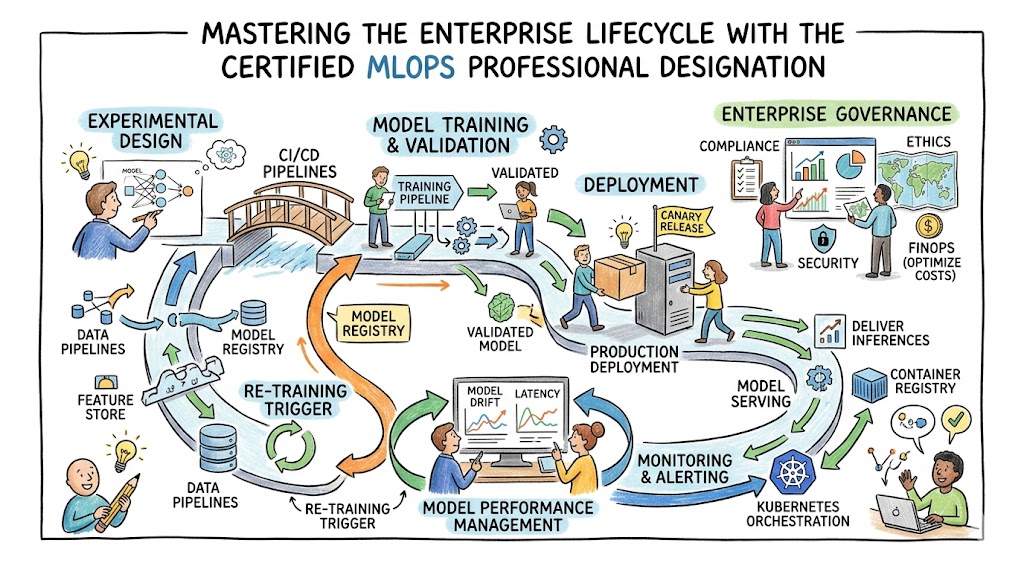
Modern engineering teams increasingly struggle to bridge the gap between experimental data science and resilient production environments. This Certified MLOps Professional curriculum offers a rigorous framework for technical experts to operationalize machine learning models at scale. By integrating the principles of AIOpsSchool, professionals learn to build automated pipelines that ensure model reliability, security, and performance. This guide serves as a strategic roadmap for DevOps, SRE, and platform engineers who seek to lead high-impact AI initiatives. We explore how this path empowers you to manage the entire model lifecycle, from data ingestion to real-time inference monitoring, without falling into the trap of manual experimentation.
What is the Certified MLOps Professional?
The Certified MLOps Professional credential validates a practitioner’s ability to manage machine learning systems with the same rigor as traditional software. It exists because organizations now require repeatable, automated workflows rather than isolated notebook scripts. This certification emphasizes production-grade excellence, focusing on the infrastructure and deployment strategies necessary for modern AI applications. It directly aligns with enterprise engineering practices by applying GitOps and CI/CD methodologies to the unique challenges of model versioning. Consequently, the program prepares engineers to build systems that handle massive datasets and complex computational requirements with ease.
Who Should Pursue Certified MLOps Professional?
Cloud architects and Site Reliability Engineers gain a significant competitive advantage by mastering these specialized operational skills. Data engineers who wish to expand their influence into the deployment phase find this certification particularly transformative. It also provides engineering managers with the technical depth required to oversee sophisticated AI platforms and cross-functional teams. Whether you operate in the Indian tech hubs or within global enterprises, this program signals a mastery of the tools and processes that drive AI innovation. Even beginners with a strong grasp of systems engineering can use this path to pivot into one of the most lucrative sectors of the industry.
Why Certified MLOps Professional is Valuable Beyond the Current Landscape
Enterprise demand for automated AI delivery continues to surge, making MLOps expertise a critical pillar for any modern technical career. Mastering these concepts ensures that your skills remain relevant even as specific frameworks like PyTorch or TensorFlow evolve. This certification provides a high return on investment by teaching you how to eliminate the technical debt associated with manual model management. As organizations prioritize efficiency, the ability to optimize GPU costs and minimize model downtime becomes a vital business asset. Ultimately, this training positions you as a leader in the transition toward fully automated, data-driven software ecosystems.
Certified MLOps Professional Certification Overview
The program delivers its specialized content through the AIOpsSchool platform, ensuring a high standard of technical instruction. The structure guides candidates from core foundational concepts to advanced architectural design through a series of hands-on challenges. Instead of relying on passive learning, the curriculum requires students to demonstrate mastery over real-world pipeline configurations. This approach ensures that every certified individual possesses the practical skills to manage complex model dependencies and data drift. By focusing on ownership and accountability, the program bridges the gap between theoretical knowledge and production-grade execution.
Certified MLOps Professional Certification Tracks & Levels
The certification roadmap includes foundation, professional, and advanced tiers to support continuous career growth. The foundation level focuses on establishing a common vocabulary and basic automation patterns, while the professional tier dives into deep orchestration. Advanced tracks offer the flexibility to specialize in niche areas like FinOps for AI or high-security MLOps environments. These tiers align perfectly with the standard progression from associate engineer to staff architect roles. By following this structured path, technical professionals can systematically broaden their impact across the entire organization.
Complete Certified MLOps Professional Certification Table
| Track | Level | Who it’s for | Prerequisites | Skills Covered | Recommended Order |
| Core MLOps | Foundation | New ML Practitioners | Python Basics | Pipeline Fundamentals | 1 |
| Core MLOps | Professional | Experienced SREs | Docker Knowledge | Advanced Orchestration | 2 |
| Core MLOps | Advanced | System Architects | Cloud Architecture | Enterprise Governance | 3 |
| ML Security | Professional | Security Specialists | Network Security | Pipeline Hardening | 4 |
| ML FinOps | Professional | Cloud Cost Leads | Budgeting Basics | Compute Optimization | 5 |
Detailed Guide for Each Certified MLOps Professional Certification
Certified MLOps Professional – Associate Level
What it is
This level confirms your understanding of the essential mechanics of machine learning operations. It ensures you can effectively support a data science team by maintaining their experimental pipelines and basic environments.
Who should take it
Software developers and junior DevOps engineers who want to enter the AI field should pursue this credential. It serves as an ideal entry point for those building their first automated training workflows.
Skills you’ll gain
- Implementation of data version control systems.
- Management of basic training and validation pipelines.
- Deployment of containerized models in dev environments.
- Monitoring of resource utilization during training.
Real-world projects you should be able to do
- Create a triggered workflow that retraining a model upon new data arrival.
- Configure a standardized environment for data scientists using Docker.
Preparation plan
- 7-14 Days: Learn the standard MLOps lifecycle and core terminology.
- 30 Days: Build and document three basic automated pipelines.
- 60 Days: Master the basics of container orchestration and simple inference.
Common mistakes
- Focusing exclusively on the code while neglecting the data artifacts.
- Failing to document the environment requirements for model reproducibility.
Best next certification after this
- Same-track option: Certified MLOps Professional – Specialist.
- Cross-track option: Certified DataOps Professional.
- Leadership option: Certified Technical Lead.
Certified MLOps Professional – Specialist Level
What it is
The Specialist level validates your ability to manage high-availability machine learning platforms in production. It focuses on the complex interplay between data scaling, model reliability, and real-time monitoring.
Who should take it
Senior SREs and DevOps professionals who are responsible for mission-critical AI services should take this exam. It is designed for engineers who must guarantee uptime and accuracy for live models.
Skills you’ll gain
- Design of resilient multi-model serving architectures.
- Implementation of automated drift detection and alerting.
- Orchestration of large-scale distributed training on Kubernetes.
- Advanced governance for model ethics and compliance.
Real-world projects you should be able to do
- Deploy a blue-green model release strategy with zero downtime.
- Build a monitoring dashboard that tracks both technical latency and model accuracy.
Preparation plan
- 7-14 Days: Study advanced orchestration patterns and feature store integration.
- 30 Days: Complete a series of labs focused on Kubernetes-based model serving.
- 60 Days: Architect a complete end-to-end MLOps platform for an enterprise.
Common mistakes
- Overlooking the cost implications of scaling GPU-intensive workloads.
- Implementing drift detection without a clear remediation plan.
Best next certification after this
- Same-track option: Certified MLOps Professional – Expert.
- Cross-track option: Certified DevSecOps Professional.
- Leadership option: Technical Director – AI Platforms.
Choose Your Learning Path
DevOps Path
The DevOps track emphasizes the rapid delivery of machine learning features through standard CI/CD pipelines. You learn to treat models as first-class software citizens, ensuring that code, data, and configuration remain in sync. This path reduces the manual effort required to move models from research to the hands of users. By mastering these skills, you ensure that your organization maintains a high velocity of AI innovation.
DevSecOps Path
Security remains a top priority in this track, which focuses on protecting the integrity of data and models. You learn to implement security gates throughout the pipeline, from static analysis of ML code to securing inference APIs. This path ensures that your AI systems remain resilient against adversarial attacks and data breaches. Professionals here become the guardians of the organization’s most sensitive intellectual property.
SRE Path
The SRE path focuses on the reliability and scalability of machine learning services in the wild. You learn to define error budgets for models and implement observability that identifies performance bottlenecks instantly. This track ensures that AI-powered applications remain responsive and stable under varying loads. SREs in this field bridge the gap between infrastructure stability and model performance.
AIOps Path
Engineers on the AIOps path apply machine learning to solve traditional IT operational challenges. You learn to build systems that predict outages, analyze massive log volumes, and automate incident responses. This track transforms traditional operations into an intelligent, self-healing ecosystem. It is the ideal path for those managing large-scale, complex infrastructure environments.
MLOps Path
The dedicated MLOps track provides a deep dive into the specific management of the machine learning lifecycle. You focus on the unique challenges of feature engineering, model training, and model governance. This path ensures that every model in production remains accurate, fair, and technically sound. It offers the most comprehensive view of how to run a modern AI-driven enterprise.
DataOps Path
The DataOps track ensures that high-quality data flows seamlessly into your machine learning pipelines. You learn to automate data preparation, validation, and integration to reduce the risk of “garbage in, garbage out.” This path focuses on building the foundation of reliable data upon which all AI success depends. By improving data velocity, you accelerate the entire development cycle.
FinOps Path
The FinOps track addresses the significant costs associated with running AI workloads in the cloud. You learn to track GPU spending, optimize storage, and implement cost-allocation strategies for different teams. This path ensures that your AI initiatives remain financially sustainable and profitable for the business. Professionals here balance technical performance with economic efficiency.
Role → Recommended Certified MLOps Professional Certifications
| Role | Recommended Certifications |
| DevOps Engineer | Certified MLOps Professional – Associate |
| SRE | Certified MLOps Professional – Specialist |
| Platform Engineer | Certified MLOps Professional – Specialist |
| Cloud Engineer | Certified MLOps Professional – Associate |
| Security Engineer | Certified MLOps Professional – Security Track |
| Data Engineer | Certified DataOps Professional |
| FinOps Practitioner | Certified MLOps Professional – FinOps Track |
| Engineering Manager | Certified MLOps Professional – Foundation |
Next Certifications to Take After Certified MLOps Professional
Same Track Progression
Once you master the professional tier, you should target the Expert or Architect level to solidify your leadership. This involves designing global systems that handle petabytes of data across multiple regions. You will focus on the highest level of automation, where systems self-correct based on performance metrics. This deep specialization makes you a prime candidate for staff-level engineering roles.
Cross-Track Expansion
Broadening your expertise into DevSecOps or FinOps creates a more well-rounded technical profile. Understanding the financial impact of your architectural decisions or the security risks of your data pipelines makes you a better architect. This cross-pollination of skills allows you to communicate effectively with diverse departments. It is the most effective way to prepare for a principal engineer position.
Leadership & Management Track
For those aiming for the boardroom, transitioning into technical management is a powerful career move. You should seek certifications that focus on AI strategy, team building, and product management. You will learn to align technical capabilities with the overarching goals of the business. This track prepares you for high-level roles such as Director of Engineering or CTO.
Training & Certification Support Providers for Certified MLOps Professional
DevOpsSchool
This organization provides comprehensive training that blends theoretical DevOps concepts with practical machine learning implementation. They offer immersive labs where students build real-world pipelines from scratch using industry-standard tools. Their instructors bring decades of experience to help you navigate the complexities of modern automation.
Cotocus
This provider specializes in cloud-native training for corporate teams looking to accelerate their digital transformation. They focus on project-based learning that mirrors the challenges found in enterprise production environments. Their MLOps curriculum emphasizes the use of Kubernetes and scalable infrastructure patterns.
Scmgalaxy
This platform offers a robust community and a wide array of resources for configuration management and pipeline automation. They provide specialized workshops that dive deep into the technical nuances of the machine learning lifecycle. It is a fantastic resource for engineers who value continuous, community-driven learning.
BestDevOps
This training provider delivers intensive bootcamps designed to get engineers up to speed on modern toolsets quickly. Their MLOps program focuses on the immediate application of best practices to solve common production bottlenecks. They prioritize hands-on mastery over simple theoretical knowledge.
devsecopsschool.com
This school focuses exclusively on the critical intersection of security and modern delivery pipelines. Their training ensures that you can build machine learning systems that are as secure as they are innovative. They cover advanced topics like model encryption and secure data handling.
sreschool.com
This institution focuses on the principles of reliability engineering for the modern cloud era. Their MLOps modules teach you how to build services that are both observable and resilient to failure. They are the go-to resource for engineers who prioritize system stability above all else.
aiopsschool.com
As the primary host of the certification, this provider offers the most direct path to the Certified MLOps Professional designation. They provide a structured curriculum that covers every aspect of the lifecycle in painstaking detail. Their focus remains squarely on the operational excellence of AI systems.
dataopsschool.com
This provider addresses the critical “Data” part of the machine learning equation with specialized training. They teach you how to build automated data supply chains that feed your models with high-quality information. Their courses are essential for anyone building a data-driven enterprise.
finopsschool.com
This school helps technical leaders manage the cloud costs associated with high-performance machine learning. They provide the frameworks needed to ensure that your AI projects deliver a positive return on investment. Their training is essential for maintaining financial discipline in the cloud.
Frequently Asked Questions (General)
- How should I gauge the difficulty of the exam?
The exam tests your ability to apply concepts to real-world scenarios, making it moderately difficult for those without hands-on experience. - What is the typical timeframe for completion?
Most professionals dedicate two to three months to master the material and pass the final assessment successfully. - Do I need specific background knowledge?
A strong foundation in Python, the Linux command line, and basic Git workflows will help you succeed in this program. - Will this certification help my career trajectory?
Earning this credential significantly increases your visibility for high-level engineering roles and increases your earning potential in the tech market. - Is there a recommended starting point?
We recommend beginning with the Foundation level to ensure you have a solid grasp of the core architectural patterns. - How often must I renew my certification?
The certification typically remains valid for two years, reflecting the rapid pace of change in the AI operations field. - Does the program focus on specific cloud vendors?
The curriculum teaches cloud-agnostic principles, though you will use tools like AWS or Azure for the practical lab exercises. - Are online testing options available?
Yes, you can complete the certification assessment from anywhere in the world through a secure proctored platform. - How important are the hands-on labs?
The labs are the most critical part of the program, as they prepare you for the practical challenges of production environments. - What materials come with the enrollment?
You will receive access to detailed study guides, video lectures, and a dedicated lab environment for the duration of your training. - Why is this different from a Data Science degree?
While data science focuses on model creation, this program focuses on the engineering required to run those models at scale reliably. - Is the credential recognized by global employers?
Major enterprises worldwide recognize this certification as a benchmark for excellence in machine learning operations and infrastructure management.
FAQs on Certified MLOps Professional
- How do we handle model performance decay in this program?
The curriculum teaches you to build automated monitoring loops that detect when a live model no longer reflects reality. You learn to implement self-healing pipelines that trigger retraining or rollbacks based on these real-time accuracy metrics. - Can I use Kubernetes to scale my inference services?
Yes, the professional tracks focus heavily on using Kubernetes to manage the lifecycle of containerized models. You will learn to architect systems that scale horizontally to meet the demands of global user bases. - Which tools form the core of the curriculum?
You will gain experience with industry leaders like MLflow, Kubeflow, and various CI/CD platforms. The program prioritizes understanding the fundamental patterns so you can adapt to any toolset in the future. - Does the program address the security of the model itself?
Security is woven into the entire lifecycle, focusing on protecting inference endpoints and preventing data poisoning. You learn to implement a “zero trust” approach to your machine learning infrastructure. - What does the practical assessment look like?
The assessment requires you to solve a series of technical challenges that mirror real-world production issues. You must demonstrate your ability to configure, monitor, and secure a functional machine learning pipeline. - How do we manage the high cost of GPUs?
The FinOps modules provide strategies for optimizing compute usage, such as using spot instances and efficient resource scheduling. You learn to build architectures that deliver maximum performance for the lowest possible cost. - Is data quality a major focus of the training?
Yes, because data is the fuel for machine learning, the program emphasizes the automation of data validation and quality checks. You learn to catch data issues before they ever reach the training phase. - Why should engineering managers consider this track?
Managers gain the technical vocabulary and strategic insight needed to lead MLOps teams effectively. It allows you to make informed decisions about tool selection, hiring, and project timelines.
Final Thoughts: Is Certified MLOps Professional Worth It?
Choosing to earn this certification represents a commitment to technical excellence and long-term career growth. It equips you with the specialized skills needed to solve the most pressing challenges in the modern AI landscape. By focusing on production-grade automation, you separate yourself from the thousands of practitioners who only understand the research side of machine learning. The investment in your education today ensures that you remain at the forefront of the engineering profession for years to come. Take the initiative, master the labs, and position yourself as a leader in the next generation of software engineering.