Introduction
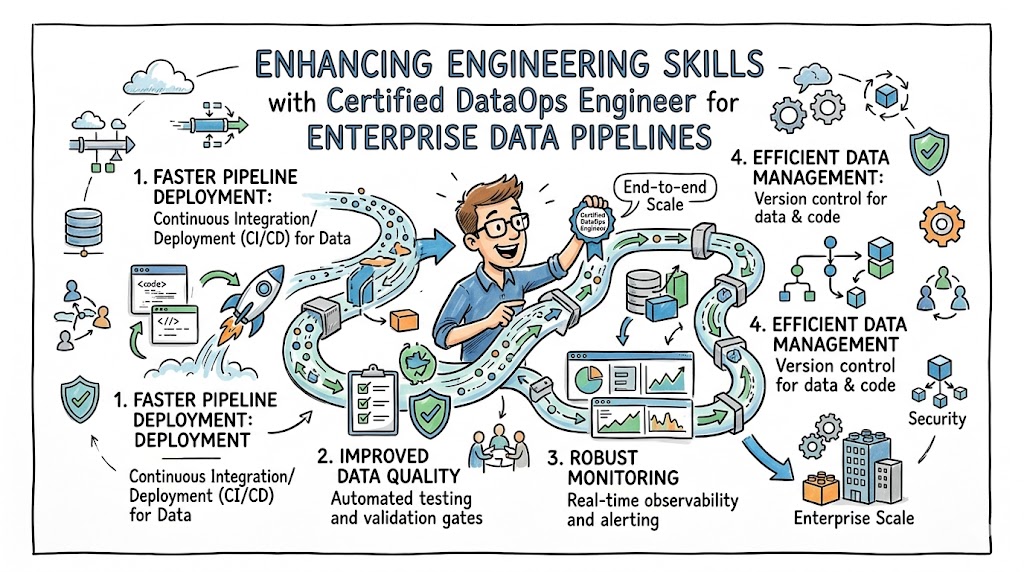
Modern software delivery demands more than just code; it requires a seamless flow of high-quality data across distributed systems. The CDOE – Certified DataOps Engineer program bridges the gap between traditional data management and agile operational excellence. This guide serves professionals looking to master the intersection of data engineering and DevOps principles within cloud-native environments. By focusing on automated pipelines and data reliability, this resource helps engineers make informed career decisions and choose the right specialization paths at DataOpsSchool.
What is the CDOE – Certified DataOps Engineer?
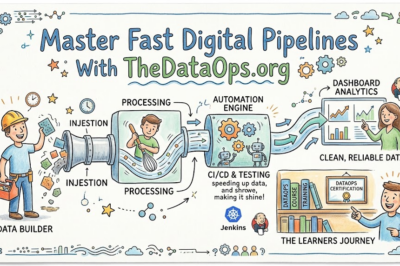
The CDOE – Certified DataOps Engineer represents a shift from static data handling to dynamic, production-focused data lifecycle management. It exists to standardize the way organizations deploy, monitor, and scale data pipelines using automated workflows. Unlike theoretical courses, this certification emphasizes real-world application, ensuring that engineers can manage complex data architectures with the same rigor applied to software code. It aligns perfectly with modern enterprise practices where data speed and quality are critical for competitive advantage.
Who Should Pursue CDOE – Certified DataOps Engineer?
This certification benefits a wide range of professionals, from SREs and cloud architects to data engineers and security analysts. Beginners gain a solid foundation in automated data delivery, while experienced engineers use it to validate their expertise in scaling enterprise data systems. Managers and technical leaders find value in the program as it provides a framework for building high-performing data teams. The curriculum holds significant relevance for both the Indian tech market and the global engineering landscape.
Why CDOE – Certified DataOps Engineer is Valuable in and Beyond
As enterprises increasingly rely on real-time analytics, the demand for professionals who can stabilize data delivery grows exponentially. This certification offers long-term career longevity because it focuses on core principles that persist even as specific tools evolve over time. Professionals who earn this credential demonstrate a commitment to operational excellence, which translates into a high return on investment for their careers. It ensures you remain a vital asset in any organization transitioning toward a data-driven culture.
CDOE – Certified DataOps Engineer Certification Overview
The program is delivered via the official portal and hosted on the primary website. It utilizes a structured assessment approach that combines theoretical knowledge with practical, lab-based evaluations of a candidate’s skills. The ownership of the program ensures that the content stays updated with the latest industry shifts in data orchestration and pipeline monitoring. Professionals can progress through various levels, ensuring a clear and practical roadmap for continuous skill development.
CDOE – Certified DataOps Engineer Certification Tracks & Levels
The certification is organized into foundation, professional, and advanced levels to cater to different stages of career growth. Foundation levels focus on core concepts and basic pipeline automation, while professional tracks dive deep into orchestration and data quality. Advanced levels are designed for those aiming for architectural roles or specialized leadership positions. Each level builds upon the last, allowing engineers to align their learning with their current job responsibilities or future career goals.
Complete CDOE – Certified DataOps Engineer Certification Table
| Track | Level | Who it’s for | Prerequisites | Skills Covered | Recommended Order |
| Core DataOps | Foundation | Junior Engineers | Basic Linux | Data Lifecycles | 1st |
| Engineering | Professional | Data Engineers | Foundation | Pipeline CI/CD | 2nd |
| Architecture | Advanced | Solutions Architects | Professional | Scaling Systems | 3rd |
| Governance | Professional | Security Analysts | Basic DataOps | Data Compliance | 2nd |
| Performance | Professional | SRE / Platform | Cloud Basics | Monitoring/Logs | 2nd |
Detailed Guide for Each CDOE – Certified DataOps Engineer Certification
CDOE – Certified DataOps Engineer – Foundation
What it is
This level validates a candidate’s understanding of the basic DataOps philosophy and the foundational tools used for data movement. It ensures the individual understands how to integrate data tasks into a standard DevOps cycle.
Who should take it
Aspiring data engineers, recent graduates, or software developers moving into data-centric roles should start here. It is ideal for those with less than two years of experience in data operations.
Skills you’ll gain
- Proficiency in version control for data schemas.
- Understanding of basic ETL and ELT automation.
- Familiarity with containerization for data workloads.
Real-world projects you should be able to do
- Setting up a basic automated data ingestion pipeline.
- Containerizing a simple data transformation script.
Preparation plan
The 7–14 days strategy involves reviewing core terminology and documentation. A 30-day plan includes hands-on labs with basic orchestration tools. The 60-day approach allows for building a complete end-to-end portfolio project.
Common mistakes
Candidates often overlook the importance of version control or fail to understand the cultural shift required for DataOps.
Best next certification after this
- Same-track: Professional DataOps Engineer.
- Cross-track: Cloud Infrastructure Associate.
- Leadership: Data Team Lead Foundation.
CDOE – Certified DataOps Engineer – Professional
What it is
This certification validates the ability to design and manage complex, production-grade data pipelines with high availability. It focuses on orchestration, quality gates, and automated testing within the data stream.
Who should take it
Mid-level engineers and SREs who are responsible for the uptime and reliability of data systems in a professional environment should pursue this.
Skills you’ll gain
- Advanced orchestration using modern workflow engines.
- Implementation of automated data quality checks.
- Managing data infrastructure as code.
Real-world projects you should be able to do
- Building a multi-stage CI/CD pipeline for data warehouse updates.
- Implementing automated monitoring and alerting for pipeline failures.
Preparation plan
A 14-day review is suitable for those already working in the field. A 30-day plan should focus on mastering specific orchestration syntax. The 60-day plan involves deep-diving into infrastructure-as-code integrations.
Common mistakes
Focusing too much on a single tool rather than the underlying workflow logic is a frequent error.
Best next certification after this
- Same-track: Advanced DataOps Architect.
- Cross-track: Security for DataOps.
- Leadership: Senior Engineering Manager.
Choose Your Learning Path
DevOps Path
The DevOps path focuses on integrating data workflows into existing software delivery pipelines. Professionals learn how to treat data infrastructure with the same automation and testing standards as application code. This path is essential for teams looking to break down silos between developers and data scientists. It results in faster release cycles and more reliable data deployments.
DevSecOps Path
In this path, the emphasis is placed on securing the data pipeline from ingestion to consumption. Engineers learn to implement automated security scans, encryption at rest, and fine-grained access controls. This ensures that data remains compliant with global regulations without slowing down the engineering team. It is a critical path for organizations in highly regulated industries like finance or healthcare.
SRE Path
The SRE path focuses on the reliability, scalability, and performance of data systems. Professionals apply site reliability engineering principles, such as error budgets and service level objectives, to data pipelines. This approach minimizes downtime and ensures that data is always available when business stakeholders need it. It bridges the gap between operations and high-scale data engineering.
AIOps Path
The AIOps path explores the use of machine learning and artificial intelligence to enhance IT operations. Professionals learn to use algorithmic analysis to predict system failures and automate incident responses. This path is ideal for those looking to manage massive scale environments where manual monitoring is no longer feasible. It represents the future of automated system management.
MLOps Path
The MLOps path is specifically designed for managing the lifecycle of machine learning models in production. It covers model versioning, automated retraining, and monitoring for feature drift. This ensures that AI models remain accurate and performant over time. It is a vital specialization for companies heavily invested in artificial intelligence products.
DataOps Path
The primary DataOps path focuses on the holistic flow of data through an organization. It emphasizes collaboration between data producers and consumers to reduce the cycle time of data analytics. Professionals master the orchestration of complex data environments and the automation of quality assurance. This path is the core of the CDOE ecosystem.
FinOps Path
The FinOps path introduces financial accountability to the cloud data spend. Engineers learn to monitor cloud costs, optimize resource usage, and align technical decisions with business budgets. This path is increasingly important as cloud data storage and processing costs can spiral out of control. It turns engineers into savvy business partners.
Role → Recommended CDOE – Certified DataOps Engineer Certifications
| Role | Recommended Certifications |
| DevOps Engineer | CDOE Foundation, Professional Pipeline Automation |
| SRE | CDOE Professional, Reliability Engineering Track |
| Platform Engineer | CDOE Advanced, Infrastructure Specialist |
| Cloud Engineer | CDOE Foundation, Cloud Native Data Specialist |
| Security Engineer | CDOE DevSecOps Specialist |
| Data Engineer | CDOE Professional, Data Quality Specialist |
| FinOps Practitioner | CDOE FinOps Specialist |
| Engineering Manager | CDOE Foundation, Leadership Track |
Next Certifications to Take After CDOE – Certified DataOps Engineer
Same Track Progression
Deep specialization involves moving from foundation to advanced levels within the DataOps domain. This path allows you to become a subject matter expert in data orchestration and large-scale pipeline management. It is the best route for those wanting to reach principal engineer or architect status. Continuing on this track ensures you stay ahead of technical debt in complex systems.
Cross-Track Expansion
Broadening your skills involves taking certifications in related fields like Security, FinOps, or AI. This makes you a more versatile professional capable of handling diverse challenges across the entire engineering organization. It is particularly valuable for those working in startups or cross-functional squads. Expanding your knowledge base prevents professional stagnation and opens new career doors.
Leadership & Management Track
For those looking to move away from individual contributor roles, the leadership track focuses on team dynamics and strategy. You will learn how to build and scale DataOps teams and align technical roadmaps with business goals. This transition requires a shift in mindset from solving technical problems to solving organizational ones. It is the natural progression for senior engineers aiming for director-level roles.
Training & Certification Support Providers for CDOE – Certified DataOps Engineer
DevOpsSchool
This provider offers extensive resources for professionals seeking to master automation and orchestration. They focus on delivering hands-on training that mirrors real-world production environments. Their curriculum is designed to help engineers transition smoothly into senior roles by emphasizing practical skills over pure theory.
Cotocus
This organization specializes in cloud-native technologies and infrastructure-as-code training. They provide deep-dive sessions on modern tools that are essential for any DataOps professional. Their approach is highly technical and aimed at engineers who want to understand the inner workings of complex cloud systems.
Scmgalaxy
This community-driven platform provides a wealth of knowledge on configuration management and software delivery. It serves as a central hub for professionals to share best practices and stay updated on industry trends. Their resources are particularly useful for those looking to understand the history and evolution of DevOps.
BestDevOps
This portal focuses on providing curated content and training for the latest trends in the DevOps ecosystem. They emphasize career growth and help professionals identify the most valuable skills to learn in a competitive market. Their insights are backed by years of industry experience and market analysis.
devsecopsschool.com
This institution focuses exclusively on the intersection of security and operations. They provide specialized training on how to integrate security gates into automated pipelines. Their goal is to empower engineers to build secure-by-default systems that can withstand modern threats.
sreschool.com
This provider focuses on the principles of site reliability engineering. They teach professionals how to apply mathematical and engineering rigor to system availability. Their training is essential for anyone responsible for maintaining high-uptime enterprise applications.
aiopsschool.com
This school is dedicated to the emerging field of using AI to improve IT operations. They provide training on automated incident detection and predictive maintenance. Their curriculum is at the forefront of the next wave of operational technology.
dataopsschool.com
This is the primary home for DataOps certification and training. They offer a comprehensive suite of courses designed to turn data engineers into DataOps professionals. Their programs are widely recognized for their practical approach and industry relevance.
finopsschool.com
This organization focuses on the financial management of cloud resources. They provide training on how to balance technical performance with cost efficiency. Their courses are vital for engineers who want to have a seat at the business decision-making table.
Frequently Asked Questions
- How difficult is the CDOE certification?
The difficulty depends on your prior experience with data pipelines and automation tools. It is designed to be challenging but achievable for those with a solid engineering foundation. - How much time is required to prepare?
Most professionals spend between 30 to 60 days preparing, depending on their existing familiarity with the subject matter and the level of certification. - Are there any prerequisites for the foundation level?
There are no formal prerequisites, but a basic understanding of Linux and at least one programming language is highly recommended for success. - What is the return on investment for this certification?
Professionals often see significant salary increases and access to more senior roles after obtaining the CDOE credential due to its high industry demand. - Should I take the DevOps track before DataOps?
While not strictly necessary, having a background in DevOps can make the transition to DataOps much smoother as many principles are shared. - How long is the certification valid?
The certification typically remains valid for two to three years, after which a renewal or advanced level certification is recommended to stay current. - Is the exam theoretical or practical?
The assessment includes both multiple-choice questions to test knowledge and lab-based tasks to evaluate your ability to solve real-world technical problems. - Does this certification help with remote job opportunities?
Yes, global companies highly value standardized certifications when hiring remote engineers to ensure a consistent baseline of technical expertise. - Can I skip the foundation level?
If you have significant documented experience in the field, you may be able to challenge the professional level directly, though foundation is recommended. - What tools are covered in the curriculum?
The program covers a wide range of industry-standard tools for orchestration, containerization, monitoring, and data transformation within cloud environments. - Is there community support for students?
Yes, most providers offer access to forums and study groups where you can collaborate with other professionals and instructors during your preparation. - How does this certification compare to others?
The CDOE is unique because it focuses specifically on the operational side of data engineering rather than just data science or general cloud administration.
FAQs on CDOE – Certified DataOps Engineer
- What makes DataOps different from traditional data engineering?
DataOps incorporates agile methodologies and automated CI/CD practices specifically for data, whereas traditional engineering often relies on manual, siloed processes for managing data. - Does this certification cover cloud-specific tools like AWS or Azure?
The certification focuses on cloud-agnostic principles and tools, ensuring that the skills you gain are transferable across any major cloud provider or on-premise environment. - Is coding a major part of the CDOE exam?
Yes, you will need to demonstrate proficiency in scripting and infrastructure-as-code to successfully pass the practical components of the professional and advanced levels. - How does DataOps impact the speed of data delivery?
By automating testing and deployment, DataOps significantly reduces the time it takes to move data from a source to a usable state for business analysts. - Are soft skills covered in the leadership track?
The leadership and management tracks include modules on team collaboration, communication, and managing the cultural shift required for successful DataOps adoption. - Can a security professional benefit from this certification?
Absolutely, the DevSecOps track is specifically designed to help security professionals integrate their requirements into the high-speed flow of data pipelines. - Is there a focus on data quality and integrity?
Data quality is a core pillar of the CDOE program, with extensive modules dedicated to automated validation and monitoring of data accuracy. - What industries value the CDOE certification the most?
Industries that handle massive amounts of data, such as finance, healthcare, e-commerce, and telecommunications, are the primary seekers of certified DataOps engineers.
Final Thoughts: Is CDOE – Certified DataOps Engineer Worth It?
Investing in the CDOE – Certified DataOps Engineer certification is a strategic move for any professional aiming to thrive in a data-centric engineering world. As organizations move away from manual data handling, the ability to automate and scale data systems becomes a non-negotiable skill. This program provides a structured, recognized way to validate your expertise and stay ahead of the curve. While the preparation requires time and effort, the resulting career growth and technical confidence are well worth the commitment. Focus on the learning process, and the certification will naturally become a powerful asset in your professional toolkit.