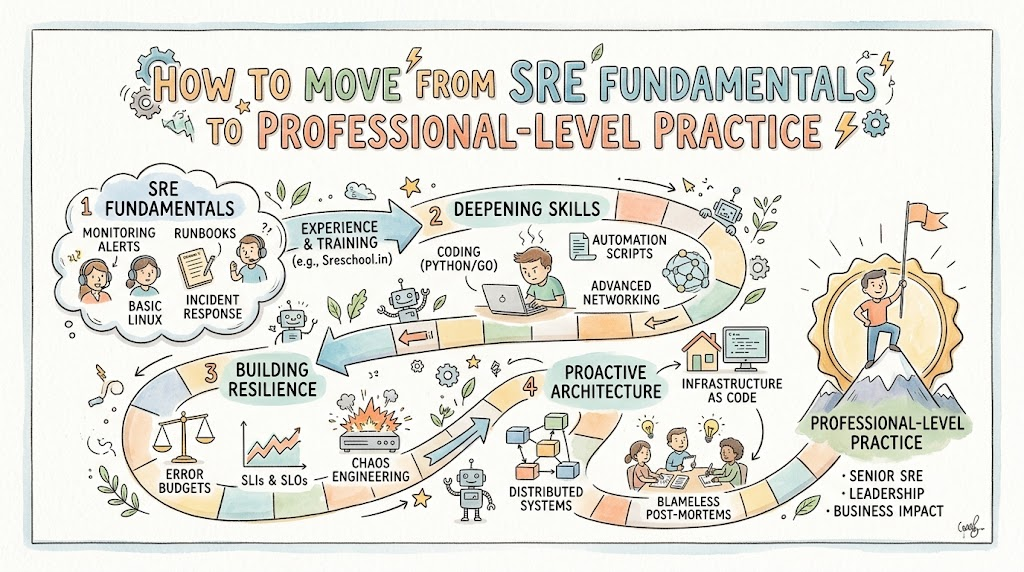
Transitioning from basic operational knowledge to professional-level site reliability practice requires a shift from reactive troubleshooting to systemic architecture design. Modern engineering teams must continually protect complex digital ecosystems by transforming manual operations into scalable software solutions. By training through structured platforms like Sreschool, engineers gain the practical mastery required to automate infrastructure resilience across large enterprise environments. This deep-dive roadmap outlines the actionable patterns, architectural principles, and cultural standards necessary to bridge the gap toward senior technical leadership.
Furthermore, moving past entry-level concepts means looking beyond simple alerts and individual server fixes to view distributed platforms holistically. You must learn how to design self-healing systems that absorb network failures and traffic spikes without human intervention. By treating operations as a software problem, you actively protect company revenue while accelerating feature release velocity. Therefore, committing to this career progression establishes a dependable foundation for long-term platform leadership.
Evolving from Reactive Support to Proactive Architecture
Foundational operations work often centers around responding to monitoring alerts and executing predefined runbook instructions. However, professional-level practice demands that you proactively eliminate the architectural root causes that trigger those alerts. You achieve this by analyzing distributed dependencies, isolating critical data paths, and implementing graceful degradation patterns.
Moreover, advanced engineers design systems to handle partial hardware outages automatically through regional failover routing and dynamic container autoscaling. This transition shifts your daily engineering responsibilities from stressful emergency firefighting to building resilient platforms. Ultimately, true professional practice ensures software systems maintain high availability even when underlying cloud infrastructure experiences unexpected degradations.
Mastering Distributed Observability and Telemetry
Basic monitoring simply informs you that an endpoint has stopped responding, leaving you to guess the root cause during high-severity outages. In contrast, professional observability provides complete visibility into internal distributed system states by synthesizing metrics, structured logs, and distributed request traces. Advanced practitioners instrument application code directly using unified open-source telemetry standards.
Consequently, you can visualize an individual transaction across dozens of interconnected microservices to pinpoint latency anomalies instantly. You also learn to build intelligent alerting pipelines that filter out background noise and highlight critical business-impacting issues. This telemetry expertise dramatically cuts downtime while providing deep diagnostic insights for future performance optimization.
Eliminating Toil with Software-Driven Automation
A key milestone in advancing your operational career is actively identifying and systematically eliminating repetitive administrative toil. Foundational administrators often spend significant energy on manual database backups, certificate rotations, and node restarts. Conversely, high-level practitioners write clean, declarative code to automate every recurring maintenance process completely.
In addition, advanced engineers develop custom Kubernetes operators and internal developer platform tools that streamline everyday deployment tasks. Applying modern software engineering practices—such as code reviews, unit testing, and version control—ensures your infrastructure scripts remain predictable and maintainable. Eliminating repetitive tasks liberates engineering bandwidth, allowing you to focus on long-term systemic reliability.
Driving Cultural Reliability and Risk Management
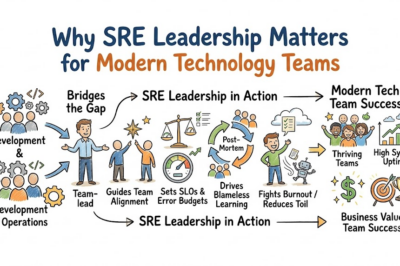
Technical expertise alone cannot sustain reliable production environments without a healthy, collaborative team culture. Seasoned practitioners act as trusted advisors who align technical reliability metrics directly with customer satisfaction and business outcomes. You learn to lead blameless retrospective meetings where teams openly examine technical failures without fear of personal blame.
Furthermore, you help product development teams understand the strategic value of balancing rapid innovation with strict system stability. By championing shared ownership of production services, you break down the traditional friction between software developers and operational defenders. This strategic leadership positions you as an indispensable architectural partner across your broader engineering organization.
Key Operational Concepts You Must Know
Service Level Objectives and Service Level Indicators
Establishing quantitative operational targets remains the baseline of all modern system reliability practices. Service Level Indicators represent the exact telemetry metrics measuring system health, such as request latency or error percentages. Meanwhile, Service Level Objectives define the target percentage thresholds those indicators must maintain over rolling monthly windows. Mastering these mathematical foundations allows you to make informed, data-driven decisions regarding release speed versus stability.
Error Budgets and Risk Toleration Strategies
An error budget represents the acceptable margin of failure your platform can experience before customers notice service degradation. For example, maintaining an objective of ninety-nine point nine percent uptime provides a point-one percent budget for deployment testing and unexpected failures. If your team exhausts this operational budget, software releases halt to prioritize infrastructure stability and performance tuning. This shared accountability eliminates traditional friction between fast-moving feature developers and stability-focused operations teams.
Blameless Post-Mortems and Root Cause Analysis
When critical platform outages occur, modern organizations direct their focus toward structural process improvements rather than personal accountability. Blameless post-mortems provide an open forum for engineers to share honest technical timelines without fear of disciplinary action. By identifying the root architectural, communicative, or systemic flaws that permitted the failure, teams eliminate the underlying risks. This collaborative methodology turns stressful infrastructure outages into valuable institutional knowledge.
Toil Reduction and Strategic Automation
Toil refers to repetitive, manual, administrative tasks directly tied to running a production service that lack enduring business value. Examples include manually updating SSL certificates, provisioning static user accounts, or restarting stalled database services. Industry standards dictate that engineers should spend less than fifty percent of their working time performing repetitive toil tasks. Automating these recurring operational duties preserves mental focus for designing resilient software architectures.
Platform Implementation vs. Culture — What’s the Real Difference?
| Operational Dimension | Platform Implementation Focus | Cultural Integration Focus |
| Primary Focus | Implementing monitoring agents, auto-scaling clusters, and deployment pipelines. | Fostering cross-team collaboration, shared accountability, and psychological safety. |
| System Health Tracking | Measuring CPU saturation, disk input/output, and network packet loss. | Evaluating post-mortem participation, knowledge sharing, and learning efficiency. |
| Incident Response | Triggering automated failover scripts and paging on-call platform engineers. | Conducting blameless technical reviews and updating deployment policies collaboratively. |
| Operational Workflow | Writing declarative configuration templates and maintaining container clusters. | Aligning product feature velocity with established business risk tolerances. |
Real-World Use Cases of Modern Operations
High-Volume E-Commerce Platforms
- Elastic Scaling: Provisioning dynamic container groups that scale compute resources instantly during flash retail events.
- Database Isolation: Applying read-replica routing and connection pooling to process massive surges of customer checkouts without database lockups.
- Graceful Degradation: Implementing circuit breakers that disable non-essential recommendation widgets when core payment gateways experience high latency.
Global Financial Services
- Transactional Integrity: Constructing active-active multi-region data replication to guarantee zero financial data loss during unexpected data center outages.
- Continuous Compliance: Running automated policy engines that scan infrastructure code to block unauthorized security changes before deployment.
- Chaos Engineering: Periodically injecting simulated server crashes into production-like staging environments to validate automatic failover systems.
Healthcare Information Systems
- High Availability: Utilizing blue-green deployment pipelines to roll out application updates without dropping active medical monitoring connections.
- Strict Audit Trails: Centralizing immutable log streams across isolated services to maintain compliance with strict healthcare regulatory standards.
- Predictive Telemetry: Analyzing memory consumption patterns with automated alerts to patch system leaks before they disrupt medical charting software.
Common Mistakes in Operations Engineering
Treating Reliability Teams as a Separate Silo
Isolating your operations engineers from everyday product development teams creates severe organizational bottlenecks. In this broken model, developers build features rapidly while throwing untested code over the wall for operations teams to maintain. This separation destroys shared accountability and slows overall development velocity. Modern engineering requires embedding operations specialists directly alongside product teams to foster shared ownership of production code.
Over-Automating Without Clear Standard Processes
Writing complex automation scripts for undocumented, unstable manual workflows inevitably leads to severe operational errors. Automating an inefficient or broken procedure merely increases the speed at which your platform encounters catastrophic failures. Teams must thoroughly document, test, and standardize manual processes before translating them into automated code. Taking time to establish stable baselines ensures your automation scripts remain clean, predictable, and maintainable.
Setting Overly Ambitious Availability Targets
Aiming for one hundred percent system uptime is practically impossible and financially counterproductive for almost every software enterprise. Achieving extreme levels of availability demands costly redundant architectures that drain engineering budgets and stall innovation. Furthermore, excessive availability targets paralyze feature releases due to an unnecessary fear of system changes. Organizations must set balanced uptime goals that satisfy customer expectations while allowing rapid software updates.
Ignoring Chronic Alert Fatigue in On-Call Rotations
Subjecting on-call engineers to hundreds of non-actionable, low-priority automated alerts leads to burnout and operational blind spots. When engineers constantly receive notifications for transient issues that resolve themselves, they naturally develop a habit of ignoring alerts. Consequently, teams inevitably miss high-severity notifications during genuine, customer-facing system outages. Every production alert must represent an urgent, actionable problem that strictly requires immediate human intervention.
How to Become an Operations Expert — Career Roadmap
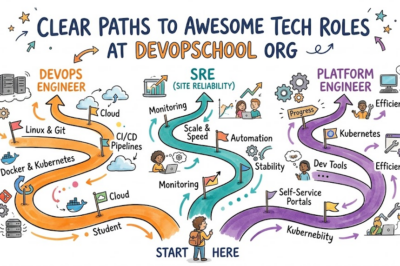
For Junior Infrastructure Engineers
- Master Core Linux Administration: Gain deep proficiency with system processes, shell commands, file systems, and network diagnostic tools.
- Develop Scripting Proficiency: Build solid programming fundamentals in Python or Go to automate repetitive operating system tasks.
- Understand Networking Protocols: Learn the mechanics of DNS resolution, HTTP status codes, TLS handshakes, and TCP connection pooling.
For Mid-Level Platform Specialists
- Implement Infrastructure as Code: Manage cloud environments programmatically using declarative tools like Terraform to ensure reproducible deployments.
- Master Container Orchestration: Learn to deploy, scale, and secure enterprise applications inside Kubernetes clusters effectively.
- Build Observability Frameworks: Construct centralized dashboards that combine distributed traces, metric visualizations, and structured log queries.
For Senior Architectural Directors
- Drive Organizational Transformation: Mentor product engineering teams on defining meaningful error budgets and embracing blameless post-mortem cultures.
- Optimize Multi-Cloud Expenditures: Analyze enterprise cloud resource utilization to lower operating costs without compromising application availability.
- Architect Disaster Recovery Plans: Design comprehensive cross-region failover strategies that protect enterprise databases against catastrophic hardware failures.
FAQ Section
- How does an error budget protect development speed?
An error budget establishes a clear metric for risk, allowing software developers to ship new features rapidly as long as uptime targets are met. If outages consume the budget, teams temporarily redirect focus toward stability, balancing rapid innovation with system reliability.
- What is the practical difference between monitoring and observability?
Monitoring tracks predefined metrics and issues alerts when specific thresholds are breached, showing that a component has failed. Observability allows engineers to infer the internal state of complex systems by analyzing telemetry data, uncovering why unfamiliar failures occur.
- Why are blameless post-mortems essential for organizational growth?
Blameless post-mortems remove the fear of personal punishment, encouraging engineers to provide honest, detailed accounts of operational mistakes. This transparency helps teams identify underlying procedural flaws and implement architectural fixes that permanently prevent repeat outages.
- How can organizations reduce operational toil effectively?
Organizations reduce toil by measuring manual repetitive tasks and establishing engineering policies that allocate time for automation development. Investing engineering resources into self-healing platforms and declarative configurations permanently removes repetitive maintenance tasks.
- What programming languages are most valuable for modern reliability engineering?
Python and Go stand out as the two most essential programming languages for modern operations engineers. Python excels at writing automation scripts and data analysis workflows, while Go powers major cloud-native orchestration platforms and distributed infrastructure tools.
Final Summary
Advancing from introductory reliability fundamentals to professional-level mastery requires an intentional balance of software engineering rigor and collaborative cultural practices. By moving away from reactive firefighting, engineers learn to design resilient platforms that withstand high user traffic and unexpected cloud failures. Mastering distributed observability, declarative automation, and blameless retrospectives transforms how modern technology teams build scalable software. Committing to this technical progression ensures you remain a vital strategic contributor to any high-performing engineering organization.
Furthermore, long-term operational success depends on establishing clear quantitative boundaries that balance rapid innovation with uncompromising platform stability. Implementing error budgets, eliminating repetitive operational toil, and standardizing automation frameworks empowers cross-functional teams to build with confidence. As enterprise architectures continue to evolve, professionals who command both technical automation and architectural strategy will shape the future of platform engineering.