Introduction: Why Site Reliability Engineers Matter
Modern digital services run around the clock. Whether users are transferring money via mobile payment apps, streaming live video, or booking train tickets, they expect applications to load instantly and work without errors. When an application slows down or crashes, users leave immediately, and businesses suffer financial and reputational damage.
Maintaining this level of availability has become significantly harder as software architectures have evolved. Today’s applications rarely run on a single server. Instead, they rely on distributed microservices, cloud infrastructure, third-party APIs, containers, and global networks. When dozens or hundreds of independent components communicate continuously, small failures—such as a slow database query, a misconfigured load balancer, or an expired certificate—can cascade into major outages.
This complexity is why organizations rely on the Site Reliability Engineer (SRE).
Traditionally, software development teams focused on building and shipping new features quickly, while IT operations teams focused on keeping production servers stable. This created natural friction: new code changes often introduced instability, while strict operational controls slowed down software releases. Site Reliability Engineering bridges this divide. SREs balance rapid software delivery with high production reliability by treating operational challenges as software engineering problems.
In this guide, we will explore what a Site Reliability Engineer does, break down core Site Reliability Engineer roles and responsibilities, walk through a typical workday, and examine the skills and tools required to succeed in this field.
What Is a Site Reliability Engineer?
A Site Reliability Engineer is a software-minded engineer responsible for ensuring that production systems remain reliable, scalable, fast, and efficient. Rather than manually watching dashboards and restarting servers when things break, an SRE writes code, builds automation, and designs resilient architectures so systems can handle high traffic and recover gracefully from failures.
At its core, Site Reliability Engineering applies software engineering principles to IT operations and infrastructure management. If a human operator has to perform the same manual task repeatedly, an SRE views that task as a bug in the system and writes software to automate it away.
Through engineering and automation, SREs directly improve four pillars of production systems:
- Availability: Ensuring the application is up and accessible when users need it.
- Performance: Keeping response times fast and resource usage efficient.
- Scalability: Allowing infrastructure to expand or shrink smoothly as user traffic fluctuates.
- Resilience: Designing systems to withstand component failures without crashing completely.
Collaboration Across Engineering Teams
An SRE does not work in isolation. Because reliability spans the entire software lifecycle, SREs collaborate closely with multiple groups:
- Software Developers: Reviewing system architecture, setting reliability targets, and improving deployment safety.
- Infrastructure and Cloud Teams: Managing underlying compute, networking, and storage platforms.
- Platform Engineering Teams: Building internal developer platforms and self-service deployment tools.
- Security Teams: Embedding access controls, vulnerability management, and compliance checks into automated pipelines.
SRE Job Title vs. The SRE Discipline
It is important to distinguish between an individual Site Reliability Engineer job title and Site Reliability Engineering as an engineering discipline. The discipline consists of practices—such as error budgets, Service Level Objectives, and blameless postmortems—that any engineering organization can adopt. While a dedicated SRE team often champions and builds the tooling for these practices, reliability itself is a shared responsibility across both development and operations teams.
What Does a Site Reliability Engineer Do?
To understand SRE roles and responsibilities in practice, let us look at the core areas where Site Reliability Engineers spend their time.
Monitoring Application and Infrastructure Performance
You cannot fix what you cannot see. SREs build deep visibility into both infrastructure health and application behavior. They track system-level metrics (CPU, memory, disk I/O, network throughput) alongside application-level metrics (request rates, error percentages, and response latency).
By combining metrics, structured logs, and distributed traces, SREs spot subtle performance degradation before users notice. They also design actionable alerts that notify engineers only when user experience is genuinely threatened, avoiding noisy alarms that wake engineers up unnecessarily.
- Practical Example: An SRE notices database connection pool usage climbing steadily over three days after a code release, allowing the team to fix a connection leak before the database locks up during peak traffic.
Managing Production Incidents
Even the best-engineered systems experience outages. When a production disruption occurs, SREs step in to coordinate the technical response. They investigate incoming alerts, identify which microservices or infrastructure components are affected, and bring the right developers and specialists together.
The immediate priority during an incident is mitigation—restoring service safely for users—rather than finding a permanent code fix under pressure. Once service is stabilized, the SRE documents the timeline and communicates business impact to stakeholders.
- Practical Example: During a flash sale, a payment gateway begins timing out. The SRE coordinates with the checkout team to temporarily disable a non-critical recommendation widget consuming database capacity, restoring payment processing within minutes.
Improving System Reliability
SREs proactively analyze architectures to eliminate single points of failure. They introduce redundancy across availability zones, configure automated failovers, implement circuit breakers, and test disaster recovery procedures. They also participate in architecture design reviews for upcoming features to ensure new services can scale safely.
- Practical Example: Before launching a new notification service, an SRE reviews the design and recommends adding a message queue so that temporary email provider outages do not cause the main application to hang or lose messages.
Automating Operational Tasks
Manual, repetitive operational work is the enemy of scalability. SREs continuously look for manual processes—such as provisioning servers, rotating SSL certificates, cleaning up disk space, or running database failovers—and replace them with reliable scripts, self-healing workflows, or software tools.
- Practical Example: Instead of engineers manually running shell commands to onboard new microservices, an SRE builds an automated pipeline that provisions repositories, monitoring dashboards, alerts, and cloud permissions from a single configuration file.
Managing Cloud and Infrastructure Environments
Modern production workloads run heavily on cloud infrastructure, virtual machines, and container orchestration platforms. SREs manage infrastructure configurations, optimize cloud resource utilization to prevent wasted spend, handle operating system patching, and maintain underlying networking and storage layers using Infrastructure as Code (IaC).
- Practical Example: An SRE writes Terraform modules to standardize Kubernetes cluster creation across staging and production environments, ensuring identical security groups and network policies everywhere.
Supporting CI/CD and Release Management
Most production outages are triggered by changes—new code deployments or configuration updates. SREs partner with developers to make releases safer and more predictable. They integrate automated smoke tests into Continuous Integration/Continuous Deployment (CI/CD) pipelines and implement progressive delivery strategies like canary releases (rolling out changes to 5% of users first) and blue-green deployments, paired with automated rollbacks if error rates spike.
- Practical Example: An SRE configures a deployment pipeline that automatically monitors HTTP 500 error rates for 10 minutes after a canary rollout and triggers an instant rollback if errors exceed 0.5%.
Managing Capacity and Performance
Applications must handle both normal daily traffic and sudden spikes. SREs analyze historical traffic patterns, run load and stress tests to find breaking points, tune application and database performance, and configure horizontal and vertical auto-scaling policies.
- Practical Example: Ahead of an annual tax filing deadline, an SRE runs load tests simulating three times normal user volume, identifies a bottleneck in an authentication microservice, and adjusts auto-scaling thresholds and caching rules to handle the surge.
Conducting Root Cause Analysis
After an outage is resolved, SREs lead structured investigations to understand why it happened. They analyze logs, traces, metrics, and system events to uncover technical bugs, architectural gaps, and process flaws. They facilitate blameless postmortems, ensuring teams focus on fixing systemic weaknesses rather than punishing individuals, and convert follow-up action items into code or automation.
- Practical Example: Following an outage caused by a misconfigured firewall rule, an SRE leads a postmortem that results in adding automated configuration validation checks to the CI/CD pipeline so invalid rules can never be deployed again.
Understanding a Site Reliability Engineer’s Daily Activities
While no two days are identical, SRE daily tasks generally balance reactive operational support with proactive engineering project work. Organizations often aim to keep reactive operational work under 50% of an SRE’s week so engineers have dedicated time to build long-term reliability improvements.
Here is what a realistic workday looks like for a Site Reliability Engineer:
- Morning Health Check: Reviewing service health dashboards, overnight alert logs, and incident handoff notes from engineers in other time zones.
- Daily Standup: Syncing with the SRE and product engineering teams on ongoing reliability projects, upcoming high-risk deployments, and active blockers.
- SLO and Error Budget Review: Checking Service Level Objective (SLO) compliance and calculating remaining error budgets to see if any services are burning through reliability margins too quickly.
- Change and Architecture Reviews: Reviewing pull requests for infrastructure changes (Terraform/Kubernetes manifests) and advising developers on scaling or resilience for upcoming features.
- Engineering Project Work: Writing Python or Go automation tools, improving Prometheus alerting rules, optimizing Kubernetes resource limits, or building self-service deployment templates.
- Performance and Incident Investigation: Digging into distributed traces to resolve a slow API endpoint or participating in a blameless postmortem meeting for a recent disruption.
- Documentation and Runbooks: Updating troubleshooting runbooks and operational guides so on-call engineers can resolve future issues faster.
Note: Daily activities vary significantly depending on company size, system maturity, team structure, and whether the engineer is currently serving as the primary on-call responder.
Key SRE Responsibilities in Detail
To understand the full scope of Site Reliability Engineer job responsibilities, let us examine the foundational areas of the role.
Service Availability and Uptime
- What it involves: Ensuring production applications remain accessible and functional for end users across expected operating hours.
- Why it matters: Downtime directly halts business operations, breaks user trust, and violates customer commitments.
- What an SRE actually does: Designs multi-region or multi-zone deployments, configures health checks, and removes single points of failure.
- Practical Example: Configuring an active-passive database failover across two cloud availability zones so that if one data center loses power, traffic shifts automatically within seconds.
Reliability Measurement and Reporting
- What it involves: Defining, tracking, and communicating quantitative reliability metrics rather than relying on guesswork.
- Why it matters: Teams cannot improve reliability or make smart release decisions without objective measurements of user experience.
- What an SRE actually does: Defines Service Level Indicators (SLIs) and Service Level Objectives (SLOs) and builds automated reliability reports.
- Practical Example: Publishing a weekly reliability scorecard showing that the core checkout API achieved 99.96% availability against its 99.9% target.
Monitoring and Observability
- What it involves: Collecting telemetry data (metrics, logs, traces) to understand internal system states from external outputs.
- Why it matters: Distributed systems fail in unpredictable ways; deep observability shortens the time required to diagnose unknown issues.
- What an SRE actually does: Instruments applications, manages telemetry pipelines, builds dashboards, and tunes alert thresholds.
- Practical Example: Implementing OpenTelemetry tracing across 15 microservices so engineers can pinpoint which downstream service caused a 3-second checkout delay.
Incident Management and Emergency Response
- What it involves: Detecting, triaging, mitigating, and communicating live production outages.
- Why it matters: Fast, structured incident response minimizes user impact and prevents chaos during high-stress outages.
- What an SRE actually does: Participates in on-call rotations, acts as Incident Commander during major outages, coordinates debugging, and updates status pages.
- Practical Example: Leading an incident bridge call during an API outage, delegating log analysis to a backend engineer while communicating status updates to customer support every 15 minutes.
Automation and Toil Reduction
- What it involves: Eliminating repetitive, manual, tactical operational work that scales linearly with system growth.
- Why it matters: Manual toil burns out engineers and leaves no time for proactive reliability engineering.
- What an SRE actually does: Writes scripts, internal tools, and event-driven automation to replace manual human intervention.
- Practical Example: Creating an automated script that detects stuck background worker queues, safely drains bad messages, and restarts unhealthy pods without waking an on-call engineer.
Infrastructure and Cloud Operations
- What it involves: Provisioning, configuring, securing, and maintaining cloud resources, servers, containers, and networks.
- Why it matters: Applications depend on stable, consistent, and properly configured underlying infrastructure.
- What an SRE actually does: Manages cloud accounts, Kubernetes clusters, virtual networks, and Infrastructure as Code repositories.
- Practical Example: Upgrading a production Kubernetes cluster version across multiple environments using automated node-draining workflows with zero user downtime.
Performance Optimization
- What it involves: Identifying and resolving latency bottlenecks, memory leaks, and inefficient resource usage.
- Why it matters: Slow applications degrade user experience and force organizations to overpay for extra compute capacity.
- What an SRE actually does: Profiles application execution, tunes garbage collection, optimizes caching layers, and collaborates on slow database queries.
- Practical Example: Identifying missing database indexes causing high CPU spikes during search queries and working with developers to reduce API latency from 800ms to 90ms.
Capacity Planning
- What it involves: Forecasting future compute, storage, and network needs based on organic user growth and planned business events.
- Why it matters: Running out of capacity causes outages, while over-provisioning wastes cloud budget.
- What an SRE actually does: Analyzes traffic trends, conducts load testing, and sets up auto-scaling policies and cloud capacity reservations.
- Practical Example: Analyzing six months of traffic growth to reserve cloud compute instances ahead of a major product launch, preventing resource exhaustion.
Release and Change Management
- What it involves: Ensuring code deployments and configuration updates reach production safely and reliably.
- Why it matters: Uncontrolled changes are the leading cause of production incidents.
- What an SRE actually does: Builds automated CI/CD quality gates, implements canary rollouts, and verifies post-deployment health.
- Practical Example: Requiring automated integration tests and gradual traffic shifting (10% -> 50% -> 100%) before any payment service update reaches all users.
Disaster Recovery and Business Continuity
- What it involves: Preparing systems and teams to recover from catastrophic failures such as region outages or data corruption.
- Why it matters: Rare catastrophic events can permanently destroy a business if backups and failover plans do not actually work.
- What an SRE actually does: Automates backups, defines Recovery Time Objectives (RTO) and Recovery Point Objectives (RPO), and runs disaster recovery drills.
- Practical Example: Conducting a quarterly “GameDay” exercise where the team simulates a primary database failure and verifies that backups restore cleanly within the 30-minute target.
Security and Operational Risk Awareness
- What it involves: Protecting production infrastructure against unauthorized access, misconfigurations, and operational vulnerabilities.
- Why it matters: Security breaches and expired credentials directly cause severe outages and data loss.
- What an SRE actually does: Automates secret rotation, enforces least-privilege IAM policies, patches OS vulnerabilities, and monitors certificate expirations.
- Practical Example: Automating TLS certificate renewal across hundreds of endpoints so an expired certificate never takes down a customer-facing domain.
Documentation and Knowledge Sharing
- What it involves: Maintaining accurate system architecture diagrams, troubleshooting runbooks, and operational procedures.
- Why it matters: Tribal knowledge trapped in one engineer’s head slows down incident recovery and onboarding.
- What an SRE actually does: Writes clear runbooks linked directly to alerts, documents postmortems, and mentors junior engineers.
- Practical Example: Attaching a step-by-step runbook link to every critical PagerDuty alert so any on-call engineer knows the exact diagnostic commands to run first.
Continuous Reliability Improvement
- What it involves: Treating reliability as an ongoing engineering journey rather than a one-time project.
- Why it matters: Software systems constantly evolve, introducing new failure modes over time.
- What an SRE actually does: Tracks postmortem action items, conducts chaos engineering experiments, and refines monitoring thresholds.
- Practical Example: Injecting controlled network latency in a staging environment to verify that upstream services handle timeouts gracefully without crashing.
Collaboration with Development and Platform Teams
- What it involves: Working closely with software engineers and platform builders to embed reliability early in development.
- Why it matters: Reliability cannot be bolted onto poorly designed software after it hits production.
- What an SRE actually does: Participates in design reviews, builds shared observability libraries, and establishes joint reliability goals.
- Practical Example: Partnering with platform engineers to create a standard microservice template that comes pre-configured with health endpoints, metrics exporters, and structured logging.
SRE Concepts Every Site Reliability Engineer Must Understand
Site Reliability Engineering relies on a specific set of practical frameworks to make objective decisions about reliability and release velocity.
Service Level Indicators (SLIs)
An SLI is a carefully defined quantitative measurement of some aspect of the level of service provided to users. Rather than measuring internal server metrics, good SLIs measure user experience directly. Common SLI categories include:
- Availability: The proportion of valid requests that succeed (e.g., successful HTTP responses divided by total requests).
- Latency: The time it takes to return a response to a request (e.g., 95th percentile response time under 250 milliseconds).
- Error Rate: The percentage of requests resulting in errors (e.g., HTTP 5xx server errors).
- Throughput: The volume of requests or data processed per second.
Service Level Objectives (SLOs)
An SLO is the target value or range of values for a service level that is measured by an SLI. For example, an SLO might state: “99.9% of login requests over a rolling 30-day window will succeed in less than 300 milliseconds.”
Teams choose realistic SLOs based on user expectations rather than aiming for 100% perfection—because every extra “nine” of reliability (e.g., moving from 99.9% to 99.99%) dramatically increases infrastructure cost and slows down engineering velocity. SLOs guide engineering decisions by providing a clear line between acceptable performance and unacceptable degradation.
Service Level Agreements (SLAs)
An SLA is an explicit or implicit external contract with customers that includes consequences (such as financial refunds or service credits) if reliability targets are missed.
In practice, an organization sets its internal SLO stricter than its external SLA. For example, if a cloud vendor promises customers a 99.9% uptime SLA, the internal SRE team might enforce a 99.95% SLO. This buffer gives engineers time to detect and fix issues before the company breaches its legal customer commitments.
Error Budgets
An error budget is the maximum amount of unreliability a service is allowed to accumulate over a given time window without violating its SLO. It is calculated simply as:
$$\text{Error Budget} = 100\% – \text{SLO Target}$$
If a service has a 99.9% availability SLO over 30 days, its error budget is 0.1% (roughly 43.2 minutes of allowable downtime or equivalent failed requests).
- When budget remains: Developers can ship new features, run experiments, and deploy rapidly.
- When budget is exhausted: Feature releases are paused (except critical bug fixes and security patches), and engineering effort shifts toward stability, testing, and reliability improvements until the rolling window recovers.
Toil Reduction
In SRE terminology, toil is operational work tied to running a production service that tends to be manual, repetitive, automatable, tactical, devoid of enduring value, and scales linearly as a service grows. For example, manually approving routine user access requests or manually restarting a leaky service every night is toil. SREs track toil and write software automation to eliminate it so engineering work creates lasting system improvements.
Blameless Postmortems
When an incident occurs, teams conduct a blameless postmortem—a structured review documenting what happened, why it happened, how it was mitigated, and what actions will prevent recurrence. The core assumption is that every engineer acted with the best intentions given the information they had at the time. If an engineer accidentally pushed a bad configuration, the postmortem asks “Why did our deployment system allow an unvalidated configuration to reach production?” rather than “Who made the mistake?”
Tools Used by Site Reliability Engineers
Site Reliability Engineers use a wide ecosystem of tools to observe systems, automate infrastructure, and manage incidents. Tool selection depends heavily on an organization’s cloud architecture, scale, and existing technology stack—no single tool is mandatory for every SRE role.
Monitoring and Observability
- Prometheus: An open-source time-series database and monitoring system widely used in cloud-native and Kubernetes environments to scrape metrics and trigger alerts.
- Grafana: A visualization platform used to build real-time operational dashboards from Prometheus, logs, and cloud metrics.
- Datadog & New Relic: Commercial all-in-one observability platforms providing infrastructure monitoring, Application Performance Monitoring (APM), and log analytics.
- Nagios: A traditional infrastructure monitoring tool used for checking server, network, and service availability.
Logging and Log Analysis
- ELK Stack (Elasticsearch, Logstash, Kibana): A popular open-source suite for collecting, indexing, searching, and visualizing massive volumes of application and system logs.
- Splunk: An enterprise log management and analytics platform used for troubleshooting complex operational and security events.
Distributed Tracing
- OpenTelemetry: An open-source observability framework providing standardized APIs and collectors to generate and export traces, metrics, and logs.
- Jaeger & Zipkin: Distributed tracing tools that visualize the path and latency of a single user request as it travels across dozens of microservices.
Containerization and Orchestration
- Docker: Packages applications and their dependencies into portable containers that run consistently across environments.
- Kubernetes: Automates the deployment, scaling, networking, and self-healing of containerized applications.
- Helm: A package manager for Kubernetes that simplifies deploying and versioning complex application manifests.
Infrastructure as Code and Configuration Management
- Terraform: Enables SREs to define, provision, and version cloud infrastructure declaratively using code.
- Ansible & Puppet: Configuration management tools used to automate software installation, OS settings, and server state across fleets of machines.
CI/CD and Deployment
- Jenkins, GitLab CI/CD, and GitHub Actions: Automation engines that build, test, and deploy code changes reliably.
- Argo CD: A declarative GitOps continuous delivery tool for Kubernetes that automatically syncs cluster state with Git repositories.
Cloud Platforms
- Amazon Web Services (AWS), Microsoft Azure, and Google Cloud Platform (GCP): Provide the foundational compute, storage, networking, and managed database services powering modern applications.
Incident Management
- PagerDuty & Opsgenie: Alert routing and on-call scheduling platforms that notify the right engineer via phone, SMS, or push notification during critical outages.
- ServiceNow: An enterprise IT service management platform used for change tracking, incident ticketing, and operational workflows.
Technical Skills Required to Become a Site Reliability Engineer
Because SRE sits at the intersection of software development and systems engineering, successful candidates build a balanced foundation across coding, infrastructure, and operational thinking.
- Programming and Scripting: Proficiency in at least one general-purpose programming language such as Python or Go, alongside Bash scripting for quick system tasks. Understanding basic data structures, APIs, error handling, and clean code practices is essential for building reliable automation tools.
- Linux and Operating Systems: Deep comfort with the Linux command line, process management, memory and CPU scheduling, file systems, permissions, systemd services, and kernel-level performance troubleshooting.
- Networking Fundamentals: Solid grasp of DNS resolution, HTTP/HTTPS protocols, TLS certificates, TCP/IP handshakes, load balancing algorithms, reverse proxies, firewalls, subnets, and routing.
- Cloud and Infrastructure: Practical experience designing and operating workloads on AWS, Azure, or Google Cloud, including virtual machines, managed databases, block/object storage, containers, and Kubernetes orchestration.
- Automation and CI/CD: Hands-on ability to write Infrastructure as Code (such as Terraform), manage server configurations, build CI/CD pipelines, and implement safe deployment patterns.
- Monitoring and Observability: Skill in instrumenting applications, designing meaningful dashboards, writing metric queries, analyzing distributed traces, and tuning alerts to minimize false positives.
- Reliability Engineering Principles: Practical understanding of SLIs, SLOs, SLAs, error budgets, capacity planning, fault-tolerant design, and disaster recovery strategies.
- Communication and Problem-Solving: Calm analytical thinking under pressure, clear written communication for incident updates and postmortems, and collaborative empathy when working across engineering teams.
How SREs Handle a Production Incident
To see how SRE incident management works in practice, let us walk through a realistic production scenario: an e-commerce web application suddenly experiences severe response time slowdowns during evening peak hours.
- Alert Detection: Prometheus detects that the 95th percentile latency of the product catalog API has crossed 2.5 seconds (violating its 400ms threshold for 3 consecutive minutes) and triggers a high-urgency PagerDuty alert.
- Acknowledgment and Initial Assessment: The on-call SRE acknowledges the alert within two minutes, joins the dedicated incident Slack channel, and opens the primary service health dashboard to confirm the issue is real and ongoing.
- Severity and Business Impact Determination: The SRE checks error rates and checkout conversions, confirming that slow catalog pages are blocking customers from completing purchases. The incident is classified as Severity-1 (critical user impact), and an incident bridge call is opened.
- Investigation Across Telemetry and Recent Changes: The SRE checks recent deployment logs and sees a catalog service update was deployed 20 minutes earlier. Simultaneously, distributed traces in Jaeger reveal that 90% of the request latency is spent waiting on a specific database query introduced in that release.
- Safe Mitigation Action: Rather than attempting to rewrite and test a new database query during a live outage, the SRE works with the on-call backend developer to trigger an immediate automated rollback to the previous stable version of the catalog service.
- Service Health Verification: Within three minutes of the rollback completing, Grafana dashboards show database CPU dropping back to normal levels and API response times returning to 180ms.
- Stakeholder Communication: The SRE posts an update on the internal status page and notifies customer support and product leads that service has been restored and monitoring continues.
- Blameless Post-Incident Review: Two days later, the SRE facilitates a blameless postmortem with the catalog developers. They discover that the staging database had far less data than production, so the unindexed query ran fast in staging tests.
- Preventive Actions and Automation: The team creates two engineering action items: adding automated query execution plan checks in CI pipelines and setting up a canary rollout stage that blocks full deployment if database latency rises.
How SREs Work With Other Engineering Teams
Modern production reliability requires alignment across the entire engineering organization. Rather than acting as gatekeepers who block releases or a support desk that fixes everyone else’s broken code, SREs act as multipliers who help other teams build reliable software.
- Software Development Teams: SREs partner with developers from the design phase onward. They help define realistic SLOs, conduct production readiness reviews before major launches, and provide shared libraries for retries, timeouts, and observability.
- DevOps Engineers: Where organizations have both DevOps and SRE roles, SREs often collaborate closely with DevOps engineers to standardize CI/CD pipelines, integrate automated reliability checks, and unify infrastructure tooling.
- Cloud and Infrastructure Teams: SREs work with core infrastructure specialists to ensure underlying cloud networks, compute pools, and storage systems meet application availability and latency requirements.
- Platform Engineering Teams: Platform teams build internal developer platforms (self-service portals, golden deployment templates). SREs feed real-world production failure insights back to platform engineers so reliability best practices become the default path for all developers.
- Security Engineers: SREs collaborate with security teams to automate vulnerability patching, enforce network segmentation, manage secrets securely, and respond to security-related availability incidents (such as DDoS attacks).
- Database Administrators (DBAs): Because databases are often the hardest stateful component to scale, SREs work closely with DBAs on replication, backup verification, connection pooling, query tuning, and failover automation.
- Product and Business Stakeholders: SREs translate technical metrics into business impact, using SLOs and error budgets to help product managers decide when to prioritize new feature launches versus stability improvements.
SRE vs DevOps Engineer vs System Administrator
Because these three roles share overlapping skills around Linux, cloud infrastructure, and automation, job descriptions often blur the lines between them. The table below highlights how they typically differ in focus and approach:
| Dimension | Site Reliability Engineer (SRE) | DevOps Engineer | System Administrator (SysAdmin) |
| Primary Objective | Ensure high service reliability, scalability, and performance using software engineering. | Accelerate software delivery and bridge collaboration between development and operations. | Maintain the health, security, and uptime of servers, networks, and IT infrastructure. |
| Daily Responsibilities | Building reliability automation, tuning observability, managing incidents, reviewing SLOs/error budgets. | Maintaining CI/CD pipelines, automating deployments, managing build tools and cloud environments. | Provisioning servers, patching OS, managing user permissions, backups, and hardware/VM maintenance. |
| Coding and Automation | Strong software engineering focus (Python, Go); writes custom tools and self-healing automation. | Strong scripting and configuration automation focus (Bash, Python, YAML, Terraform). | Basic to intermediate scripting (Bash, PowerShell) for routine administrative tasks. |
| Infrastructure Ownership | Manages production cloud/container environments via Infrastructure as Code with focus on resilience. | Builds automated infrastructure provisioning and deployment workflows for dev teams. | Directly administers servers, operating systems, storage, and internal network setups. |
| Monitoring & Incident Response | Designs deep observability (metrics, logs, traces), leads incident response, runs blameless postmortems. | Configures build/deployment monitoring and assists with deployment-related failures. | Monitors server health/uptime alerts and troubleshoots OS, network, or hardware outages. |
| Reliability Measurement | Formally defines and tracks SLIs, SLOs, SLAs, and error budgets to govern release pace. | Tracks deployment frequency, lead time, and pipeline success rates (DORA metrics). | Focuses primarily on server uptime percentages and hardware/network availability. |
| Deployment Involvement | Implements progressive delivery (canary, blue-green), automated rollbacks, and production readiness checks. | Owns and optimizes the end-to-end CI/CD build, test, and release pipelines. | Typically receives finished packages or coordinates scheduled maintenance windows for updates. |
| Collaboration Model | Embedded in or partnered with product teams to engineer reliability into application architecture. | Works across development and operations teams to streamline tooling and release workflows. | Operates primarily within IT operations to support internal infrastructure and enterprise systems. |
Note: Role boundaries vary widely depending on company size and maturity. In smaller startups, one engineer may perform all three functions, while large enterprises maintain distinct teams for each specialization.
Different Types of SRE Roles
As organizations scale, they often split general SRE roles and responsibilities into specialized focus areas. While these titles are common industry variations rather than strict universal standards, understanding them helps clarify how SRE teams organize their work:
- Production SRE: Focuses directly on live customer-facing services, managing on-call escalations, incident mitigation, capacity readiness, and day-to-day production stability.
- Infrastructure SRE: Specializes in the foundational layers—cloud networking, Kubernetes clusters, compute fleets, storage systems, and multi-region failover architectures.
- Platform SRE: Builds and maintains internal reliability platforms, self-service deployment pipelines, and standardized tooling that enable product developers to operate their own services reliably.
- Cloud SRE: Focuses on cloud-native architecture, cloud provider service reliability, IAM security posture, multi-cloud resilience, and cloud cost-to-performance optimization.
- Application SRE: Works deeply alongside specific product engineering teams, reviewing application code, optimizing database queries, tuning caching layers, and designing service-level resilience.
- Observability Engineer: Dedicated to building and scaling telemetry infrastructure—ensuring metrics, centralized logging, distributed tracing, and alerting platforms remain fast, accurate, and cost-effective.
- Reliability Automation Engineer: Concentrates on writing software tools, chaos engineering frameworks, automated remediation workflows, and self-healing systems to eliminate manual operational toil.
Challenges Faced by Site Reliability Engineers
While SRE is a rewarding engineering career, professionals in this field regularly navigate complex technical and organizational challenges:
- Complex Distributed Systems: Debugging issues across dozens of asynchronous microservices, caches, and third-party APIs makes root cause analysis difficult. Approach: Invest early in end-to-end distributed tracing and standardized correlation IDs across every service.
- Alert Fatigue: Poorly tuned monitoring creates hundreds of low-value alerts, desensitizing engineers and causing real outages to be missed. Approach: Regularly audit alert rules and delete or downgrade any alert that does not require immediate human action to protect user experience.
- Balancing Feature Delivery with Reliability: Product teams often push for rapid feature launches even when systems are unstable. Approach: Use agreed-upon SLOs and error budgets so release freezes are driven by objective data rather than personal arguments.
- Accumulating Operational Toil: Without discipline, urgent manual tickets can consume 100% of an SRE’s week. Approach: Track time spent on manual tasks and enforce a strict cap on operational work, dedicating remaining sprint capacity to automation.
- Unclear Reliability Ownership: Sometimes development teams assume SREs will fix every bug in production without developer involvement. Approach: Establish clear shared-responsibility agreements where developers participate in on-call rotations and own application code fixes.
- On-Call Workload and Burnout: Frequent late-night pages negatively impact engineer health and retention. Approach: Maintain healthy on-call rotation sizes, compensate or provide recovery time after heavy incidents, and prioritize fixing recurring alerts.
How to Become a Site Reliability Engineer
Transitioning into Site Reliability Engineering requires building strong fundamentals step by step rather than memorizing dozens of tools at once. Follow this structured roadmap:
- Learn Linux and Operating Systems: Practice navigating the Linux command line, managing processes (
ps,top,htop), analyzing disk and memory usage (df,free,vmstat), reading system logs (journalctl), and managing services (systemd). - Understand Networking Fundamentals: Learn how packets travel across networks. Master DNS records, HTTP status codes and headers, TLS/SSL handshakes, TCP/UDP differences, load balancers, reverse proxies (like Nginx), and basic troubleshooting tools (
curl,dig,netstat,tcpdump). - Learn Programming and Scripting: Build solid proficiency in Python or Go, plus Bash scripting. Practice writing scripts that parse log files, call REST APIs, automate backups, and handle errors cleanly.
- Understand Cloud Computing: Create a free-tier account on AWS, Azure, or Google Cloud. Practice launching virtual machines, configuring virtual private clouds (VPCs), setting up subnets and firewalls, and managing object storage and IAM roles.
- Learn Docker and Kubernetes: Containerize a sample web application using Docker, then deploy it onto a local or cloud Kubernetes cluster. Learn pods, deployments, services, ingress controllers, ConfigMaps, secrets, and resource limits.
- Practice CI/CD and Infrastructure as Code: Use Terraform to provision cloud resources reproducibly. Build a GitHub Actions or GitLab CI pipeline that runs automated tests, builds a container image, and deploys it automatically.
- Learn Monitoring and Observability: Set up Prometheus and Grafana to monitor your sample application. Expose custom application metrics, build dashboards tracking latency and error rates, and configure test alerts.
- Understand SLI, SLO, SLA, and Error Budgets: Practice defining realistic SLIs and SLOs for a sample web service, calculating its monthly error budget, and writing a mock postmortem document for a simulated outage.
- Practice Incident Management and Troubleshooting: Intentionally break your lab environment—such as exhausting CPU, filling disk space, or introducing network latency—and practice diagnosing the failure systematically using logs and metrics.
- Build Practical SRE Projects: Combine everything into portfolio projects: deploy a multi-tier web application on Kubernetes using Terraform, automate deployments via CI/CD, configure auto-scaling, and build full Prometheus/Grafana observability with automated alerts.
How to Measure an SRE’s Performance
Evaluating an SRE team solely on “100% uptime” or “number of incidents closed” creates unhealthy incentives. Chasing 100% uptime stops teams from innovating, while rewarding ticket volume encourages engineers to fight fires repeatedly instead of automating away the root causes.
Instead, organizations evaluate SRE effectiveness using balanced service and engineering outcomes:
- SLO Attainment: Whether critical services consistently meet their agreed availability and latency targets over rolling time windows.
- Error Budget Consumption: How effectively teams use their error budget—neither burning through it recklessly nor leaving it completely unused due to overly conservative release practices.
- Mean Time to Detect (MTTD): How quickly automated monitoring identifies genuine production anomalies.
- Mean Time to Recover (MTTR): How fast engineers mitigate user-facing disruptions once an alert fires.
- Change Failure Rate: The percentage of production deployments that cause an outage or require an immediate rollback.
- Deployment Frequency: How smoothly and frequently engineering teams can ship code safely to production.
- Automation Coverage & Toil Reduction: Measurable reductions in manual operational tasks and repetitive tickets over time.
- Incident Recurrence: Whether blameless postmortem action items successfully prevent the same failure mode from happening twice.
Career Opportunities and Growth for Site Reliability Engineers
As organizations continue migrating critical workloads to cloud-native and distributed architectures, demand for engineers who understand both software and production operations remains strong across industries—from fintech and e-commerce to SaaS, healthcare, and telecommunications.
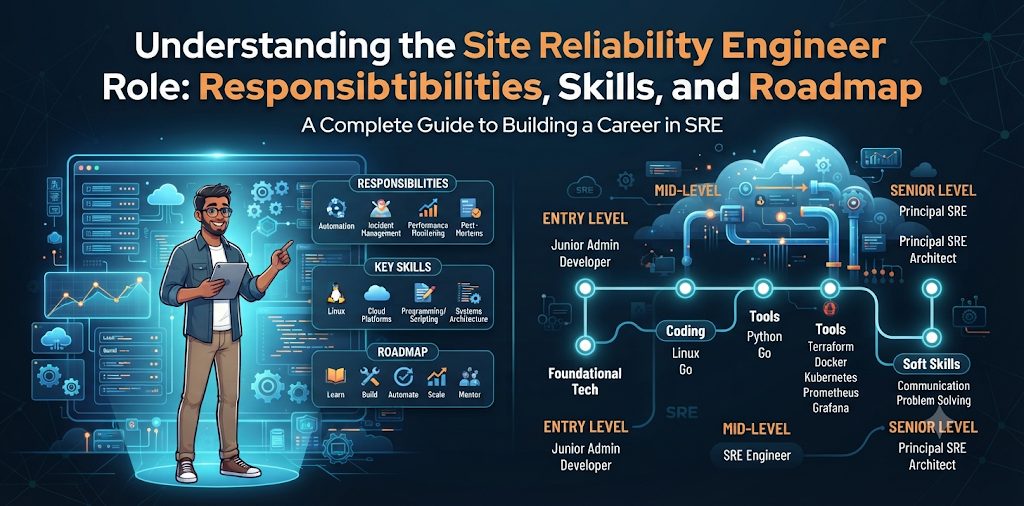
- Entry-Level SRE (Junior SRE / Associate SRE): Typically filled by computer science graduates or junior developers/sysadmins with strong Linux, networking, and scripting fundamentals. Focuses on monitoring, runbook execution, small automation scripts, and shadowed on-call duties.
- Mid-Level SRE: Independently owns service reliability, builds Terraform modules and CI/CD workflows, leads incident mitigation, conducts postmortems, and designs monitoring for complex microservices.
- Senior SRE: Architects fault-tolerant distributed systems, defines organization-wide SLO frameworks, leads major incident responses, mentors junior engineers, and solves deep performance bottlenecks.
- SRE Team Lead / Engineering Manager: Shifts focus toward people leadership, hiring, cross-team alignment, balancing on-call health, and prioritizing reliability roadmaps alongside product leadership.
- Staff / Principal SRE: Operates at an organizational or multi-team level, setting long-term technical vision for reliability platforms, disaster recovery architecture, and engineering culture across the company.
Engineers who consistently combine strong coding skills, deep systems troubleshooting ability, and calm cross-team communication progress fastest along both individual contributor and leadership tracks.
Frequently Asked Questions About Site Reliability Engineer Roles
What does a Site Reliability Engineer do? A Site Reliability Engineer applies software engineering principles to IT operations and infrastructure management. They write automation code, build monitoring systems, manage cloud infrastructure, respond to production incidents, and design resilient architectures so software services stay fast and reliable.
What are the main responsibilities of an SRE? Key responsibilities include monitoring application performance, managing production incidents, automating repetitive operational tasks (toil), maintaining cloud and Kubernetes infrastructure, supporting safe CI/CD releases, capacity planning, and conducting blameless postmortems.
What does an SRE do on a daily basis? On a typical day, an SRE checks service health dashboards, reviews SLO and error budget metrics, participates in engineering standups, reviews infrastructure code changes, writes automation tools, tunes alerting rules, and investigates performance bottlenecks or production incidents.
Is SRE a coding job? Yes, coding is a core part of Site Reliability Engineering. While SREs do not usually build customer-facing product features, they regularly write scripts, infrastructure code, internal tools, and automated remediation workflows to solve operational problems at scale.
What programming languages should an SRE learn? Python and Go are the two most widely used languages in SRE roles due to their strong ecosystem support for cloud APIs, automation, and systems tooling. Bash scripting is also essential for everyday Linux administration and quick automation tasks.
Does an SRE handle production incidents? Yes. Participating in on-call rotations and coordinating incident response is a primary responsibility. SREs investigate alerts, mitigate live disruptions to restore user service quickly, and lead blameless postmortems afterward to prevent repeat outages.
What is the difference between SRE and DevOps? DevOps is a broader cultural and engineering movement focused on uniting development and operations to speed up software delivery. SRE is a specific implementation of DevOps principles that uses concrete engineering practices—like SLIs, SLOs, error budgets, and toil automation—to measure and maintain production reliability.
Is Linux necessary for an SRE career? Yes. The vast majority of cloud servers, containers, and production infrastructure run on Linux. Strong knowledge of Linux internals, networking, process management, and command-line troubleshooting is foundational for every SRE role.
What tools do Site Reliability Engineers use? Common tools include Prometheus and Grafana for monitoring, ELK Stack or Splunk for logging, OpenTelemetry for tracing, Docker and Kubernetes for containers, Terraform for Infrastructure as Code, GitHub Actions or Jenkins for CI/CD, and PagerDuty for incident alerting.
Can a fresher become a Site Reliability Engineer? Yes, though it requires deliberate preparation. Freshers who build strong skills in Linux, networking, Python/Bash scripting, cloud basics, Docker, and monitoring—and demonstrate them through hands-on home-lab or cloud projects—can qualify for entry-level SRE or junior cloud/DevOps roles.
Is SRE responsible for application uptime? SREs share responsibility for uptime with software development and platform teams. SREs provide the observability, resilient infrastructure, deployment safeguards, and incident coordination needed for high availability, while developers ensure application code itself is well-tested and bug-free.
What skills are most important for an SRE? The most critical skills combine technical depth (Linux, networking, cloud infrastructure, Kubernetes, programming/automation, and observability) with operational practices (SLOs, incident response, root cause analysis) and calm, clear communication across teams.
Conclusion: The Importance of Site Reliability Engineers in Modern IT
As software systems grow more distributed and essential to everyday life, reliability can no longer be treated as an afterthought handled manually after code ships. Site Reliability Engineers bring structure, engineering discipline, and automation to production operations—allowing organizations to innovate rapidly without sacrificing stability or user trust.
By mastering observability, incident management, Infrastructure as Code, and reliability frameworks like SLOs and error budgets, SREs bridge the gap between fast software delivery and resilient infrastructure. Whether you are a student exploring cloud careers, a system administrator transitioning into automation, or a software developer interested in production architecture, developing SRE skills opens doors to high-impact engineering roles.
Building expertise in Site Reliability Engineering takes hands-on practice and structured learning. If you are looking to strengthen your understanding of reliability concepts, practical tooling, and real-world operational workflows, SRE School serves as a dedicated educational resource to help aspiring and working engineers develop practical knowledge of modern Site Reliability Engineering practices.