Introduction
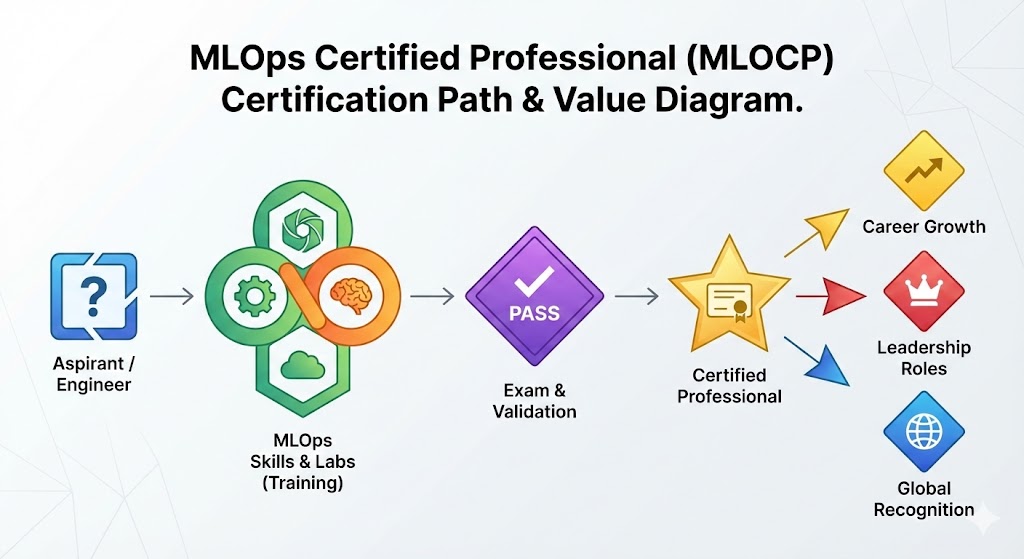
Pioneering the next phase of your technical journey involves mastering the operational demands of intelligent systems. The MLOps Certified Professional (MLOCP) offers a specialized credential for individuals who want to synchronize model development with enterprise-grade stability. This manual outlines the necessary steps to transition from experimental coding to managing production environments at scale. By choosing this path, you secure a competitive advantage in a landscape where DevOpsSchool provides the essential training to bridge modern infrastructure gaps. This guide helps professionals evaluate their current expertise and build a technical foundation that supports long-term career growth.
What is the MLOps Certified Professional (MLOCP)?
The MLOps Certified Professional (MLOCP) validates an engineer’s capacity to oversee the entire machine learning lifecycle through the lens of operational excellence. It focuses on the practical challenges of moving algorithms from research environments into live, high-traffic systems. Instead of concentrating on theoretical mathematics, this program prioritizes the stability and scalability of model deployments. It addresses the common failure points in enterprise AI projects, such as versioning conflicts and hardware inefficiency. Consequently, this certification aligns perfectly with modern engineering workflows that demand speed without sacrificing reliability.
Who Should Pursue MLOps Certified Professional (MLOCP)?
Cloud engineers and software developers who want to specialize in the intersection of data science and operations should pursue this certification. Additionally, Site Reliability Engineers (SREs) who must maintain the uptime of AI-powered applications find these modules essential for their career progression. Platform architects and data engineers who build the underlying pipelines for automated intelligence also gain significant value from this structured learning. Technical leads and engineering managers require this knowledge to guide cross-functional teams and make informed decisions about infrastructure. This program serves a diverse audience across India and the global market where companies prioritize operational stability.
Why MLOps Certified Professional (MLOCP) is Valuable and Beyond
Enterprises increasingly adopt automated intelligence to drive business outcomes, which creates a massive demand for professionals who can manage these systems reliably. This certification ensures that you remain relevant in a market that constantly shifts toward automation and data-driven decision-making. Moreover, mastering MLOps principles allows you to build durable systems that withstand changes in specific software tools or frameworks. The investment in this credential yields a high return, as certified experts often access senior architecture roles and command higher compensation. By focusing on the “Ops” side of machine learning, you protect your career against the volatility of the experimental AI market.
MLOps Certified Professional (MLOCP) Certification Overview
Candidates access the certification program via the MLOps Certified Professional (MLOCP) official portal, which DevOpsSchool hosts. The program utilizes a performance-based assessment model that requires students to solve real-world problems in simulated production environments. Unlike academic courses that rely on passive testing, this track demands that you demonstrate technical ownership of the model lifecycle. The curriculum covers every stage of the process, including automated testing, model monitoring, and secure data ingestion. Consequently, the assessment confirms that you possess the hands-on skills required to handle mission-critical enterprise workloads with confidence.
MLOps Certified Professional (MLOCP) Certification Tracks & Levels
The certification framework divides the learning path into three distinct tiers: Foundation, Professional, and Advanced. The Foundation level introduces you to the basics of model packaging and version control for non-code assets. Moving forward, the Professional level focuses on building sophisticated CI/CD pipelines and managing complex task orchestration. Finally, the Advanced level explores high-stakes specializations like financial optimization for AI and enterprise security compliance. These tiers align with the natural growth of a technical professional, allowing you to move from a junior contributor to a strategic architect. Each track provides the specific competencies needed for DevOps, SRE, or dedicated AI operations roles.
Complete MLOps Certified Professional (MLOCP) Certification Table
| Track | Level | Who it’s for | Prerequisites | Skills Covered | Recommended Order |
| Lifecycle Core | Foundation | Junior Engineers | Python Basics | Docker, Git, ML Basics | 1st |
| Automation Eng | Professional | SREs/Data Eng | Foundation Tier | CI/CD, Kubeflow, Airflow | 2nd |
| Platform Arch | Advanced | Architects/Leads | Professional Tier | Scaling, FinOps, Security | 3rd |
Detailed Guide for Each MLOps Certified Professional (MLOCP) Certification
MLOps Certified Professional (MLOCP) – Foundation
What it is
This level validates your understanding of the foundational principles of machine learning operations and the basics of workflow automation. It prepares you to support data science teams by managing the underlying infrastructure for their experiments.
Who should take it
This certification serves junior developers, entry-level DevOps practitioners, and graduates who want to establish a career in the AI operations market.
Skills you’ll gain
- Differentiating between standard software operations and machine learning lifecycles.
- Packaging models into reliable containers using Docker technology.
- Implementing basic version control for datasets and model weights.
- Setting up automated quality checks for incoming data streams.
Real-world projects you should be able to do
- Building a containerized environment for a model built with Python.
- Creating a Git repository that tracks both code and dataset changes.
- Deploying a simple model as a web service using a modern API framework.
Preparation plan
- 7 Days: Focus on the core vocabulary and the primary stages of the model lifecycle.
- 30 Days: Practice hands-on labs involving container configuration and basic automation.
- 60 Days: Explore data versioning tools and join technical community discussion groups.
Common mistakes
- Ignoring the need for data validation before the training phase begins.
- Treating model files as static binaries instead of versioned assets.
Best next certification after this
- Same-track option: MLOCP Professional.
- Cross-track option: Certified Kubernetes Administrator (CKA).
- Leadership option: Project Management Professional (PMP).
MLOps Certified Professional (MLOCP) – Professional
What it is
The Professional level validates your ability to construct and maintain sophisticated pipelines that automate the entire retraining and deployment cycle. It proves you can manage model health and infrastructure stability in production.
Who should take it
Experienced infrastructure engineers, SREs, and Data Engineers who manage the scalability of automated intelligence systems should take this certification.
Skills you’ll gain
- Engineering robust CI/CD pipelines specifically for machine learning models.
- Managing complex orchestration tasks with tools like Airflow or Kubeflow.
- Tracking model performance and identifying statistical drift in real-time.
- Implementing automated validation tests and A/B deployment strategies.
[Diagram: MLOps CI/CD Workflow with White Background]
Real-world projects you should be able to do
- Automating a retraining loop that triggers when new data arrives.
- Designing an observability dashboard that tracks prediction accuracy.
- Implementing a safe blue-green deployment strategy for AI services.
Preparation plan
- 7 Days: Review orchestration patterns and pipeline blueprints.
- 30 Days: Build several end-to-end pipelines using industry-standard tools.
- 60 Days: Finalize a production-grade project that includes full monitoring.
Common mistakes
- Designing overly complex orchestration for simple, lightweight models.
- Failing to build automated rollback paths for failed updates.
Best next certification after this
- Same-track option: MLOCP Advanced.
- Cross-track option: Specialized Cloud ML Credentials.
- Leadership option: Certified Scrum Master (CSM).
MLOps Certified Professional (MLOCP) – Advanced
What it is
The Advanced tier proves your expertise in designing large-scale, secure, and economically efficient machine learning platforms for the enterprise. It highlights your capacity for technical leadership and complex problem-solving.
Who should take it
Principal engineers, senior architects, and technical directors who oversee enterprise-wide strategies and financial budgets find this level most useful.
Skills you’ll gain
- Designing security frameworks for sensitive data within the ML pipeline.
- Optimizing the financial cost of GPU and specialized compute resources.
- Building distributed training clusters that handle massive, complex datasets.
- Establishing governance and auditing standards for AI usage across an organization.
Real-world projects you should be able to do
- Architecting a secure platform that supports multiple internal AI teams.
- Reducing infrastructure costs significantly through compute resource optimization.
- Creating a comprehensive disaster recovery strategy for mission-critical services.
Preparation plan
- 7 Days: Analyze enterprise security standards and cost optimization whitepapers.
- 30 Days: Evaluate historical case studies regarding large-scale system deployments.
- 60 Days: Produce a complete architectural design for an enterprise platform.
Common mistakes
- Prioritizing technical performance while ignoring the financial impact of hardware.
- Overlooking security vulnerabilities within the data ingestion layer.
Best next certification after this
- Same-track option: AI Governance and Ethics certifications.
- Cross-track option: Professional Cloud Architect credentials.
- Leadership option: Executive leadership and business management programs.
Choose Your Learning Path
DevOps Path
The DevOps path focuses on embedding machine learning into existing software delivery cycles with maximum automation. Therefore, you should prioritize techniques that treat model training as a standard build operation. Additionally, you will learn to manage the underlying infrastructure using code to ensure reproducibility. This path works best for those who already use Jenkins or GitHub Actions. Furthermore, you will gain the skills necessary to automate quality gates for both code and data.
DevSecOps Path
The DevSecOps path highlights the security requirements of the entire machine learning pipeline. Consequently, you will learn to protect the data supply chain and scan model artifacts for potential threats. You must also implement strict access controls for training datasets to prevent unauthorized leaks. This path ensures that AI initiatives do not create new risks for the enterprise environment. Additionally, you will master the art of secure data processing and storage.
SRE Path
The SRE path emphasizes the uptime and observability of machine learning services in live environments. Therefore, you will develop service level objectives for model latency and prediction accuracy. You will also learn to respond to incidents where a failure involves a drop in accuracy rather than a simple outage. This path is vital for maintaining reliable services in high-stakes environments like finance. Furthermore, you will implement sophisticated logging and tracing for inference clusters.
AIOps / MLOps Path
This path serves as the core of the MLOCP program and centers on model lifecycle management. Consequently, you will master model registries, feature stores, and automated retraining loops. You will also explore the complexities of hardware acceleration and GPU management for large-scale training. This trajectory connects the experimental world of data science with the stability requirements of IT operations. Additionally, you will learn to manage the versioning of non-code assets.
DataOps Path
The DataOps path addresses the foundational role of data engineering in the machine learning world. Therefore, you will build pipelines that guarantee high-quality data reaches the training environment. You will also track data lineage to understand the origin of every piece of information used by a model. This path is essential for companies dealing with fast-moving, massive data streams. Furthermore, you will implement automated data cleaning and quality checks.
FinOps Path
The FinOps path tackles the high costs associated with modern machine learning infrastructure. Consequently, you will learn to track resource usage and optimize the cost of expensive cloud hardware. You will also implement strategies like model quantization to reduce compute requirements during inference. This path ensures that your AI projects remain financially sustainable over the long term. Additionally, you will gain the ability to forecast future infrastructure costs with precision.
Role → Recommended MLOps Certified Professional (MLOCP) Certifications
| Role | Recommended Certifications |
| DevOps Engineer | MLOCP Foundation, MLOCP Professional |
| SRE | MLOCP Professional, MLOCP Advanced |
| Platform Engineer | MLOCP Professional, MLOCP Advanced |
| Cloud Engineer | MLOCP Foundation, MLOCP Professional |
| Security Engineer | MLOCP Foundation + Security Focus |
| Data Engineer | MLOCP Professional + DataOps Focus |
| FinOps Practitioner | MLOCP Advanced + FinOps Focus |
| Engineering Manager | MLOCP Foundation + Strategy Modules |
Next Certifications to Take After MLOps Certified Professional (MLOCP)
Same Track Progression
Once you reach the advanced tier, you should focus your attention on emerging domains like Large Language Model Operations. This specialization ensures that you remain at the forefront of the industry as generative AI becomes a standard business requirement. Furthermore, you can pursue mastery of specific tools like Databricks or specialized Kubeflow certifications. Deepening your knowledge of cloud-specific machine learning services also provides a logical next step. Consequently, you become the primary authority on complex platform architecture within your organization.
Cross-Track Expansion
To become a versatile engineer, you should consider expanding your expertise into broader cloud architecture or cybersecurity. For instance, earning a cloud architect credential allows you to design the entire ecosystem where your AI pipelines function. Additionally, mastering big data platforms helps you understand the upstream processes that feed your models. This broad skill set makes you a highly valuable member of cross-functional teams. Furthermore, it allows you to move fluidly between different engineering departments as company needs evolve.
Leadership & Management Track
If you want to move into management, you should focus on certifications that emphasize team delivery and business strategy. Consequently, learning about agile leadership or technical product management will help you lead MLOps teams more effectively. You should also work on your ability to communicate complex technical concepts to non-technical stakeholders. This transition allows you to shape the AI direction of your entire organization. Furthermore, you will learn to measure and report the business value and ROI of technical projects.
Training & Certification Support Providers for MLOps Certified Professional (MLOCP)
DevOpsSchool
DevOpsSchool provides a robust educational ecosystem designed for engineers who want to master machine learning operations. They offer a diverse curriculum that blends live instructor-led sessions with intensive hands-on lab exercises. Their training methodology emphasizes the practical application of MLOps principles in enterprise environments, ensuring that every student gains real-world experience. Additionally, they provide extensive support through dedicated mentors who help candidates navigate the complexities of model deployment and scaling. The platform serves as a central hub for professionals, fostering a community of technical excellence across the globe. Consequently, they remain a top-tier choice for those pursuing the MLOCP credential. Their commitment to updating content ensures that students always learn the latest industry techniques and stay ahead of the competition.
Cotocus
Cotocus offers high-level consulting and specialized training programs tailored for modern engineering teams and large organizations. They focus on delivering customized education solutions that align with the specific technical goals and operational needs of a business. Their instructors bring years of field experience into the training environment, providing students with unique insights into the challenges of production-grade AI infrastructure. Moreover, they emphasize the use of industry-standard tools and frameworks to build reliable and scalable pipelines. This practical focus ensures that graduates can immediately contribute to high-impact projects within their organizations. Furthermore, they provide post-training support to help teams implement MLOps practices successfully and maintain long-term system stability. Their dedication to quality makes them a reliable partner for professional growth.
Scmgalaxy
Scmgalaxy serves as a comprehensive resource center for professionals interested in software configuration management and the evolving field of MLOps. They provide an extensive library of technical blogs, tutorials, and video content that covers a wide array of operational tools and techniques. Their training programs focus on the intersection of DevOps and machine learning, offering a structured path for engineers to advance their careers. Additionally, they host frequent webinars and workshops featuring industry experts who share their knowledge on emerging trends. The community aspect of the platform allows members to collaborate and solve technical problems together. Consequently, it remains an essential support system for any MLOCP candidate seeking deep technical knowledge. Their vast repository of learning materials supports continuous professional development.
BestDevOps
BestDevOps focuses on providing high-quality, curated learning experiences for engineers who want to lead in the operations space. They offer specialized courses that break down complex MLOps concepts into digestible, actionable modules for working professionals. Their teaching style prioritizes clarity and simplicity, ensuring that students can grasp even the most advanced architectural principles easily. Moreover, they provide a variety of practice exams and hands-on scenarios to help candidates prepare for the final certification assessment. The platform also offers career guidance and resume-building tips to help graduates secure senior-level positions. Furthermore, their commitment to quality ensures a high success rate for their students, making them a preferred provider for career-focused individuals. They empower engineers to take control of their career paths effectively.
devsecopsschool.com
devsecopsschool.com addresses the critical need for security within the machine learning pipeline through specialized training and resources. They teach engineers how to build defensible AI architectures and protect sensitive datasets from potential threats throughout the lifecycle. Their courses cover a wide range of security topics, including identity management, encrypted processing, and vulnerability scanning for model artifacts. Additionally, they provide guidance on meeting regulatory and compliance standards for AI deployments in highly regulated industries. The instructors are recognized experts in both the security and operations fields. Furthermore, their labs allow students to practice identifying and mitigating security vulnerabilities in a safe, controlled environment, ensuring production environments remain secure. They provide the necessary tools to safeguard intelligence assets in any organization.
sreschool.com
sreschool.com focuses on the reliability and performance metrics of machine learning through the lens of site reliability engineering. They provide training that teaches you how to maintain high availability for AI services in production. Their curriculum addresses monitoring, alerting, and incident management specifically for complex, data-driven applications. Moreover, they highlight the role of automation in meeting service level objectives for model latency and prediction accuracy. Their instructors offer practical advice on handling the unique ways that machine learning systems can fail or degrade over time. Additionally, they provide resources for learning how to apply chaos engineering principles to AI clusters. Consequently, students learn to build resilient platforms that survive infrastructure failures and maintain high performance for end users.
aiopsschool.com
aiopsschool.com explores how artificial intelligence can transform traditional IT operations and automate routine management tasks. They focus on using AI to improve efficiency and reduce the human workload associated with large-scale infrastructure. Their courses provide a detailed look at AIOps tools and techniques that are highly relevant to the MLOCP curriculum. Additionally, they teach you how to build intelligent monitoring systems that can identify and heal infrastructure issues automatically. The platform offers diverse learning materials, including detailed case studies and technical whitepapers. Furthermore, their instructors are pioneers in the field, providing a unique perspective on the future of intelligent operations. Consequently, they help students stay ahead of the curve in a rapidly changing field, ensuring long-term career viability.
dataopsschool.com
dataopsschool.com addresses the critical need for professional data management and engineering within the machine learning world. They provide training on how to build and scale data pipelines that are both reliable and efficient for training models. Their curriculum covers data quality, governance, and lineage, which are all essential components of a successful MLOps lifecycle. Moreover, they emphasize the collaborative nature of DataOps, bringing different technical teams together to improve data flow. Their labs provide hands-on experience with the latest data management tools and cloud platforms. Furthermore, their focus on the data supply chain ensures that your models always have high-quality input, which leads to better predictions and more stable production environments. They bridge the gap between raw data and actionable intelligence.
finopsschool.com
finopsschool.com provides the necessary training to manage the financial health and cost optimization of cloud-based AI infrastructure. They teach you how to track hardware costs and optimize resource usage to stay within an enterprise budget. Their courses are vital for anyone responsible for the economic viability of a large-scale AI project. Moreover, they offer specific strategies for managing the high costs associated with GPUs and specialized compute resources. Their instructors provide practical tips on how to save money without hurting the performance of your machine learning models. Additionally, they explore the cultural changes needed to adopt financial discipline within a technical engineering team. Consequently, they help organizations maximize the ROI of their AI investments and maintain financial sustainability over the long term.
Frequently Asked Questions (General)
- How difficult is the MLOps Certified Professional (MLOCP) exam?The difficulty depends on your technical background, but most candidates find it challenging because it requires a combination of operations and data science knowledge. Consequently, you should prepare thoroughly using the provided labs.
- What is the typical time commitment for preparation?Most working professionals spend between 30 and 60 days preparing, depending on their existing familiarity with containerization and Python scripting.
- Are there any mandatory prerequisites for the Foundation level?While there are no strict mandatory certifications, a basic understanding of Linux and Python is highly recommended to succeed in the performance-based labs.
- What is the return on investment (ROI) for this certification?The ROI is high, as the certification validates a specialized skill set that is currently in high demand, often leading to significant salary increases.
- Should I take the DevOps certification before MLOps?Having a foundation in traditional DevOps makes the transition to MLOps much smoother as you will already understand the core principles of automation.
- Does the certification focus on a specific cloud provider?The MLOCP focuses on tool-agnostic principles and open-source tools, though the concepts are easily applicable to all major cloud platforms like AWS or Azure.
- How often do I need to renew the certification?Typically, the certification remains valid for two to three years, after which you may need to demonstrate continuous learning or pass a recertification assessment.
- Is this certification recognized globally?Yes, the certification is recognized by major technology firms and enterprises across the globe, including significant adoption in the Indian tech market.
- Can an engineering manager benefit from this technical certification?Absolutely, as it provides managers with the technical vocabulary and understanding needed to lead specialized MLOps teams and make informed decisions.
- What kind of hands-on projects are included in the training?Projects include building automated retraining pipelines, setting up model monitoring dashboards, and containerizing complex models for production clusters.
- Are the exams remote-proctored?Yes, the certification exams are typically conducted through a secure remote-proctored environment for your convenience and accessibility.
- Does the program cover the latest trends like LLMOps?The advanced levels and updated modules frequently include content on managing large language models and other modern generative AI infrastructure trends.
FAQs on MLOps Certified Professional (MLOCP)
- How does MLOCP differ from a standard Data Science certification?A standard Data Science certification focuses on model building and statistics, whereas MLOCP focuses on the infrastructure, automation, and reliability of those models in production. Consequently, MLOCP is for engineers who want to build the systems that run the models. This distinction is critical for large enterprises that struggle to scale their AI initiatives.
- Which specific tools will I master during the MLOCP journey?The curriculum covers a wide range of industry-standard tools including Docker, Kubernetes, MLflow, Kubeflow, and various CI/CD platforms. Additionally, it explores data versioning tools like DVC to ensure you have a complete toolkit for managing the ML lifecycle. By learning these tools, you gain the ability to create reproducible environments for AI development.
- Is coding a major part of the MLOps certification?Yes, you will need to be comfortable with Python scripting and YAML configuration files to automate the pipeline stages. Furthermore, you will use code to define your infrastructure, following the industry standard of infrastructure-as-code. This approach ensures that your pipelines are automated and easily scalable across different environments.
- Can I jump straight to the Professional level?If you have significant experience in DevOps and basic ML knowledge, you may be able to skip the Foundation level, but it is generally recommended to follow the levels. Starting from the beginning ensures you have a cohesive mental model of the entire MLOps workflow before moving to complex orchestration tasks.
- How does MLOCP address model drift?The program teaches you how to implement monitoring systems that compare live production data with training data to detect shifts in performance. Consequently, you will learn to trigger automated retraining or alerts when the model becomes less accurate over time. This proactive approach ensures that AI-powered services remain reliable and deliver consistent value.
- Does the certification cover security for ML?Yes, especially at the Professional and Advanced levels, you will learn about securing the data pipeline and protecting models from adversarial attacks. This ensures that your AI deployments are both robust and safe for enterprise use. You will explore techniques for scanning container images and securing the communication between different microservices.
- Is there a focus on cost optimization in MLOCP?The Advanced level specifically addresses FinOps for ML, teaching you how to manage the high costs of compute resources and specialized hardware. You will learn strategies for efficient scaling and resource allocation to keep projects financially viable. This includes learning when to use spot instances and how to optimize inference workloads to save money.
- What is the format of the MLOCP exam?The exam usually consists of a mix of multiple-choice questions and practical lab scenarios where you must solve real-world problems. This ensures that you have both the theoretical knowledge and the hands-on skills required by modern employers. By completing these performance-based tasks, you demonstrate your ability to handle actual production issues effectively.
Final Thoughts: Is MLOps Certified Professional (MLOCP) Worth It?
As you evaluate your next professional milestone, consider the undeniable shift toward automated intelligence in the enterprise sector. Organizations no longer view machine learning as a luxury but as a core component of their competitive strategy. This certification provides you with the professional roadmap to lead that transformation with confidence and technical precision. It replaces the messy trial-and-error of early AI projects with established industry standards and repeatable success. If you want to protect your career from obsolescence and position yourself at the forefront of modern infrastructure, this investment is highly logical. It offers a clear competitive edge in a global market that is desperate for engineers who can manage both code and data. Therefore, the MLOCP remains a powerful and necessary asset for any professional committed to technical excellence.


Leave a Reply
You must be logged in to post a comment.