Introduction
Launching an aviation career demands deliberate planning, disciplined execution, and transparent institutional insights. Future aviators regularly confront conflicting promotional claims and opaque pricing from hundreds of flight organizations worldwide. Consequently, prospective cadets need dependable, data-backed guidance to distinguish world-class flight academies from under-equipped local operations.
BestPilotsSchool delivers that essential clarity by centralizing verifiable academy benchmarks, curriculum standards, and fleet specifications within a single interactive hub. Aviators leverage our independent directory to evaluate certified programs, verify real flight training costs, and select an academy that matches their long-term career aspirations with absolute certainty.
Why Choosing the Right Pilot School Matters
Primary aviation schools forge your core flying instincts, procedural adherence, and professional reputation across the global industry. Chief pilot interview panels rigorously examine where applicants build their foundational flight hours, favoring candidates who demonstrate exceptional crew resource management and disciplined airmanship from day one. Premium institutions enforce rigorous standard operating procedures that mirror transport-category airline environments.
Conversely, poorly organized training providers create chronic dispatch delays, maintenance backlogs, and rapid instructor attrition. These operational inefficiencies deplete your training capital and stall your seniority progression toward the airlines. Choosing an accredited, well-managed aviation academy safeguards your financial investment and keeps your professional progression moving forward without disruption.
Understanding Different Types of Flight Schools
Civil aviation regulators certify flight training organizations under distinct regulatory structures that establish training intensity, daily scheduling, and syllabus progression:
- Modular Training Centers: This pathway enables candidates to conquer each license rating sequentially. Working professionals often select modular programs because they can maintain existing employment while funding their flying credentials tier by tier.
- Integrated Full-Time Academies: These fast-track programs transition zero-experience candidates directly into airline-ready commercial pilots through an immersive syllabus. Major airlines prefer these structured environments because they accustom cadets to high-tempo airline operations.
- Collegiate Aviation Universities: These programs combine a four-year bachelor’s degree with complete professional flight ratings, equipping graduates with formal academic credentials alongside their commercial pilot certificates.
Commercial Pilot License Training Explained
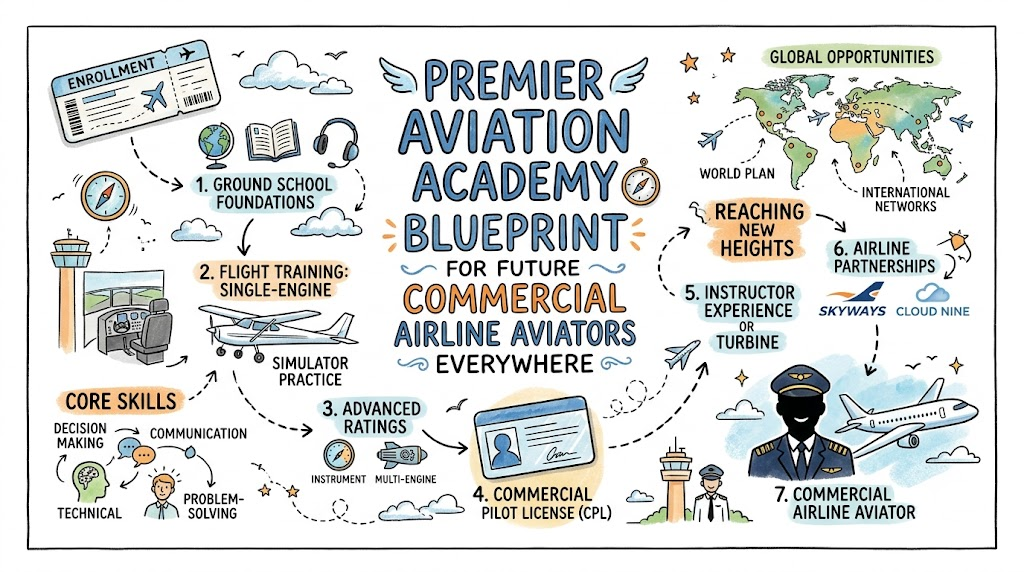
Securing full commercial pilot license training qualifications demands complete mastery over complex multi-engine systems, advanced instrument navigation, high-altitude performance, and decisive emergency reactions:
| Milestone Phase | Logged Flight Hours | Technical Focus & Flight Proficiencies |
|---|---|---|
| Private Pilot Foundation | 40 – 60 Hours | Basic aerodynamics, single-engine solo operations, cross-country visual pilotage |
| Instrument Rating (IR) | 40 – 50 Hours | Full cockpit instrument flying, adverse weather operations, air traffic clearances |
| Commercial Certificate (CPL) | 190 – 250 Hours | Complex aircraft operations, high-performance systems, precision commercial flight profiles |
| Multi-Engine Add-On | 15 – 25 Hours | Multi-engine aerodynamics, asymmetric thrust control, critical engine-out procedures |
Conquering these sequential stages converts a novice into a disciplined, commercially rated pilot ready to command multi-engine aircraft across congested airspace systems.
How to Compare the Best Pilot Schools
Assessing flight academies requires inspecting daily flight line operations rather than slick marketing brochures. First, verify the active student-to-instructor ratio across the training fleet. When academies overload their instructors with excessive flight rosters, daily flying slots collapse and total course durations expand significantly.
Next, examine the operational airspace surrounding the home airfield. Flying out of dense, towered airfields sharpens radio communication discipline, traffic scanning, and operational decision-making. Target the best pilot schools that combine active airspace environments with dependable visual-flight weather conditions throughout the annual cycle.
Best Flight Schools Should Match Your Career Plan
Every cadet enters flight training with distinct aviation aspirations. Some candidates target wide-body international jet operations, while others pursue executive corporate aviation, regional freight transport, or specialized flight instruction. The best flight schools configure their training syllabi, twin-engine aircraft, and flight simulators to support these diverse career targets directly.
Cadets targeting airline cockpits must prioritize institutions that deliver advanced multi-crew cooperation courses, jet transition modules, and modern glass-cockpit simulation. Aligning your immediate training environment with your ultimate airline objective eliminates costly transition training later.
What Makes the Best Commercial Pilot Training Schools Different?
Premier aviation academies set themselves apart through certified on-site maintenance departments and modern training fleets. The best commercial pilot training schools operate dedicated maintenance hangars that inspect and service aircraft continuously every single day to maximize fleet availability.
Additionally, elite academies recruit veteran airline captains to design comprehensive safety management systems. These institutions enforce airline-standard operating procedures during initial solo and cross-country stages, creating an effortless transition when cadets enter regional or mainline airline training classes.
How Much Does Pilot Training Cost?
Financial clarity represents an indispensable requirement when mapping out your flight education. Complete professional commercial pilot training typically demands an investment between sixty thousand and one hundred thirty thousand dollars depending on training location, fleet selection, and course structure.
Structure your overall budget around these primary financial components:
- Aircraft and Instructor Fees: Dual instruction rates, solo aircraft wet rental charges, and required pre-flight and post-flight ground briefings.
- Aviation Authority and Testing Costs: Computerized knowledge tests, designated pilot examiner checkride fees, and initial medical exam clearances.
- Flight Equipment and Daily Accommodation: Aviation headsets, electronic flight bags, uniform sets, and daily living expenses during full-time training.
Always demand a fully itemized, contractually binding cost breakdown before signing enrollment paperwork or transferring advance funds.
Integrated vs. Modular Pilot Training
Your financial reserves and personal schedule determine whether you should pursue integrated academies or modular training routes. Integrated programs guide candidates from zero flight time to a frozen air transport pilot license within twelve to eighteen continuous months of full-time training.
Modular training allows students to finance and complete each rating tier independently while maintaining their current employment. While modular paths provide excellent financial adaptability, integrated pathways provide accelerated graduation and preferential recruitment pipelines into major airline cockpits.
Finding the Best Pilot Schools in the World
Major global flight training centers offer distinct operational advantages thanks to reliable meteorological conditions and advanced aviation infrastructure. Many of the best pilot schools in the world operate in regions with over three hundred flyable visual-flight-rules days every single year.
International flight training exposes cadets to global airspace protocols, diverse air traffic control accents, and varied weather challenges. Researching global destinations enables you to capitalize on favorable currency exchange rates and high-frequency flight schedules.
How to Evaluate a Pilot Training Academy
Inspect flight training facilities in person before signing agreements or transferring deposits. A premier pilot training academy maintains immaculate aircraft hangars, active flight dispatch desks, and modern synthetic flight training devices.
During your visit, speak directly with current flight cadets away from sales recruiters to gain unvarnished feedback regarding aircraft availability. Ask senior flight instructors about realistic student completion timelines, and observe the institution’s safety culture firsthand.
Choosing an Airline Pilot Training Academy
Major airlines partner directly with select aviation academies through specialized mentorship and recruitment channels. An accredited airline pilot training academy often secures conditional first officer job offers for cadets before they complete primary training.
These partner academies incorporate airline-specific aptitude tests, crew resource management drills, and jet transition courses directly into the curriculum. Selecting an institution with formal airline connections significantly decreases career uncertainty and accelerates your entry into the first officer seat.
How to Identify the Best Flying Schools
Finding the best flying schools requires evaluating aircraft fleet age, maintenance tracking systems, and cockpit avionics. Modern airline cockpits require glass-cockpit avionics systems, such as Garmin suites, rather than outdated mechanical gauges.
Training on digital flight decks equips cadets with automation management skills, digital engine monitoring, and electronic moving maps early in their flying careers. Prioritize schools that continuously invest in modern aircraft and high-fidelity flight simulation devices.
The Importance of Student Reviews
Marketing brochures rarely highlight aircraft maintenance delays, instructor shortages, or hidden administrative fees. Independent student reviews provide indispensable, objective insights into daily flight line operations.
Examine detailed student reviews regarding aircraft dispatch reliability, instructor professionalism, billing accuracy, and scheduling consistency. Learning from authentic student experiences protects you from institutions that overpromise and underdeliver on flight hours.
Using BestPilotsSchool to Research Your Options
Navigating flight academy research across multiple countries and regulatory authorities demands substantial time and energy. BestPilotsSchool simplifies this process by organizing verified institutional profiles, aircraft fleet details, and pricing structures in one accessible place.
Aspiring pilots can compare training programs, evaluate modern simulator facilities, explore licensing pathways, and connect with reputable aviation academies. Our platform eliminates the guesswork so you can focus entirely on developing your aeronautical knowledge and cockpit skills.
Common Mistakes Students Make
Many aspiring aviators make preventable errors during their initial research phase. Review these major mistakes to protect your time and educational funds:
- Paying Complete Fees Upfront: Never transfer entire program fees in advance; instead, establish an escrow arrangement or pay in small, milestone-based installments.
- Overlooking Regional Climate Realities: Training in areas with prolonged winter freezes or continuous monsoon seasons leads to severe flight cancellations and stalled progression.
- Delaying Medical Certifications: Always secure an official First-Class Medical Certificate before spending funds on uniforms, headsets, or ground school courses.
- Focusing Solely on Lowest Hourly Rates: The cheapest hourly price often conceals neglected aircraft maintenance, high instructor turnover, and hidden institutional fees.
Avoiding these common pitfalls ensures a smooth, cost-effective journey toward your professional pilot certificates.
Frequently Asked Questions About BestPilotsSchool
- Which practical benefits does BestPilotsSchool offer aspiring flight candidates?
The platform compiles verified data regarding aircraft fleets, tuition costs, facilities, and licensing pathways to enable side-by-side academy comparisons.
- What primary features elevate the best aviation academy for pilot training above average schools?
Leading academies provide modern glass-cockpit fleets, certified in-house maintenance facilities, experienced instructor corps, and established airline hiring connections.
- Does BestPilotsSchool include international flight academies across global regions?
Prospective aviators can explore training institutions worldwide to compare foreign training environments, licensing accreditations, and program costs.
- Which operational details separate full-time integrated programs from modular courses?
Integrated paths follow a fast-track, full-time curriculum toward airline placement, whereas modular programs let students pace individual ratings according to personal budgets.
- When should a prospective student obtain a First-Class Medical Certificate?
Candidates must secure this official medical clearance from an authorized aviation medical examiner before spending capital on flight equipment or flight hours.
- How does BestPilotsSchool present commercial flight program expenses clearly?
The platform details all cost categories openly, itemizing dual flight hours, solo wet rental fees, ground school briefings, and testing expenses.
- Can students discover schools with direct airline cadet mentorship programs on the site?
BestPilotsSchool highlights institutions that manage formal cadet pathways, airline bridge courses, and direct employment agreements with commercial carriers.
- Why do candid student reviews matter when picking a flight academy?
Unfiltered reviews from active students reveal true operational conditions, including aircraft dispatch reliability, instructor quality, and administrative transparency.
- What specific flight deck avionics should students prioritize during their school search?
Aviation cadets should select schools equipped with modern glass-cockpit displays and certified flight training devices that replicate airline environments.
- Where should an aspiring pilot begin when choosing a flight training program?
Start by assessing your personal budget, available training time, preferred aircraft, and long-term airline goals against verified academy profiles to make an informed choice.
Final Thoughts
Realizing your dream of entering a commercial cockpit demands relentless discipline, thorough institutional vetting, and intelligent financial management. Take the necessary time to tour aircraft maintenance facilities, evaluate instructor standards, and read unvarnished student reviews before enrolling. BestPilotsSchool provides the independent data, clear comparisons, and comprehensive insights you need to choose the perfect flight academy and launch your airline career with total confidence.