Introduction
A green check mark on a deployment job tells you a script finished without errors. It does not always tell you which pull requests reached production, whether every linked ticket was included, if an artifact matches a signed build, or who approved the change under pressure.
Modern engineering teams ship faster than ever. That speed creates a gap between deployment status and verified release evidence. A deployment can succeed while documentation lags behind, hotfixes bypass standard paths, or force-pushes alter commit history after a build runs.
Closing that gap requires a unified, explainable release record. Instead of stitching together memories, chat threads, and spreadsheets, teams need evidence collected from across their delivery pipeline and reconciled into a clear picture of what actually shipped.
Why Traditional Software Release Tracking Becomes Difficult
Most engineering organizations already have capable tools for each step of software delivery. Trouble starts when those tools hold partial stories and nobody connects them into one release record.
Fragmented Information Across Engineering Tools
Source code lives in a repository, work items live in an issue tracker, pipelines run in a CI/CD? tool, container images sit in a registry, and infrastructure changes run elsewhere. When a release has an issue, engineers often check four or five systems just to reconstruct what changed.
Manual Status Reports and Spreadsheets
Many teams still track releases with release spreadsheets, release checklists, or weekly status meetings. These manual summaries depend on human memory and copy-pasted links. By the time a spreadsheet is updated, another commit or deployment may have already happened.
Unlinked Commits and Development Issues
A developer may merge a quick fix without referencing a ticket, or close a ticket before the code reaches production. Without strong links between commits, pull requests, and tracked issues, teams struggle to answer basic questions like which bug fixes went into version 2.4.1.
Differences Between Build Success and Deployment Success
A passing build proves that code compiled and tests ran in the pipeline environment. It does not prove that the resulting artifact was promoted to staging or production, or that the running workload matches the intended version.
Missing Artifact or Environment Records
Sometimes a build produces an artifact, but metadata about the exact commit SHA, digest, or target environment is missing or recorded inconsistently. During an incident, unclear artifact lineage slows down root-cause checks.
Inconsistent Release Documentation
Different teams write release notes in different styles. One service gets a detailed changelog, while another gets a vague note like “bug fixes and improvements.”
Limited Visibility Across Multiple Teams
In multi-service architectures, a single user-facing release may touch several services owned by different teams. Without a shared view, release managers, SRE? teams, product managers, and leadership often hold conflicting views of release status.
Understanding Evidence-Based Release Intelligence
Basic version tracking tells you a tag or version number exists. Deployment monitoring tells you whether a rollout succeeded, failed, or triggered alerts.
Evidence-based release intelligence goes a step further. It treats a release as a collection of verifiable engineering signals across tools, connects those signals to a specific version and service, and highlights where evidence is complete, missing, or conflicting.
Instead of asking a single person to summarize what happened, an evidence-backed approach builds the release record from observed events: merged pull requests, referenced issues, build runs, artifacts, deployments, infrastructure changes, and incidents.
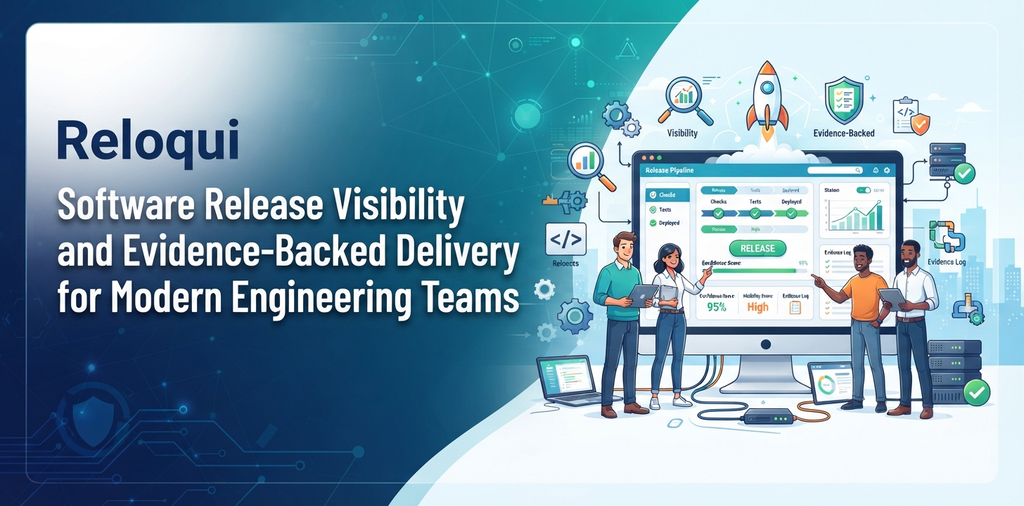
Reloqui is built around this model as a release intelligence and evidence-reconciliation platform. Rather than replacing your existing engineering tools, it ingests signals from them and computes an explainable release record with supporting evidence, confidence breakdowns, governance gates, and audience-specific notes.
How Release Evidence Is Connected Across Engineering Systems
Reliable release visibility depends on linking events across the systems teams already use every day. Each system provides a different piece of the puzzle.
- Source-control repositories: Record branches, commits, tags, and history rewrites.
- Pull requests and code changes: Show who reviewed and merged code, along with commit diffs and metadata.
- Issue-tracking systems: Capture why a change was requested, its scope, and links to work items.
- CI/CD pipelines: Record when builds and deployment jobs ran and whether they passed or failed.
- Build records: Connect source revisions to test outcomes and execution timestamps.
- Artifact registries: Store versioned packages or container images and help verify what was built.
- Deployment environments: Show where releases were rolled out, such as staging, canary, or production.
- Infrastructure changes: Capture provisioning or configuration updates, such as Terraform runs, alongside application releases.
- Incident information: Connect production incidents to release windows so teams can investigate context quickly.
A Practical Trace Across Systems
Suppose a team ships billing-api v1.8.0. A developer opens a pull request #314 to fix a webhook retry bug linked to issue BILL-109. After review, the pull request merges to the release branch, CI runs tests and builds the container image billing-api:1.8.0, the image lands in the artifact registry, a deployment pipeline rolls it out to production, and an alert fires ten minutes later.
When these records are connected, an engineer can trace that alert back to the deployment, the exact image digest, the CI build, the merged pull request, and the issue BILL-109 in minutes. Teams practicing GitHub Jira release tracking gain clear context when code changes in GitHub connect directly to work items in Jira instead of relying on manual cross-checking.
CI/CD pipeline flow from code to deployment. Source: ByteByteGo
Understanding Release Reconciliation and Confidence Scoring
Raw events from separate tools rarely line up cleanly on their own. Webhooks can arrive late, clocks can drift slightly, hotfixes can be backported, and branches can be rewritten.
Reloqui’s 11-Stage Reconciliation Process
Reloqui uses an advertised 11-stage, deterministic-first reconciliation engine designed to turn raw delivery signals into a structured release view. Rather than relying on guesswork first, it applies deterministic rules and evidence checks across stages to associate signals with a service, version, and release window.
Key parts of this reconciliation flow include:
- Evidence collection: Ingesting typed events from connected tools via webhooks and polling, while archiving raw payloads alongside normalized events.
- Change classification: Categorizing items such as included changes, heuristic matches, excluded items, uncertain items, or orphaned changes.
- Version association: Bounding the release window using baselines, tags, and version metadata so changes map to the right release.
- Missing or orphaned changes: Flagging unattributed commits or changes that lack expected links so they do not silently disappear.
- Build and artifact evidence: Checking build status and artifact availability tied to the release scope.
- Deployment confirmation: Linking deployment events and environment targets to the release record.
- Force-push activity: Detecting history rewrites or backports so invalidated commits do not stay quietly trusted.
- Confidence scoring: Computing a score and tier from weighted evidence signals and deductions.
- Exceptions and uncertainty: Surfacing gaps, ambiguities, and manual overrides with clear reasons.
Confidence Scores Are Signals, Not Guarantees
A release confidence score summarizes how much supporting evidence aligns with a release—and whether deductions such as orphaned changes, rollbacks, or force-pushes lowered that trust. It helps teams spot weak spots before shipping.
However, a high confidence score does not guarantee that software is bug-free, fast, or secure. Tests can miss edge cases, dependencies can fail at runtime, and vulnerabilities can exist in code that passed every check.
Why Uncertainty Must Stay Visible
Hiding missing links or conflicting signals behind a single “ready” badge creates false assurance. If a pull request has no linked issue, a deployment record is missing for an environment, or a late force-push changes history, surfacing that uncertainty lets engineers inspect the exact reason and decide how to proceed.
Improving Release Readiness Before Production Deployment
Release readiness is more than a checklist of green boxes. Before promoting a change to production, teams benefit from reviewing several practical areas:
- Evidence completeness: Are expected pull requests, issues, builds, and deployment records present for the version?
- Build status: Did the relevant builds succeed for the exact revision being released?
- Artifact availability: Is the expected build artifact present and matched to the release?
- Deployment records: Are prior environment steps, such as staging or canary rollouts, accounted for?
- Unresolved changes: Are there orphaned changes, uncertain matches, or unreviewed exceptions?
- Policy requirements: Does the release meet team rules for minimum confidence or required sign-offs?
- Release exceptions: If a team waives a check, is the reason recorded clearly?
Using release readiness assessment software can help organize these checks in one place and highlight missing items early. Even so, software cannot replace engineering judgment. A release with complete metadata can still carry high operational risk, while a well-understood hotfix during an outage may warrant a conscious, documented exception.
Building Consistent Release Approval and Governance Practices
As organizations grow, informal “looks good in chat” approvals become hard to defend during incidents or audits. Clear governance turns release decisions into repeatable practices.
Effective release governance often includes:
- Approval responsibilities: Defining who can approve releases for a service or environment, including rules like multi-approver sign-off or preventing self-approval.
- Confidence thresholds: Setting minimum evidence confidence levels before a release can move forward without extra review.
- Publishing policies: Defining rules for when a release can be published or promoted.
- Freeze windows: Blocking routine releases during high-risk periods—such as peak sales events or major migrations—unless an approved waiver applies.
- Exception handling: Recording when a rule or freeze is bypassed, why it happened, and who approved it.
- Approval history: Keeping a clear log of who approved or rejected a release and when.
With release approval workflow software, teams can enforce gates consistently while keeping a clear record of decisions. Reloqui also supports features such as automatic approval suspension if late evidence—like a force-push—drops a release’s confidence score.
Snapshots, Audit Trails, and Compliance Boundaries
An immutable release snapshot preserves what the evidence, gate results, and approval state looked like at publish time. Paired with a software release audit trail, it helps teams answer historical questions without reconstructing events from scratch.
At the same time, a release audit trail is not the same thing as a formal security audit, regulatory certification, or independent compliance attestation. Release records document delivery evidence and internal approvals; broader organizational compliance still depends on security controls, policies, and external assessments.
Creating Better Release Notes and Documentation
Writing release notes by hand is slow and error-prone. Engineers often forget small fixes merged late in the cycle, while product and support teams struggle to translate technical commit messages into plain language.
An automated release notes generator can draft summaries directly from reconciled release evidence, linking claims back to pull requests, issues, and deployments. That saves time and reduces forgotten changes.
Tailoring Summaries to Different Readers
One release matters to different people in different ways:
- Engineering teams: Need technical details, pull requests, commit context, breaking changes, and dependency shifts.
- Operations teams: Need deployed versions, environment targets, infrastructure changes, rollbacks, and incident context.
- Product managers: Need user-facing features, bug fixes, and completed scope tied to issues.
- Executives: Need high-level delivery progress, release health, and cross-service trends without raw log noise.
- Compliance professionals: Need traceable links to evidence, approvals, exceptions, and immutable release snapshots.
Why Human Review Still Matters
Automated notes are only as good as the underlying evidence and commit titles. If a pull request has a vague title, a ticket was mislabeled, or a workaround needs business context, human review is still essential before sharing notes externally or relying on them for decisions.
Understanding Deployment Activity Across Environments
Tracking a release across environments helps teams answer where code actually lives right now. A service might be at v3.1.0 in development, v3.0.4 in staging, and v3.0.2 in production.
A CI/CD deployment tracking dashboard gives teams a central view of deployments across environments and services. It helps spot stuck rollouts, failed deployments, or drift between environments.
Three Distinct Views of Delivery
Teams get clearer answers when they separate three related concepts:
- Pipeline monitoring: Tracks whether CI/CD jobs and workflows execute and succeed.
- Deployment tracking: Tracks whether and where a version or artifact was deployed across environments.
- Release-level evidence reconciliation: Connects code changes, issues, builds, artifacts, deployments, and exceptions into a single explainable record for a release version.
You can have healthy pipeline runs and even a recorded deployment, yet still lack full release-level evidence if changes were unlinked or history changed after the build.
Improving Change Traceability and Service Impact Analysis
In distributed systems, a change in one service can affect upstream callers, downstream consumers, shared data stores, or underlying cloud resources. Good software release change traceability connects a release not only to its code and tickets, but also to the services and infrastructure around it.
A service catalog establishes clear ownership, tiers, and metadata for services, components, and resources. When combined with a dependency graph, teams can visualize relationships between services and trace potential blast radius before or after a release. Release comparisons and manifest or dependency diffs further show what changed between versions.dependency graph showing component relationships. Source: Medium
Practical Limits of Dependency Mapping
Dependency graphs are valuable for investigation and planning, but they have real limits. Dynamic runtime calls, undocumented integrations, shared queues, and configuration drift can create dependencies that static maps do not show. Dependency analysis helps narrow where to look—it cannot predict every production failure.
Choosing Between Self-Hosted and Managed Deployment
Once a team sees value in centralized release intelligence, a practical question follows: should we run it on our own infrastructure or use a managed option?
Self-Hosted Deployment
With self-hosted release management software, your team runs the application and data store inside your own environment. According to Reloqui’s pricing and documentation, Reloqui offers a free self-hosted option with its full feature set, where you manage installation, upgrades, backups, and disaster recovery yourself.
Self-hosting gives strong control over where data is stored and how network access is configured. The trade-off is ongoing operational effort: your team handles updates, monitoring, backups, and troubleshooting.
Managed Deployment
With a managed option—such as Reloqui’s hosted/enterprise offering—the vendor operates the platform, typically providing dedicated or isolated infrastructure, uptime SLA? terms, managed backups and disaster recovery, and operational support.
Managed hosting reduces day-to-day maintenance burden on internal platform engineers. The trade-offs include subscription or enterprise scoping costs and trusting an external provider to run the service according to agreed terms.
| Factor | Self-Hosted Approach | Managed Approach |
|---|---|---|
| Infrastructure ownership | Run on your own servers or cloud accounts | Operated by the provider, often with dedicated/isolated setup |
| Data control | Kept directly inside your environment | Governed by provider hosting architecture and agreements |
| Maintenance & upgrades | Handled by your internal team | Handled by the provider |
| Backups & disaster recovery | Your team configures and tests them | Managed by the provider |
| Support & SLAs | Relies on internal skill, docs, or community channels | Includes vendor support and formal service commitments |
| Team effort & cost | Lower licensing cost, higher internal ops time | Higher service cost, lower internal ops overhead |
Where Reloqui Fits Into an Existing Engineering Toolchain
A release intelligence platform works best as a connective layer rather than a replacement for core engineering tools. Developers still write code in Git, plan work in Jira or Linear, run builds and deployments in CI/CD, store packages in registries, and manage infrastructure with tools like Terraform.
Reloqui is designed to sit alongside those systems. Its advertised capabilities include twelve connector types (covering source control, issue trackers, CI/CD, artifact registries, Terraform, incidents, and more), an 11-stage reconciliation engine, explainable confidence scoring, policy gates and approval workflows, five audience-specific release note views, service catalog and dependency graphs, and a REST API?.
Because it reads and reconciles signals across existing tools, teams can adopt it incrementally—starting with a single repository or service before expanding across more of their delivery estate.
Practical Considerations Before Adopting a Release Intelligence Solution
Before rolling out any release intelligence tool, engineering and operations leaders should evaluate how it fits their actual workflows.
- Connector compatibility: Does it support your source control, issue tracker, CI/CD, registry, Terraform, and incident tools?
- Evidence completeness: How does it behave when a tool is not connected or an event is delayed?
- Accuracy and explainability: Can engineers see why an item was included, flagged as an orphan, or penalized?
- Deployment coverage: Does it track releases across all relevant environments and service types?
- Release approval requirements: Does it support your review rules, freeze windows, and exception records?
- Audit record retention: Are release snapshots and approval histories preserved for as long as your team needs?
- API and automation needs: Can you query data or integrate workflows via an API and webhooks?
- Hosting preferences: Do you prefer self-hosting or a managed deployment model?
- Security and access controls: Does it support role-based access and single sign-on needs?
- Operational support: What support options and documentation are available when issues arise?
- Ease of adoption: Can teams start small—such as testing with a demo workspace or one service—without disrupting daily work?
Final Thoughts on More Reliable Software Releases
A successful deployment pipeline shows that automation ran; it does not automatically prove what changed, why it changed, who approved it, or where evidence is missing. When release information stays scattered across disconnected tools, teams spend valuable time piecing together history during high-stakes moments.
Connecting evidence across engineering systems, keeping uncertainty visible, using clear governance and audit records, and tailoring release notes to each audience all help make software delivery more dependable. For organizations evaluating this category, Reloqui offers an evidence-backed approach worth reviewing alongside existing DevOps workflows.