Rapid deployment cadences power competitive advantage, yet hasty release cycles regularly inject critical vulnerabilities into production environments. Development groups push updates constantly, while traditional governance teams struggle to audit complex codebases manually before launch deadlines. Consequently, exposed credentials, unvetted open-source packages, and misconfigured infrastructure components create severe vulnerabilities across digital platforms.
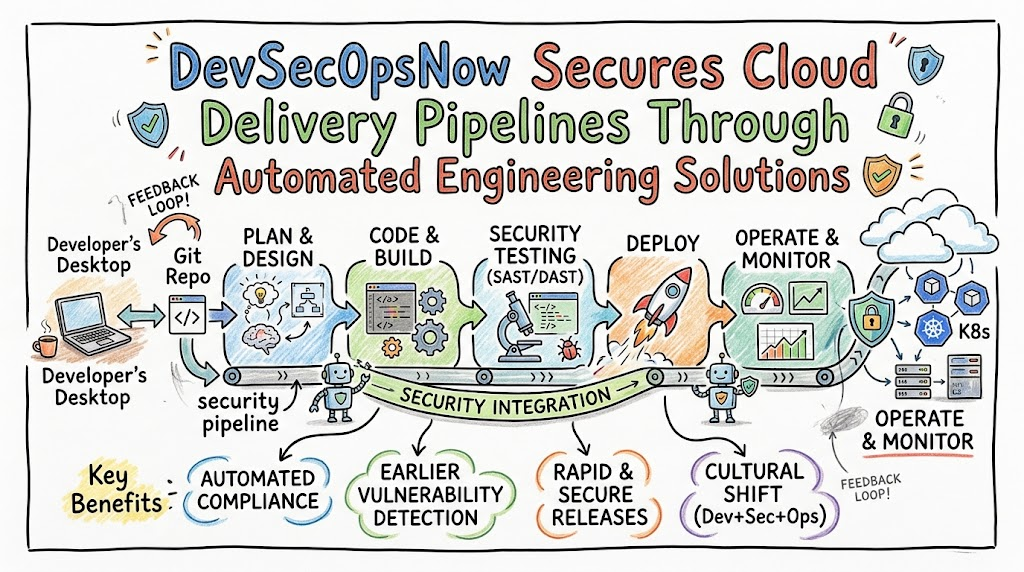
DevSecOpsNow solves this operational bottleneck by integrating automated security controls directly into continuous deployment pipelines. Therefore, developers spot and fix security flaws during everyday coding tasks. By aligning engineering teams, automated scanning platforms, and live cloud guardrails, companies protect their software ecosystems while accelerating release momentum.
Exploring the DevSecOpsNow Ecosystem
DevSecOpsNow operates as an engineering partner and specialized advisory platform that integrates continuous security validation into existing delivery workflows. The framework guides developers, platform engineers, and security analysts toward shared delivery standards and automated guardrails.
Rather than running periodic manual audits that stall progress, DevSecOpsNow embeds automated analysis across codebases, artifact registries, orchestration engines, and multi-cloud environments. Consequently, engineering organizations maintain complete visibility over their security posture while continuously delivering production-ready software.
The Business Case for Shifting Security Left
Legacy security reviews take place at the end of delivery cycles, causing costly release delays and developer frustration. Furthermore, fixing architectural flaws and security defects in production costs up to thirty times more than resolving them during early development sprints.
+-----------------------------------------------------------------------------------+
|                        DELIVERY SPEED AND RISK COMPARISON                         |
+--------------------------+----------------------------+---------------------------+
| Operational Dimension    | Traditional Manual Audit   | DevSecOpsNow Automation   |
+--------------------------+----------------------------+---------------------------+
| Review Schedule          | End-of-cycle manual check  | Automated pipeline run    |
| Feedback Turnaround      | Weeks of waiting           | Instant pull request alert|
| Remediation Ownership    | Isolated compliance team   | Cross-functional squads   |
| Deployment Reliability   | Risky batch updates        | Continuous, safe delivery |
+--------------------------+----------------------------+---------------------------+
When software teams run automated testing routines inside their pipelines, defect volumes drop by more than fifty percent during initial builds. Moreover, automated policy validation guarantees compliance across cloud environments without requiring slow, bureaucratic documentation approvals.
Core Architecture of an Automated Security Program
A resilient engineering security framework combines three essential components: automated tooling, standardized pipelines, and clear team metrics.
+-----------------------------------------------------------------------------------+
|                       PIPELINE SCANNING TOOLCHAIN MATRIX                          |
+-------------------------+----------------------------------+----------------------+
| Scanning Layer          | Primary Protection Goal          | Industry Solutions   |
+-------------------------+----------------------------------+----------------------+
| Source Code (SAST)      | Intercept vulnerable logic       | SonarQube, Semgrep   |
| Open Source (SCA)       | Remove compromised dependencies  | Snyk, Trivy          |
| Web Applications (DAST) | Identify runtime attack vectors  | OWASP ZAP, Burp Suite|
| Infrastructure as Code  | Block cloud misconfigurations    | Checkov, tfsec       |
| Credential Scanning     | Stop hardcoded API keys          | GitGuardian, TruffleH|
+-------------------------+----------------------------------+----------------------+
First, connect scanner plugins directly into pull request workflows so engineers receive actionable remediation guidance instantly. Next, define clear vulnerability classification matrices to eliminate confusion regarding risk severity and remediation deadlines. Finally, track key delivery metrics such as mean time to remediate and build failure rates to maintain continuous operational improvement.
Hardening Cloud and Kubernetes Environments
Cloud infrastructure deploys dynamically through code, requiring teams to secure infrastructure code before provisioning live cloud resources. Specialized Cloud Security Consulting Services help engineering groups protect multi-cloud architectures across identity configurations, runtime workloads, and data storage boundaries.
Furthermore, cloud engineers must inspect Terraform, OpenTofu, and CloudFormation blueprints using automated policy engines. Consequently, infrastructure teams block unsecured storage buckets and excessive access permissions before cloud providers launch the assets. Dedicated Kubernetes Security Consulting Services reinforce container platforms by enforcing admission controllers, mutual TLS communication, and granular role-based access policies.
Securing the Software Supply Chain
External open-source libraries power modern enterprise applications, creating severe exposure to upstream package tampering and malicious dependencies. Therefore, development groups utilize dedicated Software Supply Chain Security Services to verify external dependencies, base container images, and continuous delivery systems.
Engineering squads must generate cryptographic Software Bills of Materials for every production build. In addition, signing build artifacts with Cosign verifies source provenance and prevents attackers from injecting malicious code into container registries. By establishing strict control over third-party components, companies prevent upstream library compromises from impacting production systems.
End-to-End Security Testing Across the SDLC
Maintaining continuous system verification requires a layered testing strategy across every phase of the software delivery lifecycle.
- Code Creation: Developers leverage IDE plugins and local pre-commit hooks to capture insecure syntax during development.
- Continuous Integration: Automated build pipelines execute software composition analysis and container scans to block vulnerable packages.
- Staging Verification: Automated runners launch dynamic application security tests and API checks against running instances.
- Runtime Validation: Thorough Penetration Testing Services identify complex business logic flaws and multi-step exploitation vectors across live systems before adversaries exploit them.
Diagnosing Maturity via DevSecOps Assessment Services
Organizations frequently struggle to determine where to begin their security modernization initiatives. Professional DevSecOps Assessment Services evaluate current development workflows, operational maturity, and tooling coverage against proven industry benchmarks.
During this diagnostic evaluation, specialists inspect delivery pipelines, access control policies, and incident response procedures across engineering departments. Subsequently, leaders receive a prioritized transformation roadmap that addresses high-risk vulnerabilities first. This diagnostic baseline ensures that subsequent tooling investments directly address real security risks.
Expert Guidance With DevSecOps Consulting Services
Achieving continuous delivery while satisfying strict compliance mandates requires deliberate architectural planning. Engaging DevSecOps Consulting Services enables organizations to design zero-trust platforms, build scalable automated pipelines, and establish shared security guardrails.
Advisors collaborate closely with engineering leaders to select appropriate tools, define release policies, and structure governance models. Additionally, this advisory support aligns security strategies with business goals, ensuring technology investments enhance engineering speed rather than creating bureaucratic friction.
Pipeline Automation Through DevSecOps Implementation Services
Adopting security tooling often triggers excessive alert fatigue when pipelines lack proper tuning. Hands-on DevSecOps Implementation Services embed static analysis, dynamic scanning, and secret detection tools directly into continuous integration workflows.
Engineers configure automated quality gates that break builds only for critical, exploitable vulnerabilities, keeping developer workflows smooth. Furthermore, specialists build automated vulnerability management dashboards that centralize findings and assign tickets automatically to responsible engineers. This operational structure transforms security from a theoretical goal into an automated reality.
Continuous Coverage via DevSecOps Managed Services
Many organizations experience severe shortages of in-house security automation professionals. Dedicated DevSecOps Managed Services supply continuous operational support, pipeline maintenance, policy tuning, and proactive vulnerability triage.
Specialists monitor scan outputs, eliminate false alerts, and assist product developers with fast remediation guidance. Moreover, the team updates scanning rules and cloud security policies whenever new threat vectors emerge across the software industry. This ongoing support ensures consistent enterprise protection without overloading internal development teams.
Technical Upskilling via DevSecOps Training
Individual practitioners require practical, hands-on experience to secure continuous integration systems and container clusters effectively. Comprehensive DevSecOps Training programs teach developers and system administrators how to write secure code, automate pipeline checks, and configure runtime defenses.
Participants gain direct practice securing container registries, configuring runtime policies with Falco, and securing infrastructure deployments. Consequently, developers and DevOps practitioners expand their technical capabilities, making them valuable contributors to modern cloud native engineering teams.
Organizational Scale With Corporate DevSecOps Training
Building organization-wide compliance requires cross-functional alignment across development, infrastructure, testing, and operations units. Specialized Corporate DevSecOps Training programs upskill enterprise engineering departments through customized, interactive laboratory environments.
+-----------------------------------------------------------------------------------+
|                        ENTERPRISE TEAM TRAINING MATRIX                            |
+----------------------+---------------------------------+--------------------------+
| Engineering Role     | Primary Learning Objectives     | Core Hands-On Labs       |
+----------------------+---------------------------------+--------------------------+
| Software Developers  | Secure coding, SAST, SCA triage | IDE tools, pull requests |
| DevOps Engineers     | Pipeline security, secret mgmt  | CI/CD gates, vault setup |
| Cloud Engineers      | Cloud posture, IaC policy code  | Terraform, admission ctrl|
| Security Analysts    | Threat modeling, vulnerability  | Centralized triage, DAST |
+----------------------+---------------------------------+--------------------------+
These intensive simulation workshops expose teams to realistic attack scenarios and broken deployment pipelines. As a result, engineers learn to resolve critical defects cooperatively without stalling release schedules.
Avoiding Pitfalls in Pipeline Security Adoption
Organizations frequently encounter friction when rolling out automated pipeline controls without adequate preparation.
First, activating all scanner checks simultaneously floods engineers with low-priority warnings. This alert overload leads developers to disregard critical notifications.
Second, organizations purchase complex tools without providing proper workflow guidance. Without hands-on coaching, defect backlogs expand steadily despite high software expenditures. Finally, isolating security personnel from product teams recreates organizational silos instead of fostering shared accountability.
Fostering a Collaborative Engineering Culture
Long-term security success depends on strong team collaboration, mutual trust, and practical enablement. Organizations should establish Security Champions programs by placing trained software engineers within individual product squads.
+-----------------------------------------------------------------------------------+
|                      CULTURAL MATURITY EVOLUTION TIMELINE                         |
+---------------------+-------------------------------+-----------------------------+
| Cultural Phase      | Key Operational Behaviors     | Primary Milestone Outcome   |
+---------------------+-------------------------------+-----------------------------+
| Phase 1: Awareness  | Baseline security education   | Security champions selected |
| Phase 2: Automation | CI/CD testing integration     | Automated pull request scans|
| Phase 3: Ownership  | Squads manage triage backlogs | Low MTTR and minimal friction|
+---------------------+-------------------------------+-----------------------------+
Additionally, managers should recognize squads that resolve vulnerabilities quickly and maintain clean codebases. When leaders praise proactive remediation instead of assigning blame, developers willingly embrace continuous security practices.
Leveraging DevSecOpsNow for Enterprise Transformation
DevSecOpsNow operates as a specialized engineering partner for companies modernizing their software delivery pipelines. Through consulting, managed operations, and hands-on corporate education, the platform solves security challenges for modern engineering teams.
Whether an organization needs an initial maturity assessment, managed Kubernetes protection, or customized pipeline integration, DevSecOpsNow provides practical technical guidance. This comprehensive support model allows businesses to deploy cloud applications with confidence.
Step-by-Step Security Implementation Blueprint
Transitioning toward automated pipeline validation requires a methodical, step-by-step roadmap.
+-----------------------------------------------------------------------------------+
|                        STEP-BY-STEP ADOPTION BLUEPRINT                            |
+-------------------+-----------------------------------+---------------------------+
| Execution Step    | Tactical Implementation Tasks     | Deliverable / Artifact    |
+-------------------+-----------------------------------+---------------------------+
| Step 1: Discover  | Map software supply chains        | Complete tool & asset map |
| Step 2: Integrate | Embed SAST, SCA in pull requests  | Automated scan pipelines  |
| Step 3: Hardening | Enforce IaC rules & policy engines| Compliant cloud templates |
| Step 4: Governance| Deploy runtime monitors & metrics | Unified risk dashboards   |
+-------------------+-----------------------------------+---------------------------+
First, catalog every source code repository, delivery pipeline, and cloud workload across the business. Next, embed automated static analysis and open-source dependency scanners into standard pull request reviews.
After establishing automated pipelines, enforce infrastructure-as-code policies and container admission controllers across production clusters. Finally, create unified dashboards to track mean time to remediate and maintain continuous governance standards.
Frequently Asked Questions About DevSecOpsNow
- Which core capabilities does DevSecOpsNow deliver to engineering organizations?DevSecOpsNow delivers technical consulting, automated pipeline integration, managed security operations, cloud hardening, container security, penetration testing, and corporate training programs.
- How do automated pipeline checks accelerate release cycles?Automated pipeline scanners check code changes during pull requests, allowing developers to spot and remediate vulnerabilities within minutes instead of waiting for manual reviews.
- Why do teams prioritize software composition analysis in modern development?Software composition analysis inspects third-party open-source packages, uncovering unpatched vulnerabilities and outdated libraries before attackers can exploit them in production environments.
- What benefits does policy-as-code provide for cloud infrastructure?Policy-as-code engines validate infrastructure scripts automatically, stopping misconfigured network routes and unencrypted data volumes before cloud providers deploy them.
- How does corporate team training strengthen organizational security?Corporate training equips developers and operations engineers with hands-on skills to triage vulnerabilities, configure scanners, and fix security flaws directly within daily workflows.
- What distinguishes static analysis from dynamic application security testing?Static testing inspects source code for security vulnerabilities without executing the software, whereas dynamic testing evaluates running applications from an external perspective.
- Why should companies conduct penetration testing alongside automated scanning?Penetration testing simulates manual attack methods, exposing complex logic flaws and chained vulnerabilities that automated scanning tools cannot detect.
- How do managed services resolve internal technical skill shortages?Managed services supply dedicated security engineers who maintain testing tools, filter false positives, update policies, and guide remediation efforts for internal teams.
- What responsibilities do security champions handle within development teams?Security champions serve as internal peer advocates within development squads, promoting secure coding standards and assisting teammates with fast vulnerability resolution.
- How does an assessment accelerate overall pipeline maturity?An assessment evaluates existing workflows, measures tooling effectiveness, and delivers a clear roadmap, ensuring teams allocate resources to high-impact security improvements first.
Building Resilient Engineering Workflows for Tomorrow
Embedding automated security controls directly into delivery pipelines enables companies to protect core digital assets without slowing down release schedules. Modern businesses that discard slow manual approvals in favor of proactive verification construct adaptable, hardened software environments.
By unifying automated pipeline scanning, cloud hardening, software supply chain controls, and targeted team training, engineering organizations secure their platforms end to end. Partnering with seasoned practitioners ensures that your teams build, deploy, and scale high-performance software with complete confidence.