Introduction
Organizations often face severe cybersecurity incidents when software delivery pipelines prioritize deployment speed over defensive verification. Shifting security evaluation directly into early development stages eliminates these hazardous delivery bottlenecks. When software teams integrate automated vulnerability scanners into their repositories, they protect digital assets and avoid stressful production repairs.
Gaining genuine engineering proficiency requires continuous hands-on experimentation with production-ready security tools. Practical cloud sandbox exercises allow practitioners to configure automated pipeline scanners, enforce programmable guardrails, and harden runtime containers against live threats. This comprehensive technical guide details the modern architectural standards, defensive strategies, and structured training programs that high-performing organizations use to build resilient software platforms.
Core Components of a DevSecOps Program
Establishing a resilient engineering baseline requires technology teams to deploy automated verification checks across every phase of the application lifecycle:
- Static Code Analyzers: Scan source code repositories continuously to discover logical flaws, insecure syntax, and algorithmic defects before runtime execution.
- Third-Party Dependency Checkers: Audit software packages to pinpoint outdated libraries, unmaintained codebases, and documented CVE entries.
- Dynamic Black-Box Scanners: Probe live staging environments with automated attack payloads to expose network misconfigurations and interface flaws.
- Central Credential Managers: Issue dynamic, short-lived API tokens and certificates to keep sensitive credentials out of source repositories.
- Infrastructure Template Evaluators: Analyze declarative configuration files against security baselines before cloud tools provision live resources.
Security in CI/CD Pipelines
Automated integration pipelines serve as the primary enforcement highway for modern high-velocity delivery teams. By integrating non-blocking automated scanners into everyday build stages, engineers receive instant feedback whenever they push code changes.
| Deployment Phase | Core Security Objective | Practical Tooling Baseline |
|---|---|---|
| Code Push | Static code analysis and secret token detection | Semgrep, SonarQube, Gitleaks |
| Artifact Build | Container image vulnerability and license audits | Trivy, Grype |
| Integration Staging | Automated web application testing and API probing | OWASP ZAP, Postman Security |
| Production Release | Continuous policy validation and admission gates | Open Policy Agent, HashiCorp Vault |
Standardizing these automated gates across development workflows enables teams to eliminate exploitable weaknesses while maintaining uninterrupted release momentum.
What Is DevSecOps?
Old-school delivery patterns isolated security reviews into slow, post-release inspection phases. DevSecOps modernizes this mindset by uniting development, operations, and security specialists into a single collaborative team.
Rather than slowing releases down with manual reviews, teams deliver automated guardrails as internal platform services. Developers write resilient code, operations personnel maintain hardened platforms, and security engineers design automated policies. This shared ownership model protects enterprise assets without compromising feature velocity.
Kubernetes Security
Orchestration clusters present complex network perimeters that require layered, defense-in-depth security strategies. Protecting containerized environments requires strict identity controls, tight network isolation, and continuous kernel-level observability.
+-------------------------------------------------------------+
|                 CLUSTER DEFENSE ARCHITECTURE                |
+-------------------------------------------------------------+
|  [ Identity & RBAC ] --> Least-Privilege Roles & Tokens     |
|  [ Admission Gate  ] --> Automated OPA & Kyverno Validation |
|  [ Pod Hardening   ] --> Calico Network Rules & Non-Root    |
|  [ Runtime Shield  ] --> Real-Time Falco Event Monitoring   |
+-------------------------------------------------------------+
Furthermore, specialized Kubernetes Security Training equips engineers with the tactical skills needed to isolate anomalous pods, enforce mutual TLS communication, and prevent container breakout techniques.
Policy as Code
Static spreadsheets and traditional compliance checklists cannot keep pace with modern cloud infrastructure. Policy as Code bridges this gap by declaring governance standards and security policies directly inside version-controlled configuration files.
Policy engines evaluate resource definitions programmatically during automated pull request reviews. For example, a policy rule can automatically block any pod deployment that attempts to mount sensitive host system paths. This automated evaluation ensures consistent governance across every target cloud environment.
Why DevSecOps Matters for Modern Engineering Teams
Modern microservices present expansive attack surfaces that traditional network perimeter tools cannot defend. Industry research confirms that resolving security defects in production costs drastically more than fixing issues during early design phases.
Automated pipelines remove manual approval roadblocks while defending corporate credibility. Building real-time feedback loops helps engineers spot exposed API keys and permissive configurations immediately. Consequently, companies sustain accelerated release schedules while maintaining a dependable, defensible cloud infrastructure.
Cloud Security and DevSecOps
Dynamic cloud environments require continuous posture evaluation rather than static quarterly reviews. Platform engineering teams must enforce least-privilege identity access management while continuously tracking asset drift across diverse cloud accounts.
Deploying automated configuration checkers allows teams to measure cloud resource alignments against CIS Benchmarks consistently. This continuous validation loop ensures rapid application delivery without leaving sensitive cloud storage endpoints or management interfaces open to the internet.
Vulnerability Management
Effective vulnerability management prioritizes real exploitable risk over raw alert volume. Modern applications depend on extensive open-source dependencies, making it essential for scanning systems to identify reachable code paths rather than flooding teams with theoretical warnings.
Engineering leaders must implement direct operational workflows to remediate high-severity findings quickly. Automating regression testing inside staging environments allows developers to apply critical patches without breaking core business functionalities.
Compliance Automation
Manual compliance audits create severe administrative drag through repetitive documentation reviews and disconnected spreadsheets. In contrast, automated governance tools continuously inspect live cloud environments against frameworks such as SOC 2, ISO 27001, and PCI-DSS.
Every infrastructure update generates immutable log records automatically. As a result, engineering groups spend significantly less time gathering audit artifacts while leadership maintains real-time evidence of continuous compliance.
Building a DevSecOps Culture
Adopting modern scanning tools delivers little value if engineering departments operate inside disconnected functional silos. Achieving long-term security maturity requires open communication, shared deployment metrics, and an active Security Champions program.
Security champions act as embedded subject matter experts within development squads, bridging domain knowledge gaps and mentoring peers. Rewarding proactive security design patterns encourages engineers to ship innovative features while maintaining platform resilience.
Common DevSecOps Mistakes
Organizations often hit avoidable roadblocks when rolling out automated security programs. Watching out for these common implementation errors protects digital transformation roadmaps:
- Deploying Default Scanner Configurations: Flooding developers with noisy false alarms causes alert fatigue and delays genuine fixes.
- Failing Pipelines Too Aggressively: Breaking build workflows before teaching teams how to resolve findings stalls project delivery.
- Leaving Repository Credentials Exposed: Storing unencrypted credentials inside source code histories creates easy targets for attackers.
- Treating Technical Education as Optional: Denying staff structured skill development leads to tool misconfigurations and patchy security coverage.
How DevSecOps Training Can Help
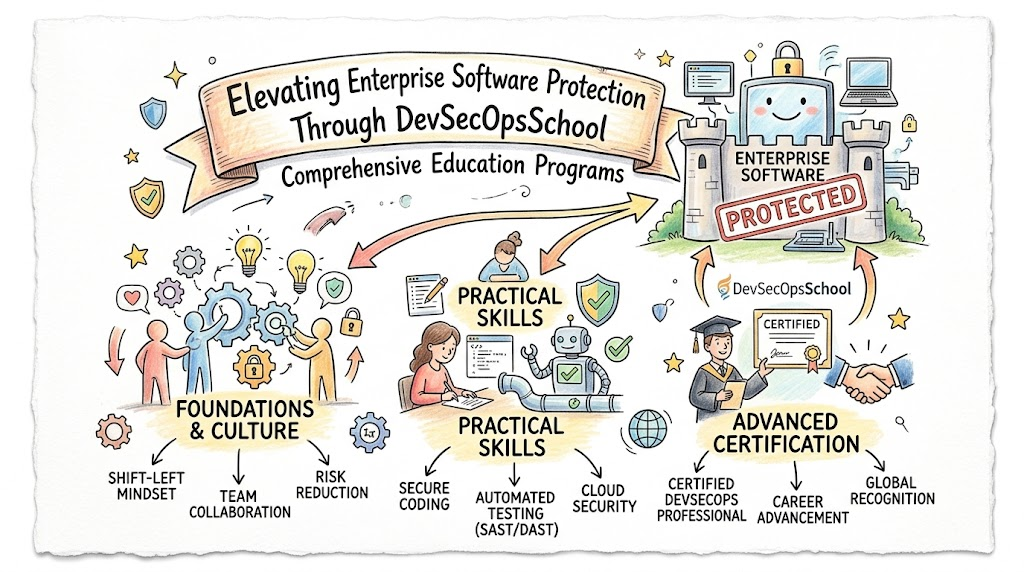
Mastering complex modern security architectures requires practical, mentor-led guidance from seasoned industry professionals. Enrolling in a structured DevSecOps Course bridges conceptual principles and enterprise implementations through realistic lab scenarios.
Engineers learn how to build automated pipelines, write custom detection policies, and harden live container clusters. Consequently, practical DevSecOps Training accelerates team proficiency, lowers operational risk, and empowers engineers to architect defensible enterprise platforms.
Who Can Benefit From DevSecOps Learning?
Automated security skills offer substantial career advantages across diverse technical functions:
- Software Engineers: Build defensive programming capabilities, remediate package vulnerabilities, and implement automated security checks.
- DevOps Specialists: Automate security within deployment workflows, manage credential distribution, and test infrastructure code.
- Cybersecurity Analysts: Shift from manual penetration testing to orchestrating automated security scanners across cloud environments.
- Platform Architects: Design resilient cloud infrastructure models while driving organization-wide security modernization.
DevSecOps Online Training
Distributed technology teams need practical educational programs that accommodate demanding production schedules. Comprehensive DevSecOps Online Training provides practitioners with real-time lectures, interactive environments, and dedicated mentor guidance from any location.
Furthermore, remote laboratory platforms replicate intricate enterprise attack vectors, including container privilege escalations and pipeline intrusions. Learners analyze these incidents within sandboxed platforms, acquiring operational capabilities that translate directly to enterprise workloads.
DevSecOps Training in India
India serves as a primary center for global digital innovation, cloud engineering, and enterprise application modernization. As technology organizations migrate legacy workloads to cloud-native platforms, demand for DevSecOps Training in India continues to surge across enterprises and individual engineers alike.
Participating in focused programs equips engineering teams with modern development methodologies aligned with international standards. These educational paths ensure engineers handle complex compliance mandates while optimizing continuous integration workflows.
DevSecOps Engineer Certification
Validating technical expertise through industry-recognized certifications establishes verifiable competence in a competitive industry. Completing an official DevSecOps Engineer Certification confirms an engineer’s ability to deploy automated defense pipelines and secure enterprise cloud assets.
Candidates demonstrate practical mastery over static code evaluators, centralized secrets management, and dynamic admission webhooks. This credential confirms that the specialist can design and execute security initiatives immediately upon hire.
Becoming a Certified DevSecOps Professional
Achieving the status of a Certified DevSecOps Professional proves complete proficiency in managing enterprise-scale security platforms. This professional milestone certifies an engineer’s capability to architect comprehensive defense strategies across multi-cloud footprints and orchestration engines.
Certified specialists successfully translate organizational compliance targets into automated technical guardrails. They supervise automation initiatives, train technical staff, and construct defensible systems capable of defeating sophisticated threat vectors.
Choosing the Right DevSecOps Learning Program
Selecting an effective professional development curriculum requires evaluating current capabilities against career targets:
| Career Target | Optimal Learning Route | Key Technical Focus |
|---|---|---|
| Enterprise Modernization | Corporate DevSecOps Training | Team alignment, pipeline baselines, culture |
| Domain Specialization | DevSecOps Certification Training | SAST/DAST automation, policy as code, cloud security |
| Cluster Defense Mastery | Kubernetes Security Training | RBAC, network policies, runtime monitoring, admission control |
| Leadership Preparation | DevSecOps Certification programs | End-to-end architecture, compliance auditing, toolchain mastery |
Selecting programs that focus on extensive sandbox experimentation ensures that every study module builds concrete technical competence.
DevSecOpsSchool’s Practical Learning Approach
Developing production-ready engineering skills requires active hands-on experimentation rather than passive video consumption. DevSecOpsSchool programs focus on lab-centric education where students construct, test, break, and remediate realistic enterprise pipelines.
Engineers configure automated testing systems using industry tooling such as Jenkins, GitHub Actions, SonarQube, Trivy, and HashiCorp Vault. In addition, organizations benefit from targeted Corporate DevSecOps Training customized to their exact technology stacks, accelerating organizational security maturity.
Frequently Asked Questions About DevSecOpsSchool
- Which foundational technical capabilities should candidates bring to these modules?Candidates benefit from an operational grasp of Linux systems, shell scripting, container fundamentals, and common continuous integration pipelines.
- How do students access the hands-on laboratory environments?Engineers receive dedicated cloud sandboxes provisioned with security scanners, target applications, and pre-configured continuous integration environments.
- Do the instructional modules address major public cloud vendors?Yes, the curriculum provides practical exercises for implementing access controls and security policies across Amazon Web Services, Microsoft Azure, and Google Cloud Platform.
- Which specific container defense techniques does the coursework cover?The courses examine container image analysis, secret injection techniques, custom admission webhooks, network isolation rules, and runtime threat detection.
- Can enterprises tailor the curriculum for internal engineering squads?Corporate training programs deliver tailored syllabi matching an enterprise’s specific deployment tools, infrastructure configurations, and compliance requirements.
- Which automated testing tools do students use during class sessions?Learners gain hands-on operational practice with SonarQube, Semgrep, OWASP ZAP, Trivy, Checkov, Open Policy Agent, and HashiCorp Vault.
- How does acquiring this technical credential assist professional development?Earning industry certifications confirms an engineer’s practical capability to automate pipeline defenses, unlocking opportunities for senior engineering roles.
- Do programs deliver live instructor sessions or pre-recorded modules?The platform provides live, interactive virtual classes combined with recorded archives, reference architectures, and ongoing lab access.
- How do instructors present Policy as Code within the practical modules?Students develop, test, and enforce programmable validation rules using Open Policy Agent and Rego across Kubernetes manifests and Terraform templates.
- What post-course mentorship opportunities remain open to graduates?Graduates retain access to technical community forums, updated course documentation, and instructor guidance to resolve complex workplace deployment challenges.
Final Thoughts
Uniting disciplined engineering methodologies, continuous automation frameworks, and collaborative team cultures creates an invincible security posture. Shifting security left into early pipeline stages empowers developers to eliminate critical vulnerabilities, prevent expensive production incidents, and release resilient applications with complete confidence.
Enrolling in structured, lab-intensive training gives professionals and enterprise teams the practical capabilities needed to protect modern cloud environments. By mastering continuous code scanning, programmable governance, and container defense strategies, engineers build defensible architectures that protect enterprise assets and drive sustainable business growth.