Introduction
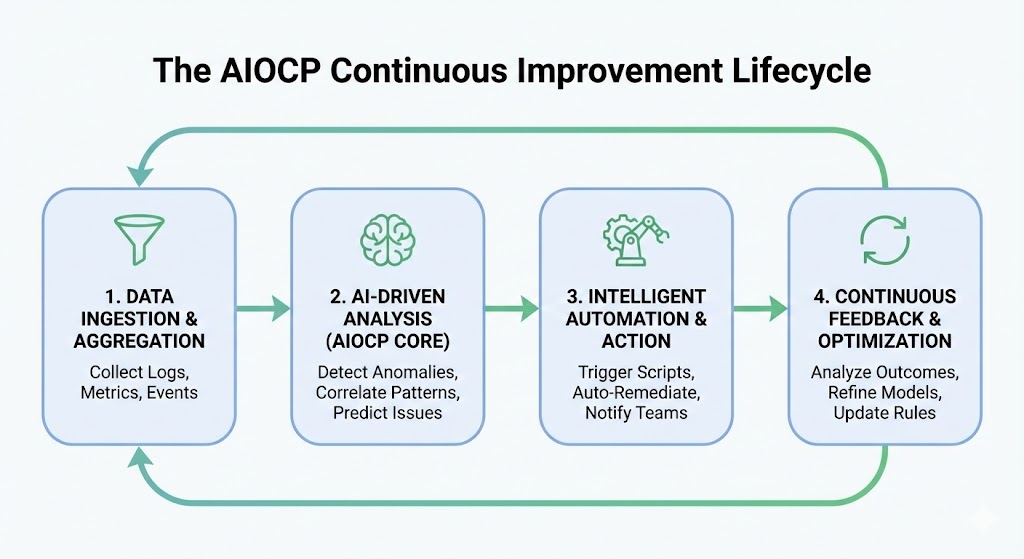
Modern digital ecosystems generate telemetry at a velocity that overwhelms traditional human-led monitoring. The AiOps Certified Professional (AIOCP) offers an elite technical path for engineers who want to command these complex environments using artificial intelligence. This guide explores how you can leverage machine learning to revolutionize system reliability and infrastructure management. By choosing DevOpsSchool, you access a curriculum designed to transform you into an expert capable of building self-healing systems. Whether you manage global cloud footprints or local enterprise stacks, this certification provides the competitive edge you need in a data-driven world.
What is the AiOps Certified Professional (AIOCP)?
The AiOps Certified Professional (AIOCP) functions as a specialized benchmark for engineers who integrate machine learning into IT operations. It exists to replace reactive, manual troubleshooting with proactive, algorithmic observability. This program focuses on training professionals to handle the massive data streams inherent in microservices and cloud-native architectures. By earning this credential, you prove your ability to deploy production-ready AI models that predict failures before they impact the end-user. It represents the gold standard for anyone aiming to lead high-velocity engineering teams.
Who Should Pursue AiOps Certified Professional (AIOCP)?
Cloud Architects, Site Reliability Engineers (SREs), and DevOps practitioners gain the most immediate professional boost from this certification. It also empowers Security and Data engineers to automate threat detection and optimize complex data pipelines. This roadmap serves a wide range of professionals, from ambitious juniors in India’s tech hubs to senior architects managing global platforms. Engineering managers also benefit by gaining the technical depth required to oversee AI-driven digital transformation initiatives.
Why AiOps Certified Professional (AIOCP) is Valuable in 2026 and Beyond
As infrastructure grows increasingly ephemeral, companies demand professionals who can manage systems through automation rather than manual toil. The AiOps Certified Professional (AIOCP) remains valuable because it focuses on the durable logic of AI rather than just specific, short-lived tools. This knowledge ensures you stay relevant even as the cloud landscape undergoes rapid evolution. By mastering these skills, you offer enterprises a clear way to reduce operational costs while simultaneously increasing system uptime.
AiOps Certified Professional (AIOCP) Certification Overview
The program delivers its specialized curriculum via the official course page and hosts all technical resources on the primary website. Candidates face a rigorous assessment process that prioritizes hands-on lab performance over theoretical knowledge. The certification owners update the syllabus frequently to reflect the latest breakthroughs in predictive analytics and automated incident response. This ensures that every certified professional possesses the practical competence to solve real-world enterprise infrastructure challenges.
AiOps Certified Professional (AIOCP) Certification Tracks & Levels
The AIOCP framework features a tiered progression: Foundation, Professional, and Advanced. The Foundation level establishes your understanding of data ingestion and basic telemetry analysis. The Professional level requires you to build and maintain operational machine learning models. The Advanced level prepares you for strategic architecture and enterprise-wide AI implementation. This structure allows you to build your expertise systematically, ensuring your skills match your career aspirations at every stage.
Complete AiOps Certified Professional (AIOCP) Certification Table
| Track | Level | Who it’s for | Prerequisites | Skills Covered | Recommended Order |
| Operations | Foundation | Junior Admins | Basic Linux | Data Prep, Telemetry | 1 |
| Engineering | Professional | SREs / DevOps | Python & Cloud | ML Modeling, Auto-remediation | 2 |
| Strategic | Advanced | Tech Leads | 5+ Years Exp | AI Governance, Strategy | 3 |
| Intelligence | Security AI | SecOps | Cyber Basics | Anomaly Detection, AI Defense | 4 |
Detailed Guide for Each AiOps Certified Professional (AIOCP) Certification
AiOps Certified Professional (AIOCP) – Foundation
What it is
This certification validates your grasp of the essential pillars of intelligent operations. It confirms that you can navigate modern observability tools and prepare data for AI-driven analysis.
Who should take it
Aspiring DevOps engineers and recent graduates should start here to build a technical foundation. It also serves managers who need to understand the technical language of their AI-focused teams.
Skills you’ll gain
- Distinguishing between Metrics, Logs, and Traces.
- Applying basic Python for data cleaning.
- Identifying noise vs. signal in alerting systems.
- Visualizing infrastructure health trends.
Real-world projects you should be able to do
- Create an observability dashboard that highlights significant system anomalies.
- Format raw infrastructure logs for ingestion into a machine learning pipeline.
Preparation plan
- 7–14 days: Study core AIOps definitions and the lifecycle of operational data.
- 30 days: Learn basic data visualization and Python syntax for operations.
- 60 days: Complete all lab modules and take the foundation exam.
Common mistakes
- Ignoring the importance of data quality at the point of ingestion.
- Focusing on tool features instead of the underlying statistical principles.
Best next certification after this
- Same-track: AIOCP Professional.
- Cross-track: Cloud Associate level certs.
- Leadership: Agile or ITIL Foundation.
AiOps Certified Professional (AIOCP) – Professional
What it is
This professional credential proves your ability to build and deploy machine learning models in live production environments. It focuses on using AI to maintain system uptime and optimize resources.
Who should take it
Active DevOps engineers and SREs who want to lead automation projects using advanced AI techniques.
Skills you’ll gain
- Deploying predictive models for capacity planning.
- Designing automated self-healing infrastructure workflows.
- Managing the lifecycle of operational algorithms.
- Implementing advanced log clustering techniques.
Real-world projects you should be able to do
- Build an automated system that predicts and prevents service degradations.
- Deploy a model that identifies security breaches through behavioral pattern analysis.
Preparation plan
- 7–14 days: Review specific ML libraries used for time-series forecasting.
- 30 days: Build end-to-end automation scripts in a staging environment.
- 60 days: Finalize your technical portfolio and pass the professional assessment.
Common mistakes
- Over-tuning models, which causes them to miss new types of failures.
- Failing to integrate AI insights into the team’s standard communication tools.
Best next certification after this
- Same-track: AIOCP Advanced Architect.
- Cross-track: Certified Kubernetes Administrator (CKA).
- Leadership: PMP or similar management credentials.
Choose Your Learning Path
DevOps Path
The DevOps path focuses on making the release process smarter and more resilient. You learn to use AI to predict deployment risks and optimize CI/CD pipelines automatically. This track targets engineers who want to eliminate manual bottlenecks in the software delivery life cycle through data-driven insights. It ensures that every code change benefits from intelligent safety checks before reaching production.
DevSecOps Path
This path prioritizes the use of AI for proactive security and threat management. You will learn to build systems that recognize malicious patterns in network traffic faster than traditional manual rules. This track focuses on automated compliance and the rapid remediation of vulnerabilities in cloud-native environments. It is the ideal choice for security specialists who want to stay ahead of automated cyber threats.
SRE Path
The SRE path targets the goal of zero-touch reliability through intelligent automation. You focus on building systems that maintain high availability by predicting and fixing issues before they impact SLOs. This track covers the automation of error budget management and complex system failovers using predictive modeling. It serves professionals who prioritize system stability in large-scale distributed environments.
AIOps / MLOps Path
This specialized track teaches you how to manage the models that manage your systems. You focus on the health, accuracy, and deployment of machine learning models within the infrastructure stack. This path bridges the gap between pure data science and systems engineering. It is ideal for those who want to oversee the technical health of the AI engines themselves.
DataOps Path
The DataOps path ensures that the telemetry flowing into your AI systems remains clean, timely, and relevant. You learn to build robust data pipelines that handle the massive scale of modern enterprise data. This track focuses on monitoring the data lifecycle and preventing “data drift” from ruining your AI insights. It suits engineers who love the architecture of large-scale data systems.
FinOps Path
The FinOps path uses AI to solve the challenge of cloud cost optimization. You learn to apply machine learning to forecast cloud spending and identify wasted resources with high precision. This track turns operational efficiency into direct financial savings for the organization. It is essential for anyone responsible for the economic health of a cloud-native business.
Role → Recommended Certifications
| Role | Recommended Certifications |
| DevOps Engineer | AIOCP Foundation + Professional |
| SRE | AIOCP Professional + Advanced |
| Platform Engineer | AIOCP Professional |
| Cloud Engineer | AIOCP Foundation |
| Security Engineer | AIOCP Security Track |
| Data Engineer | AIOCP DataOps Track |
| FinOps Practitioner | AIOCP FinOps Track |
| Engineering Manager | AIOCP Advanced |
Next Certifications to Take After AIOCP
Same Track Progression
After reaching the professional tier, you should pursue the Advanced Architect certification. This allows you to design high-level AI strategies that span multiple departments and cloud providers. You will focus on enterprise-wide governance and the ethical implementation of autonomous systems across the organization.
Cross-Track Expansion
Expand your technical reach by mastering container orchestration or advanced cloud networking. Certifications like the CKA (Certified Kubernetes Administrator) complement your AIOCP skills perfectly. Understanding the underlying infrastructure allows you to build more effective AI models for those specific platforms.
Leadership & Management Track
For those aiming for executive positions, combine your technical AI expertise with management credentials. Focus on programs that teach digital transformation and the financial management of tech teams. This path prepares you for high-level roles like Director of Engineering or VP of Infrastructure.
Training & Certification Support Providers for AIOCP
DevOpsSchool
This provider leads the industry by offering comprehensive training specifically built for the AIOCP curriculum. They focus on practical, lab-based learning that forces students to solve real-world production challenges. Their mentors bring decades of industry experience, ensuring that every student understands how to apply AI principles in actual enterprise environments.
Cotocus
This organization helps corporate teams transition to intelligent operations through tailored training programs. They focus on the specific tools and platforms that your organization already uses, making the learning process highly relevant. Their training ensures that teams can immediately implement AIOps strategies to improve system reliability and performance.
Scmgalaxy
This platform serves as a massive community resource for anyone pursuing the AIOCP certification. They offer a wealth of scripts, tutorials, and community support to help self-motivated learners succeed. Their approach blends formal education with peer-to-peer knowledge sharing, providing a well-rounded learning experience for engineers at all levels.
BestDevOps
This provider emphasizes the engineering rigor required to build professional-grade AI systems. Their courses dive deep into the algorithms and data structures that power modern observability tools. They cater to engineers who want a thorough, technical understanding of how AI transforms the world of DevOps and SRE.
devsecopsschool.com
This site focuses on the critical intersection of security and artificial intelligence. They offer specialized training for the AIOCP security track, teaching students how to use AI to hunt for threats and automate defense. Their labs use real-world attack scenarios to ensure students can handle the pressure of modern cybersecurity operations.
sreschool.com
This provider focuses exclusively on the needs of Site Reliability Engineers in the age of AI. Their training covers the use of machine learning to maintain SLOs and manage incident response at scale. They provide the practical skills needed to turn traditional SRE practices into intelligent, autonomous operations.
aiopsschool.com
As a dedicated institution for AIOps, this provider offers the most direct path to the AIOCP credential. They cover everything from the basics of telemetry to the design of complex, self-healing architectures. Their curriculum remains at the absolute forefront of the industry, reflecting the latest shifts in AI-driven operations.
dataopsschool.com
This organization teaches the vital data engineering skills required to power any AIOps initiative. They focus on the design and maintenance of data pipelines that feed AI engines with high-quality information. Their training ensures that your AI insights are always based on accurate and timely telemetry data.
finopsschool.com
This provider helps you master the economic impact of your technical work through AI-driven FinOps. They teach you how to use machine learning to identify hidden costs and optimize cloud resources automatically. This is a critical skill for any engineer who wants to prove the ROI of their AIOps projects to senior management.
Frequently Asked Questions (General)
- How difficult is the AIOCP exam?The exam is challenging because it requires practical knowledge, but if you complete the recommended labs, you will be well-prepared.
- How long should I study for the Professional level?Most successful candidates spend about 10 hours a week for three months to master the professional curriculum.
- Are there any prerequisites for the Foundation level?No formal prerequisites exist for the foundation level, though a basic understanding of how servers and networks function is highly recommended for success.
- What is the ROI of this certification?Certified professionals often see significant salary increases and are eligible for senior roles such as AI Operations Architect or Lead SRE in major tech firms.
- Does the certification expire?Yes, typically certifications in this fast-moving field are valid for two to three years, after which recertification is required to ensure knowledge of new technologies.
- In what order should I take the certifications?It is best to follow the linear path: Foundation, then Professional, and finally the Advanced or Specialized tracks based on your specific career goals.
- Is Python mandatory for AIOCP?While not strictly mandatory for the foundation, Python is essential for the Professional and Advanced levels where you will be building and deploying actual models.
- Can I skip the Foundation level if I have experience?If you have over 3 years of active DevOps experience and understand basic data science, you may choose to start directly at the Professional level.
- Does this certification cover specific tools like Splunk or ELK?The certification focuses on the principles of AIOps, but you will use popular tools like ELK, Prometheus, and various ML libraries during the practical labs.
- How is the exam conducted?The exam is usually an online proctored test consisting of multiple-choice questions and, for higher levels, a practical lab assessment.
- Is there a community for AIOCP students?Yes, there are active forums and Slack channels where candidates share study tips, practice questions, and real-world implementation challenges.
- Are there global job opportunities for AIOCP holders?Absolutely; major tech hubs in the US, Europe, and India have a high demand for experts who can manage AI-driven infrastructure at scale.
FAQs on AiOps Certified Professional (AIOCP)
- How specifically makes AIOCP different from a standard Data Science cert?AIOCP focuses on IT operational data like logs and metrics, whereas data science is broader and often focuses on business or consumer data.
- Can I use AIOCP to transition from a traditional SysAdmin role?Yes, it provides the perfect bridge by teaching you how to apply modern automation and AI to traditional server management tasks.
- What kind of math is required?You need a basic understanding of statistics, such as mean, median, standard deviation, and probability, to understand how anomaly detection works.
- How does AIOCP help with incident management?It teaches you to build systems that automatically correlate events, reducing alert fatigue and helping you find the root cause of issues faster.
- Is this certification recognized by major cloud providers?While it is an independent certification, the skills taught are directly applicable to AWS, Azure, and Google Cloud AI services.
- Will this certification help me in a FinOps role?Yes, the predictive analytics portion of the course is directly applicable to forecasting cloud spend and optimizing resource utilization.
- Are there hands-on labs included in the training?Yes, the program emphasizes practical application, requiring students to set up observability pipelines and deploy ML models in sandbox environments.
- How does AIOCP address “Black Box” AI concerns?The curriculum includes sections on explainable AI, ensuring that engineers understand why a model made a specific operational recommendation.
Final Thoughts: Is AiOps Certified Professional (AIOCP) Worth It?
Investing in the AIOCP certification represents a commitment to the future of high-scale engineering. As an industry veteran, I have watched the burden on operations teams grow to unsustainable levels. This certification offers the only viable way forward by teaching you how to let the machines handle the data while you focus on the architecture. It is not just about learning new tools; it is about adopting a mindset where data dictates operational decisions. If you want to move into the highest tiers of engineering and command the respect of your peers, the AIOCP is your roadmap to success. Start today, and secure your place at the forefront of the intelligent operations revolution.


Leave a Reply
You must be logged in to post a comment.