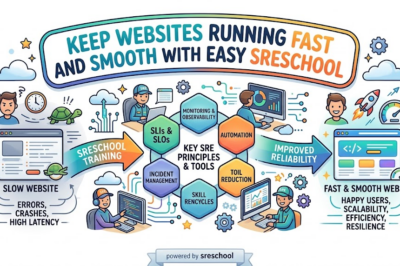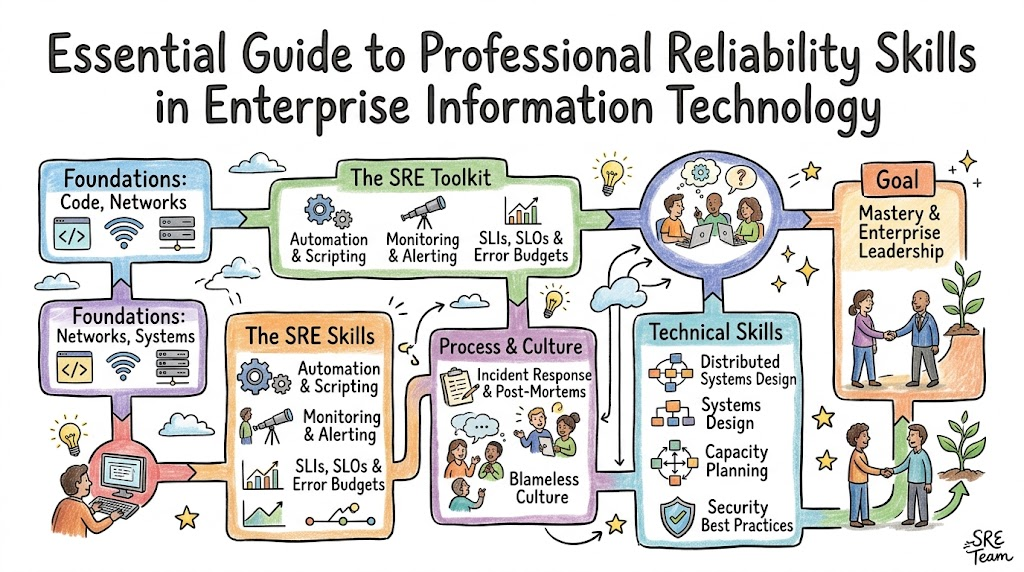
Modern organizations increasingly depend on resilient digital infrastructure to support uninterrupted customer transactions and seamless operations. Consequently, IT professionals must build robust engineering habits that safeguard large-scale software platforms from unexpected failure. Partnering with a dedicated educational platform like Sreschool equips engineers with the practical competencies necessary to navigate sophisticated multi-cloud ecosystems. This detailed guide demonstrates precisely how building advanced operational capabilities transforms enterprise architectures and elevates long-term career growth.
Furthermore, traditional operational approaches struggle to maintain high uptime requirements across complex, distributed microservices. Learning to approach infrastructure problems using software development techniques allows you to design automated, self-healing platforms. This strategic perspective eliminates repetitive manual overhead while substantially accelerating your team’s software release cadence. Therefore, mastering these modern methodologies positions you at the very forefront of digital transformation across global enterprises.
Architectural Resilience and Distributed System Engineering
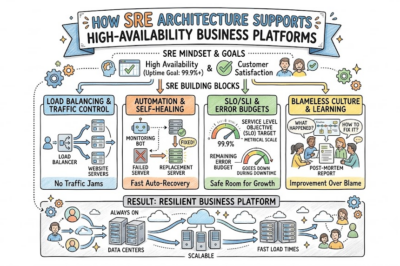
Enterprise applications require robust distributed architectures capable of handling massive spikes in user traffic without service degradation. By understanding fundamental distributed computing principles, engineers implement dynamic load-balancing strategies and geographic redundancy to maintain continuous availability. Moreover, structuring software components around isolated failure domains prevents localized server faults from triggering cascading system outages across entire platforms.
Additionally, resilient design involves embedding automated telemetry agents and strict access policies directly into your continuous integration workflows. Developing an eye for single points of failure enables you to eliminate vulnerabilities before they reach live production environments. As a direct result, your enterprise minimizes unplanned downtime, safeguards critical transactional data, and protects corporate brand reputation.
Strategic Automation and Scalable Infrastructure Management
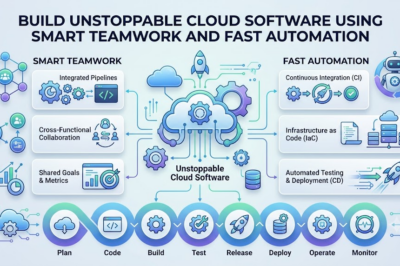
Manual infrastructure maintenance quickly introduces human configuration errors when operating across thousands of cloud-native instances. Applying programmatic automation ensures that every environment matches precise baseline configurations without costly configuration drift. Through declarative infrastructure scripts, technical teams deploy identical environments consistently across staging and production clusters in mere minutes.
Furthermore, building automated self-healing mechanisms allows digital infrastructure to recover autonomously from routine faults, such as memory exhaustion or stuck application threads. Automating these recurring operational duties frees engineers to focus on architectural innovation and capacity planning. Ultimately, programmatic management ensures sustainable enterprise scalability while lowering operational maintenance expenditure.
Aligning Technical Reliability with Core Business Objectives
Technical performance metrics must directly correspond to positive customer experiences and tangible business outcomes. By establishing clear thresholds for latency and error rates, technical teams establish objective benchmarks that guide daily development priorities. This alignment guarantees that engineering teams balance rapid feature delivery against the non-negotiable requirement for high platform availability.
In addition, protecting transactional uptime directly preserves enterprise revenue streams and customer loyalty over the long term. Demonstrating the financial value of system resilience allows technical leaders to secure vital resources for continuous infrastructure upgrades. Consequently, cross-functional collaboration thrives when engineering output aligns transparently with broader organizational milestones.
Building a Blameless and Collaborative Operational Mindset
High-performing organizations recognize that human error serves as a symptom of deeper systemic weaknesses rather than individual negligence. Cultivating a blameless culture encourages team members to share comprehensive incident details without fear of professional reprisal. This open atmosphere enables engineers to uncover root causes and implement lasting preventative safeguards across all technical layers.
Moreover, eliminating organizational silos between developers and infrastructure engineers fosters mutual empathy and shared accountability. When developers understand operational constraints and platform specialists understand application logic, software releases become predictable and stable. This collaborative environment continuously drives operational maturity across all engineering teams.
Key Operational Concepts You Must Know
Service Level Indicators and Service Level Objectives
Accurate infrastructure evaluation begins by gathering objective, quantitative metrics that mirror real user satisfaction levels. Service Level Indicators capture precise runtime data, including request latency, error distribution, and database query durations. Meanwhile, Service Level Objectives represent the explicit performance targets your teams commit to maintaining over set rolling windows. Tracking these metrics ensures that technical modifications remain guided by empirical performance evidence rather than subjective assumptions.
Managing Risk Through Error Budget Frameworks
An error budget represents the specific threshold of permissible platform unreliability your enterprise can tolerate without harming client relationships. For instance, an objective targeting ninety-nine point nine percent uptime provides an error budget of zero point one percent for planned maintenance and safe experiments. If this allocated budget is exhausted due to unexpected disruptions, teams immediately freeze feature releases to focus exclusively on stability enhancements.
Conducting Blameless Post-Mortems and Cause Analyses
When production outages occur, engineering teams must prioritize uncovering procedural defects over assigning personal fault. Blameless incident analyses thoroughly evaluate architectural configurations, deployment timelines, and alert responsiveness to find underlying failure mechanisms. Documenting these findings within an open knowledge base prevents similar outages from recurring in future software iterations.
Eradicating Repetitive Operational Toil
Toil describes repetitive, non-creative operational duties that scale linearly with service usage and provide no persistent value. Common examples include manual database backups, static firewall updates, and manual application restarts. Mature engineering teams mandate that less than half of engineering capacity goes toward toil, dedicating the majority of time to strategic platform automation.
Platform Implementation vs. Culture — What’s the Real Difference?
| Operational Aspect | Platform Implementation Focus | Cultural Integration Focus |
|---|---|---|
| Primary Objective | Provisioning telemetry agents, cloud instances, and continuous integration pipelines. | Fostering psychological safety, blameless inquiry, and shared product ownership. |
| Core Evaluation | Measuring resource utilization, request throughput, and raw network bandwidth. | Assessing team psychological safety, knowledge sharing, and learning velocity. |
| Incident Response | Triggering automated failover scripts and notifying active on-call staff. | Facilitating comprehensive post-mortems and improving developer feedback loops. |
| Workflow Strategy | Writing declarative configuration templates and orchestrating containers. | Aligning product release velocity with objective reliability thresholds. |
Real-World Use Cases of Modern Operations
High-Volume Retail Platforms
- Dynamic Auto-Scaling: Adjusting compute nodes programmatically in response to sudden traffic surges during flash promotion campaigns.
- Database Partitioning: Implementing data sharding to maintain rapid read and write transactions during peak purchasing windows.
- Fault Isolation: Deploying circuit breakers to isolate third-party payment gateways during unexpected third-party service degradation.
Scalable Financial Technologies
- Geographic Data Synchronization: Establishing ultra-low latency data replication protocols across globally separated secure data centers.
- Automated Policy Validation: Enforcing continuous compliance scans to guarantee infrastructure meets stringent banking regulations.
- Controlled Chaos Injection: Simulating spontaneous server terminations in staging environments to validate automated failover routines.
Modern Healthcare Data Networks
- Continuous Updates: Executing rolling zero-downtime application upgrades to maintain uninterrupted access to critical patient databases.
- Tamper-Resistant Logging: Generating immutable audit logs to document every data access event for regulatory health compliance.
- Predictive Alerting: Implementing proactive pattern recognition algorithms to spot memory leaks before applications crash.
Common Mistakes in Operations Engineering
Operating Platform Teams in Complete Isolation
Establishing an isolated infrastructure team separate from software development groups recreates old-fashioned functional silos. Software developers often push untested application code into production while assuming operations engineers will independently resolve runtime defects. This detachment slows release cycles and causes persistent communication breakdowns across departments.
Automating Flawed Procedures Without Prior Standardization
Attempting to build automated scripts around inconsistent manual workflows merely accelerates how quickly systems fail. If an underlying deployment routine contains logical errors, automating that procedure guarantees repeated production issues. Technical teams must rigorously test and document operational processes manually before committing them to automated code.
Establishing Unattainable Availability Objectives
Striving for absolute zero downtime creates unrealistic operational burdens that quickly drain annual technical budgets. Building extreme infrastructure redundancy introduces excessive architectural complexity without delivering proportional customer value. Teams must select pragmatic uptime targets that satisfy consumer expectations while preserving fast development velocity.
Overlooking Chronic Notification Fatigue
Subjecting engineering teams to an endless stream of low-priority, non-actionable alerts causes dangerous operational exhaustion. Over time, engineers become desensitized to routine notifications and accidentally ignore critical production outages. Alert rules must strictly target actionable conditions that require direct human intervention to resolve.
How to Become an Operations Expert — Career Roadmap
For Junior Infrastructure Specialists
- Master Command-Line Environments: Gain complete confidence navigating Linux directory trees, configuring permissions, and inspecting system logs.
- Develop Core Scripting Proficiencies: Build practical skills in Python or Bash to automate repetitive system maintenance chores.
- Understand Networking Protocols: Learn foundational concepts covering the TCP/IP stack, DNS resolution, and secure network routing.
For Mid-Tier Systems Engineers
- Implement Infrastructure as Code: Use declarative configuration tools to orchestrate multi-cloud resources reproducibly.
- Containerize Workloads: Package microservices within secure container environments and manage deployments using container orchestration tools.
- Construct Centralized Telemetry: Assemble comprehensive monitoring dashboards that integrate application logs, platform metrics, and distributed traces.
For Senior Infrastructure Architects
- Champion Cultural Transformation: Mentor development groups on applying error budget guidelines and practicing blameless incident reviews.
- Optimize Cloud Expenditure: Conduct comprehensive cost analyses to remove wasted computing capacity without degrading performance.
- Formulate Disaster Recovery Blueprints: Author multi-region disaster recovery architectures that ensure continuous business operations during catastrophic regional cloud outages.
FAQ Section
- How do reliability engineering principles differ from standard system administration?
Traditional system administration emphasizes manual server configurations and reactive problem solving during outages. In contrast, modern reliability engineering applies programmatic software development practices to automate operational tasks, using clear quantitative metrics like error budgets to balance platform stability with fast product releases.
- What programming knowledge is essential for infrastructure engineers?
Engineers should possess a solid understanding of scripting languages like Python, Go, or Bash to build automation tools, manage deployment pipelines, and interact with cloud APIs. Deep algorithmic expertise is less critical than writing clean, readable code to manage systems programmatically.
- Why do organizations prioritize blameless incident post-mortems?
Blameless reviews foster an open atmosphere where engineers comfortably reveal precise operational missteps without fear of punishment. This transparent investigation helps organizations identify underlying architectural vulnerabilities and improve procedural safeguards, preventing similar disruptions from happening again.
- How do error budgets balance product innovation and system stability?
Error budgets define the acceptable level of system downtime an application can experience over a set timeframe. When the budget is intact, development teams deploy new features rapidly; when the budget is spent, teams redirect resources toward stability improvements until performance targets recover.
- Can traditional developers transition smoothly into enterprise platform roles?
Developers transition naturally into platform engineering roles because they already understand programming principles and software design patterns. They simply need to expand their knowledge of cloud infrastructure, distributed systems networking, container orchestration, and observability platforms.
Final Summary
Mastering modern platform reliability practices equips technical professionals with the necessary tools to navigate complex enterprise cloud environments successfully. Combining software development techniques with infrastructure management allows engineers to eliminate manual operational toil and construct resilient systems. These advanced capabilities enable organizations to maintain continuous software availability while accelerating their product delivery schedules. Consequently, skilled engineers who master these disciplines enjoy high demand across forward-thinking technology enterprises worldwide.
Furthermore, lasting organizational success requires harmonizing scalable software automation with an open, blameless team culture. Cultivating shared accountability between development and operational units ensures that business targets align directly with high technical standards. As you progress along your career roadmap, focus on refining both your infrastructure automation skills and your collaborative leadership capabilities. Committing to this well-rounded path guarantees your ongoing growth as an essential technical leader in enterprise IT.