Introduction
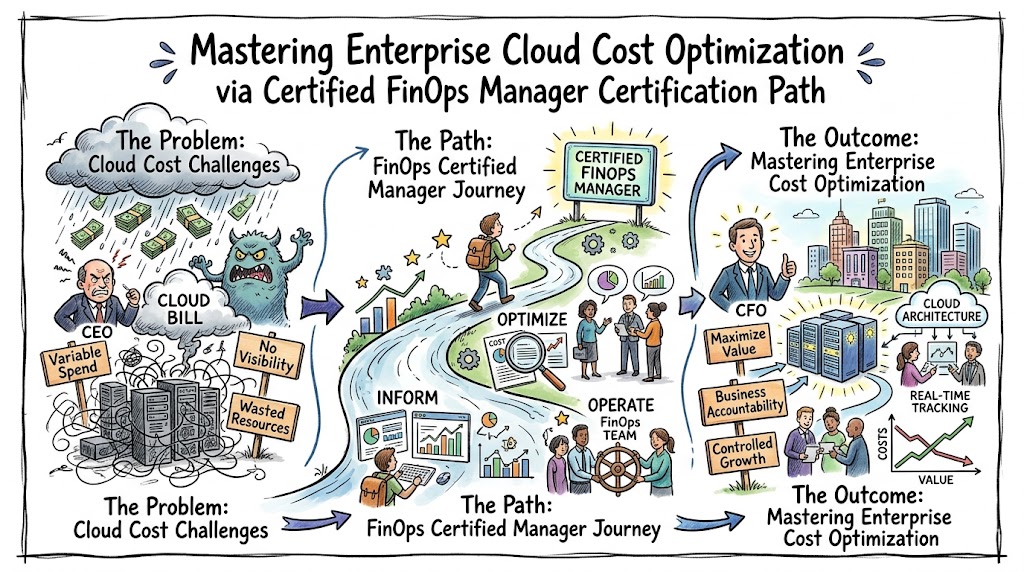
The modern cloud ecosystem demands a rigorous approach to financial accountability, making the Certified FinOps Manager a vital credential for today’s engineering leaders. This guide provides a comprehensive roadmap for professionals working across DevOps, platform engineering, and cloud operations who need to bridge the gap between technical execution and fiscal responsibility. By exploring this certification at FinOpsSchool, you will learn how to navigate the complexities of variable cloud spending while maintaining high-velocity delivery cycles. This documentation helps managers and senior individual contributors determine if this specific path aligns with their long-term career trajectory and organizational goals.
What is the Certified FinOps Manager?
The Certified FinOps Manager represents a specialized professional standard designed to validate an individual’s ability to lead cloud financial management initiatives within an enterprise. It focuses heavily on the intersection of cultural change, process optimization, and technical tooling required to manage cloud costs effectively. Unlike theoretical finance courses, this program emphasizes production-focused learning where engineers learn to translate cloud usage data into actionable business insights. It aligns perfectly with modern engineering workflows by treating cost as a primary non-functional requirement alongside performance and security.
Who Should Pursue Certified FinOps Manager?
This certification serves a diverse group of professionals ranging from SREs and DevOps engineers to cloud architects and finance business partners. Senior engineers who find themselves managing massive cloud budgets will find immense value in the structured frameworks provided here. It is equally relevant for engineering managers in India and across the global market who must justify infrastructure ROI to executive leadership. Beginners looking to specialize in the niche but high-demand field of cloud economics also benefit from the foundational principles established in the curriculum.
Why Certified FinOps Manager is Valuable and Beyond
The demand for FinOps expertise continues to surge as enterprises move away from simple cloud migration toward mature cloud-native optimization. This certification offers long-term career longevity because it focuses on universal principles of efficiency and accountability that persist regardless of specific tool changes. It provides a significant return on time investment by equipping professionals with the language and metrics needed to communicate with both developers and CFOs. As organizations prioritize sustainable growth, those who can demonstrate a mastery of cloud financial operations become indispensable assets.
Certified FinOps Manager Certification Overview
The program is delivered via the official portal and hosted on the primary website. It utilizes a multi-tiered assessment approach that combines conceptual knowledge with practical, ownership-based scenarios. Candidates must demonstrate they can manage the entire FinOps lifecycle, including the inform, optimize, and operate phases. The structure ensures that practitioners are not just memorizing definitions but are actually capable of implementing unit economics and discount monitoring in a live environment.
Certified FinOps Manager Certification Tracks & Levels
The certification hierarchy begins with a foundation level that introduces core terminology and the lifecycle of cloud financial management. It then progresses to the professional level, which is geared toward those who actively manage cloud portfolios and implement optimization strategies. The advanced track focuses on leadership, policy-making, and driving cultural transformation across large-scale distributed teams. These levels align with career progression from individual contributor roles to high-level strategic management positions.
Complete Certified FinOps Manager Certification Table
| Track | Level | Who it’s for | Prerequisites | Skills Covered | Recommended Order |
| Core FinOps | Foundation | Aspiring Practitioners | Basic Cloud Knowledge | Terminology, Lifecycle | 1st |
| Operations | Professional | Cloud Engineers/SREs | 1 Year Experience | Unit Metrics, Tagging | 2nd |
| Management | Advanced | Engineering Leaders | 3+ Years Experience | Policy, Governance | 3rd |
Detailed Guide for Each Certified FinOps Manager Certification
Certified FinOps Manager – Foundation Level
What it is
This level validates a fundamental understanding of the FinOps framework and the shift from traditional IT procurement to variable cloud spending. It ensures the candidate speaks the standard language of cloud financial management.
Who should take it
It is suitable for entry-level cloud analysts, finance team members, and developers who want to understand how their code impacts the company’s cloud bill.
Skills you’ll gain
- Identification of cloud cost drivers.
- Understanding the FinOps lifecycle phases.
- Ability to read and interpret basic billing reports.
Real-world projects you should be able to do
- Create a basic cloud cost visibility dashboard.
- Identify orphaned resources in a development environment.
Preparation plan
- 7–14 days: Review the core FinOps handbook and official glossary.
- 30 days: Complete the foundational course modules and practice quizzes.
- 60 days: Apply the inform phase principles to a small-scale project.
Common mistakes
Candidates often underestimate the importance of the cultural aspects of the framework, focusing too much on technical tools rather than people and process.
Best next certification after this
- Same-track option: Professional FinOps Specialist.
- Cross-track option: Cloud Practitioner (AWS/Azure/GCP).
- Leadership option: Project Management Professional (PMP).
Certified FinOps Manager – Professional Level
What it is
This certification validates the ability to implement and manage FinOps practices within a team or department. It focuses on driving optimization and creating accountability through detailed reporting.
Who should take it
Cloud architects, SREs, and DevOps leads who are responsible for the day-to-day cost management of production workloads should pursue this level.
Skills you’ll gain
- Advanced anomaly detection techniques.
- Implementing automated cost governance policies.
- Managing commitment-based discounts like RIs and SPs.
Real-world projects you should be able to do
- Develop a tagging enforcement policy using Infrastructure as Code.
- Conduct a rightsizing exercise for a Kubernetes-based microservices cluster.
Preparation plan
- 7–14 days: Focus on deep-dive optimization strategies and case studies.
- 30 days: Perform hands-on lab exercises involving billing data exports.
- 60 days: Lead a real-world cost-saving initiative within your organization.
Common mistakes
Many candidates fail to account for the performance trade-offs that sometimes accompany aggressive cost optimization strategies in production.
Best next certification after this
- Same-track option: Advanced FinOps Leader.
- Cross-track option: Certified Kubernetes Administrator (CKA).
- Leadership option: ITIL 4 Strategist.
Choose Your Learning Path
DevOps Path
The DevOps path focuses on integrating cost feedback loops directly into the CI/CD pipeline. Engineers learn to shift-left cost awareness, ensuring that developers see the financial impact of their infrastructure choices before deployment. This path emphasizes automation and the use of tools that provide real-time cost visibility.
DevSecOps Path
In this path, professionals explore the intersection of security and cost, such as the expense of security logging and the cost of data breaches. It covers how to maintain a secure posture without over-provisioning expensive security appliances or storage. The focus remains on lean, secure, and cost-effective cloud operations.
SRE Path
The SRE path treats cost as a Service Level Objective (SLO), balancing reliability with fiscal efficiency. SREs learn to optimize for the “Error Budget” while also managing a “Cost Budget” to ensure system health. It involves deep technical work in rightsizing and managing high-scale distributed systems.
AIOps Path
Professionals in this path use machine learning to predict cloud spend and detect anomalies automatically. It focuses on the algorithmic side of FinOps, where historical data drives future budget forecasting. This reduces the manual effort required to monitor vast, complex cloud environments.
MLOps Path
The MLOps path addresses the specific high costs associated with training and deploying machine learning models. It covers GPU utilization, data egress costs, and the financial lifecycle of model development. This ensures that AI initiatives remain profitable and sustainable for the business.
DataOps Path
DataOps focuses on the financial management of data pipelines, warehouses, and big data clusters. Practitioners learn to manage the costs of data storage and processing, which are often the most volatile parts of a cloud bill. It emphasizes efficient data architecture and lifecycle management.
FinOps Path
The pure FinOps path is for those dedicated to the profession of cloud financial management as a primary role. It covers everything from executive reporting to vendor negotiations and cross-departmental chargeback models. This is the most comprehensive path for those aiming to lead a FinOps Center of Excellence.
Role → Recommended Certifications
| Role | Recommended Certifications |
| DevOps Engineer | Foundation + Professional Operations |
| SRE | Professional Operations + SRE Specialist |
| Platform Engineer | Foundation + Cloud Governance Track |
| Cloud Engineer | Foundation + Optimization Specialist |
| Security Engineer | DevSecOps + Cost Management Foundation |
| Data Engineer | DataOps Specialist + Foundation |
| FinOps Practitioner | All Levels (Foundation to Advanced) |
| Engineering Manager | Foundation + Advanced Leadership Track |
Next Certifications to Take After Certified FinOps Manager
Same Track Progression
Deep specialization within the FinOps domain involves moving toward architectural roles where you design systems for cost-efficiency from the ground up. You might pursue advanced certifications that focus on multi-cloud financial management or specialized tooling certifications. This path ensures you remain the go-to expert for complex financial challenges in large organizations.
Cross-Track Expansion
Broadening your skills by pursuing technical certifications like the CKA or professional cloud architect exams allows you to implement your FinOps knowledge more effectively. Understanding the underlying technology enables you to provide better optimization recommendations. This makes you a more versatile engineer who can both build and budget effectively.
Leadership & Management Track
Transitioning to leadership involves moving beyond the technical implementation to focus on organizational strategy and cultural change. Certifications in business management or executive leadership can complement your FinOps background. This path prepares you for roles like Director of Cloud Operations or Head of Infrastructure.
Training & Certification Support Providers for Certified FinOps Manager
DevOpsSchool
This provider offers extensive resources and structured training programs for those looking to master the financial aspects of cloud computing. They focus on delivering hands-on experience through real-world scenarios and expert-led sessions that cover the entire DevOps and FinOps spectrum.
Cotocus
This organization provides specialized consulting and training services that help professionals bridge the gap between technical execution and business value. Their curriculum is designed to support engineers in achieving high-level certifications while maintaining a focus on practical, enterprise-grade skills.
Scmgalaxy
As a community-driven platform, this provider offers a wealth of tutorials, blog posts, and forums dedicated to software configuration management and cloud operations. Their resources are excellent for staying updated on the latest trends in FinOps and automation tools.
BestDevOps
This portal focuses on providing high-quality educational content and certification pathways for modern engineering roles. They emphasize the importance of integrated learning where cost management is treated as a core component of the software development lifecycle.
devsecopsschool.com
This site specializes in the intersection of security and operations, providing deep dives into how financial accountability can be maintained within a secure framework. Their training modules are essential for those operating in highly regulated industries.
sreschool.com
Focused on reliability and scalability, this provider offers training that integrates FinOps into the SRE mindset. They teach how to manage cost as a performance metric, ensuring that systems are both stable and financially sustainable.
aiopsschool.com
This provider focuses on the future of operations, where machine learning and automation drive efficiency. Their courses help practitioners understand how to use AI to enhance FinOps practices and automate complex financial reporting tasks.
dataopsschool.com
Dedicated to the data professional, this site offers training on managing the specific financial challenges of large-scale data environments. They provide strategies for optimizing storage and processing costs across various data platforms.
finopsschool.com
The primary authority for this certification, this site provides the official curriculum and assessment for becoming a certified manager. Their platform is the central hub for the most up-to-date frameworks and industry standards in cloud finance.
Frequently Asked Questions
- How difficult is the certification exam for a manager role?The exam is moderately challenging as it requires a blend of financial literacy and technical cloud knowledge rather than just technical skills.
- What is the typical time commitment required for preparation?Most professionals find that 30 to 60 days of consistent study is sufficient to cover the material and pass the assessment comfortably.
- Are there specific technical prerequisites for this program?While a basic understanding of cloud services is required, you do not need to be a senior coder to succeed in this track.
- What is the expected return on investment for this credential?Certified individuals often see higher salary brackets and are prioritized for leadership roles in cloud-native organizations due to their specialized skills.
- In what order should I take the different levels?It is highly recommended to start with the foundation level to grasp the terminology before moving into the more complex professional and advanced tracks.
- Does this certification cover multiple cloud providers?Yes, the framework is cloud-agnostic and applies equally to AWS, Azure, Google Cloud, and other private or public cloud environments.
- How often does the certification need to be renewed?Generally, these credentials require renewal or continuing education credits every two to three years to ensure practitioners stay current with evolving practices.
- Can a finance professional without an engineering background pass?Yes, though they will need to spend extra time learning the technical architecture components that drive cloud costs and resource utilization.
- Is this certification recognized globally?The standards taught are based on global industry best practices and are recognized by major enterprises and consulting firms worldwide.
- Does the program include hands-on lab exercises?The professional and advanced levels involve practical scenarios that simulate real-world billing and optimization challenges found in production environments.
- How does this differ from a standard cloud architect certification?While architects focus on building and performance, this program focuses specifically on the financial governance and optimization of those builds.
- Is there a community for certified practitioners?Yes, there are active forums and local chapters where certified professionals share insights, templates, and successful cost-saving strategies.
FAQs on Certified FinOps Manager
- What specific tools are covered in the curriculum?The course covers native cloud billing tools like AWS Cost Explorer and Azure Cost Management, alongside third-party platforms for multi-cloud visibility and automated rightsizing.
- How does the certification address cloud waste?It provides structured frameworks for identifying idle resources, over-provisioned instances, and unattached storage through automated scanning and reporting.
- Can I apply these principles to a hybrid cloud setup?The methodology is designed to handle hybrid environments by focusing on unit economics and cost allocation regardless of where the workload resides.
- What is the focus of the “Inform” phase in the exam?This phase focuses on cost allocation, tagging compliance, and visibility, ensuring that every dollar spent can be traced back to a specific business unit.
- How are commitment-based discounts handled in the training?The program teaches the strategy behind Reserved Instances and Savings Plans, including how to calculate coverage and utilization for maximum savings.
- Does the certification cover Kubernetes cost management?Yes, it includes specific modules on container cost allocation, addressing the challenges of shared resources in a multi-tenant Kubernetes cluster.
- What leadership skills are evaluated in the advanced track?The advanced track evaluates the ability to drive cultural change, negotiate with vendors, and establish a cross-functional FinOps Council within an organization.
- Is there an emphasis on automated governance?Automation is a core theme, teaching candidates how to use policy-as-code to prevent cost overruns before they happen in a live environment.
Final Thoughts: Is Certified FinOps Manager Worth It?
Investing in the Certified FinOps Manager credential is a strategic move for any professional looking to lead in the modern cloud era. As organizations mature, the focus shifts from “getting to the cloud” to “operating efficiently in the cloud,” and this is where FinOps specialists shine. The ability to speak both the language of the boardroom and the language of the terminal makes you a rare and valuable asset in any engineering team.
Choosing this path demonstrates a commitment to operational excellence and business value that goes beyond simple technical implementation. It prepares you to handle the fiscal challenges of scaling global infrastructure while ensuring that innovation remains sustainable. For those aiming for senior management or specialized architect roles, this certification provides the necessary framework to manage cloud resources with precision and accountability.