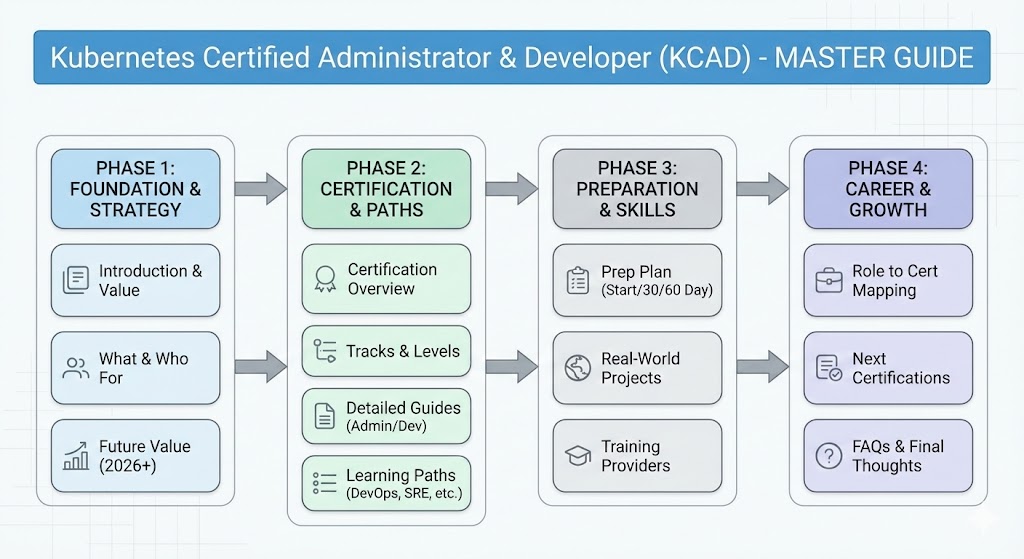
Introduction
Mastering container orchestration requires a hands-on approach that bridges the gap between theory and production-grade execution. Consequently, following a Step-by-Step Guide to Implement Kubernetes Certified Administrator & Developer (KCAD) Skills empowers engineers to build resilient, automated infrastructure from the ground up. This roadmap from DevOpsschool provides the technical clarity needed to apply Kubernetes Certified Administrator & Developer (KCAD) principles in real-world scenarios. By executing these steps, you transform your conceptual knowledge into a practical toolkit that satisfies the rigorous demands of the modern cloud-native landscape.
The Architecture of Implementation
The KCAD framework demands more than simple memorization; it requires the active management of a live ecosystem. You must interact with the Kubernetes API to orchestrate containers, manage networking, and ensure data persistence. This implementation guide focuses on building the “muscle memory” necessary to handle high-pressure environments. By following a structured deployment path, you ensure that every component—from the control plane to the worker nodes—functions in perfect harmony.
Who Should Execute This Roadmap?
Platform engineers, SREs, and backend developers find the most value in this implementation strategy. It serves professionals in India and across the globe who need to move beyond managed services and understand the raw power of Kubernetes. Recruiters prioritize candidates who can demonstrate these implementation skills because they prove an engineer can manage the entire lifecycle of a production application without external assistance.
Long-Term Value of Practical Skills
As organizations scale their digital footprints, the ability to implement Kubernetes manually remains a top-tier skill. These skills offer longevity because they rely on open-source standards that apply to any cloud provider. Whether you deploy on private servers or public clouds like AWS and Azure, the implementation logic remains identical. Investing in these practical steps today ensures your relevance in an industry that increasingly automates every layer of the stack.
Training Environment and Setup
The curriculum for this guide lives on the official training platform and organizes learning into modular, actionable steps. You will utilize a simulated terminal environment to practice kubectl commands in real-time. This setup guarantees that your learning occurs in a safe yet realistic space, allowing you to break and fix clusters until you achieve total mastery of the implementation process.
Implementation Table: From Setup to Scale
| Step | Action | Focus Area | Goal |
| 1 | Cluster Initialization | Infrastructure | Build the Control Plane and add Worker Nodes |
| 2 | Resource Deployment | Development | Launch Pods, Deployments, and Services |
| 3 | Network Configuration | Connectivity | Set up Ingress and Network Policies |
| 4 | Storage Management | Persistence | Configure PVs, PVCs, and Storage Classes |
| 5 | Security Hardening | Protection | Implement RBAC and Secret Management |
Detailed Implementation Guide
Phase 1: Building the Infrastructure Foundation
What it is
This phase focuses on the “plumbing” of your environment. You will install the core components that allow Kubernetes to function as a unified system.
Key Steps
- Install a container runtime (like containerd) on all nodes.
- Use Kubeadm to initialize the Master node.
- Join Worker nodes to the cluster using secure tokens.
- Install a Pod Network Add-on (CNI) to enable communication.
Skills you’ll gain
- Troubleshooting node-to-node connectivity.
- Managing systemd services for Kubelet and Docker.
- Understanding the bootstrap process of a cluster.
Real-world projects
- Build a three-node cluster on raw virtual machines.
- Perform a manual version upgrade of the API server.
Phase 2: Deploying Scalable Applications
What it is
Once the cluster stands ready, you must learn to run applications that can self-heal and scale. This phase focuses on the developer’s perspective of orchestration.
Key Steps
- Create Deployments that manage multiple replicas of your app.
- Configure Liveness and Readiness probes to monitor health.
- Use Services to expose your apps to internal or external traffic.
- Implement Horizontal Pod Autoscalers to handle load spikes.
Skills you’ll gain
- Designing multi-container pod patterns (Sidecars).
- Executing zero-downtime rolling updates.
- Managing application logs for debugging.
Real-world projects
- Migrate a monolithic web application into a microservice pattern.
- Configure an Ingress controller to manage TLS and routing.
Specializing Your Implementation Path
DevOps Path
The DevOps path emphasizes the automation of your implementation steps. You will learn to use CI/CD tools to trigger Kubernetes deployments automatically whenever you push new code. This path bridges the gap between the developer’s workstation and the production cluster.
DevSecOps Path
This track places security at the center of the implementation. You will learn to scan container images for vulnerabilities and enforce strict pod security standards. It ensures that your automated deployments remain safe from external attacks.
SRE Path
The Site Reliability Engineering path focuses on observability. You will learn to implement monitoring stacks like Prometheus and Grafana to track the health of your implementation. This path is for those who value system uptime above all else.
AIOps / MLOps Path
This path explores running AI workloads on Kubernetes. You will learn to manage specialized hardware resources and deploy operators that automate the training of machine learning models.
DataOps Path
DataOps focuses on stateful implementation. You will learn to manage databases in containers, ensuring that data remains persistent even if the underlying pods restart or move to different nodes.
FinOps Path
The FinOps path teaches you to monitor the costs of your implementation. You will learn to set resource quotas and analyze billing data to ensure your cluster remains efficient and within budget.
Role-Based Implementation Guide
| Role | Primary Implementation Task |
| DevOps Engineer | Automating Deployments and CI/CD |
| SRE | Monitoring and Incident Response |
| Platform Architect | Designing High-Availability Clusters |
| Backend Developer | Packaging and Scaling Microservices |
| Security Analyst | Hardening Clusters and RBAC |
| Data Engineer | Managing StatefulSets and Databases |
Support and Training Providers
DevOpsSchool
DevOpsSchool provides a lab-heavy environment that prioritizes hands-on implementation. Their mentors guide you through every configuration hurdle, ensuring you understand the logic behind the commands. They prepare you to walk into any enterprise and build a cluster from scratch.
Cotocus
Cotocus focuses on corporate-level training and architectural strategy. They provide high-level insights for teams looking to modernize their infrastructure through Kubernetes. Their curriculum reflects the latest enterprise standards.
Scmgalaxy
Scmgalaxy serves as a community hub for practitioners. They offer a wealth of free tutorials and a global network of peers who share real-world implementation tips and troubleshooting guides.
BestDevOps
BestDevOps delivers high-intensity bootcamps designed for rapid skill acquisition. They focus on the most critical implementation goals, helping busy professionals get certified in record time.
devsecopsschool.com
This platform focuses exclusively on the security layer of the implementation. They teach you how to build “security-first” cultures and protect your data from sophisticated threats.
sreschool.com
Sreschool.com teaches the principles of reliability and uptime. Their training focuses on monitoring, logging, and building systems that can survive major hardware failures.
aiopsschool.com
Aiopsschool.com prepares you for the future of AI infrastructure. They teach you how to manage the unique resource requirements of machine learning workloads on Kubernetes.
dataopsschool.com
This school addresses the unique challenges of managing stateful data in containers. They teach you how to build robust, scalable data pipelines.
finopsschool.com
Finopsschool.com provides the financial literacy necessary for modern engineers. They teach you how to optimize your implementation to save money without sacrificing performance.
Frequently Asked Questions (General)
- How long does the implementation training take?
Most professionals require 30 to 60 days of consistent practice to master the full implementation roadmap. - Is there any multiple-choice content in the KCAD exam?
No, the exam consists entirely of hands-on implementation tasks in a live terminal. - What is the passing score?
You typically need a score of 66% or higher to earn the certification. - Can I use documentation during the implementation?
Yes, you can access the official Kubernetes documentation website during both training and the exam. - How long is the certification valid?
The certification remains valid for two years before you must renew it. - Do I need a strong computer to practice?
No, most labs run in a web browser, so you only need a stable internet connection. - Is the KCAD recognized globally?
Yes, it is one of the most respected credentials in the global tech industry. - What happens if I fail the first time?
Most registrations include one free retake attempt. - How long does it take to get results?
- You usually receive your results via email within 24 to 48 hours.
- Do I need to know Linux?
Yes, a strong understanding of the Linux command line is mandatory for implementation. - Can I take the exam from home?
Yes, you can take it in any quiet, private room with a webcam. - Are there lab environments provided?
Yes, providers like DevOpsSchool include dedicated lab environments for practice.
FAQs on Kubernetes Certified Administrator & Developer (KCAD)
- What primary skills does the KCAD curriculum emphasize?
The curriculum focuses heavily on the operational and development aspects of Kubernetes. You learn to handle cluster components, API primitives, and the full lifecycle of containerized applications. This ensures you can build clusters and keep applications resilient under heavy load. - Does the program include detailed security training?
While the curriculum covers basic security like RBAC and Secrets, deep security topics belong to the specialized Security track. However, the foundational security knowledge you gain here is vital for anyone transitioning into DevSecOps. - How does the proctoring system work for the exam?
A remote proctor monitors your session via webcam and screen sharing. You must stay in a quiet, private room with a clean workspace to ensure the integrity of the performance-based test. - Will I learn about Helm or other package managers?
The exam focuses on native Kubernetes objects. However, many training programs include Helm because it is the industry standard for managing application deployments in real-world environments. - Which Kubernetes version does the exam use?
The exam usually runs on a version within one or two releases of the current stable software. Frequent updates ensure the test remains relevant to modern engineering standards. - Are languages other than English available for the exam?
Yes, you can take the exam in several languages, including Chinese and Japanese, though English remains the primary choice for many global professionals. - How do I verify my certification for potential employers?
After passing, you receive a digital badge and a certificate with a unique ID. You can share this verification directly on LinkedIn or your professional resume. - What passing score do I need to achieve?
You generally need a score of 66% or higher to pass the Administrator and Developer level exams, though the governing body may adjust this threshold.
Final Thoughts: The Path to Implementation Mastery
Mastering the implementation of Kubernetes Certified Administrator & Developer (KCAD) skills marks the beginning of your journey as a cloud-native architect. This path requires dedication, but the ability to build and manage complex systems from the ground up offers unparalleled career rewards. By staying consistent with your labs and focusing on the command line, you become an essential asset to any engineering organization. Stay curious, keep building, and you will undoubtedly find success in this high-demand field.


Leave a Reply
You must be logged in to post a comment.