Introduction
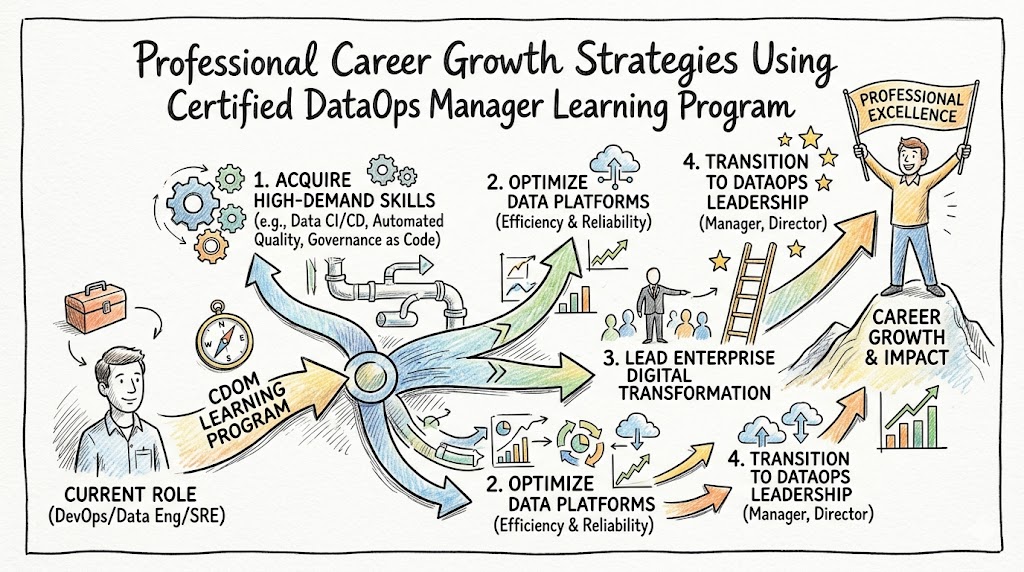
The modern data landscape demands more than just storage; it requires seamless integration and rapid delivery through the CDOM – Certified DataOps Manager program. DataOps represents the intersection of data engineering, DevOps, and agile methodologies, ensuring that high-quality data reaches stakeholders without traditional bottlenecks. This guide serves professionals seeking to bridge the gap between technical data management and strategic operational leadership. By following this roadmap, engineers can navigate the complexities of automated data pipelines and governance frameworks effectively. Understanding this certification helps DataOpsSchool students and global professionals align their technical skills with enterprise business objectives.
What is the CDOM – Certified DataOps Manager?
The CDOM – Certified DataOps Manager is a professional designation focused on the operationalization of data science and engineering workflows. It exists to standardize how organizations manage the end-to-end data lifecycle, from ingestion to consumption, using automated processes. This program emphasizes production-grade excellence, moving beyond theoretical data modeling into the realm of continuous integration and continuous delivery for data. It aligns perfectly with modern engineering practices by treating data code with the same rigor as software application code.
Who Should Pursue CDOM – Certified DataOps Manager?
Senior data engineers and cloud architects find immense value in this certification as it validates their ability to lead complex platform migrations. System administrators and SREs transitioning into data-centric roles use this path to understand the unique telemetry and monitoring requirements of data pipelines. Management professionals in the technology sector benefit by learning how to reduce cycle times and improve data quality across diverse teams. Whether you are based in a burgeoning tech hub in India or working for a global enterprise, this certification addresses universal data challenges.
Why CDOM – Certified DataOps Manager is Valuable and Beyond
The demand for streamlined data operations continues to grow as enterprises move away from siloed departmental structures. This certification provides longevity because it focuses on core principles like automation, collaboration, and monitoring rather than specific, fleeting tools. Professionals holding this credential stay relevant by mastering the cultural and technical shifts necessary for agile data management. Organizations prioritize hiring certified managers who can demonstrate a clear return on investment through reduced operational costs and faster insight generation.
CDOM – Certified DataOps Manager Certification Overview
The certification program is delivered via the official curriculum and hosted on the specialized educational platform. It utilizes a practical assessment approach that requires candidates to demonstrate proficiency in managing complex data environments and stakeholder expectations. The ownership of the program ensures that the content remains updated with the latest industry trends and security compliance standards. Structurally, the certification focuses on real-world scenarios that a manager would encounter during a typical enterprise digital transformation journey.
CDOM – Certified DataOps Manager Certification Tracks & Levels
The program is organized into foundation, professional, and advanced levels to cater to different stages of a professional career. The foundation level introduces the core philosophy of DataOps and the basic automation techniques required for stable pipelines. Moving to the professional level, the focus shifts toward orchestration, security integration, and multi-cloud data strategies. Finally, the advanced level is designed for aspiring leaders who must manage entire departments and large-scale data ecosystems across global infrastructures.
Complete CDOM – Certified DataOps Manager Certification Table
| Track | Level | Who it’s for | Prerequisites | Skills Covered | Recommended Order |
| Core DataOps | Foundation | Junior Engineers | Basic Data Knowledge | Pipeline Basics, Agile | 1 |
| Engineering | Professional | Data Engineers | 2 Years Experience | CI/CD for Data, Testing | 2 |
| Management | Advanced | Lead Engineers | 5 Years Experience | Governance, ROI, Strategy | 3 |
| Security | Specialist | Security Ops | Cloud Security Basics | Data Masking, Compliance | 2 |
| Platform | Specialist | SRE / DevOps | Kubernetes Knowledge | Infrastructure as Code | 2 |
Detailed Guide for Each CDOM – Certified DataOps Manager Certification
CDOM – Certified DataOps Manager – Foundation Level
What it is
This certification validates a candidate’s understanding of the fundamental principles of DataOps and the collaborative culture required for success. It ensures the professional speaks the common language of automated data delivery.
Who should take it
It is ideal for junior data scientists, entry-level engineers, and project managers who are new to the concept of operationalizing data. It serves as a solid starting point for those moving from traditional DBA roles.
Skills you’ll gain
- Understanding the DataOps Manifesto and core values.
- Knowledge of automated testing for data quality.
- Basic version control for data schema management.
Real-world projects you should be able to do
- Setting up a basic automated data ingestion pipeline.
- Implementing a version control system for SQL scripts.
Preparation plan
- 7-14 Days: Review the core glossary and the DataOps manifesto.
- 30 Days: Complete the official foundation course and practice basic pipeline automation.
- 60 Days: Not required for this level unless the candidate is entirely new to IT.
Common mistakes
- Focusing too much on specific tools rather than the underlying methodology.
- Ignoring the cultural aspect of collaboration between developers and data scientists.
Best next certification after this
- Same-track: CDOM Professional Level.
- Cross-track: Cloud Practitioner Certification.
- Leadership: Project Management Professional.
CDOM – Certified DataOps Manager – Professional Level
What it is
This level focuses on the technical execution of DataOps, including orchestration and continuous integration of data assets. It validates the ability to build resilient and scalable data architectures.
Who should take it
Senior data engineers and DevOps specialists who are responsible for the daily reliability of data platforms should pursue this. It requires a deeper technical grasp of automation tools.
Skills you’ll gain
- Advanced orchestration using modern workflow tools.
- Implementation of “Data as Code” principles.
- Monitoring and observability for high-volume data streams.
Real-world projects you should be able to do
- Creating a self-healing data pipeline that alerts on quality drift.
- Deploying a containerized data environment using Kubernetes.
Preparation plan
- 7-14 Days: Brush up on containerization and advanced SQL.
- 30 Days: Build three different production-style pipelines in a lab environment.
- 60 Days: Deep dive into security compliance and data governance automation.
Common mistakes
- Underestimating the complexity of stateful data in a CI/CD environment.
- Neglecting the documentation of automated workflows.
Best next certification after this
- Same-track: CDOM Advanced Manager.
- Cross-track: Certified SRE Professional.
- Leadership: Technical Program Manager.
Choose Your Learning Path
DevOps Path
Engineers in this path focus on bringing the rigor of software engineering to the data world. They learn how to apply Jenkins or GitLab CI/CD patterns to data transformations and database migrations. This path ensures that data infrastructure is treated as code, allowing for rapid environment provisioning. It bridges the gap between infrastructure stability and data agility.
DevSecOps Path
This path prioritizes the security of data throughout its lifecycle, focusing on automated compliance and encryption. Professionals learn to integrate security checks directly into the data pipeline to prevent leaks and unauthorized access. It involves mastering identity and access management for massive datasets. The goal is to ensure that speed does not compromise data privacy or regulatory standards.
SRE Path
Site Reliability Engineering for data focuses on the availability and performance of data platforms. Professionals in this path manage service level objectives for data freshness and accuracy. They implement advanced monitoring to catch pipeline failures before they impact downstream business intelligence tools. This ensures that the data platform remains robust under heavy enterprise loads.
AIOps Path
This path explores the use of machine learning to enhance operational efficiency within IT environments. It involves using data-driven insights to predict system failures and automate incident responses. Professionals learn how to manage the specialized data needs of AI models. It focuses on the intersection of infrastructure telemetry and predictive analytics.
MLOps Path
MLOps is dedicated to the lifecycle management of machine learning models, from training to production deployment. This path teaches how to version models and datasets simultaneously to ensure reproducibility. It addresses the unique challenges of “model drift” and continuous retraining. Professionals learn to create a feedback loop that keeps AI applications accurate over time.
DataOps Path
The pure DataOps path is about optimizing the entire value stream of data within an organization. It focuses on reducing the time it takes to turn raw data into actionable insights for the business. Professionals learn to manage the “data factory” by applying lean manufacturing principles to data flows. This path is essential for those who want to lead data transformation initiatives.
FinOps Path
FinOps professionals focus on the cloud economics of data processing and storage. This path teaches how to monitor and optimize the costs associated with massive data warehouses and compute clusters. It involves aligning technical spending with business value to ensure profitability. The goal is to create a culture of financial accountability within engineering teams.
Role → Recommended CDOM – Certified DataOps Manager Certifications
| Role | Recommended Certifications |
| DevOps Engineer | CDOM Professional, Kubernetes Administrator |
| SRE | CDOM Professional, SRE Foundation |
| Platform Engineer | CDOM Advanced, Terraform Specialist |
| Cloud Engineer | CDOM Foundation, AWS/Azure Architect |
| Security Engineer | CDOM Security Specialist, CISSP |
| Data Engineer | CDOM Professional, Big Data Specialist |
| FinOps Practitioner | CDOM Foundation, FinOps Certified |
| Engineering Manager | CDOM Advanced, Leadership Professional |
Next Certifications to Take After CDOM – Certified DataOps Manager
Same Track Progression
Once the manager level is achieved, professionals should look toward specialized data architecture certifications. These programs dive deeper into specific technologies like Snowflake or Databricks while maintaining a DataOps mindset. Deep specialization ensures that you remain the go-to expert for complex technical troubleshooting. It allows for a transition into principal or fellow engineer roles.
Cross-Track Expansion
Broadening your skills into SRE or security provides a more holistic view of the enterprise ecosystem. Understanding how data operations impact overall system reliability makes you a more versatile asset. Cross-training in cloud-native security ensures that your data pipelines are not just fast but also impenetrable. This approach makes you suitable for high-level Platform Engineering roles.
Leadership & Management Track
For those moving into executive roles, certifications in IT strategy and digital transformation are the logical next steps. These programs focus on the business impact of technology and how to lead large-scale cultural changes. It involves mastering budget management, vendor relations, and organizational design. This transition is perfect for those aiming for CTO or Head of Data positions.
Training & Certification Support Providers for CDOM – Certified DataOps Manager
DevOpsSchool
This provider offers extensive resources for professionals looking to master the integration of development and operations. They focus on practical labs and real-world scenarios that prepare students for the rigors of modern enterprise environments. Their curriculum is designed to be accessible for both beginners and experienced engineers seeking a career shift.
Cotocus
A specialized training organization that emphasizes cloud-native technologies and containerization. They provide hands-on experience with tools that are essential for any DataOps or DevOps practitioner today. Their training modules are updated frequently to reflect the rapidly changing tech landscape.
Scmgalaxy
This community-driven platform provides a wealth of knowledge on configuration management and software supply chains. It is an excellent resource for those who want to understand the history and evolution of DevOps practices. They offer deep dives into the technical aspects of version control and build automation.
BestDevOps
Focusing on high-level strategy and career mentorship, this provider helps engineers transition into leadership roles. Their training includes soft skills and architectural decision-making which are crucial for senior management positions. They emphasize the value of long-term career growth over short-term tool mastery.
devsecopsschool.com
This institution focuses exclusively on the intersection of security and development operations. They teach students how to build “secure by design” pipelines that protect sensitive enterprise data. Their courses are essential for anyone working in highly regulated industries like finance or healthcare.
sreschool.com
Site Reliability Engineering is the core focus here, teaching the principles of system uptime and performance. Students learn how to manage large-scale distributed systems with confidence and precision. The curriculum covers everything from error budgets to advanced automated monitoring.
aiopsschool.com
Dedicated to the emerging field of artificial intelligence in operations, this provider explores predictive analytics. They help professionals understand how to use machine learning to manage complex IT infrastructures. Their training is at the forefront of the next wave of operational automation.
dataopsschool.com
The primary authority for DataOps education, providing the specific framework for the CDOM certification. They offer a comprehensive look at how to manage the data lifecycle with agility and scale. Their programs are recognized globally for their practical approach to data management.
finopsschool.com
This provider tackles the financial side of cloud operations, helping teams manage their spending effectively. They teach the frameworks necessary for cost optimization and financial accountability in the cloud. It is a vital resource for managers who need to balance performance with budget constraints.
Frequently Asked Questions (General)
1. How difficult is the CDOM certification exam for a beginner?
The foundation level is manageable with dedicated study, but higher levels require significant hands-on experience with data systems.
2. What are the primary prerequisites for starting this certification path?
A basic understanding of data structures, SQL, and general software development life cycles is highly recommended for all candidates.
3. How much time should I dedicate to preparing for the exam?
Most professionals find that 30 to 60 days of consistent study and lab work provides a comfortable cushion for success.
4. Is there a high return on investment for this specific certification?
Yes, as organizations increasingly prioritize data-driven decision-making, the need for managers who can operationalize data is at an all-time high.
5. In what order should I take the different certification levels?
It is always recommended to start with the foundation to build a strong theoretical base before moving to professional and advanced.
6. Does this certification focus on specific tools like Jenkins or Airflow?
While it uses popular tools for demonstrations, the core focus is on the methodology and principles that apply to any toolset.
7. Can I maintain this certification indefinitely once I pass?
Most professional certifications require periodic renewal or continuing education credits to ensure your skills remain current with industry shifts.
8. Are there lab environments provided during the training phase?
Most authorized training providers include cloud-based lab environments where you can practice building and managing real data pipelines.
9. How does this differ from a standard Data Engineering certification?
Data engineering focuses on building the pipes, while DataOps focuses on the speed, quality, and reliability of the entire delivery process.
10. Is this certification recognized by major tech companies globally?
The principles taught are universal and aligned with the practices of top-tier technology firms and global enterprises.
11. Are there group discounts available for corporate engineering teams?
Many providers offer corporate packages for teams looking to standardize their operations under a single methodology.
12. What kind of support is available if I fail the exam?
Most programs offer a retake policy and additional coaching to help you identify and strengthen your weak areas.
FAQs on CDOM – Certified DataOps Manager
1. What is the core philosophy behind the CDOM framework?
The philosophy is rooted in the DataOps Manifesto, which emphasizes individuals and interactions over processes and tools to achieve rapid, high-quality data delivery.
2. How does CDOM address data quality issues in production?
It introduces automated testing and observability at every stage of the pipeline to catch and remediate data drift or corruption instantly.
3. Can a project manager without a coding background pass CDOM?
A project manager can pass the foundation level, but the professional and advanced levels require a deeper understanding of technical automation.
4. How does CDOM integrate with existing DevOps workflows?
It extends DevOps principles like CI/CD and monitoring to the specific nuances of data, such as schema changes and stateful transformations.
5. What role does automation play in the CDOM certification?
Automation is central, as the goal is to eliminate manual interventions that lead to errors and slow down the data delivery cycle.
6. Is CDOM relevant for small startups or only large enterprises?
While enterprises benefit from the scale, startups use CDOM to build lean, efficient data practices that can scale without adding massive headcount.
7. Does the certification cover data governance and privacy?
Yes, the curriculum includes sections on automating compliance and ensuring data privacy is baked into the pipeline rather than added later.
8. How often is the CDOM curriculum updated by the providers?
The curriculum is reviewed annually to include new best practices in cloud-native data management and emerging security threats.
Final Thoughts: Is CDOM – Certified DataOps Manager Worth It?
Investing in the CDOM – Certified DataOps Manager certification is a strategic move for any professional serious about the future of data. As the industry moves away from “big bang” data projects toward continuous delivery, these skills become indispensable. The certification does not just teach you how to use a tool; it teaches you how to lead a cultural and technical shift. This results in higher reliability for your organization and a more clear career path for you as an engineer or manager. Focus on the principles, master the automation, and you will find yourself at the forefront of the modern data economy. Balancing technical depth with operational excellence is the key to long-term success in this field.