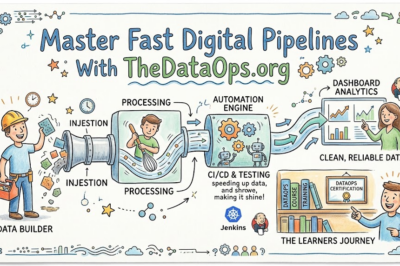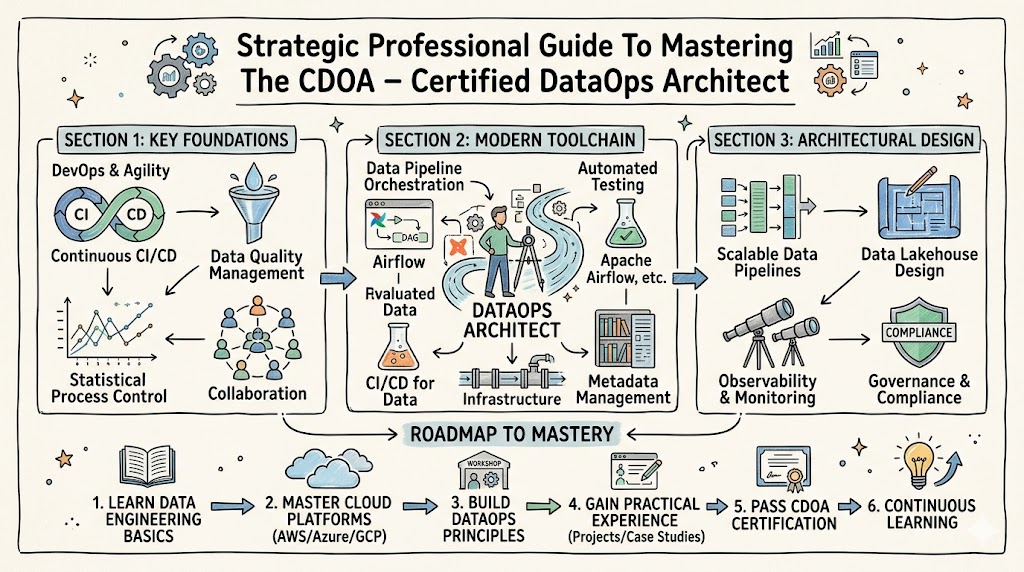
The contemporary data environment necessitates a smooth flow of high-quality data via automated pipelines in addition to storage. This is where CDOA – Certified DataOps Architect becomes essential for professionals looking to bridge the gap between data engineering and operational excellence. This guide is designed for software engineers, platform specialists, and architects who aim to lead enterprise-grade data initiatives. By understanding the principles of DataOps, you can significantly improve the agility and reliability of data-driven applications in cloud-native environments. This comprehensive walkthrough helps you navigate the certification landscape offered by DataOpsSchool to make informed decisions for your career trajectory.
What is the CDOA – Certified DataOps Architect?
The CDOA – Certified DataOps Architect represents a specialized discipline that merges DevOps principles with data management. It exists to solve the inherent friction between data producers and consumers by introducing automation, continuous integration, and rapid deployment into data workflows. Rather than focusing on abstract theory, this certification emphasizes the creation of production-ready environments where data quality is monitored in real-time. It aligns perfectly with modern engineering workflows by treating data pipelines as code, ensuring that enterprise practices remain scalable and resilient.
Who Should Pursue CDOA – Certified DataOps Architect?
This architectural path is ideally suited for senior data engineers, SREs, and cloud architects who manage large-scale information systems. Since DataOps sits at the intersection of various departments, even security professionals and engineering managers benefit from understanding how to govern automated data flows. Beginners with a strong foundation in Linux and cloud basics can use this to specialize early, while experienced engineers use it to pivot into high-demand architecture roles. Given the global shift toward data-centric decision-making, professionals in India and across the world find this expertise increasingly vital for leadership positions.
Why CDOA – Certified DataOps Architect is Valuable in and Beyond
As enterprises move away from static data silos, the demand for architects who can build fluid, automated systems continues to grow rapidly. This certification ensures longevity because it focuses on the methodology of “Continuous Data” rather than just a single fleeting software tool. By mastering the orchestration of data pipelines, professionals remain relevant even as underlying technologies evolve from traditional warehouses to modern lakehouses. The return on time and career investment is substantial, as organizations prioritize candidates who can reduce the cycle time of data analytics while maintaining strict compliance.
CDOA – Certified DataOps Architect Certification Overview
The program is delivered via the official portal and hosted on the main site to provide a structured learning experience for technical professionals. The certification levels are designed to move from foundational knowledge to complex architectural design using a practical, assessment-based approach. Ownership of the curriculum is maintained by industry experts who ensure the structure reflects current enterprise needs, including version control for data and automated testing. Candidates are evaluated on their ability to design systems that are both observable and reproducible in high-stakes production environments.
CDOA – Certified DataOps Architect Certification Tracks & Levels
The curriculum is divided into foundation, professional, and advanced levels to cater to different stages of career progression. The foundation level introduces the core philosophy of automating data delivery, while the professional track dives deep into specific orchestration tools and cloud integrations. For those seeking mastery, the advanced level focuses on multi-cloud data architecture and cross-functional leadership in DataOps. These levels align with career growth, allowing an engineer to move from a contributor role into a strategic architect or principal consultant position.
Complete CDOA – Certified DataOps Architect Certification Table
| Track | Level | Who it’s for | Prerequisites | Skills Covered | Recommended Order |
| Core DataOps | Foundation | Associate Engineers | Basic SQL & Linux | Data Pipeline Basics | First |
| Architecture | Professional | Senior Engineers | Cloud Experience | Orchestration & CI/CD | Second |
| Enterprise | Advanced | Lead Architects | 5+ Years Industry | Governance & Scale | Third |
| Analytics | Specialization | Data Analysts | Python Knowledge | Automated Reporting | Optional |
Detailed Guide for Each CDOA – Certified DataOps Architect Certification
CDOA – Certified DataOps Architect – Foundation Level
What it is
This certification validates a candidate’s understanding of the fundamental principles of DataOps, focusing on the cultural and technical shifts required for automation. It confirms that the professional understands how to apply DevOps-style agility to data management tasks.
Who should take it
Entry-level data engineers, system administrators, or software developers who want to understand how data flows through a modern CI/CD pipeline. It is perfect for those new to the intersection of data and operations.
Skills you’ll gain
- Mastery of version control for data assets.
- Understanding of automated data testing frameworks.
- Knowledge of basic containerization for data workloads.
- Familiarity with the DataOps manifesto and core values.
Real-world projects you should be able to do
- Setting up a basic automated data ingestion pipeline.
- Implementing versioning for a small-scale database schema.
Preparation plan
A 7-14 day plan involves reviewing core definitions and the DataOps manifesto. A 30-day strategy includes hands-on labs with Git and basic Docker. The 60-day approach allows for deep diving into SQL optimization and pipeline monitoring tools.
Common mistakes
- Focusing too much on specific tools rather than the underlying methodology.
- Ignoring the importance of data quality testing in the early stages.
Best next certification after this
- Same-track option: CDOA Professional Level.
- Cross-track option: SRE Foundation.
- Leadership option: Project Management Professional.
CDOA – Certified DataOps Architect – Professional Level
What it is
This level validates the ability to implement and manage complex data orchestration layers within a cloud environment. It focuses on the technical execution of “Data as Code” and the integration of security and monitoring.
Who should take it
Experienced engineers and SREs who are responsible for the uptime and performance of data platforms. It is intended for those who need to build scalable, self-healing data systems.
Skills you’ll gain
- Proficiency in advanced orchestration tools like Airflow or Prefect.
- Implementation of Infrastructure as Code for data environments.
- Designing real-time data monitoring and alerting systems.
- Managing multi-tenant data platforms with strict access controls.
Real-world projects you should be able to do
- Building a production-grade ETL/ELT pipeline with automated error recovery.
- Deploying a scalable data warehouse on a cloud provider using Terraform.
Preparation plan
Spend 7-14 days mastering orchestration syntax and logic. Use a 30-day window to build full-stack data projects in a lab environment. A 60-day plan should include studying security compliance and cost optimization strategies.
Common mistakes
- Over-engineering pipelines with unnecessary complexity.
- Neglecting the documentation of data lineage and metadata.
Best next certification after this
- Same-track option: CDOA Advanced Architect.
- Cross-track option: Certified DevSecOps Professional.
- Leadership option: Technical Program Manager.
Choose Your Learning Path
DevOps Path
The DevOps path focuses on integrating data pipelines into existing CI/CD workflows to ensure seamless delivery. Engineers in this track learn how to treat data infrastructure with the same rigor as application code. By mastering these skills, they bridge the gap between software releases and data availability. This path is essential for organizations that want to avoid data-related bottlenecks during frequent deployment cycles.
DevSecOps Path
In this track, the focus shifts to the security and compliance aspects of data movement across the enterprise. Professionals learn how to implement automated security checks and data masking within the pipeline. It ensures that sensitive information is protected without slowing down the development process. This path is critical for industries like finance and healthcare where data governance is non-negotiable.
SRE Path
The SRE path emphasizes the reliability, scalability, and observability of data systems. Engineers learn how to set Service Level Objectives for data freshness and accuracy while managing distributed systems. By applying SRE principles, they ensure that data platforms can handle sudden spikes in traffic without failure. This is the preferred route for those maintaining mission-critical data infrastructure.
AIOps Path
This path explores how artificial intelligence can be used to automate IT operations and data management. Professionals learn to implement machine learning models that predict system failures and optimize resource allocation. It focuses on reducing the manual burden of monitoring by using intelligent algorithms. This specialization is vital for modern enterprises managing massive, complex cloud environments.
MLOps Path
The MLOps path is dedicated to the lifecycle management of machine learning models in production. It covers the automation of model training, testing, and deployment to ensure consistent performance. Engineers learn how to handle data versioning and model drift to maintain high-quality AI outputs. This track is indispensable for teams looking to scale their machine learning initiatives effectively.
DataOps Path
The core DataOps path focuses entirely on the orchestration and quality of data flows throughout the organization. It teaches how to build a collaborative environment where data scientists and operations teams work in sync. By reducing cycle times for data analytics, professionals in this track drive faster business insights. It is the primary choice for those specializing in modern data architecture.
FinOps Path
The FinOps path centers on the financial management and cost optimization of cloud-based data systems. Professionals learn how to track data spending and implement strategies to reduce waste in storage and compute. This track ensures that data initiatives remain profitable and sustainable within the corporate budget. It is highly valued by management for its direct impact on the bottom line.
Role → Recommended CDOA – Certified DataOps Architect Certifications
| Role | Recommended Certifications |
| DevOps Engineer | CDOA Foundation, DevOps Professional |
| SRE | CDOA Professional, SRE Advanced |
| Platform Engineer | CDOA Architect, Kubernetes Expert |
| Cloud Engineer | CDOA Foundation, Cloud Architect |
| Security Engineer | CDOA DevSecOps, Security Lead |
| Data Engineer | CDOA Professional, Data Specialist |
| FinOps Practitioner | CDOA FinOps, Cost Management |
| Engineering Manager | CDOA Foundation, Leadership Track |
Next Certifications to Take After CDOA – Certified DataOps Architect
Same Track Progression
After achieving the initial architect status, professionals should look toward deep specialization in niche areas of data management. This might involve focusing on specific high-performance computing clusters or advanced streaming data architectures. Staying within the same track allows you to become a subject matter expert who can solve the most complex technical challenges. Deepening this expertise is the fastest way to reach principal or distinguished engineer status.
Cross-Track Expansion
Broadening your skills into related fields like DevSecOps or AIOps can make you a more versatile asset to any organization. By understanding how data interacts with security and artificial intelligence, you can design more holistic systems. This cross-pollination of skills is highly sought after in modern platform engineering teams. It allows you to act as a bridge between different technical silos, improving overall company efficiency.
Leadership & Management Track
For those looking to move away from individual contributor roles, the leadership track offers a path into management. This involves learning about team dynamics, strategic planning, and the business impact of technical decisions. Transitioning to leadership requires a shift from “how to build” to “why we build” certain systems. It is the ideal route for those who want to influence the long-term direction of an engineering department.
Training & Certification Support Providers for CDOA – Certified DataOps Architect
DevOpsSchool
This provider offers extensive training programs that cover the entire spectrum of modern engineering practices, including DataOps and SRE. Their curriculum is known for being highly practical and aligned with current industry standards for enterprise-grade automation.
Cotocus
Specializing in cloud-native technologies, this organization provides focused bootcamps and certification support for professionals looking to master infrastructure. They emphasize hands-on learning and real-world scenarios to ensure students are ready for complex production environments.
Scmgalaxy
As a community-driven platform, they offer a wealth of resources, tutorials, and certification guides for software configuration management. Their focus is on helping engineers understand the intricacies of version control and continuous integration in a data-driven world.
BestDevOps
This training provider focuses on delivering high-quality education for those seeking to excel in DevOps and related disciplines. Their courses are designed to be concise and effective, making them a popular choice for busy working professionals.
devsecopsschool.com
This platform is dedicated to the integration of security into the DevOps lifecycle, providing specialized training for modern security engineers. Their programs ensure that safety is never an afterthought in the automated delivery process.
sreschool.com
Focused on site reliability engineering, this site offers deep dives into system stability, observability, and performance optimization. It is a primary resource for those looking to build and maintain resilient cloud-based architectures.
aiopsschool.com
This provider leads the way in teaching how to apply artificial intelligence to operations, helping teams automate routine tasks. Their curriculum covers the latest in predictive analytics and intelligent system monitoring.
dataopsschool.com
As the primary host for the architect certification, this site offers the most direct and comprehensive path to mastering DataOps. Their training is specifically tailored to the requirements of the architectural exam and real-world application.
finopsschool.com
This organization addresses the growing need for financial accountability in the cloud, teaching professionals how to manage costs. Their training helps bridge the gap between engineering teams and the finance department.
Frequently Asked Questions (General)
- How difficult is the architect certification for a beginner?
While it is challenging, the foundational track is designed to guide beginners through the core concepts systematically before moving to complex topics. - How much time does it typically take to complete the program?
Most professionals spend between one and three months preparing, depending on their existing experience with cloud and data systems. - Are there any mandatory prerequisites before I can start?
There are no strict legal prerequisites, but a basic understanding of SQL, Linux, and cloud infrastructure is highly recommended for success. - What is the expected return on investment for this certification?
The ROI is significant, as it qualifies you for high-paying roles in data architecture and platform engineering which are currently in high demand. - In what sequence should I take the different certification levels?
It is best to start with the Foundation level, move to Professional, and finally tackle the Advanced Architect level to build a solid knowledge base. - Does the certification focus on specific software tools?
The program focuses primarily on methodologies and architectural patterns, though it uses popular tools like Docker and Airflow for practical demonstrations. - Is the exam conducted online or at a physical center?
The certification exam is conveniently offered online, allowing you to take it from anywhere in the world at a scheduled time. - How long does the certification remain valid after passing?
Typically, the certification is valid for two years, after which you may need to renew or move to a higher level to stay current. - Will this help me transition from a developer to an architect?
Yes, it is specifically designed to provide the high-level perspective and technical depth required for architectural decision-making. - Are there any hands-on labs included in the training?
The training providers usually include intensive hands-on labs that simulate real-world production environments to ensure practical competence. - How does this differ from a standard data engineering course?
Standard courses focus on data transformation, while this certification focuses on the operational excellence and automation of those transformation processes. - Is there a global community for certified architects?
Yes, there is a growing community where certified professionals can network, share best practices, and find new career opportunities.
FAQs on CDOA – Certified DataOps Architect
- What makes DataOps different from traditional DevOps?
DataOps specifically addresses the unique challenges of data quality, schema evolution, and large-scale state management that are not present in standard application code. - Can I use these skills in a multi-cloud environment?
Absolutely, the architectural principles taught are cloud-agnostic and focus on patterns that work across AWS, Azure, and Google Cloud Platform. - How does this certification address data privacy regulations like GDPR?
The curriculum includes modules on building automated governance and compliance checks directly into the data pipelines to ensure regulatory adherence. - Is Python a requirement for the architectural track?
While not strictly required for every module, having a working knowledge of Python is extremely beneficial for scripting and orchestration tasks. - How does DataOps improve the speed of analytics?
By automating the testing and deployment of data, it reduces the manual errors and bottlenecks that typically slow down the delivery of insights. - Are there group discounts available for corporate teams?
Most training providers offer customized packages for engineering teams looking to upskill their entire department in DataOps practices. - Does the program cover real-time streaming data?
Yes, the professional and advanced levels dive into the complexities of managing and monitoring real-time data flows and event-driven architectures. - What kind of support is available if I fail the exam?
Most providers offer a retake policy and additional coaching to help you identify and bridge the gaps in your knowledge before the next attempt.
Final Thoughts: Is CDOA – Certified DataOps Architect Worth It?
Any engineer who understands that data will drive technology in the future would be wise to invest in this certification. Building automated, robust systems that can manage the complexity of contemporary company data is now the primary responsibility of architects, rather than merely creating diagrams. You may show that you are dedicated to operational excellence and have a thorough understanding of how to connect development and data science by obtaining this credential. It offers both the strategic understanding needed to impact organizational growth and the technical depth needed to lead teams. This path provides a clear and useful roadmap if you want to advance your career and take on bigger responsibilities. If you concentrate on the fundamentals and become proficient with automation, you will discover