Cloud financial management has evolved from simple cost-tracking into a sophisticated architectural discipline that bridges the gap between engineering and finance. The Certified FinOps Architect program at FinOpsSchool provides a robust framework for professionals looking to master the art of cloud value optimization. This guide is designed for senior engineers, architects, and managers who need to move beyond basic reporting to building scalable, cost-aware cloud platforms. As modern infrastructure becomes increasingly complex, understanding how to bake fiscal accountability into the technical design process is no longer optional but a core requirement for leadership.
What is the Certified FinOps Architect?
The Certified FinOps Architect represents a specialized professional standard that validates an individual’s ability to design cloud systems with financial efficiency as a primary architectural pillar. Unlike theoretical courses, this program emphasizes production-focused learning, teaching participants how to implement automated governance and real-time visibility. It aligns perfectly with modern engineering workflows by integrating unit economics directly into the CI/CD pipeline and resource provisioning cycles. This ensures that enterprise practices remain sustainable even as cloud footprints grow across multi-cloud and hybrid environments.
Who Should Pursue Certified FinOps Architect?
This certification is ideal for Site Reliability Engineers (SREs), Platform Engineers, and Cloud Architects who are responsible for large-scale infrastructure. Experienced engineers will find value in the advanced optimization techniques, while engineering managers can use the framework to better align their team’s technical output with business objectives. Beginners in the cloud space can use this path to differentiate themselves by showing they understand the “business of cloud.” Both global and India-specific enterprises are currently seeking these roles to manage the rising costs of digital transformation.
Why Certified FinOps Architect is Valuable and Beyond
The demand for specialized financial architects is surging as organizations realize that uncontrolled cloud spending can erode the benefits of agility. Pursuing this path offers long-term career longevity because the principles of resource efficiency and architectural accountability remain relevant even as specific cloud providers or tools change. It provides a significant return on time by equipping professionals with a unique skill set that combines deep technical knowledge with business acumen. This dual expertise makes you an indispensable asset in any enterprise adoption strategy.
Certified FinOps Architect Certification Overview
The program is delivered via the official course page and is hosted on FinOpsSchool. It utilizes a practical assessment approach that moves away from simple multiple-choice questions toward demonstrating ownership of architectural decisions. The structure is designed to be modular, allowing professionals to grasp complex concepts like commitment-based discounts and shared cost allocation in a logical sequence. It effectively bridges the gap between high-level financial goals and the low-level technical configurations required to achieve them.
Certified FinOps Architect Certification Tracks & Levels
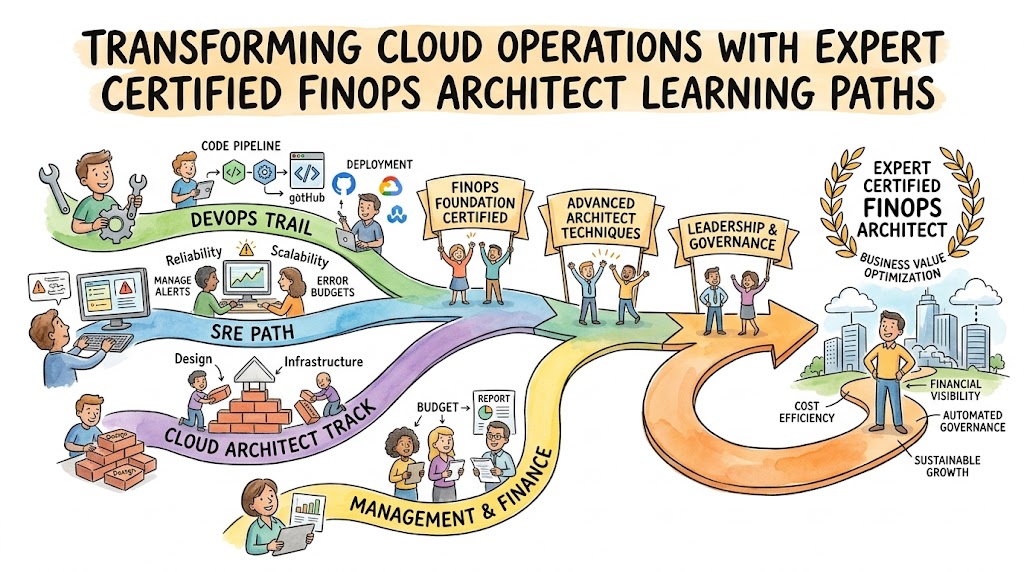
The certification follows a progressive path starting with foundation concepts before moving into professional and advanced architectural strategies. Foundation levels focus on terminology and the FinOps lifecycle, while professional tracks dive into tool integration and data analysis. The advanced levels are where specialization occurs, allowing practitioners to align their learning with specific domains like DevOps or SRE. This tiered approach ensures that career progression is supported by a continuous deepening of technical and financial expertise.
Complete Certified FinOps Architect Certification Table
| Track | Level | Who it’s for | Prerequisites | Skills Covered | Recommended Order |
| FinOps Foundations | Associate | Entry-level Engineers | Basic Cloud Knowledge | Lifecycle, Terminology | First |
| FinOps Professional | Professional | Senior Engineers | Associate Cert | Tooling, Unit Economics | Second |
| FinOps Architect | Advanced | Principal Architects | Professional Cert | Governance, Automation | Third |
| FinOps for DevOps | Specialization | DevOps Engineers | Foundation Cert | Pipeline Integration | Optional |
Detailed Guide for Each Certified FinOps Architect Certification
Certified FinOps Architect – Foundation Level
What it is
This certification validates a baseline understanding of the FinOps lifecycle: Inform, Optimize, and Operate. It ensures the candidate understands how cloud billing works and the importance of visibility.
Who should take it
It is suitable for junior cloud engineers, procurement officers, and finance professionals who need to speak the same language as the engineering team.
Skills you’ll gain
- Understanding cloud billing data structures.
- Identifying wasted cloud spend.
- Implementing basic tagging and labeling strategies.
Real-world projects you should be able to do
- Create a basic cloud cost dashboard for a small team.
- Perform a month-over-month cost variance analysis.
Preparation plan
- 7-14 Days: Review official glossary and lifecycle stages.
- 30 Days: Participate in community forums and practice billing data analysis.
- 60 Days: Not typically required for this level unless new to cloud.
Common mistakes
- Ignoring the cultural aspect of FinOps.
- Focusing too much on one specific cloud provider’s tools.
Best next certification after this
- Same-track option: FinOps Professional.
- Cross-track option: DevOps Foundation.
- Leadership option: Engineering Management.
Certified FinOps Architect – Professional Level
What it is
This validates the ability to manage complex cost allocation and commitment strategies across multiple accounts. It moves into the “Optimize” phase of the lifecycle with technical depth.
Who should take it
Cloud Architects and SREs who manage budgets over one million dollars annually should prioritize this level.
Skills you’ll gain
- Managing Reserved Instances and Savings Plans.
- Advanced anomaly detection setup.
- Defining unit metrics for business value.
Real-world projects you should be able to do
- Automate the cleanup of orphaned cloud resources.
- Design a shared-cost allocation model for containerized environments.
Preparation plan
- 7-14 Days: Deep dive into discount mechanics.
- 30 Days: Hands-on labs with cloud billing APIs.
- 60 Days: Case study reviews of enterprise migrations.
Common mistakes
- Failing to account for data transfer costs.
- Over-committing to long-term contracts without growth forecasts.
Best next certification after this
- Same-track option: FinOps Architect.
- Cross-track option: Site Reliability Engineer.
- Leadership option: FinOps Director.
Choose Your Learning Path
DevOps Path
Integrating financial metrics into the delivery pipeline is the core of this path. Engineers learn to treat cost as a functional requirement alongside performance and security. This ensures that every deployment is evaluated for its fiscal impact before reaching production.
DevSecOps Path
This path focuses on the intersection of security compliance and cost management. It covers how security scanning tools and compliance-related logging can be optimized to prevent “bill shock” while maintaining a robust security posture across the organization.
SRE Path
Reliability and cost are often in tension, and this path teaches SREs how to balance service level objectives with budget constraints. It emphasizes building automated self-healing systems that scale down effectively to save money without compromising on availability.
AIOps Path
Using machine learning to predict cloud spend and detect anomalies is the focus here. Professionals learn how to implement AI-driven insights to manage the massive datasets generated by cloud billing systems, allowing for proactive rather than reactive management.
MLOps Path
Machine learning models are notoriously expensive to train and host. This path provides specific strategies for managing the lifecycle of ML experiments, ensuring that GPU and TPU resources are used efficiently and that model decay doesn’t lead to wasted spend.
DataOps Path
Data pipelines can quickly become a significant portion of the cloud bill. This path teaches data engineers how to optimize storage tiers, query performance, and data egress to ensure that big data projects remain financially viable over the long term.
FinOps Path
This is the dedicated route for those wanting to specialize entirely in cloud financial management. It covers the full spectrum from cultural transformation to technical automation, preparing individuals to lead a FinOps center of excellence within an enterprise.
Role → Recommended Certified FinOps Architect Certifications
| Role | Recommended Certifications |
| DevOps Engineer | FinOps Associate, Professional Cloud Developer |
| SRE | FinOps Professional, Site Reliability Associate |
| Platform Engineer | FinOps Architect, Infrastructure Specialist |
| Cloud Engineer | FinOps Associate, Cloud Solutions Architect |
| Security Engineer | FinOps Specialist, Cloud Security Professional |
| Data Engineer | DataOps FinOps, Big Data Architect |
| FinOps Practitioner | Professional FinOps, Advanced FinOps Architect |
| Engineering Manager | FinOps Leadership, IT Financial Management |
Next Certifications to Take After Certified FinOps Architect
Same Track Progression
Once you have mastered the architectural level, focusing on specialized cloud provider financial certifications (like those from AWS or Azure) can provide deeper technical implementation knowledge. This allows you to apply the general principles of the architect program to specific vendor ecosystems effectively.
Cross-Track Expansion
Broadening your skills into Site Reliability Engineering or Platform Engineering is a logical next step. Understanding how to build the underlying systems that the FinOps principles govern makes you a more versatile engineer and a better architect.
Leadership & Management Track
For those looking to move into executive roles, certifications in ITIL or general business management can complement your technical expertise. This helps in communicating the value of FinOps to the C-suite and driving organizational change across departments.
Training & Certification Support Providers for Certified FinOps Architect
DevOpsSchool
This provider offers extensive resources for professionals looking to master cloud financial management. They focus on delivering hands-on labs that simulate real-world enterprise environments. Their instructors bring years of industry experience to the table, ensuring that the training is both practical and relevant to current market demands.
Cotocus
Specializing in high-end technical training, this organization provides tailored programs for architecture and site reliability. They emphasize the integration of various cloud disciplines, helping students see the bigger picture. Their curriculum is updated frequently to reflect the latest changes in cloud provider billing and management tools.
Scmgalaxy
As a community-driven platform, they offer a wealth of knowledge on configuration management and automation. Their training modules for financial architecture focus on how to use code to control costs. They are a go-to resource for engineers who prefer a deep-dive into the technical implementation of governance policies.
BestDevOps
This site provides focused tracks for individuals aiming for top-tier certifications. They provide comprehensive study guides and practice assessments that help candidates prepare for the rigors of professional exams. Their approach is straightforward and results-oriented, making it a popular choice for busy working professionals.
devsecopsschool.com
Focusing on the intersection of security and operations, this provider ensures that financial management doesn’t come at the cost of safety. They offer specialized courses that teach how to implement cost-effective security measures. Their training is essential for those working in highly regulated industries like finance or healthcare.
sreschool.com
This platform is dedicated to the art of reliability engineering. They teach how to build systems that are both resilient and cost-efficient. Their curriculum covers everything from service level objectives to automated incident response, all through the lens of modern cloud financial principles.
aiopsschool.com
As artificial intelligence becomes more prevalent, this provider helps engineers manage the associated costs and complexities. They offer training on using AI to optimize infrastructure and predict future spending patterns. This is a critical resource for those looking to stay at the forefront of cloud technology.
dataopsschool.com
Managing data at scale requires a specific set of financial skills, which is exactly what this provider offers. They focus on the economics of data storage, processing, and movement. Their courses are designed for data engineers who need to keep their pipelines efficient and affordable.
finopsschool.com
This is the primary hub for the architect program, offering direct access to the official curriculum and community. They provide the most up-to-date information on certification standards and industry best practices. It is the essential starting point for anyone serious about a career in this field.
Frequently Asked Questions (General)
- How difficult is the Certified FinOps Architect exam?
The exam is moderately challenging as it requires a mix of technical knowledge and financial understanding.
- What is the typical time commitment for preparation?
Most professionals spend between 30 to 60 days preparing, depending on their existing cloud experience.
- Are there any hard prerequisites for the foundation level?
There are no formal prerequisites, but a basic understanding of cloud computing is highly recommended.
- What is the return on investment for this certification?
Professionals often see increased salary potential and opportunities for leadership roles in cloud governance.
- Should I take this before or after a cloud provider certification?
It is often better to have at least one cloud provider certification first to understand the underlying infrastructure.
- Does this certification expire?
Most certifications in this field require renewal every two to three years to stay current with cloud changes.
- Is the exam conducted online or in person?
The exam is typically available online through proctored platforms for global accessibility.
- How much does the certification cost?
Pricing varies by region and level, so it is best to check the official hosting site for current rates.
- Can I use these skills on any cloud platform?
Yes, the principles taught are vendor-neutral and apply to AWS, Azure, Google Cloud, and others.
- Is there a community for support during preparation?
Yes, there are several online forums and study groups dedicated to cloud financial management.
- Does the program cover container costs like Kubernetes?
Yes, modern programs include significant sections on managing and allocating costs in containerized environments.
- Will this help me move into a management role?
Absolutely, as it demonstrates an ability to manage budgets and align technical work with business value.
FAQs on Certified FinOps Architect
- What specific architectural patterns are covered in the curriculum?
The program covers patterns for auto-scaling, serverless optimization, and multi-region cost balancing to ensure efficient resource utilization.
- How does this certification handle multi-cloud cost consolidation?
It teaches strategies for normalizing data from different providers into a single pane of glass for unified reporting.
- Is there a focus on automation tools like Terraform or Pulumi?
Yes, the architect level emphasizes using Infrastructure as Code to enforce financial governance and tagging policies automatically.
- How are unit economics defined in this program?
It teaches you how to identify the specific business metrics, like cost per customer or cost per transaction, that matter most.
- Does the course cover the cultural change required for FinOps?
A significant portion is dedicated to breaking down silos between finance and engineering teams to foster shared accountability.
- Are real-world case studies included in the training?
The curriculum uses enterprise-grade scenarios to illustrate how large organizations have successfully reduced waste and improved efficiency.
- How does the program address anomaly detection?
It covers setting up automated alerts and thresholds to catch unexpected spending spikes before they impact the monthly budget.
- Is commitment-based discount management a major topic?
Yes, the professional and architect levels dive deep into the mechanics of Reserved Instances, Savings Plans, and Spot instances.
Final Thoughts: Is Certified FinOps Architect Worth It?
Any cloud professional hoping to advance in their career would be wise to invest in this certification. The emphasis has drastically changed to efficiency and value as businesses go past the initial “migration” stage of cloud usage. You become an important member of any technological organization if you can not only create a sophisticated system but also make sure it is financially sustainable. The information acquired here is immediate, useful, and has a significant influence. This route is unquestionably worthwhile if you wish to move from a strictly technical position to a strategic architectural one.