Introduction
Transforming infrastructure into a scalable, code-driven asset requires a strategic approach to modern cloud operations. This AWS DevOps Engineer – Professional guide provides a clear roadmap for engineers who want to implement automated lifecycles with precision. Specifically, this resource assists senior developers and cloud practitioners who seek to optimize their software delivery pipelines. By choosing DevOpsschool for technical training, candidates ensure they master the high-level orchestration skills that top-tier enterprises demand. Furthermore, this roadmap explains how to integrate continuous delivery and security guardrails into every stage of the production cycle. Resultantly, professionals use these best practices to distinguish themselves in the competitive landscape of site reliability and platform engineering.
What is the AWS DevOps Engineer – Professional?
The AWS DevOps Engineer – Professional represents the highest standard of validation for individuals who manage distributed systems on the Amazon Web Services platform. Specifically, this certification validates an engineer’s technical proficiency in provisioning, operating, and managing complex cloud architectures. It moves beyond simple service knowledge to focus on the high-level automation of compliance, governance, and operational controls. Engineers must demonstrate their ability to implement self-healing infrastructures and robust continuous delivery systems. Consequently, the program emphasizes real-world, production-focused learning over abstract theoretical concepts. Therefore, this credential confirms that an architect can handle the entire application lifecycle from code commit to global production distribution.
Who Should Pursue AWS DevOps Engineer – Professional?
Senior cloud engineers, site reliability experts, and experienced system administrators find this track essential for validating their operational mastery. Additionally, software developers who want to take full responsibility for their deployment pipelines gain the technical depth required for lead-level roles. Engineering managers also utilize this knowledge to align their organizational strategies with modern, automated enterprise practices. Furthermore, security professionals use the curriculum to learn how to bake automated security guardrails directly into the delivery cycle. Resultantly, any professional in India or the global market who manages production-grade infrastructure should consider this rigorous validation. Therefore, the program serves as a critical milestone for anyone aiming for a principal engineering or architectural leadership position.
Why AWS DevOps Engineer – Professional is Valuable and Beyond
Organizations prioritize hiring certified professionals because these experts possess the skills to reduce operational overhead and increase release frequency significantly. This certification ensures that you remain relevant in a fast-moving industry by teaching underlying principles that outlast specific tool versions. Furthermore, professionals who hold this credential command higher salaries and gain access to the most innovative projects in the cloud-native ecosystem. Holding this certification proves you can maintain system integrity and security while navigating the rapid changes inherent in enterprise environments. Consequently, the program offers an immense return on time investment by securing your position as a high-level technical authority. Therefore, it serves as a long-term career asset that demonstrates your commitment to technical maturity and operational excellence.
AWS DevOps Engineer – Professional Certification Overview
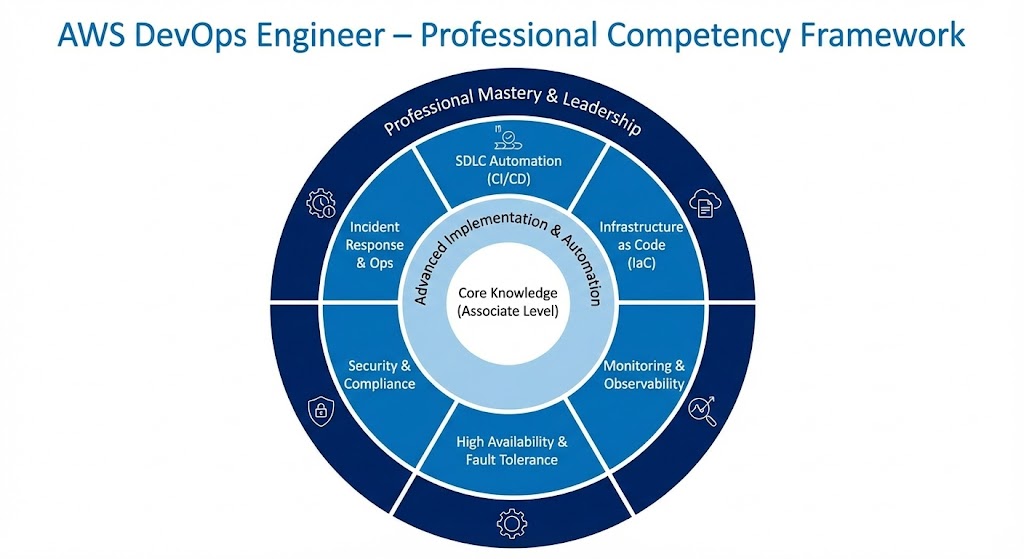
The training program delivers its specialized curriculum through the AWS DevOps Engineer – Professional course hosted on the DevOpsschool platform. Specifically, the curriculum uses a rigorous assessment approach featuring scenario-based questions that mirror actual production crises. The program covers six critical domains, including SDLC automation, configuration management, and incident response. Furthermore, candidates must prove they can manage multi-account strategies and complex networking configurations with high precision. Resultantly, the certification ensures a holistic understanding of how various cloud services interact to support large-scale business operations. Therefore, the overview prepares candidates to architect systems that are not only automated but also resilient and cost-effective.
AWS DevOps Engineer – Professional Certification Tracks & Levels
Professional development in this field typically follows a structured progression starting with foundation-level knowledge to build a core understanding. Subsequently, practitioners move to the professional tier to master advanced orchestration and enterprise-scale automation strategies. Specialty tracks in security, networking, or data allow for even deeper specialization once you complete the professional requirements. This alignment ensures that your technical growth matches the increasing complexity of your professional responsibilities. Furthermore, following these levels provides a clear and logical path for anyone aspiring to reach the pinnacle of cloud engineering. Therefore, the levels reflect a commitment to continuous learning and technical mastery in the modern digital economy.
Complete AWS DevOps Engineer – Professional Certification Table
| Track | Level | Who it’s for | Prerequisites | Skills Covered | Recommended Order |
| Cloud Ops | Associate | Junior Admins | Basic Knowledge | SysOps, Monitoring | Step 1 |
| Developer | Associate | App Devs | Coding Basics | SDKs, CI/CD | Step 1 |
| DevOps | Professional | Senior Leads | Associate Certs | HA, DR, Automation | Step 2 |
| Security | Specialty | Security Leads | Professional Cert | IAM, Encryption | Step 3 |
| Networking | Specialty | Network Leads | Professional Cert | VPC, Hybrid Cloud | Step 3 |
AWS DevOps Engineer – Professional – Associate Level
What it is
This level validates the technical capability to deploy, manage, and operate scalable systems on the AWS platform while ensuring operational health.
Who should take it
Junior cloud engineers and aspiring administrators who want to build a solid foundation in cloud-native operations should start with this certification.
Skills you’ll gain
- Implementing automated scaling strategies to maintain performance under load.
- Monitoring system health using CloudWatch and centralized logging.
- Managing secure data transit and storage across various cloud services.
- Utilizing managed platforms to simplify the deployment of modern applications.
Real-world projects you should be able to do
- Architect a self-healing infrastructure using Auto Scaling and Health Checks.
- Establish a multi-region logging dashboard for distributed microservices.
- Automate the scheduled backup and recovery cycle for a production database.
Preparation plan
- 7–14 days: Deeply review official whitepapers and service-specific FAQs.
- 30 days: Complete interactive video modules and participate in intensive hands-on labs.
- 60 days: Solve multiple sets of practice exams and build a portfolio of unique projects.
Common mistakes
- Focusing exclusively on the web console instead of mastering the Command Line Interface (CLI).
- Underestimating the complexity of identity and access management policies for cross-service communication.
Best next certification after this
- Same-track option: AWS DevOps Professional.
- Cross-track option: AWS Developer Associate.
- Leadership option: AWS Solutions Architect Professional.
AWS DevOps Engineer – Professional – Professional Level
What it is
This advanced level confirms that a candidate can design and manage complex, fully automated production environments and delivery systems.
Who should take it
Senior DevOps engineers and cloud architects with at least two years of experience managing production-grade AWS setups should pursue this.
Skills you’ll gain
- Orchestrating sophisticated CI/CD pipelines that span multiple accounts and regions.
- Provisioning infrastructure as code using advanced CloudFormation and CDK patterns.
- Executing blue/green and canary deployment strategies to minimize user impact.
- Automating enterprise-wide governance, compliance, and security guardrails.
Real-world projects you should be able to do
- Design a globally distributed pipeline featuring automated testing and rollback.
- Build a secure multi-account landing zone using Organizations and Control Tower.
- Implement a full-stack observability framework for a complex microservices mesh.
Preparation plan
- 7–14 days: Solve high-difficulty scenario questions that test architectural decision-making.
- 30 days: Deeply explore advanced features of OpsWorks, Config, and CodeSuite.
- 60 days: Build a complete production environment including automated cost governance.
Common mistakes
- Underestimating the nuances of cross-account IAM roles and resource sharing.
- Choosing an inappropriate deployment strategy for specific business uptime goals.
Best next certification after this
- Same-track option: AWS Security Specialty.
- Cross-track option: AWS Advanced Networking Specialty.
- Leadership option: Certified Kubernetes Administrator (CKA).
Choose Your Learning Path
DevOps Path
The DevOps path merges development and operations through continuous automation and profound cultural transformation. Engineers focus on building resilient pipelines that facilitate the rapid delivery of high-quality software to end-users. Furthermore, they use infrastructure as code to ensure every environment remains consistent across the entire enterprise. This route requires a deep commitment to version control and the total automation of all testing phases. Consequently, professionals following this path often drive the most critical innovations within their engineering teams. Therefore, this path creates a versatile expert capable of handling any production challenge.
DevSecOps Path
The DevSecOps path emphasizes the integration of security protocols directly into the heart of the automated development lifecycle. Professionals implement proactive security scanning and compliance checks to catch vulnerabilities long before they reach production. Furthermore, they focus on sophisticated identity management and encryption standards to protect sensitive organizational data. This approach ensures that delivery speed never compromises the safety or integrity of the application system. Therefore, DevSecOps experts remain highly sought after by companies operating in sensitive or regulated sectors. Consequently, this path offers immense career stability and specialized growth.
SRE Path
The Site Reliability Engineering path applies rigorous software engineering principles to solve the most difficult operational challenges. These professionals focus on maximizing system availability and performance while managing strict service level objectives. They also work tirelessly to eliminate manual toil through the implementation of advanced automation and self-healing mechanisms. Moreover, they utilize comprehensive observability tools to predict and mitigate system failures before they impact the user experience. This path is essential for managing the world’s most demanding and high-traffic cloud applications. Therefore, SREs act as the guardians of system uptime and reliability.
AIOps / MLOps Path
The AIOps and MLOps path leverages artificial intelligence to enhance and automate complex operational workflows and decision-making. Professionals use machine learning models to analyze massive datasets from logs and metrics to predict potential failures. Additionally, MLOps focuses on the systematic management of machine learning model lifecycles, including automated training and deployment. This specialty helps engineering teams handle the overwhelming amount of data generated by modern cloud-native environments. Consequently, it represents the next major frontier in the quest for fully autonomous and intelligent infrastructure. Therefore, this path prepares you for the future of automated systems management.
DataOps Path
The DataOps path centers on the automated management and orchestration of data pipelines and analytical environments. Engineers ensure that high-quality data flows seamlessly from various sources to consumers while maintaining performance standards. Furthermore, they implement version control for data schemas and automate the testing of all extraction and transformation processes. This path is critical for organizations that rely on real-time data to drive their strategic business decisions. Therefore, DataOps practitioners provide the necessary technical bridge between data engineering and traditional operational teams. Consequently, they ensure that data remains a consistent and reliable asset.
FinOps Path
The FinOps path focuses on the financial optimization and strategic management of cloud expenditures across the entire enterprise. Professionals implement detailed tagging strategies and cost-allocation models to bring financial accountability to every engineering team. Additionally, they analyze complex usage patterns to identify significant cost-saving opportunities through the use of reserved instances. This path ensures that the rapid scaling of cloud resources remains economically sustainable for the business. Consequently, FinOps practitioners play a vital role in maximizing the overall business value of cloud investments. Therefore, this path bridges the gap between engineering execution and financial reality.
Role → Recommended AWS DevOps Engineer Professional Certifications
| Role | Recommended Certifications |
| DevOps Engineer | AWS DevOps Professional, Terraform Associate |
| SRE | AWS DevOps Professional, CKA, Prometheus Specialist |
| Platform Engineer | AWS DevOps Professional, Solutions Architect Pro |
| Cloud Engineer | AWS SysOps Associate, AWS DevOps Professional |
| Security Engineer | AWS Security Specialty, DevSecOps Practitioner |
| Data Engineer | AWS Data Engineer Associate, DataOps Expert |
| FinOps Practitioner | AWS DevOps Professional, FinOps Certified Pro |
| Engineering Manager | AWS Cloud Practitioner, AWS DevOps Professional |
Next Certifications to Take After AWS DevOps Engineer Professional
Same Track Progression
Deepening your specialization within the AWS ecosystem allows you to become a primary subject matter expert for your organization. Specifically, obtaining specialty certifications in Security or Advanced Networking builds significantly upon the professional foundation you established. This path leads directly to high-impact roles such as Principal Cloud Architect or Distinguished Systems Engineer. Furthermore, it ensures that you remain the go-to person for solving the most complex and critical infrastructure challenges. Consequently, staying on this track solidifies your position as a top-tier technical authority in the field. Therefore, professional level mastery acts as the perfect springboard for specialty expertise.
Cross-Track Expansion
Broadening your technical skill set by exploring other cloud platforms or tool-specific certifications greatly increases your professional versatility. Indeed, mastering additional platforms like Google Cloud or Microsoft Azure allows you to manage complex multi-cloud strategies effectively. You might also pursue certifications in Kubernetes or HashiCorp tools to diversify your technical resume and appeal to employers. This expansion makes you a more resilient and flexible asset in a technology landscape that changes almost daily. Therefore, cross-track learning ensures you never become dependent on a single vendor or technology stack. Consequently, you build a robust and future-proof career.
Leadership & Management Track
Transitioning into leadership requires a strategic shift from technical execution to team mentorship and high-level project planning. Certifications in Agile management or ITIL complement your deep technical background by adding essential business value and structure. Additionally, focusing on soft skills helps you communicate technical risks and opportunities to non-technical executive stakeholders. This path often leads to influential roles such as DevOps Manager, Director of Cloud Infrastructure, or CTO. Consequently, merging technical mastery with leadership skills provides the ultimate trajectory for long-term career growth and influence. Therefore, this track turns you into a strategic business partner.
Training & Certification Support Providers for AWS DevOps Engineer Professional
DevOpsSchool
DevOpsSchool provides an exceptionally comprehensive and robust learning environment for students pursuing the AWS DevOps Engineer Professional credential. They offer a vast array of hands-on labs and real-world projects that accurately simulate the challenges of production-grade cloud environments. Their instructors possess decades of practical industry experience, ensuring that every lesson contains deep, experience-driven insights. Furthermore, the platform updates its curriculum constantly to reflect the latest advancements and changes in the AWS ecosystem. The community also fosters a strong collaborative environment where learners solve complex problems together. This total support system ensures that every student leaves the program ready to excel in high-stakes roles. Consequently, many successful cloud leaders attribute their technical foundations to this platform.
Cotocus
Cotocus delivers high-impact corporate training and consultancy services that focus on the most advanced cloud and DevOps methodologies available today. They create tailored learning paths that help enterprise engineering teams master the complexities of automated infrastructure on AWS. Their teaching methodology emphasizes the practical implementation of tools over simple theoretical knowledge, ensuring immediate operational impact. Additionally, Cotocus offers specialized workshops that dive deep into specific technologies like Kubernetes, Terraform, and advanced monitoring suites. By addressing the unique needs of large-scale organizations, they ensure that their training leads to measurable improvements in deployment speed and stability. This makes them a trusted partner for digital transformation projects. Furthermore, they provide ongoing support to maintain technical excellence within corporate teams.
Scmgalaxy
Scmgalaxy serves as a vital global community hub and knowledge center for DevOps and configuration management professionals across the industry. They provide a massive library of technical blogs, video tutorials, and active discussion forums covering every aspect of the AWS journey. Their content assists engineers in troubleshooting difficult production issues and staying current with the latest industry trends and best practices. Moreover, Scmgalaxy offers a unique platform where experts can contribute their own findings and mentor the next generation of cloud talent. This open and collaborative environment is invaluable for candidates who need diverse technical perspectives on complex architectural challenges. Their long history of community service makes them a highly reliable source of information. Consequently, they empower thousands of practitioners daily.
BestDevOps
BestDevOps focuses on providing curated, high-quality content and expert-led training specifically designed for busy senior engineering professionals. Their courses cut through the noise and focus directly on the skills required for mastering production-level automation and CI/CD. They prioritize the teaching of advanced deployment strategies and robust infrastructure as code patterns that offer immediate business value. Furthermore, BestDevOps provides personalized career coaching to help individuals navigate the difficult transition into high-level leadership and architecture roles. Their dedication to quality ensures that every learning module adds tangible value to a professional’s career trajectory. This results-oriented approach makes them a favorite among those seeking efficient and effective professional development. Therefore, they remain a top choice for elite technical experts.
devsecopsschool.com
DevSecOpsSchool is a highly specialized educational platform dedicated entirely to the critical integration of security into the modern DevOps lifecycle. They provide intensive training on security automation, compliance as code, and proactive vulnerability management within the AWS ecosystem. Their curriculum ensures that engineers know how to build secure-by-default systems without sacrificing the speed of software delivery. Additionally, they explore a wide range of security tools and frameworks that are essential for protecting modern cloud-native assets and data. By teaching a security-first mindset, they prepare professionals to face the increasingly complex and dangerous global threat landscape. This expertise is now a mandatory requirement for many high-paying and sensitive cloud roles. Consequently, they bridge the vital gap between security and speed.
sreschool.com
SRESchool centers its training on the essential principles of Site Reliability Engineering to ensure the stability and performance of large-scale systems. They teach engineers how to manage error budgets, reduce manual toil through automation, and implement effective incident response strategies. Their courses cover a wide range of observability tools, including Prometheus, Grafana, and various cloud-native monitoring services. Furthermore, SRESchool highlights the cultural and organizational changes necessary to adopt SRE practices successfully within traditional corporate structures. By focusing on reliability and resilience, they help engineers build systems that can withstand extreme traffic and unexpected failures. This training is essential for anyone managing mission-critical infrastructure. Therefore, they produce the guardians of enterprise uptime.
aiopsschool.com
AIOpsSchool offers cutting-edge courses on how artificial intelligence and machine learning are revolutionizing the world of IT operations and infrastructure. They teach students to use AI for automated log analysis, anomaly detection, and predictive maintenance to prevent outages. Their training helps engineers turn massive amounts of operational data into actionable insights that drive business efficiency. Additionally, they cover the seamless integration of AI-driven tools into existing DevOps pipelines to improve overall system performance. This forward-thinking approach prepares professionals for the next era of fully autonomous and intelligent infrastructure management. As cloud systems grow in scale, the skills taught here become vital for maintaining operational control. Consequently, they lead the charge into the future of operations.
dataopsschool.com
DataOpsSchool specializes in the automation and orchestration of data-centric workflows and complex pipelines for modern enterprises. They apply the core principles of DevOps to data engineering to improve the speed, quality, and reliability of analytical delivery. Their curriculum includes essential topics like data versioning, automated testing for ETL processes, and advanced cloud data warehouse management. Furthermore, they guide students in building scalable and resilient data architectures using the latest AWS services and tools. This training is vital for professionals who want to ensure that data remains a consistent and reliable asset for business decision-making. DataOps experts play a crucial role in enabling the success of data-driven organizations. Therefore, they empower teams to unlock the full potential of their data assets.
finopsschool.com
FinOpsSchool is dedicated entirely to the growing discipline of cloud financial management and strategic cost optimization for the modern business. They provide comprehensive training on how to align cloud spending with actual business value through transparency and financial accountability. Their courses cover essential topics such as tagging strategies, cost-allocation models, and the use of various cloud cost management tools. Additionally, they teach engineers how to identify and eliminate wasteful cloud spending while maintaining high levels of system performance. By bridging the gap between finance and engineering teams, FinOpsSchool helps organizations scale their cloud presence in a sustainable and profitable manner. This expertise is critical for any company looking to maximize its cloud investment. Consequently, they ensure financial sanity in the cloud environment.
Frequently Asked Questions (General – 12 questions)
- How much harder is the Professional exam than the Associate level?
The Professional exam increases difficulty significantly because it focuses on complex, multi-service architectural scenarios rather than simple service features. - What is the recommended preparation time for this certification?
Most successful candidates spend 60 to 90 days of consistent study, assuming they already possess significant hands-on experience with AWS. - Does AWS require any mandatory prerequisites to sit for the exam?
AWS no longer mandates Associate certifications as a formal prerequisite, but they strongly suggest having one and at least two years of professional experience. - Will this certification lead to a salary increase?
Certified professionals often command higher salaries and gain access to senior-level roles in cloud architecture and platform engineering. - Should I take the Developer or SysOps Associate exam first?
Taking both provides the most complete foundation, but starting with the one that matches your daily tasks builds the best momentum. - How long does the certification remain valid?
The credential stays active for exactly three years, after which you must undergo a recertification process to maintain your status. - Does the exam cover third-party tools like Jenkins?
The exam focuses on AWS-native tools like CodePipeline, but understanding integration with third-party tools is essential for production use. - What is the actual format of the exam?
The test features multiple-choice and multiple-response questions that require a deep, analytical approach to solving complex architectural problems. - Can I take the exam from home?
Yes, AWS offers proctored online exams through official partners, allowing you to complete the test from your own secure location. - What happens if I fail the exam?
You must wait a minimum of 14 days before you can attempt the exam again, and you must pay the full fee for each attempt. - How much does the Professional-level exam cost?
The current standard fee for the Professional exam is 300 USD, though local taxes may apply depending on your region. - Is this certification recognized globally?
AWS certifications are recognized worldwide and serve as a trusted proof of expertise for elite employers across the global tech industry.
FAQs on AWS DevOps Engineer Professional (8 Focused Q&A)
- Which AWS services carry the most weight in the exam?
You must prioritize CloudFormation, CodePipeline, CodeDeploy, and OpsWorks for the automation domains. - How do I prepare for the governance and compliance sections?
Deeply study AWS Config, CloudTrail, and AWS Organizations to manage multi-account compliance and security guardrails. - Does the exam require actual coding or scripting?
While you don’t write scripts, you must comfortably read and interpret JSON and YAML templates used in CloudFormation and IAM. - What is the focus of the monitoring and logging domain?
Focus on centralized logging strategies using CloudWatch and implementing automated incident response through EventBridge and Lambda. - How prominent are disaster recovery questions?
Expect several questions on multi-region DR strategies, including pilot light, warm standby, and multi-site active-active setups. - Can I skip the Associate levels and go straight to Professional?
Technically yes, but the difficulty level makes this extremely risky without the foundational knowledge verified by the Associate exams. - Are there live labs during the certification exam?
Currently, the exam uses scenario-based multiple-choice questions rather than a live lab environment. - How do I stay updated with curriculum changes?
Regularly check the official AWS Certification blog and service FAQs, as AWS frequently updates the exam to include newer services.
Final Thoughts: Cultivating a Mindset of Perpetual Excellence
Implementing the principles of an AWS DevOps Engineer Professional involves much more than simply passing a technical exam. You must embrace a philosophy of constant improvement and absolute automation to thrive in today’s demanding cloud environments. I encourage you to view every production hurdle as an opportunity to refine your infrastructure as code and enhance system observability. Consequently, your ability to maintain stability during rapid changes will define your value as a principal architect. Never stop experimenting with new services, but always ground your innovations in the core best practices of security and reliability. You hold the power to transform how organizations deliver value; do so with technical rigor and a visionary mindset. Ultimately, this journey secures your position at the forefront of the technology sector for years to come.


Leave a Reply
You must be logged in to post a comment.