Introduction
Modern cloud environments demand a rigorous approach to cost management that balances speed with financial accountability. This guide provides a deep dive into the Certified FinOps Engineer program offered by FinOpsSchool, designed specifically for those navigating complex cloud infrastructures. As organizations scale, the need for technical professionals who understand the intersection of cloud architecture and unit economics becomes a critical necessity for sustainable growth. This roadmap helps SREs, DevOps specialists, and platform engineers understand how to integrate financial literacy into their technical workflows to drive higher business value.
What is the Certified FinOps Engineer?
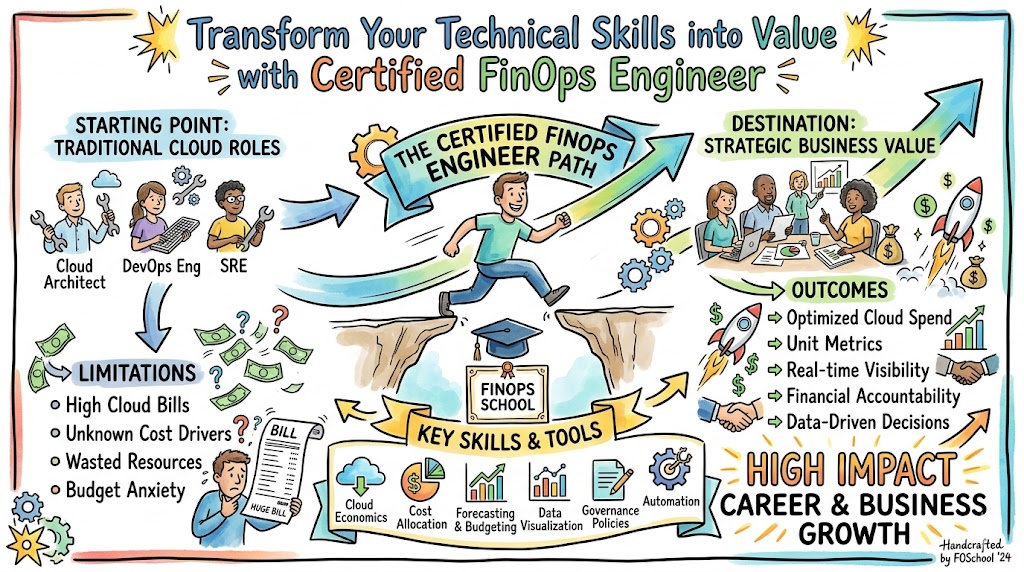
The Certified FinOps Engineer designation represents a specialized technical mastery over cloud financial management within a DevOps ecosystem. It exists to bridge the gap between traditional procurement and agile engineering, moving beyond basic cost-cutting to value optimization. This program emphasizes production-focused learning, teaching engineers how to automate cost governance and implement real-time visibility. By aligning with modern enterprise practices, it ensures that financial metrics are treated as first-class citizens alongside performance and availability.
Who Should Pursue Certified FinOps Engineer?
This certification is ideal for cloud engineers, SREs, and platform architects who are responsible for large-scale cloud deployments and want to influence architectural decisions through cost-efficiency. Engineering managers and technical leaders who need to justify cloud spend and align their departments with corporate finance goals will find the curriculum highly relevant. It serves both experienced engineers looking to diversify their skill set and beginners aiming to understand the economic impact of their code. Its global relevance is particularly strong in India and other major tech hubs where cloud optimization is a top organizational priority.
Why Certified FinOps Engineer is Valuable in and Beyond
In an era of fluctuating cloud costs and massive enterprise adoption of multi-cloud strategies, the demand for FinOps expertise continues to grow at a rapid pace. This certification ensures professionals remain relevant by providing them with tool-agnostic principles that survive changes in specific cloud provider features or pricing models. It offers a significant return on time because it addresses a fundamental business problem that persists regardless of technological shifts. Professionals with this credential become indispensable assets who can translate technical performance into financial success.
Certified FinOps Engineer Certification Overview
The program is delivered via the official portal and hosted on the main domain to ensure a centralized and high-quality learning experience. It features a structured assessment approach that focuses on practical ownership of cloud environments rather than mere theoretical knowledge. The curriculum is divided into logical levels that test a candidate’s ability to implement reporting, analyze variance, and execute optimization strategies. This structure allows engineers to demonstrate a clear progression from basic awareness to complex architectural cost optimization.
Certified FinOps Engineer Certification Tracks & Levels
The certification path is organized into foundation, professional, and advanced levels to cater to different career stages and technical depths. Foundation levels introduce the core lifecycle of Inform, Optimize, and Operate, while professional tracks dive deep into automation and policy-as-code. Advanced specializations allow practitioners to focus on niche areas such as container cost allocation or serverless economics. These levels align directly with career progression, moving a professional from a contributor to a strategic lead within a FinOps practice.
Complete Certified FinOps Engineer Certification Table
| Track | Level | Who it’s for | Prerequisites | Skills Covered | Recommended Order |
| Cloud Finance | Foundation | Junior Engineers | Basic Cloud Knowledge | Cost Allocation, Lifecycle | 1 |
| Engineering | Professional | SREs / DevOps | Cloud Experience | Automation, Rightsizing | 2 |
| Architecture | Advanced | Solutions Architects | Prof. Certification | Cloud Economics, Strategy | 3 |
| Leadership | Management | Tech Leads | 5+ Years Exp | Governance, Team Culture | 4 |
Detailed Guide for Each Certified FinOps Engineer Certification
Certified FinOps Engineer – Foundation
What it is
This certification validates a foundational understanding of the FinOps framework and the basic mechanics of cloud billing. It ensures candidates can speak the language of cloud finance.
Who should take it
It is suitable for entry-level cloud professionals, procurement officers, and developers who want to understand how their cloud usage impacts the company budget.
Skills you’ll gain
- Understanding the three phases of the FinOps lifecycle.
- Ability to identify different cloud pricing models and commitment types.
- Basic tag management and resource organization for cost visibility.
Real-world projects you should be able to do
- Create a basic cost transparency dashboard for a single-team project.
- Perform a simple audit of unattached cloud resources and orphaned disks.
Preparation plan
- 7–14 days: Review official documentation and memorize the FinOps phases and principles.
- 30 days: Complete mock exams and practice manual cost allocation using cloud native tools.
- 60 days: Not typically required for foundation level unless starting from zero technical background.
Common mistakes
Candidates often overlook the “Operate” phase, focusing too much on “Optimize” without understanding the cultural shifts required for long-term success.
Best next certification after this
- Same-track option: Professional FinOps Engineer.
- Cross-track option: DevOps Associate.
- Leadership option: Technical Project Management.
Certified FinOps Engineer – Professional
What it is
This level confirms the ability to execute complex optimization strategies and automate cost governance across multi-account environments. It focuses on the “how-to” of financial engineering.
Who should take it
Senior DevOps engineers, SREs, and Cloud Architects who need to implement programmatic guardrails and advanced commitment strategies should pursue this.
Skills you’ll gain
- Implementing automated rightsizing using Infrastructure as Code.
- Managing complex Reserved Instance and Savings Plan portfolios.
- Developing unit metric reporting to measure cost against business output.
Real-world projects you should be able to do
- Build an automated “Shutdown” bot for non-production environments using serverless functions.
- Design a chargeback or showback model for a multi-tenant Kubernetes cluster.
Preparation plan
- 7–14 days: Intensive review of advanced discount models and commitment sharing logic.
- 30 days: Hands-on lab work focusing on automation scripts and API-based billing exports.
- 60 days: Comprehensive study of anomaly detection and multi-cloud billing data normalization.
Common mistakes
Focusing solely on technical automation while failing to engage with finance stakeholders often leads to rejected optimization proposals.
Best next certification after this
- Same-track option: Advanced FinOps Architect.
- Cross-track option: Kubernetes Administrator (CKA).
- Leadership option: Engineering Manager Certification.
Choose Your Learning Path
DevOps Path
In this path, the focus remains on integrating cost metrics into the CI/CD pipeline and the developer experience. Engineers learn to treat cost as a performance metric, ensuring that every deployment is evaluated for its economic impact. This helps teams build faster without the fear of massive end-of-month billing surprises.
DevSecOps Path
The security path emphasizes the overlap between cost management and resource governance. By identifying unused or rogue resources, engineers improve the security posture while simultaneously reducing spend. This path teaches how to implement policies that enforce both security compliance and budget limits in a single workflow.
SRE Path
Site Reliability Engineers focus on the “Operate” phase, ensuring that cost optimization does not compromise system availability or performance. This path explores the trade-offs between redundancy and cost, helping SREs build resilient systems that are also fiscally efficient. It bridges the gap between uptime and bottom-line impact.
AIOps Path
This specialized track utilizes machine learning to predict cloud spend and identify anomalies before they become major issues. Engineers learn to use AI-driven tools to automate the optimization of complex workloads that are too large for manual intervention. It focuses on proactive rather than reactive financial management.
MLOps Path
Machine Learning operations involve unique cost challenges, such as GPU utilization and high-volume data egress. This path teaches how to manage the expensive infrastructure required for training and deploying models. It ensures that data science initiatives remain viable by keeping infrastructure costs under control.
DataOps Path
Data-heavy environments require specific FinOps strategies regarding storage tiers and query optimization. Professionals on this path learn to manage data lakes and warehouses efficiently, ensuring that big data projects deliver insights without excessive storage or processing costs. It focuses on the economics of data movement.
FinOps Path
This is the dedicated track for those looking to become specialists or FinOps Lead. It covers the entire spectrum from cultural transformation to advanced technical automation. Candidates become the primary link between the engineering floor and the finance office, driving organizational-wide financial accountability.
Role → Recommended Certified FinOps Engineer Certifications
| Role | Recommended Certifications |
| DevOps Engineer | Foundation + Professional Engineer |
| SRE | Professional Engineer + SRE Fundamentals |
| Platform Engineer | Advanced Architecture + Governance |
| Cloud Engineer | Foundation + Cloud Native Optimization |
| Security Engineer | Foundation + Policy & Compliance |
| Data Engineer | Foundation + Data Economics Specialist |
| FinOps Practitioner | Full Track (Foundation to Advanced) |
| Engineering Manager | Foundation + Leadership & Culture |
Next Certifications to Take After Certified FinOps Engineer
Same Track Progression
Deep specialization involves pursuing advanced certifications that focus on multi-cloud orchestration and global cost governance. Professionals might look into specialized certifications for specific cloud providers to master the intricate billing APIs of AWS, Azure, or GCP. This path establishes you as a Subject Matter Expert (SME) in the niche field of cloud financial management.
Cross-Track Expansion
Broadening your skill set means moving into related engineering disciplines like Kubernetes management or Security. Since FinOps touchpoints exist everywhere, having a CKA (Certified Kubernetes Administrator) or a Security certification allows you to implement cost measures more effectively. This makes you a more versatile engineer who understands the technical constraints of the systems you are optimizing.
Leadership & Management Track
For those transitioning into leadership, certifications in ITIL, PMP, or specialized Engineering Management programs are beneficial. These help you move from executing technical tasks to building entire FinOps teams and defining corporate policy. It shifts the focus from “how to save” to “how to build a culture of accountability” across the entire organization.
Training & Certification Support Providers for Certified FinOps Engineer
DevOpsSchool
This provider offers extensive resources and structured bootcamps for professionals aiming to master the intersection of development and operations. Their curriculum focuses on practical toolchains and real-world scenarios that prepare candidates for high-level certifications. With a strong emphasis on continuous integration and delivery, they help students build the technical foundation necessary for managing modern cloud environments effectively.
Cotocus
A specialized training organization that delivers deep-dive technical workshops and corporate training solutions globally. They focus on emerging technologies and provide hands-on labs that simulate production-grade challenges. Their instructors are typically industry veterans who bring practical insights into the classroom, ensuring that learners gain more than just theoretical knowledge.
Scmgalaxy
This platform serves as a massive community hub and training provider for software configuration management and DevOps professionals. It offers a wealth of tutorials, blog posts, and certification guides that are updated regularly to reflect the latest industry trends. Their goal is to simplify complex technical concepts and make them accessible to engineers at all levels.
BestDevOps
Focusing on quality and curriculum depth, this provider offers targeted training programs for elite engineering roles. They emphasize the mastery of specific tools and methodologies that are in high demand across the enterprise sector. Their training approach is designed to bridge the skill gap between traditional IT and modern cloud-native engineering.
devsecopsschool.com
This institution focuses specifically on the critical integration of security into the DevOps lifecycle. Their courses teach engineers how to automate security checks and maintain compliance without slowing down the development process. They provide the necessary context for understanding how security governance impacts both operational efficiency and financial costs.
sreschool.com
Dedicated to the principles of Site Reliability Engineering, this provider helps engineers master the art of maintaining system stability at scale. Their training covers monitoring, incident response, and the technical aspects of reliability. They provide essential insights into how SRE practices correlate with efficient resource utilization and cost management.
aiopsschool.com
This platform explores the application of artificial intelligence and machine learning to IT operations. Their curriculum focuses on using data-driven insights to automate problem-solving and enhance system performance. For FinOps professionals, this training provides the tools needed to implement predictive cost modeling and automated anomaly detection.
dataopsschool.com
Addressing the unique challenges of data engineering and management, this provider offers specialized tracks for data professionals. They teach how to build robust data pipelines and manage large-scale data infrastructure. This is crucial for understanding the specific financial implications of data storage and processing in the cloud.
finopsschool.com
As the primary host for the Certified FinOps Engineer program, this site provides the most direct and comprehensive path to certification. They offer a range of materials from foundational courses to advanced technical tracks. Their focus is entirely on the FinOps framework, making them the leading authority for anyone looking to specialize in cloud financial management.
Frequently Asked Questions (General)
- How difficult is the Certified FinOps Engineer exam?The difficulty is moderate to high, requiring both conceptual knowledge of the FinOps framework and practical experience with cloud provider billing tools.
- How long does it take to prepare for this certification?Most professionals with a cloud background spend between four to eight weeks preparing, depending on the level they are pursuing.
- Are there any prerequisites for the foundation level?There are no formal prerequisites, but a basic understanding of cloud computing services (like compute, storage, and networking) is highly recommended.
- What is the return on investment for this certification?Professionals often see immediate career growth as companies prioritize engineers who can help them reduce or justify their massive cloud expenditures.
- Do I need to be a developer to become a FinOps Engineer?While you don’t need to be a full-stack developer, having basic scripting skills in Python or Bash is very helpful for automating cost-saving tasks.
- In what order should I take the certifications?It is highly recommended to start with the Foundation level to master the terminology before moving into the more technical Professional Engineer track.
- Is this certification recognized globally?Yes, the principles taught are universal and apply to any organization using cloud services anywhere in the world.
- Does the exam focus on a specific cloud provider like AWS?The certification is generally cloud-agnostic, focusing on principles that apply to AWS, Azure, and Google Cloud, though examples from these providers are used.
- Can I renew my certification?Yes, certifications typically require renewal or continuing education every two to three years to ensure your skills stay current with evolving cloud tech.
- How does this differ from a standard Cloud Architect certification?While an Architect focuses on building systems, a FinOps Engineer specifically focuses on the financial efficiency and economic sustainability of those systems.
- Are there lab components in the exam?Higher-level certifications often include practical scenarios or case studies where you must apply optimization strategies to solve a business problem.
- Is it worth it for managers who don’t code?Yes, managers benefit significantly from the Foundation level as it provides them with the framework to lead teams toward a culture of financial accountability.
FAQs on Certified FinOps Engineer
- What specific tools are covered in the FinOps Engineer curriculum?The curriculum covers cloud-native tools like AWS Cost Explorer and Azure Cost Management, as well as third-party platforms for multi-cloud visibility and automated governance.
- How does this certification address Kubernetes and container costs?It includes specific modules on container cost allocation, teaching you how to split shared cluster costs among different teams or projects using labeling and namespaces.
- Is the Certified FinOps Engineer certification valid for multi-cloud environments?Absolutely, the core focus is on creating a unified financial management strategy that works across different cloud providers and hybrid-cloud setups.
- Does the program teach how to negotiate with cloud vendors?While it focuses on technical optimization, it also provides the data-driven insights needed to have better negotiations regarding commitments and enterprise discount programs.
- Will I learn how to build automated “Rightsizing” workflows?Yes, the professional level dives into using automation to identify underutilized resources and programmatically resize them to save money without manual effort.
- How much emphasis is placed on “Unit Economics”?A significant portion of the advanced track is dedicated to unit economics, helping you calculate the cost per transaction or cost per customer.
- Are there community resources available for students?Students get access to a global network of practitioners, forums, and exclusive webinars to share best practices and real-world cost-saving tips.
- Can I take the exam online?Yes, the certification exams are typically proctored online, allowing you to complete your certification from anywhere in the world at your convenience.
Final Thoughts: Is Certified FinOps Engineer Worth It?
Investing time in the Certified FinOps Engineer program is a strategic move for any serious technical professional. In the current landscape, technical skill alone is no longer enough; engineers must understand the business and financial impact of their architectural choices. This certification does not just teach you how to save money; it teaches you how to maximize the value of every dollar spent in the cloud. It provides a structured, unbiased framework that bridges the gap between engineering and finance, making you a more effective and versatile professional. For those looking to future-proof their careers and take on high-impact roles in modern enterprises, this path is highly recommended.